Breaking News
Breaking News
from Washington and beyond

Man Who Killed Minnesota Democratic Rep. Sentenced to Life in Prison

Vance Boelter has received two life sentences for killing former state House Speaker Melissa Hortman and her husband, Mark.

Melissa and Mark Hortman and their dog Gilbert lie in state in the Minnesota state Capitol.
Joshua Lott/The Washington Post/Getty Images
Melissa and Mark Hortman and their dog Gilbert lie in state in the Minnesota state Capitol.

The man who assassinated former Minnesota House Speaker Melissa Hortman and her husband, Mark, has been sentenced to life in prison.

In addition to killing the Hortmans (and their dog Gilbert), Vance Boelter also shot state Democratic Senator John Hoffman and his wife, Yvette.

In court Thursday, Boelter didn’t once look at his victims or their families, remaining remarkably still as the judge read out the extraordinarily long prison sentence for the crimes he committed on June 14, 2025, reported The Guardian.

Boelter pleaded guilty in June to the double homicide, recounting to the court how the previous year, he had spent months stalking his targets. He then disguised himself as a police officer in a tactical vest and hyperrealistic silicon mask, and killed the Hortmans in their home in the middle of the night.

He was found guilty on six counts related to the killing of the Hortmans, as well as for the shooting of the Hoffmans.

Boelter was committed to two consecutive life sentences, with an additional 40 years in prison tacked on. He confessed to the crimes to avoid the death penalty, though the decision was ill received by Mark Hortman’s family, who voiced their anger that Boelter would not face capital punishment.

“It will not offer me peace of mind that he will have room and board provided for the rest of his life, paid for by my tax dollars,” said Mark Hortman’s sister, Lisa Hortman Bean.

The shootings ripped the Hortmans away from their two children, Sophie and Colin, and tortured the Hoffmans’ daughter Hope, who witnessed her parents bleed out as she attempted to call for help.

Hoffman and his wife shared with the court their own experiences with Boelter, emphasizing the lasting emotional, mental, and physical damage that the politically motivated assassination attempt had on their lives.

“The defendant looked me in the eyes and pulled the trigger. The defendant looked at my wife and chose to do the same,” Hoffman told the court Thursday. “My wife and I now live with injuries. We live with our bodies remembering the gunfire.”

The couple said they have been haunted by the memory of the attack, even within the minutiae of their day-to-day lives: The doors to their home have been replaced by solid steel, they no longer receive mail at the house, and everyday tasks have been altered to accommodate their lingering injuries.

Yvette Hoffman said that the trauma was so great it has prevented her from returning to work entirely.

“I fought him, your Honor, with everything I had. And I finally got him out of our home. I will never forget looking down and watching my blood slowly stream down that white washing machine as I felt myself sinking to the floor,” she said, choking back her emotion.

Shortly after the crimes were committed, former acting U.S. Attorney for the District of Minnesota Joseph Thompson likened Boelter’s activity to “the stuff of nightmares.”
Trump Moves to Cut Off Student Loans for Tons of Degrees

Under a new rule, if your degree doesn’t make enough money, you won’t be able to get a student loan.

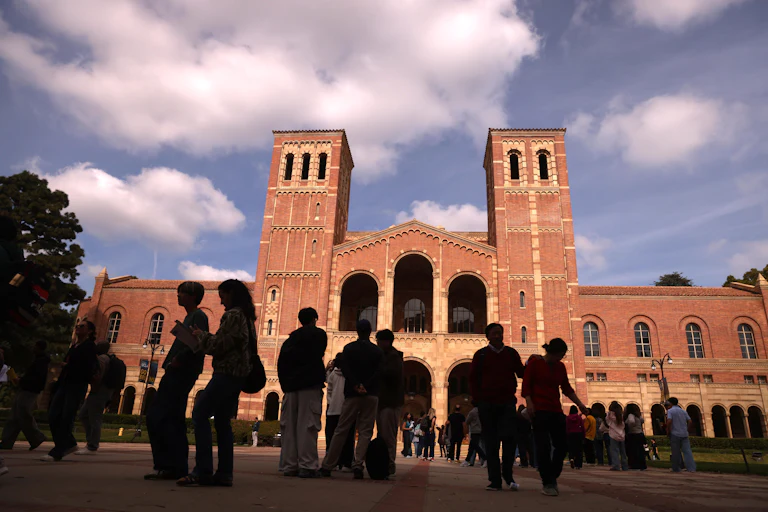
Students on a university campus
Genaro Molina/Los Angeles Times/Getty Images

President Trump is banning students majoring in degrees that don’t make enough money from taking out college loans. 

The Los Angeles Times reported Wednesday that the Education Department has finalized a rule that will force schools to prove that the loans students are taking out are paying off. 

Degrees for social work, art, religious studies, teaching aides, and music, and cosmetic certification programs will be hit the hardest. For-profit programs will also be hit particularly hard.

While the Trump administration is framing the policy as “accountability” for higher education, and some are welcoming the move, others see it as an attack on those whose work is important regardless of salary. 

The Education Department intends to use IRS data to determine students’ salaries four years after they graduate and compare them to those of people similar in age who just have high school diplomas. If they’re below that baseline, that degree will be ineligible for loans.  

“We need social workers,” Mitchell said. “Whether it’s the fentanyl epidemic or homelessness in L.A., we need people who can work on the street with people who need it the most,” American Council on Education Ted Mitchell told the Times

Even some on the right are concerned. 

“The government shouldn’t punish people who pursue socially valuable callings just because in its judgment they don’t earn enough money,” said Gregory Baylor, senior counsel at Alliance Defending Freedom, a Christian nonprofit that the Southern Poverty Law Center lists as a designated hate group.

“In certain fields of study, especially in the humanities, whether or not that program has been successful and has done a really good job in its educational mission might not be all that directly tied to immediate earnings potential,” added Stanford professor Jonathan Gienapp.

The policy will be implemented in 2027. 

Clip & Save: Trump Says People Are “Begging” to Live Near Data Centers

Donald Trump made the claim while announcing an unenforceable and voluntary “ratepayer protection pledge.”

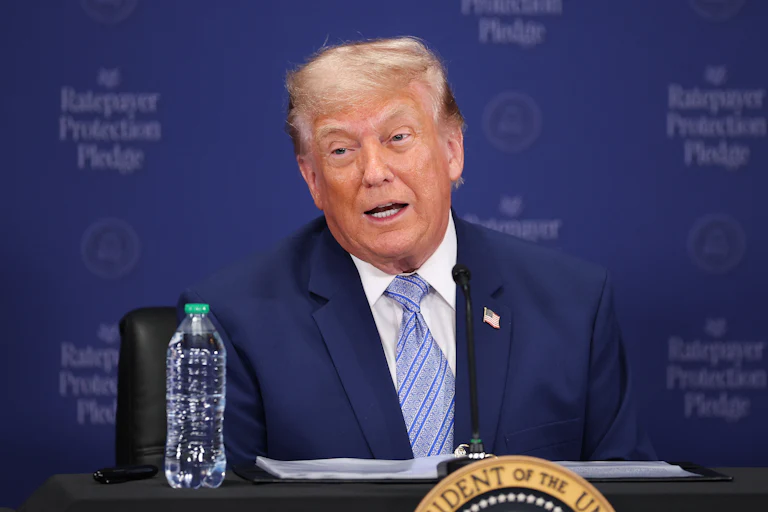
Donald Trump speaks while seated at a table with a "Ratepayer Protection Pledge" backdrop behind him.
Kevin Dietsch/Getty Images
President Trump delivers remarks on the Ratepayer Protection Pledge during a roundtable at the Environmental Protection Agency on July 23.

President Trump thinks that Americans against data centers are being duped by foreign propaganda and that in reality, there are a lot of people who want to live near them.

“Other nations are trying to get us to slow down” regarding data center construction, Trump said at the Environmental Protection Agency Thursday afternoon. “They’re spending a lot of money on propaganda, on press, P.R., trying to convince everybody that this isn’t a positive thing, and if we don’t do this, we’re going to be left behind.”

“You have some communities that really want this, this isn’t all negative stuff, you have communities that really want the data centers, and frankly those are the smart communities because it means a tremendous numbers of jobs, very little actual disruption,” Trump said.

Trump made the remarks at an event promoting the White House’s “Ratepayer Protection Pledge,” in which states and companies pledge to keep consumers from paying higher electricity bills due to data centers. The plan has supposedly gotten the support of companies such as Google, Microsoft, Meta, Oracle, xAI, OpenAI, and Amazon, who vowed to pay for increased power costs in areas where data centers are built. The pledge is completely voluntary—and unenforceable.

People who live near data centers complain about the overhaul to their lives, from the drain on water supplies to increased noise and higher utility costs. In most areas where data centers are proposed, local opposition quickly becomes protests that unite the left and the right. The economic benefit that comes with data centers is actually minimal, with most providing only a few dozen on-site jobs. Trump is very much out of touch with how Americans, including many of his supporters, view data centers.

Read The TNR Blue Book, our new newsletter on the Democratic Party:

Trump Caves and Withdraws Subpoenas for New York Times Journalists

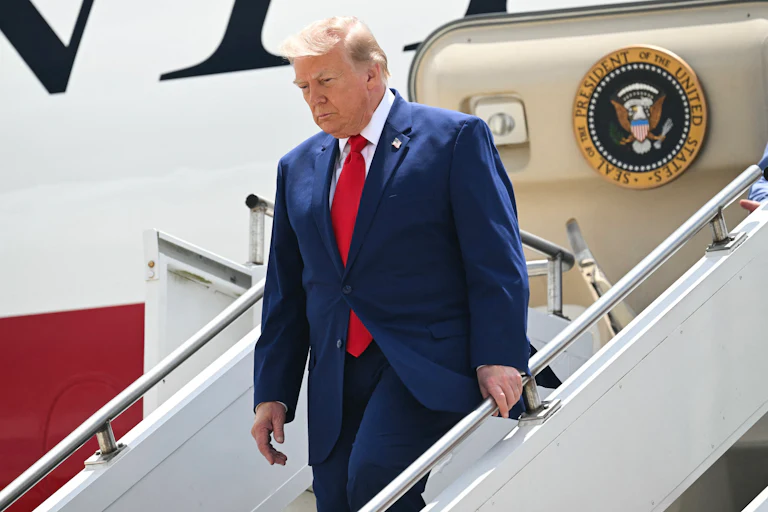
Donald Trump is targeting a group of Times journalists over leaks regarding his new Air Force One.

Donald Trump walks down the steps of Air Force One.
Saul Loeb/AFP/Getty Images
Donald Trump disembarks from Air Force One.

Donald Trump’s administration withdrew its subpoenas Thursday for three New York Times journalists who reported on Air Force One’s security issues.

Lawyers for the publication appeared in court to challenge subpoenas that would’ve compelled reporters to testify about their confidential sources before a grand jury, and granted access to reporters’ and their family members’ phone records.

Times lawyers argued that the Department of Justice had ignored its own protocols for failing to give advance notice and issuing subpoenas “without first conducting any serious investigation.” On Thursday, U.S. District Court Judge Arun Subramanian seemed to agree.

“Subpoenas are not the first thing you do, they are the last thing you do,” he said. The judge argued that the Trump administration’s actions had turned the First Amendment and free speech regulation “on its head.”

After nearly an hour of intense grilling, Sean Buckley, chief counsel to the U.S. attorney in Manhattan, announced that the government was prepared to “unilaterally withdraw” its subpoenas. Subramanian made it clear he would have rejected the subpoenas anyway.

White House officials were left fuming earlier this month after the Times reported that Trump had ditched his new Air Force One in Europe because it was missing certain security and communications capabilities. The president later announced plans to further “max out” the plane, suggesting that the $400 million luxury jumbo jet indeed lacked sufficient security features—all but confirming the story had been accurate.

The Air Force has already spent roughly $400 million on renovating the plane, changing the cabin layout, communications system, and security upgrades. That doesn’t account for the taxpayer-funded continued maintenance of the plane, either. The Qatari-gifted jet will be moved to Trump’s presidential library foundation in 2029, where it may be available for him to use as a private citizen.

This story has been updated.

Trump Is Already Fighting With His New Homeland Security Secretary

Markwayne Mullin has only been on the job for four months.

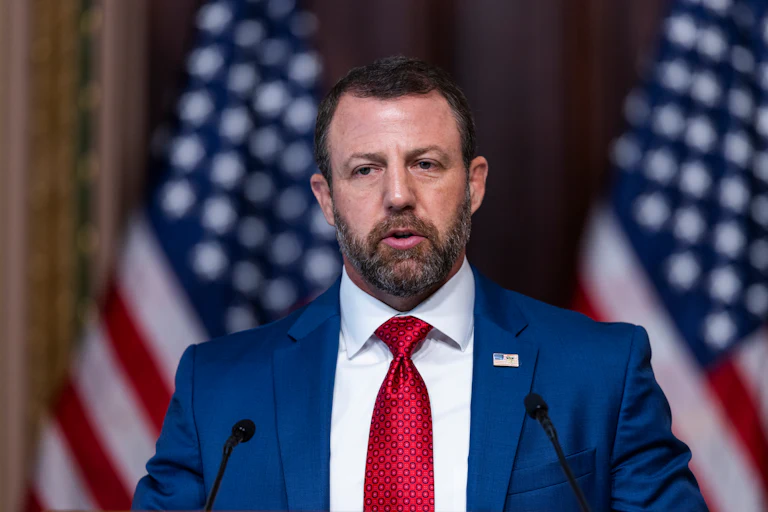
Homeland Security Secretary Markwayne Mullin speaks during a press conference.
Jim Lo Scalzo/EPA/Bloomberg/Getty Images
Homeland Security Secretary Markwayne Mullin

It’s only been four months, but it looks like Homeland Security Secretary Markwayne Mullin is already on the White House’s bad side.

The rift is a result of some early missteps and concerns about Mullin’s personnel choices, according to a senior Trump administration official and a senior Department of Homeland Security official who spoke with NBC News Thursday.  

The White House wasn’t happy with Mullin’s decision to temporarily restrict Immigration and Customs Enforcement vehicle stops after two deadly shootings by immigration officers in Texas and Maine. 

Just one day after Mullin announced the change, and yet another person was killed during a chaotic ICE incident, Trump ordered the agency to resume traffic stops.

An administration official told NBC News that Mullin’s decision was “100 percent” a bad move.

Mullin reportedly never received the White House’s blessing before announcing the sudden policy change—leaving President Donald Trump and border czar Tom Homan in the dark. Trump was reportedly furious, believing that it signaled the administration was softening on immigration enforcement. 

Another source of tension between Mullin and the White House is the secretary’s decision to nominate Lance Schroyer, one of his allies, to run ICE. 

The decision had “a lot of people talking,” as Schroyer has no direct experience with federal law or immigration enforcement, a DHS official told NBC News. In addition to Schroyer’s lackluster résumé, he’s also been accused of failing to pay for child support.

In any case, several officials “aren’t thrilled with him,” one Trump administration official told NBC News. 

Rising tensions with the freshly appointed DHS secretary come as a new report suggests that Trump’s second administration has even higher turnover among Senate-confirmed officials than his first.