Breaking News
Breaking News
from Washington and beyond

Trump Seeks Journalists’ Phone Records as Air Force One Tantrum Grows

Donald Trump’s administration is trying to acquire the phone records of multiple New York Times journalists and their relatives.

Donald Trump raises his fist while walking down the steps of Air Force One
Mandel NGAN/AFP/Getty Images

Donald Trump’s administration demanded the phone records of several New York Times journalists and their families in an effort to track down the sources who spilled on the president’s new Air Force One.

Late last week, the Department of Justice told the publication it had issued subpoenas to third-party phone service providers in order to acquire records of journalists’ phone calls and text messages—including messages with one reporter’s mother and two reporters’ spouses, the Times reported Monday.

Those subpoenas were issued in addition to ones earlier this month compelling the reporters to testify before a grand jury. Lawyers for the Times journalists filed a motion Saturday to quash the new subpoenas.

White House officials were left fuming earlier this month after the Times reported that Trump had ditched his Qatari-gifted Air Force One in Europe because it was missing certain security and communications capabilities. Trump claimed that U.S. forces in Europe were clamoring for a chance to see the magnificent plane.

But it seems the Times’ reporting was right on the money: The president announced plans Sunday to further “max out” Air Force One, suggesting that the $400 million luxury jumbo jet had insufficient security features.

The Air Force has already spent roughly $400 million on renovating the plane, changing the cabin layout, communications system, and security upgrades. That doesn’t account for the taxpayer-funded continued maintenance of the plane, either. The jet—one of the largest presidential gifts ever—will be moved to Trump’s presidential library foundation in 2029, where it may be available for him to use as a private citizen.

This story has been updated.

State Department Targets Hasan Piker, Ilhan Omar’s Daughter, and DSA

A new State Department report on Cuba goes after American citizens on the left.

Splitscreen of Hasan Piker and Isra Hirsi
Getty x2
Hasan Piker (left) and Isra Hirsi

The State Department is trying to smear left-wing organizations and activists as “front groups and fellow travelers” for the Cuban government.

In a report published Monday titled “Cuba: The Capital of 21st Century Communism,” the State Department singled out political commentator-streamer Hasan Piker, Amazon union leader Christian Smalls, the Democratic Socialists of America, and environmental activist Isra Hirsi, the daughter of Representative Ilhan Omar, for allegedly supporting the Cuban government.

“This constant stream of Western left-wing activists, influencers and organizers is coordinated by a network of Cuba-backed nonprofits, foundations, academic and cultural partnerships, and even dedicated U.S.-based travel agencies,” the report said, mentioning the activists’ visits to the island.

The report also asserts that the DSA, an organization claiming over 120,000 members, “maintains a fierce, almost religious commitment to the cause of the Cuban regime—not because the group is controlled by Cuban agents, per se, but because that commitment is now simply the de facto policy orthodoxy on the American far left.”

It seems to be part of the administration’s attack on “far-left political terrorism,” coupled with an attempt to engineer regime change in Cuba, both led by Secretary of State Marco Rubio. Under his watch, the U.S. government has taken the decades-long economic embargo against Cuba and escalated it into a de facto oil blockade that has crippled much of the country.

Rubio has refused to answer questions about whether the U.S. plans to invade Cuba or to elaborate on long-term plans for the island. In January, the U.S. military abducted and arrested Venezuelan President Nicolás Maduro in an overseas raid and brought him to the U.S. to face trial. Is Cuba headed toward a similar fate? And will the White House brand its left-wing opponents in the U.S. as terrorists who support Cuba?

Hegseth Swapped Key Pentagon Office for AI Before Iran War

The Defense Department is struggling to minimize civilian harm thanks to the changes.

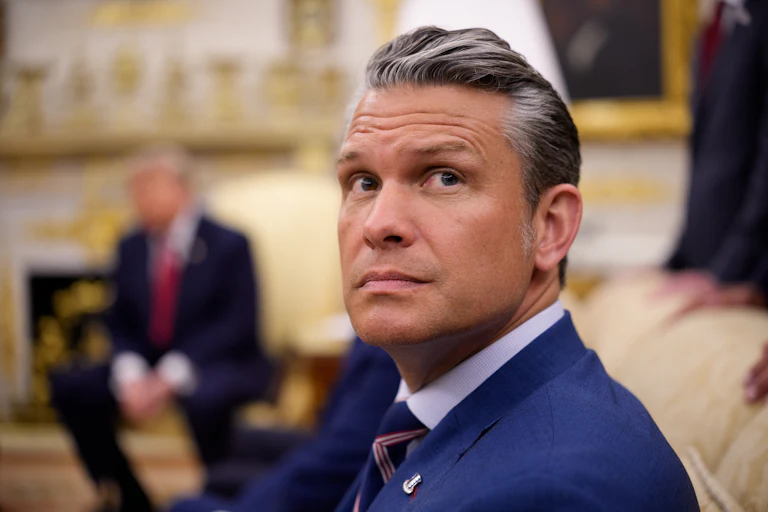
Defense Secretary Pete Hegseth looks up while seated in the Oval Office of the White House
Andrew Harnik/Getty Images
Defense Secretary Pete Hegseth

Last January, Defense Secretary Pete Hegseth fired most of the Pentagon’s civilian harm mitigation and response, or CHMR, workers and replaced them with artificial intelligence. 

The Intercept has reported that the Pentagon’s Civilian Protection Center of Excellence was cut from 40 to just nine staffers at the beginning of last year. No new hires have been made since, leaving the center unable to do its job: protecting civilians from harm due to wars we’re fighting in their regions. Remaining staff also said they are not allowed to investigate incidents like the Minab elementary school bombing that left 120 children dead on the first day of the war in Iran.   

CHMR suffered across the Defense Department, as AFRICOM, CENTCOM, and SOUTHCOM saw civilian casualty prevention infrastructure cut, signaling what has been obvious for years: Those casualties are not a moral priority for the United States. CENTCOM’s CHMR has only one person remaining, while cuts to SOUTHCOM’s team left them unable to identify the full scope of civilian harm in the kidnapping of Venezuelan President Nicolás Maduro in January.

“The Hegseth regime held on to a thread of the program mostly in effort to be able to say they are following the law, but the reality is the Center and its efforts have had little to no influence on or oversight or visibility on operations,” former Protection Center Chief of civilian harm assessments Wes Bryant told The Intercept. “As long as they sit in the seat, they are continuing to try to put out good work, but the reality is, most of it is being thrown into the wind, and neither institutionalized nor operationalized.”

Now, instead of human beings, Hegseth is relying on a Palantir-created Maven Smart System, which a defense official claimed presents a “better layer of protection” for people living in places we’re currently attacking. 

“The Department’s failure to implement the CHMR [Action Plan] has profound consequences for civilians in conflict zones and makes service members’ jobs harder and riskier,” Senator Elizabeth Warren and nine other Democrats wrote in a letter to Hegseth earlier this month. “Gutting CHMR programs leads to ‘target misidentification [that] harms readiness by wasting Do[D] munitions’ and increases the operational risk of ‘civilian casualties, damaged coalitions and alliances, loss of legitimacy, increased local resistance, propaganda opportunities for adversaries, prolonged conflicts, and failed strikes.’”

Thousands of Iranians have been killed since the downsizing of CHMR. 

Republicans Try to Ignore Trump’s Deranged Speech on Election Fraud

Many acknowledge that Donald Trump’s message could screw them over in the midterms.

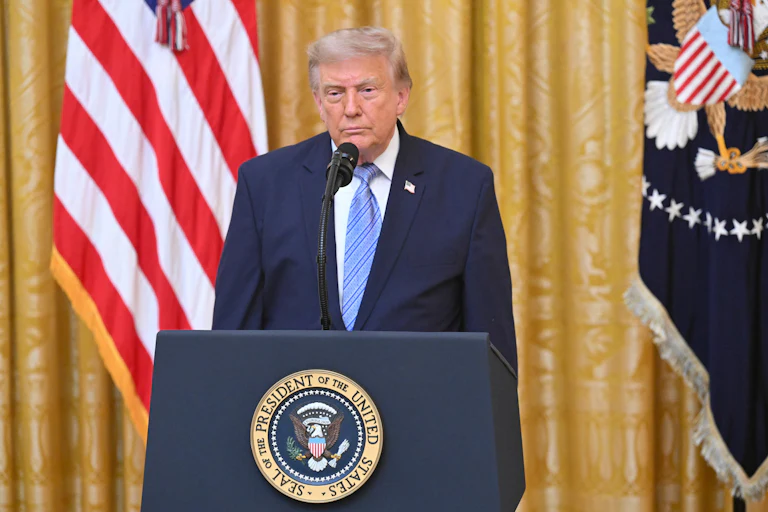
Donald Trump stands at a podium during a national address.
Saul Loeb/AFP/Getty Images

Republican lawmakers are moving on from Donald Trump’s election conspiracy.

The president spent more than 25 minutes last week addressing the public—and his supposed congressional allies—to revive his 2020 election fraud claims. He demanded that Republicans prioritize mail-in ballot bans and voter roll purges, and investigate what he claimed was a nationwide cover-up by the “deep state.” Days later, however, the conservative caucus appears to have completely missed the message.

Most GOP candidates aren’t willing to revisit Trump’s thoroughly debunked election fraud claims as the issue has failed to galvanize voters, The Washington Post reported Monday.

The day after Trump’s address, former Republican National Committee chair Michael Whatley—who is trailing former Democratic Governor Roy Cooper in the race to replace retiring North Carolina Senator Thom Thillis—held a 34-minute campaign event that touched on none of Trump’s advertised priorities. Instead, Whatley told local voters that the number one issue this election cycle is “keeping our kids and our communities safe.”

Whatley had previously supported Trump’s 2020 election fraud claims. But when asked by a Post reporter to expound on Trump’s latest speech, Whatley simply mentioned that he is a “big proponent of election integrity.”

Top Republicans also seemed disillusioned with the president’s fixation. Outgoing Texas Senator John Cornyn lamented to the Post that “we have 109 days until the midterm elections, and I don’t understand talking about what happened six years ago in light of these upcoming elections.”

The situation for the campaigning caucus is precarious: If they attempt to get in good with the MAGA movement by publicly supporting the president in an act of fealty, they also risk alienating independent voters in their districts who have become increasingly disillusioned with Trump’s second term.

Paul Shumaker, a veteran Republican strategist and longtime political adviser to Tillis, told the Post that the “clear and simple” explanation for the difference in messaging is that voters are focused elsewhere.

“If candidates are not talking about the economy, if candidates are not talking about affordability, if they’re not talking about how they’re going to make people’s lives at home cheaper and less expensive, then they’re not talking about the issues that voters care about,” Shumaker said.

Matthew Bartlett, a Republican strategist who served in the State Department during Trump’s first term, said many GOP candidates seem relieved that Trump’s prime time speech has failed to make major waves.

“If the president makes outrageous claims about an election and no one is listening, did it even happen?” Bartlett asked rhetorically when describing the Republican response to the Post.

Democrats have criticized the address for laying the groundwork for potential challenges to the upcoming midterm elections. They have good cause to believe so: Last week, Homeland Security Secretary Markwayne Mullin announced that the government already plans to take action against state election officials who refuse to bend to the White House’s demands. In a press conference, Mullin pledged that state officials who decide not to scrub their voter registration lists could be fined or even jailed for their disobedience.

Mullin does not have the authority to make such a threat, however. The Department of Homeland Security lacks the necessary authority to either withhold federal grants or force states to purge voter rolls. Only Congress has the power to do that.

Is Donald Trump Shrinking? An Investigation.

Trump accidentally revealed his real height while crashing Spain’s World Cup victory celebration.

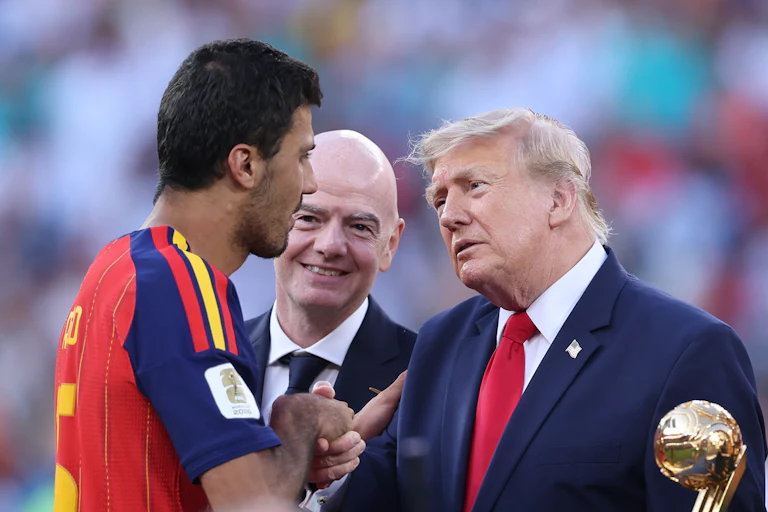
Donald Trump, standing next to FIFA President Gianni Infantino, shakes hands with Spanish player Rodrigo Hernández Cascante after the World Cup.
Catherine Ivill/AMA/Getty Images
Donald Trump shakes hands with Spanish team captain Rodrigo Hernández Cascante.

Trump towers?

Donald Trump’s presence loomed large over FIFA’s World Cup Finals on Sunday—but footage from the event has sparked speculation that the president’s actual stature may be smaller than he claims.

For years, Trump has claimed to be six feet, three inches tall. His past two annual physical reports, published in April 2025 and April 2026, confirmed this, asserting that the president is 75 inches tall—equal to six feet, three inches.

But a video shared Sunday on social media by the White House showed Rodrigo Hernández Cascante, the six-foot-three captain of Spain’s national football team known as Rodri, towering over Trump. If both men are supposedly the same height, why does Trump appear so much shorter?

Considering soccer cleats only add about an inch maximum of height, it seems unlikely Rodri’s footwear is responsible for the difference. In the video, Trump appears much closer in height to FIFA president Gianni Infantino, who is reportedly only five feet, 11 inches tall.

The debate about Trump’s height has been going on for decades. In 1999, Trump told Maureen Dowd of The New York Times that his seemingly diminutive stature was merely a trick of the camera. “I photograph short. I’m six foot three,” he said.

As recently as last month, the president appeared much shorter than Republican Senator John Thune, who is widely reported to be six feet, four inches tall. In response to those photographs, The Daily Beast’s Joanna Coles suggested that Trump was actually getting shorter. “He’s shrinking into the giant shrimp that Steve Bannon said that he was,” Coles said. “I think that Donald Trump is literally shrinking as we see him.”

It’s certainly not impossible. It’s a scientific fact that people can get shorter as they age, and last month, Trump officially became an octogenarian. Still, the president clearly feels the need to lie about his height, when Americans can see for themselves that the president just doesn’t measure up.

Read more about Trump’s time at the World Cup: