Breaking News
Breaking News
from Washington and beyond

New Photos Reveal How Much Damage U.S. Has Suffered in Iran War

And yet Donald Trump continues to insist the U.S. has won.

U.S. soldiers at Camp Buehring in Kuwait
U.S. soldiers at Camp Buehring in 2023
Mark Wilson/Getty Images
U.S. soldiers at Camp Buehring in 2023

A plane split in two, a charred armored vehicle, flattened trailers, and smoke rising from a structure at Camp Buehring, Kuwait: New photos released by CBS News depict dramatic damage to American military infrastructure in the Middle East as a result of Iranian missile and drone attacks. The Iranian military, it seems, is alive and well.

These photos, released Tuesday night, follow an account published by the Department of Defense inspector general Monday that reveals far more damage to American military capabilities in the Middle East than had previously been disclosed. Despite the U.S. spending upward of $33.4 billion in the war effort so far, the military has lost dozens of drones, fighter jets, helicopters, and refueling tankers. Hundreds of buildings on U.S. bases in the Middle East, like those depicted in these photographs, have been damaged or destroyed by Iranian missile and drone attacks.

The new photos were reportedly sent to CBS News by active service members who have been on the ground at Prince Sultan Air Force Base in Saudi Arabia and Camp Buehring and Camp Arifjan in Kuwait.

“This is major damage to our bases that hasn’t been communicated to the American public,” one service member currently deployed overseas told the news outlet. “We’re standing there with our eyes closed getting punched in the face.”

Still, according to President Donald Trump, the U.S. already “won” the ongoing war against Iran—a claim he has repeated at least 66 times in the past six months.

If Trump’s definition of “winning” includes the deaths of at least 18 American service members; $184 million in damages to diplomatic facilities in Iraq, Kuwait, Saudi Arabia, and the UAE; skyrocketing gas prices; damage to the global economy; a critical missile shortage; a U.S. naval base in Bahrain blown to “hell”; and historic unpopularity for his party ahead of a critical midterm election, then sure. Agree to disagree.

“We’re not defending these bases,” the service member added to CBS. “We’re just watching them get destroyed.”

House Cancels Votes to Avoid Embarrassment Over Hegseth Impeachment

Republicans are sending members of Congress home early to avoid a vote on the impeachment of Defense Secretary Pete Hegseth.

Defense Secretary Pete Hegseth and House Speaker Mike Johnson
Andrew Harnik/Getty Images
Defense Secretary Pete Hegseth and House Speaker Mike Johnson

The House is going home again—this time to avoid a vote on Defense Secretary Pete Hegseth’s impeachment.

House GOP leadership announced Wednesday morning that they will end their current slate of votes early and head home until the midterms, a nearly two-month break.

“Members are further advised that upon completion of today’s legislative business, votes are no longer expected in the House tomorrow, September 17th,” a message from the office of House Majority Whip Tom Emmer read. “The last votes for the week are expected at approximately 4:45 p.m. this afternoon. This is a change from the previously announced schedule.”

The House will now move up votes on cutting Environmental Protection Agency regulations to Wednesday.

The vote the House GOP is most notably avoiding regards outgoing Republican Representative Thomas Massie’s eight articles of impeachment against Hegseth for his handling of the Iran war and other “high crimes and misdemeanors.”

Massie’s impeachment articles focused on Hegseth’s “waging the Iran war despite no declaration of war, statutory authorization, attack on the United States, or imminent threat,” and continuing to attack Iran after the War Powers Resolution expired. They also cited Hegseth’s suppression of Democratic Senator Mark Kelly’s right to free speech, initiating an unlawful war in Yemen, and “ignoring laws that minimize civilian casualties.” Massie said he hid his privileged resolution, which forces a vote within 48 hours, from House leadership.

This Congress is extremely avoidant and unproductive, as it pulled a similar disappearing act last summer when Massie demanded a vote on the release of the Epstein files. Now it’s going on another paid vacation after essentially doing nothing at work all week.

Federal Workers Got Paid Billions Not to Work Thanks to DOGE

A new report reveals how the federal government paid billions as part of its supposed plan to save taxpayers money.

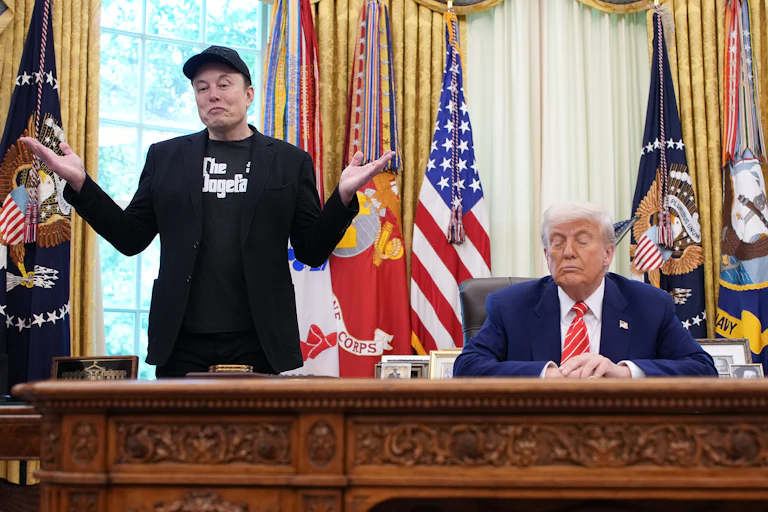
Elon Musk wears a DOGE cap and a shirt that says The Dogefather (in Godfather font) and shrugs. Donald Trump is seated at his desk in the Oval Office beside him.
Tesla CEO and DOGE leader Elon Musk speaks alongside President Donald Trump in the Oval Office, on May 30, 2025.
Kevin Dietsch/Getty Images
Tesla CEO and DOGE leader Elon Musk speaks alongside President Donald Trump in the Oval Office, on May 30, 2025.

The federal government paid employees $9.5 billion not to work in 2025 as a result of Elon Musk’s Department of Government Efficiency.

The New York Times, citing a new estimate from the Government Accountability Office, reports that DOGE’s deferred resignations program increased paid administrative leave by 435 percent in 2025. That’s an increase of over six times since 2023.

President Trump and Musk’s efforts have shrunk the federal workforce by 12 percent since the inauguration in January last year, but that has not translated into any savings. The Trump administration claims that the government has saved over $200 billion, but that has never been proven, and the federal deficit has only shot up thanks to the Iran war and Republican tax cuts passed last year.

Of the $9.5 billion figure, $6.7 billion was spent on DOGE’s deferred resignation offer, which about 139,963 federal employees took, resulting in several government departments losing their most experienced personnel. Many departments later scrambled to restaff those positions: The Partnership for Public Service, a nonprofit organization, found that over 20,000 federal jobs vacated by the resignation program have been backfilled. The federal government has also tried to recruit new employees to fill the void, focusing on early-career workers.

“Trump spent billions to push out experienced and badly needed experts across government—this was the most expensive way imaginable to make government worse,” said Democratic Senator Patty Murray in a statement Tuesday.

DOGE was supposed to reduce the size of the federal government and eliminate waste, fraud, and abuse, with Musk promising $1 trillion in savings. Instead, the entire program appears to be a massive example of setting taxpayer dollars on fire.

Trump to Drop Thousands on Public Signs Name-Calling the Smithsonian

Donald Trump wants to install signs accusing the museum of bias.

A sign for the Smithsonian in Washington, D.C.
Jakub Porzycki/NurPhoto/Getty Images

The Trump administration has a lot of things “visitors should know” before entering the National Museum of American History.

According to reporting by The Atlantic, Interior Secretary Doug Burgum is mobilizing the National Park Service to display at least a dozen signs around the National Museum of American History warning visitors of “ideologies that distract from a coherent and accurate presentation of America’s story” before they step foot on the premises. The signs are projected to cost at least $84,000.

This is the Trump administration’s latest attack on the Smithsonian, a cultural institution that has stood witness to the American story for 180 years. It comes after the September 8 announcement that Lonnie G. Bunch III, the Smithsonian’s chief official and founder of the National Museum of African American History and Culture, will retire at the end of this year. Bunch has said that the repeated attacks from the Trump administration and pressure to eliminate exhibits representing “improper ideology,” such as anything to do with race, gender, or oppression, did not influence his decision.

In June, Donald Trump signed an executive order giving his administration unprecedented control over the institution, which he claimed “views American history as a ‘prime tool’ to advance ideas of social justice and the radical transformation of our society.”

The White House Domestic Policy Council elaborated on Trump’s claims in an Independence Day report on the status of the institution. “The Smithsonian Institution, and the National Museum of American History in particular, under its current leadership and current interpretive ideology, cannot be trusted to tell America’s story honestly and in a way that is inspiring, unifying, and worthy of our great republic,” the report said.

When he announced the signs to Senators Jeff Merkley and Lisa Murkowski, Burgum said that the “informational signage therefore will provide visitors with important context about the exhibits they are about to encounter and the personal viewpoints that the curators of the exhibits are seeking to advance.”

“We believe the public should enter the museum fully equipped with the information needed to evaluate whether to invest their time in viewing these exhibits and programming,” he wrote in a letter to the senators.

It is not yet clear what exactly the “information needed” will be. The text of the signs or the plans for their physical structure is still undetermined, but Burgam’s letter suggests direct attacks on Smithsonian leaders, including Bunch and museum director Anthea Hartig.

Trump’s attacks on the Smithsonian are a textbook example of an administration using its power to manipulate how citizens encounter history and discredit institutions that challenge its preferred narrative—a stepping stone, of course, toward fascism.

Canada Invited to Join European Union in Pivot Away from America

The rest of the world is joining forces against the Trump administration.

European Commission President Ursula von der Leyen, European Parliament President Roberta Metsola and Canadian Prime Minister Mark Carney pose for a group photograph.
From left: European Commission President Ursula von der Leyen, European Parliament President Roberta Metsola, and Canadian Prime Minister Mark Carney at the European Parliament in Strasbourg, France, on September 16
Photo by Ahmet Sel/Anadolu/Getty Images
From left: European Commission President Ursula von der Leyen, European Parliament President Roberta Metsola, and Canadian Prime Minister Mark Carney at the European Parliament in Strasbourg, France, on September 16

The European Union has offered Canada an associate membership, a move that underscores eroding relations with the United States caused directly by President Trump’s spiteful trade war and general disrespect. 

“We must urgently reimagine our partnerships.… I would like to work with you on opening the door for Canada to be the first associate member of the European Union,” European Commission President Ursula von der Leyen told Canadian Prime Minister Mark Carney on Wednesday. 

Von der Leyen emphasized that the invitation was “not a partnership against anyone else, but for our common strength.” And yet Trump’s trade war on Canada—alongside his deranged threats to take over the country and make it the fifty-first state—is only growing in its unpopularity. On top of that, Trump’s reduced support for NATO and Ukraine  has alienated most of the EU, while his erratic trade war has only made things worse. 

“It’s not just Europe backing away from the United States. Leaders of America’s partners in Asia and the Middle East are quietly doing the same,” Jon Finer, former deputy national security adviser under President Biden, told The New York Times. “The second Trump administration’s ostentatious corruption, trade conflicts, military adventurism and mercurial artificial intelligence regulation have produced a new moment in international affairs: a nearly global grand strategy of countries distancing themselves from the world’s most powerful nation.” 

While it’s unclear what exactly Canada’s potential membership would look like, it’s obvious that Canada is looking elsewhere as its relationship with its strongest ally flounders. 

“You’re very welcome in this house, and I hope you’re already feeling comfortable amongst the member states sitting here,” German politician Terry Reintke told Carney on Wednesday. “Because we hope to see you there very often in the future.”