Breaking News
Breaking News
from Washington and beyond

Trump Rigs America.gov AI Chatbot After It Keeps Correcting His Lies

Trump officials seem to have realized their AI chatbot was fact-checking the president’s biggest lies.

The America.gov homepage is displayed on a smartphone resting on a computer keyboard
The America.gov homepage
Cheng Xin/Getty Images
The America.gov homepage

Donald Trump’s artificial intelligence chatbot used to tell the ugly truth about the president—but now it’s playing dumb.

It appears that someone at the General Services Administration has tweaked the Trump administration’s new America.gov chatbot to prevent it from debunking president’s many lies.

After the tool’s launch on Tuesday, if you asked whether there was “widespread voter fraud” in the 2020 election, the chatbot would state that “No. Official findings did not show widespread voter fraud that changed the 2020 presidential election result.” On Wednesday, however, the chatbot refused to answer, CNN’s Daniel Dale wrote on X.

“I help with official U.S. government services and information. I do not provide political commentary. If you have a question about a federal program, benefit, form, or how to use a government service, ask that and I can point you to official sources,” the chatbot now replies.

The platform provided the same answer to a question about whether Trump had truly inherited the “worst inflation in history,” even though it had originally stated that inflation was not at a “historic high,” Dale posted on X.

The New Republic found that several queries that originally yielded damning-fact checks now summoned similarly canned answers that undermine the usefulness of the tool altogether.

One X user on Tuesday asked: “How many people will lose access to Medicaid and other social services because of Trump’s One Big Beautiful Bill? One sentence.”

The chatbot initially returned an answer citing the Congressional Budget Office’s estimate that 10.4 million people would lose health insurance by 2034. The next day: “I do not provide political commentary or estimates of how legislation will change Medicaid or other benefits.”

An inability to address changes to health care benefits seems like a pretty major issue for a tool meant to help answer questions about federal services.

In other cases, the chatbot walked back honest answers to simple questions about Trump’s policies.

Bobby Kogan, senior director of federal budget policy at the Center for American Progress, asked: “Is it accurate to say that the Big Beautiful Bill on average made the poorest people in America even poorer, and the richest people in America even richer, when looking at total household resources? One word answer only please.”

The chatbot initially responded simply, “Yes.” The next day it said, “I do not provide political commentary or assessments of how legislation affected income groups.”

One X user asked for an estimate of how many children would die as a result of federal funding cuts to the U.S. Agency for International Development, or USAID. The chatbot had initially returned an answer citing a study that estimated 4.5 million additional deaths of children under the age of five by 2030. The next day, it said, “I do not provide political commentary or estimates of deaths from legislation.”

Experts have expressed concerns that AI chatbots are overly sychophantic—but clearly the president’s new AI tool takes that to a whole new level.

Kennedy Center in Total Financial “Free Fall” Thanks to Trump

Donald Trump’s handpicked board has spent all the money the prestigious institution has.

The Kennedy Center building
The Kennedy Center
Graeme Sloan/Getty Images
The Kennedy Center

The Kennedy Center has financially collapsed in the 19 months since Donald Trump took control.

The venerated performing arts space is “in free fall,” having already bled dry most of its cash reserves, The Washington Post reported Wednesday.

Trump has repeatedly claimed that the Kennedy Center was a dying relic that needs his name—and brand—to survive. But a Post analysis of the living memorial’s financials indicate that isn’t true. The center was more financially sound throughout the decade than it was most years before the pandemic. Its downward spiral began when Trump took the reins in February 2025.

“This was a pretty stable—large, complicated, but stable—organization,” Karen Gahl-Mills, an expert in arts management and director of the Indiana University arts administration program, told the Post. “It had a hard time during the pandemic, lots of people did. And it was pretty stable at September 30, 2024.”

The Kennedy Center did not turn a profit on its performances, but that was expected. The federal site is primarily a congressionally founded living memorial, as well as a nonprofit arts organization. Its lifeblood were ticket sales and donations.

But both of those stopped when Trump needled his way onto the center’s board and into its programming.

“The burst happened up the pipe,” Andrew Taylor, who directs the arts management program at American University, told the Post. “The water stopped flowing into the organization because of the choices the administration was making.”

Most of the people in charge of procuring donor money were let go by Trump officials. Richard Grenell, a political consultant and Trump’s former acting director of national intelligence, was in charge of the center in March when he announced that the center’s development staff had been cut from 94 to 16 people.

The center’s latest tax filing revealed more issues, including a $48 million write-off for pledges that it no longer believes it can collect, according to documents reviewed by the Post.

“This is unusual, that this organization has gone this far south, this fast,” Gahl-Mills told the paper. “It’s not the thing we typically see. It is an organization clearly in distress.”

The Kennedy Center has also chewed through most of its debt reserves, which are projected to hit $9 million by the end of the week—an enormous sink from the $18 million recorded this time last year. That would suggest the space is already scraping the bottom of the barrel for cash to spend, as almost the entire remaining sum is collateral for the loan on the Reach, the center’s 2019 expansion.

Another indicator of the center’s waning health is its recent decision to dip into the endowment for the Washington National Opera, a donation tranche that has historically been untouched.

But its financials are only expected to get worse: The center expects ticket sales to plummet by about two-thirds this year. Gift sales were also down: in Ihe first quarter of 2026, donations fell by about 40 percent compared to the last four months of 2025, according to an internal report obtained by the Post in June.

Meanwhile, Trump is still scheming to affix his name to the property. After a vote to protect federal memorials failed to pass the Senate on Monday, Justice Department attorneys echoed Trump’s claims in court, arguing in a legal filing that “without appropriate recognition” of Trump, “the Kennedy Center will be back where it was at the beginning—a financially insolvent facility and a decrepit, dilapidated, crumbling building, that is bleeding hundreds of millions of dollars in losses and that continues to race toward physical and financial ruin.”

John Fetterman Helps Block Investigation Into Murders of Americans

Nine Americans have been killed by Israeli settlers in the occupied West Bank since 2022.

Senator John Fetterman sits in a Senate committee hearing
Senator John Fetterman
Anna Moneymaker/Getty Images
Senator John Fetterman

Embattled Senator John Fetterman was the only Democrat to vote against a resolution that would require the State Department to report when Americans are murdered by Israeli settlers in the West Bank. The Tuesday night motion failed 47–53, with Senator Rand Paul being the only Republican to join the rest of the Democrats.

This is a low point, even for someone as rabidly and irrationally pro-Israel as Fetterman. The resolution, introduced by Senators Chris Van Hollen, Tim Kaine, and Bernie Sanders, would have been largely symbolic—requiring a State Department report to Congress on fatal settler violence against American citizens in the West Bank within 30 days of their murders, nothing more. The State Department failing to deliver said report would only trigger a stoppage of some aid to Israel, an issue that Fetterman lives and dies by. The resolution also included reports on the status and conditions of Palestinian-American children from the West Bank who are currently in IDF custody. But thanks to Fetterman and the GOP, Congress won’t even get access to that basic and vital information.

“Tonight, 47 Senators supported my resolution to get accountability for the 9 Americans killed on the West Bank & for Palestinians who face injustices daily. That’s more support than we’ve ever had in this fight,” Van Hollen wrote Tuesday night on X. “Republicans blocked us, but we won’t stop until we get justice.”

Nine American citizens have been killed by Israeli settlers in the West Bank since 2022, with little to no justice from either the U.S. or Israeli government. Palestinian-American journalist and Al Jazeera correspondent Shireen Abu Akleh and 20-year-old Palestinian-American and Florida resident Sayfollah Kamel Musallet are perhaps the most notable of the nine deaths. The resolution does not account for the at least 1,000 Palestinians without American citizenship who have been killed in violent pogroms by Israeli settlers in the West Bank since October 7.

Only Trump Would Spell United States Wrong in an Executive Order

The president signed his name right above the obvious error.

Donald Trump holds up a signed executive order.
Kevin Dietsch/Getty Images

President Trump’s accord on “super intelligence” signed with tech leaders in the White House Tuesday contains a glaring error—“United States” is misspelled.

The accord lays out criteria for regulation and safeguards for different artificial intelligence technologies, and was signed by five technology company CEOs along with the president. But under the president’s signature, the text reads “President of the Unites States.”

Trump's signature Donald J. Trump President of the Unites States (near Mark Zuckerberg of Meta and Greg Brockman of OpenAI's signatures)

The accord is part of an executive order signed by Trump replacing the use of the phrase “artificial intelligence” with “super intelligence,” reaffirming what Trump said in his U.N. General Assembly speech.

“Welcome to the new world of super intelligence—S.I. Let’s see if that goes. It sounds much better, it is much better, and it’s much more accurate,” Trump said last week. “Let’s see if I have any power. Maybe I do, and maybe I don’t. We’re gonna find out pretty soon.”

Every day, the American public is more and more opposed to the corporate misuse of AI and the proliferation of data centers. Attempting to rebrand AI already opens the president—and the U.S.—up to ridicule. Misspelling “United States” only increases that ridicule. One wonders if a White House aide or staffer used AI to draft the document.

Ken Paxton Caught Privately Trashing Trump in Leaked Audio

The attorney general and Senate candidate warned Trump is dragging down all Republicans with him.

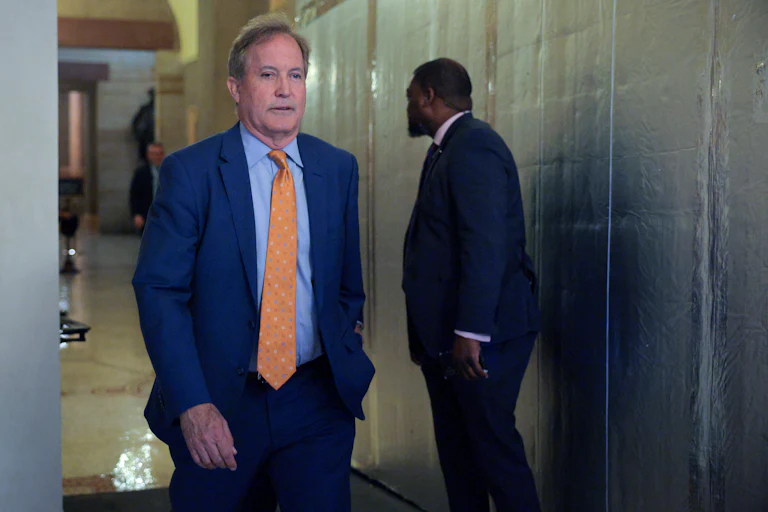
Texas Attorney General Ken Paxton walks in the Capitol
Texas Attorney General Ken Paxton
Chip Somodevilla/Getty Images
Texas Attorney General Ken Paxton

In a leaked audio recording, Texas Attorney General and Republican Senate nominee Ken Paxton privately admitted that President Donald Trump’s disastrous midterm convention in Dallas hurt Republican candidates.

At a private fundraiser in Washington last Thursday, Paxton spoke candidly about the event, according to a recording shared with The New York Times. 

In the recording, Paxton is asked: “Do you feel like he’s a little bit of a drag?” It is not immediately clear to whom the speaker is referring.

“So to be honest with you, the numbers—when we did that convention—it dropped our numbers. Everybody’s numbers dropped. Right now, yeah, not good,” Paxton said.

Three other people confirmed Paxton’s attendance at the fundraiser to the Times. Two recalled that Paxton was asked this question, and one recalled his negative response. The person who recorded the audio opposes Paxton’s Senate campaign. 

Paxton’s comments are obviously a humiliating gaffe for Trump, who backed the attorney general against Senator John Cornyn in a shocking political maneuver. 

The Republican midterm convention in Dallas earlier this month was key to Trump’s plan to energize his base—but polls have shown that Democrats benefited far more than Republicans did. RealClearPolitics’s Generic Congressional Vote, which averages results of other major polls, showed a sharp rise in support for Democrats after the convention, while Republicans’ support stayed about the same. 

Paxton has long struggled to match Democratic candidate James Talarico’s funding. According to their latest quarterly filings with the Federal Election Commission, Talarico’s campaign had raked in $31.6 million, while Paxton had only raised $9.3 million. 

Trump has repeatedly pledged his desire to see Paxton elected but hesitated to commit any part of his $400 million MAGA Inc. war chest to help him win. Earlier this month, Trump held a fundraiser in Houston that was touted as a lifeline for Paxton’s campaign—but the money actually went to the Republican National Convention, according to the Wall Street Journal.  

The president’s super PAC eventually gave $10 million to fund two advertisements for Paxton’s campaign. Meanwhile, Republican donors have been skittish about contributing to Paxton’s campaign amid mounting scandals.