In 2017, the urban planner Bruce Appleyard asked 9- and 10-year-olds from two Bay Area suburbs to draw maps of their neighborhoods. The first group lived in a community with heavy traffic and little bike infrastructure. They created maps lacking in detail and dominated by red and orange, colors that Appleyard asked the children to use to indicate zones of danger or dislike. The second group, from a community with light traffic where children could safely walk or bike to school, drew very different maps. These maps were full of details like houses, trees, and play spots. They featured lots of green and blue, the colors used to indicate positive associations. They had more labeled destinations. After the first suburb added new pedestrian infrastructure, Appleyard compared maps drawn by children before and after the upgrades. The new maps more closely resembled the second group’s: They reflected the day-to-day experience of the neighborhood.
Appleyard’s study revealed the hidden psychic cost of car dependency. Its methodology followed the cognitive mapping approach associated with the MIT planner Kevin Lynch, whose work emphasized the legibility of urban environments. In the 1960s, figures like Lynch, the journalist William H. Whyte, and the writer Jane Jacobs drew attention to the negative effects of the car. They critiqued the highways that ripped through U.S. cities in the name of urban renewal, calling instead for intimate, walkable neighborhoods. This romantic urbanist tradition influenced generations of city officials and planners whose touchstone remains The Power Broker, Robert Caro’s epic biography of New York City’s midcentury planning czar, Robert Moses. Caro placed the blame for the city’s planning failures at the feet of Moses and his six-lane Cross Bronx Expressway (Moses was recently played off-Broadway by the actor Ralph Fiennes, famous for his role as archvillain Lord Voldemort in the Harry Potter franchise). But can the fight against cars win support beyond a technocratic elite?
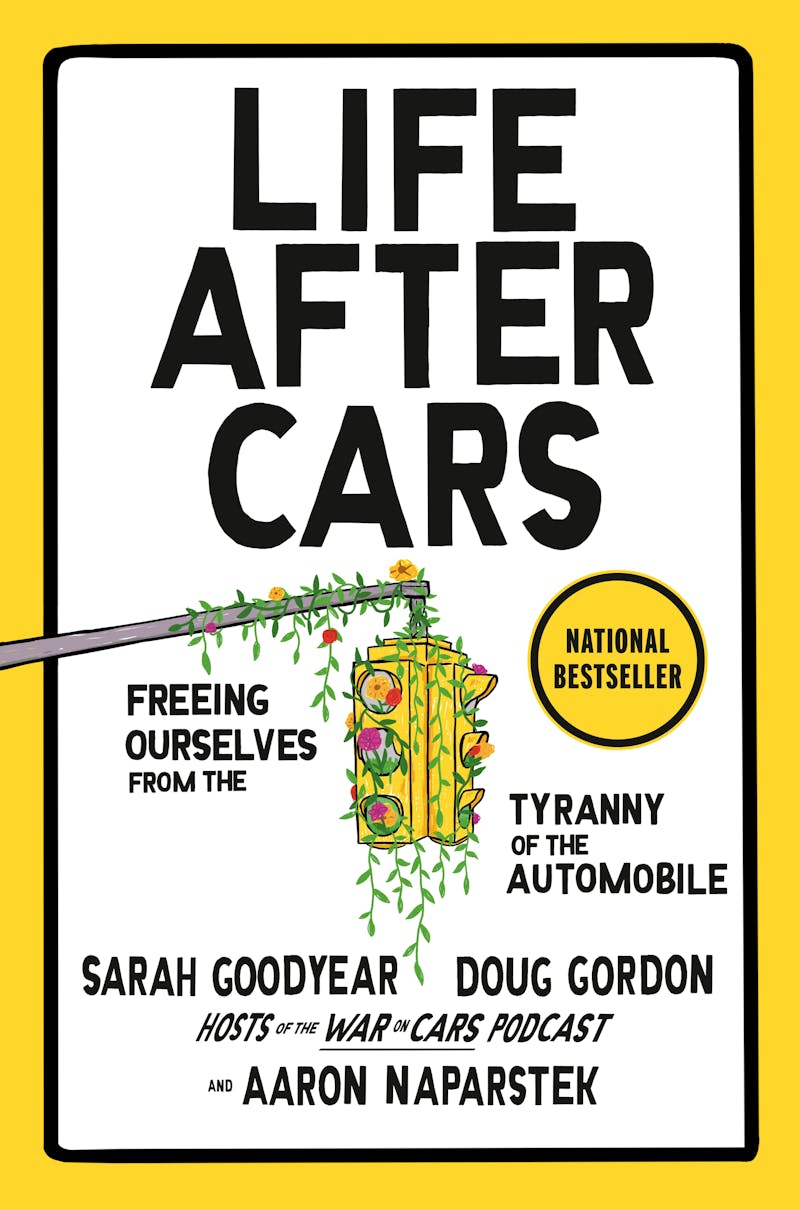
Sarah Goodyear, Doug Gordon, and Aaron Naparstek, authors of Life After Cars: Freeing Ourselves from the Tyranny of the Automobile, certainly think so. Goodyear and Gordon host the podcast The War on Cars and Naperstek is a former co-host. They are winningly self-aware about the optics of a trio of podcast hosts from Park Slope, Brooklyn, lecturing middle America on the evils of personal car ownership. Accordingly, Life After Cars seeks to appeal to a wide swathe of readers, from public transit nerds to the congenitally bike lane–averse. The authors marshal a compelling blend of history, statistics, and anecdote in support of a quietly radical argument: that mass car ownership, far from natural and inevitable, is a historical blip that can and should be reversed. They are quick to make some exceptions: emergency workers, residents of rural areas, and people with mobility disabilities, among others, have good reasons for driving. Their lives would be easier if everyone else got off the road.
The authors begin their chronicle of car culture’s ills in 1899, when a man named Henry Bliss stepped into the path of an oncoming taxi, becoming the first victim of a car crash in the United States. The advent of mass automobility in the 1920s generated fierce backlash from citizens outraged by the number of people being killed by cars. Just as cities were on the brink of regulating the automotive menace, however, the auto industry stepped in. Industry allies persuaded voters to reject proposed speed ordinances that would have significantly reduced the chance of dying from being hit by a car. Local governments reinforced the message that wayward pedestrians, not cars, bore the blame for collisions. In the postwar period, the Eisenhower administration subsidized the construction of the U.S. Interstate Highway System, creating endless suburban developments that took car ownership as a given.
As a result, the authors argue, we have accepted the massive costs of car dependency rather than questioning a way of life centered around personal vehicles. Some of these costs are obvious. Cars kill 40,000 people a year on American roads, a toll so ingrained that other risks—the chance of being a victim of gun violence or an opioid overdose—are assessed relative to your chances of being killed in a car crash (one in 95 over a lifetime). Some are borne by animals, not people. Advocates have successfully campaigned for wildlife crossings, concrete corridors that help animals safely navigate deadly highways. But there is no feel-good solution for the toxic chemicals that leach from tires into bodies of water, poisoning fish and disrupting fragile ecosystems. Equally insidious is the hollowing out of social space as people retreat into cars that resemble armored vehicles, shuttling in isolation between home, work, and soccer practice.
That last destination is significant. As Appleyard’s 2017 study underlined, car dependency prevents children (as well as anyone else who can’t drive, from seniors to disabled people) from autonomously navigating their environments. Among the many revealing anecdotes in Life After Cars is the artist Sean Kenney’s tale of moving from the U.S. to the Netherlands. Arriving in Amsterdam, Kenney is surprised when their landlord apologizes for only handing over three sets of keys for his family of four—Kenney, his wife, their 9-year-old, and their 6-year-old. “A key for the 6-year-old?” he asks in disbelief. The landlord is equally bewildered. Of course a 6-year-old would be exploring the neighborhood independently and letting themselves in and out of the family home.
The authors anticipate the response that inevitably follows charming tales like this one: The U.S. isn’t Amsterdam. They counter by showing that Amsterdam wasn’t Amsterdam until the 1970s, when new policies favoring cycling pushed cars out of Dutch city centers. In 1975, the Netherlands’ traffic fatality rate was 20 percent higher than that of the U.S.; it is now 60 percent lower than the U.S. rate. This rebuttal isn’t entirely convincing. Amsterdam, like many European cities, is centuries old and was built to be navigated on foot, or, later, by horse-drawn conveyance or trams. Its dense, narrow streets naturally favor bikes and pedestrians.
There are plenty of examples of this kind of compact urban development in the United States, from colonial-era cities like Philadelphia to streetcar suburbs like Shaker Heights, Ohio. But we also have a lot of twentieth-century planning based around cars, as the authors note: sprawling Sun Belt cities like Houston and Phoenix; low-density suburbs strung out along freeways; nightmarish street-road hybrids, or “stroads,” lined with parking lots. Adding infrastructure like sidewalks and bike lanes, rezoning for density, and investing in transit represent a start. Yet the stubborn legacy of car-centric growth means that not all U.S. communities will be able to emulate Ghent, Belgium, Paris, or Emeryville, California, the cities the authors single out for their pedestrian- and bike-friendly upgrades in the face of concerted opposition.
If we’re stuck with car-centric built environments, at least for now, what about electric cars? The authors concede that electric cars are undoubtedly a better option than their gas-powered counterparts—they’re quieter, don’t produce tailpipe exhaust, and, assuming the gradual decarbonizing of the electricity grid, have the potential to be zero-emission. But they kill just as many people in collisions as gas-powered cars, take up space in cities, and fail to solve the social problems that cars have caused. Life After Cars urges a more radical reexamining of the design of our cities and our lives. The authors acknowledge the extent to which the promise of the automobile—mobility, freedom, power—is intertwined with the American dream. Decentering the car means rethinking the good life.
In January of this year, New York City’s congestion pricing plan finally went into effect. The rollout of congestion pricing, which requires drivers to pay a fee to enter Manhattan below 60th Street, hit plenty of bumps along the way. Governor Kathy Hochul of New York initially shelved the plan in June 2024, just weeks before its planned launch. She cited the cost to working-class New Yorkers—even though only 4 percent of outer-borough residents commute into Manhattan by car, and more than two-thirds of this number have moderate or higher incomes. Local lawmakers came out in opposition, describing the plan as a shadow tax on hardworking commuters—even though drivers are already heavily subsidized through free on-street parking. Behind the rhetoric is a set of facts that points to congestion pricing’s success: lower rates of traffic congestion and air pollution; quieter streets and fewer crashes.
The frenzy around congestion pricing reflects what Goodyear, Gordon, and Naparstek call “bikelash”—an irrational aversion to anything that threatens to topple the car from its sacred place in American life. Knee-jerk defenses of cars can be found across the political spectrum. In April 2024, the City Council of Cambridge, Massachusetts voted 5–4 to delay the completion of the city’s 25-mile protected bike lane plan by 18 months. Cambridge is one of the most bike-friendly cities in America; walking to work through the city’s Inman Square neighborhood last year, I passed streams of bike commuters whizzing down Hampshire Street. Yet the city’s commitment to cyclists has triggered bikelash, with a vocal constituency claiming that bike lanes hurt small businesses and pose a risk to pedestrians. A far bigger risk to pedestrians is, unsurprisingly, cars. Moreover, as the authors point out, when cyclists break the law—by riding on sidewalks, for instance, where they can endanger pedestrians—their behavior is typically motivated by safety concerns stemming from poor infrastructure, rather than the urge to go faster.
Listen to any city resident complain about cyclists, and delivery workers on e-bikes inevitably come up. (I have advocated for e-bikes through my involvement with the E-Mobility Project). Missing from Life After Cars’s analysis are the ways in which rising demand for last-mile delivery is exacerbating the pressure on roads. Gig workers face intense pressure to complete deliveries while navigating heavy traffic and limited bike infrastructure. At the same time, last-mile deliveries on vehicles generate 30 percent of all greenhouse gas emissions in cities and 40 percent of fine particle pollution. Trucks take up more physical room on roads than cars; they are heavier and wear down roads more quickly. Tackling car culture also means reckoning with the ripple effects of next-day delivery.
Of course, most people don’t drive delivery vehicles. Most people drive cars. Life After Cars concludes by listing steps readers can take to reduce car dependency in their communities. These range from tactics like setting up flowerpots to create a visual barrier between bike lanes and traffic to learning to see cars by walking through an area where people usually drive. There is hope, they argue, even for places that don’t resemble Amsterdam or Copenhagen. Life After Cars shows us how different, how enriching, a car-free world could be. Until then, we can only echo the theorist Marshall Berman, surveying the shattered landscape of the South Bronx in 1982. Looking out at acres of blight, Berman reflected on both the devastation caused by the Cross-Bronx Expressway and the extent to which the area’s old residents had hastened its decline by moving to the suburbs. “We fight back the tears, and step on the gas.”