
When Americans think of the civil rights movement, we may think of the bridge in Selma or the boycott in Montgomery or the march on Washington, but if we remember a single image, it is likely Birmingham, 1963: the protesters battered by the propulsive spray of the fire hoses, the snarling German shepherds, the children in their high-tops and bobby socks, the policemen with their billy clubs aloft. Photos of these scenes shocked the nation. They are widely credited with securing the Alabama city’s swift agreement to desegregate and hastening the passage of the landmark Civil Rights Act the following year.
The story these photos told was one of passive resistance: of protesters putting their bodies in the path of state violence without resorting to force. They remain at the center of the standard-issue narrative of the civil rights movement, that in the face of brutality and injustice, a dignified perseverance will ultimately prevail. Today, this version of the story has been told and retold by so many parties that it’s become completely severed from the spirit of the struggle: Republicans citing Martin Luther King Jr.’s “color blindness” to scorn affirmative action, liberals waxing poetic about nonviolence while shrinking from the provocations of more militant leaders, older Black politicians lecturing young people about the right way to protest. In this version, the FBI wishes MLK a happy birthday each year, pledging to “reaffirm our commitment to Dr. King’s legacy of fairness and equal justice for all.”
A popular counternarrative to this story tends to pay most attention to the activist groups that embraced violent direct action: less ballot, more bullet. During the summer of 2020, as police abolitionism entered mainstream left discourse, the Black Panther Party’s open clashes with police and radical critique of the white power structure appeared far more applicable to the moment. Former BPP member Angela Davis, one of abolition’s earliest and most prominent theorists, appeared at protests and civil rights events and was interviewed widely, including for a special issue of Vanity Fair guest-edited by Ta-Nehisi Coates. (In popular culture, too, the BPP has received sympathetic portraits in recent years: Black Panther deputy chairman Fred Hampton was the hero of the Oscar-nominated 2021 movie Judas and the Black Messiah, which also shows him as a victim of the FBI’s war on Black activists.) In both versions of the story, though, Birmingham Public Safety Commissioner Bull Connor’s all-out attack on the crowd that May afternoon in 1963 is remembered as the main way law enforcement interacted with the early civil rights demonstrators—in the streets, suppressing protest with naked brutality, Jim Crow style.
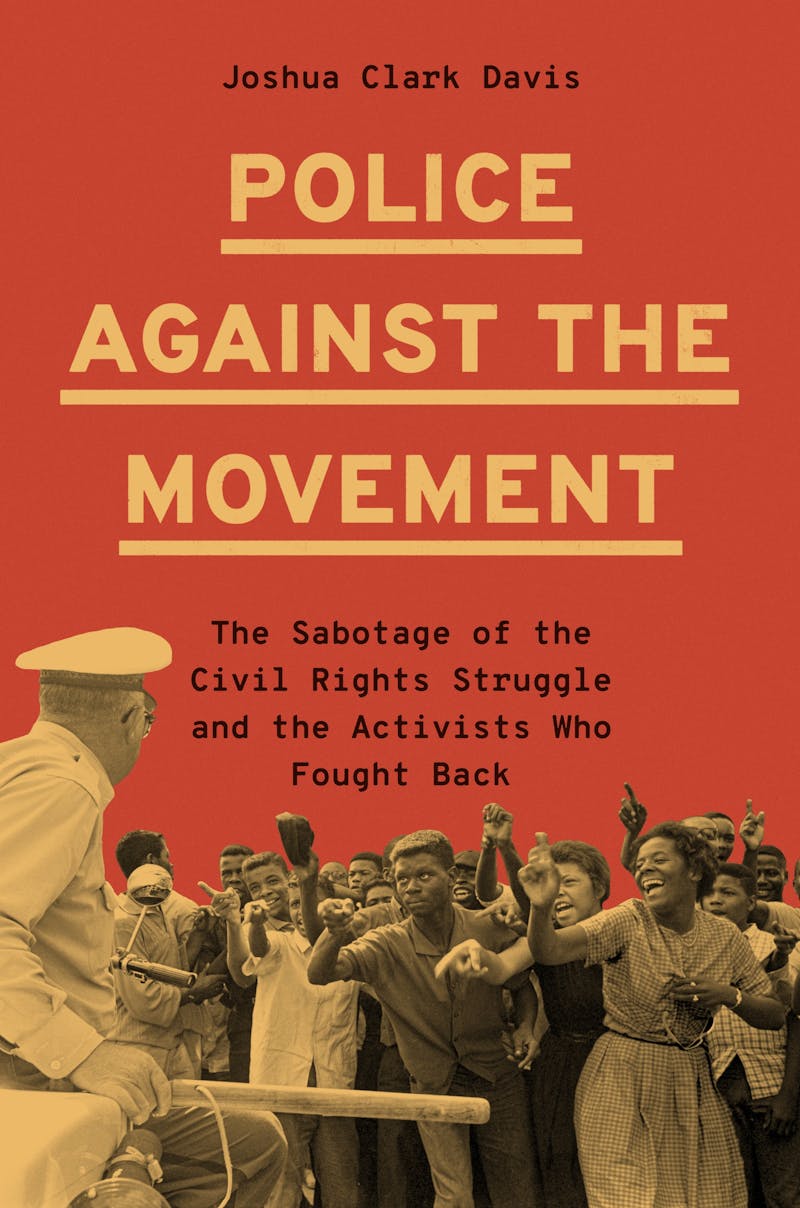
Joshua Clark Davis’s Police Against the Movement: The Sabotage of the Civil Rights Struggle and the Activists Who Fought Back excavates a more nuanced story. Instead of focusing on the most visible and well-known crackdowns, his account traces the police repression of Black Americans in its more insidious, day-to-day form, showing how civil rights activists identified that repression—and how they responded.
At the center of his narrative are the Student Nonviolent Coordinating Committee, or SNCC, and the Congress of Racial Equality, or CORE, the two more radical movement mainstays. By 1963, CORE had adapted its civil disobedience playbook, honed during the fight against segregation and disenfranchisement in the South, to demand an end to police violence across the North and West. Even before the Black Panther Party was founded in October 1966, both groups helped run community patrols to guard against white mob violence and monitor police abuses. The violence that SNCC’s and CORE’s organizers encountered in Birmingham and beyond led them to understand law enforcement not just as one brick in the wall of state-sponsored racist oppression but as something more like the keystone. Those dogs and hoses were a particularly blunt manifestation of official power, but not its only manifestation. Equally important, Davis shows how law enforcement across the country systematically surveilled, harassed, and repressed the movement—with local detectives on the front lines. The FBI’s infamous COINTELPRO operation targeting Black and antiwar radicals, he argues, can be better understood as “federalizing efforts that local police departments had already undertaken to disrupt the civil rights movement.”
For Davis, the movement’s constitutive battle is not Birmingham but Albany, Georgia, or Danville, Virginia. Albany’s police chief, Laurie Pritchett, had read up on civil disobedience. When the desegregation campaign came to his city in 1962, he realized the freedom riders were foregoing bail as a tactic, and so he conspired to pay King’s bond, releasing him from jail and taking the wind out of the movement’s sails. His goal was to “out-nonviolent” the protesters, Pritchett told interviewers later. His canny approach won him national praise: The New York Times depicted him as an “outstanding example of the new breed of Southern policeman.”
In the summer of 1963, after initially using the same playbook as in Birmingham, police in Danville switched course and began to fight back—“not with clubs and fire hoses but with mass arrests, felony indictments, and unrelenting surveillance,” Davis writes. They transferred detained activists to more conservative rural jurisdictions and constantly monitored local organizing; some town residents active in the struggle were kicked out of public housing or lost unemployment benefits. “Mass brutality was abandoned…. Less dramatic and more corrosive tactics were adopted,” the movement lawyer Len Holt recalled in his book An Act of Conscience.
Davis has another term for this: “slow violence.” Slow violence is harassment, spying, infiltration, and undermining; it is the weaponization of the criminal justice system. Bit by bit by bit, it makes the already hard work of fighting for change too exhausting, too maddening, too costly, or too dangerous to continue. And it doesn’t photograph well.
Davis opens his book with a scene that took place in 1933, but which registers as uncannily familiar: mourners gathering to remember yet another Black man killed by the cops. At the service, a young attorney named Benjamin Davis tells the assembled: “the funeral of Glover Davis, whose body lies down there, is the funeral of every Negro in this city unless the murderous brutality of the Atlanta police is stopped!”
Benjamin Davis was a Communist. Facing serious state retaliation for his involvement with the International Labor Defense and activism against police violence, he fled to New York, where he would eventually become a City Council member representing Harlem. He consistently used his position to raise the issue of law enforcement misconduct, working with the nascent organization Civil Rights Congress and even using his office to put out a report called “Police Brutality: Lynching, Northern Style.” CRC, a Communist Party–affiliated group that grew out of the ILD, would go on to appeal to the United Nations to intervene in the U.S. government’s crimes against its Black citizens, submitting a formal report in 1951 entitled “We Charge Genocide.”
Police Against the Movement brings “communists and socialists back into the history” of civil rights. Davis elevates less widely remembered figures like the “unmitigated radical” Fred Shuttlesworth, who clashed with King over strategy in Birmingham and was the lone voice of dissent when more cautious movement leaders persuaded a young John Lewis to edit the speech he would give at the March on Washington, softening the tone and excising his denunciation of Kennedy’s civil rights legislation proposal for its lack of protections against police brutality. The characters Davis sketches—their clear-sightedness, their defiance—are among the pleasures of this otherwise somber book. “I’m not crazy,” the Bronx chairman of CORE tells a judge who wants to remand him to Bellevue rather than standard pretrial detention. “I’m black.”
Anti-communism provided the framework for later police surveillance and repression of Black activists. The NYPD first established a unit to combat political radicals and organized crime in 1904, which it sometimes referred to as the “Italian squad.” Cops in other cities followed suit: Chicago, Detroit, L.A. “Red squads,” as these operations came to be known, cropped up across the South, too. Bull Connor didn’t just crack skulls; he also presided over a formidable political policing unit that raided and arrested suspected reds, bolstered by municipal ordinances against criminal anarchy and radical literature. (In Birmingham, such an ordinance apparently included a ban on this publication.)
As the civil rights movement flourished in the 1950s, red squads shifted focus. They dispatched detectives to observe protests and gather as much intelligence on the other attendees as they could. They developed informants in the community, and even sent in their own men. The scene was absolutely crawling with undercover cops; remarkably, a red squad officer was standing next to both King and Malcolm X at the moment of each man’s assassination.
For police leaders, tarring activists as reds was also a rhetorical strategy. Black communities’ fury over yet another state killing couldn’t possibly be an organic reaction to intolerable circumstances—it had to be a Commie plot. Sometimes these allegations were thinly veiled: “Birmingham does not need outside agitators coming into our city and dabbling in our affairs,” Connor told reporters in 1958. Other times, they were quite explicit. Using scare quotes, a NYPD red squad memo on a 1964 uprising in Harlem and Bedford-Stuyvesant dismissed “the ‘police brutality’ theme” as just “a long-term expression of communist groups in America.” After officers brutally attacked and almost killed a Black truck driver playing dice with his wife and friends in 1952, officials even lobbied the Department of Justice to let the NYPD investigate civil rights complaints in-house, on the grounds that these investigations were fodder for bad-faith Communist denunciations of the department.
Sometimes, slow violence and overt violence complemented one another. By 1966, Houston’s revamped red squad had an informant in the local chapter of SNCC who reported on gatherings and demonstrations at the historically Black Texas Southern University—where students were demanding, among other things, the disarmament of campus security guards. Soon, local police arrested a young student leader named Lee Otis Johnson and two of his comrades, hitting them with retaliatory charges like blocking access to public buildings. A month later, after students occupied the university and a police riot left one officer dead, very likely by friendly fire, 52 students were expelled, including every known member of Friends of SNCC. Even more disturbing, the local district attorney indicted five demonstrators, also SNCC members, for murder—not because anyone thought that one of these five men had pulled the trigger on the gun that killed the officer, but because, under a state anti-riot law, they could be held criminally liable regardless.
“Police and city officials seemed content to leave the murder indictments hanging over the five men as long as possible,” Davis writes. In the year and a half it took for the first case to go to trial, all five were kicked out of school; at least two lost good federal jobs. Two more years after that, a judge dropped all felony charges against the five men. But their lives had been upended. So had Lee Otis Johnson’s. In 1968, just after King’s murder, he was arrested for felony marijuana distribution, tried, convicted, and sentenced—to 30 years in state prison. He had passed a joint to an undercover red squad officer.
Police Against the Movement deftly shows how police departments neutralize movement demands and make even mandated changes work in their favor. No matter how many times they get struck, they mostly manage to reconstitute their power. For instance, a 1963 CORE memo on policing included a list of goals that members should push for in their respective cities: more Black officers, better cultural sensitivity training, and the creation of civilian review boards to evaluate accusations of misconduct. But wherever these reforms were enacted, police found ways to defy them, or to harness them for their own gain.
New York’s red squad began to hire more Black detectives—people like NAACP member William DeFossett, who served as a liaison to the city’s activist groups and was treated as a “community pillar” by Black papers like The New York Amsterdam News. Yet all the while he was spying on the NAACP and the Nation of Islam: sending back detailed reports to his superiors on rallies and sensitive internal meetings alike, noting down members’ identities and license plate numbers. Or Raymond Wood, who infiltrated CORE’s Bronx chapter, wormed his way into more radical groups, and entrapped a few rightfully frustrated young men into an absurd plot to blow up the Statue of Liberty. Though the defendants were hardly key organizers in the fight to rein in police misconduct, the widely publicized trial allowed bad-faith critics to paint the rest of the movement with the same extremist brush.
At a 1963 meeting of law enforcement leaders, the San Francisco chief of police boasted about his force’s requirements for racial relations training and counseled his counterparts to establish community relations departments. “But how different were community relations and intelligence work, really?” Davis asks. “While police promoted dialogue with activists as a recipe for improved relations, those communications also lay at the heart of efforts to collect intelligence on the movement.” These political policing units understood that knowledge was power. As James Baldwin wrote, sometime later: “A Black policeman could completely demolish you. He knew far more about you than a White policeman could.”
Davis’s retelling is, of course, a narrative like any other, and in seeking to advance it he sometimes overstates his case. His contention that the surveillance practices of local police have never faced a public reckoning the way the FBI’s spying did is enough to make the case for his focus on local law enforcement. It is confusing, then, that he sometimes minimizes or obfuscates the central role the FBI did play in all this. For instance, his discussion of the reprisals Benjamin Davis faced mentions the NYPD red squad’s infiltration of the Communist Party around the same time, while neglecting to mention that the Harlem council member was investigated by the FBI and tried in federal court. Other consequential instances of law enforcement infiltration of Black activists are covered only glancingly because they don’t fit his focus on local police surveillance of CORE and SNCC members: Fred Hampton’s undoing was the work of an FBI informant, while one of the most consequential NYPD red squad targets was not SNCC or CORE but the local Black Panther Party chapter.
It may be a pedantic distinction, but Davis tends to exclusively reach for the term “police violence” even when he is talking about, say, retaliatory prosecutions or judicial bias. U.S. courts and district attorneys’ offices are also weighted in favor of the status quo, but not in exactly the same way the police are; Davis draws from examples of both to bolster his thesis without pausing to tease out the distinctions. In seeking to cover civil rights battles and police repression throughout the South, North, and West over a period of nearly 20 years, he can spread himself thin, which may be one reason for some of these slippages. But his choice to give a broader overview is useful in another respect: It offers readers a clear blueprint for decoding the narratives and tactics that have, over the past five years, sprung up in response to the biggest mass uprising this country has ever seen.
If the “outside agitators” charge levied by Bull Connor all those years ago sounds familiar, it’s because it’s exactly the sort of language bandied about by politicians during the 2020 protests following the murder of George Floyd, and again, more recently, during the Cop City fight in Atlanta. Really, there is no more fitting contemporary example of “slow violence” than the RICO case the state of Georgia brought against 61 individuals who protested the construction of a massive police training facility. This September, a judge finally tossed the racketeering charges, but the damage was already done: The case’s glacially slow dissolution over two and a half years following the initial mass arrests and detentions in March 2023 has cost its defendants work, disrupted their education, and provoked endless anguish and uncertainty.
Without ever quite saying it explicitly, Police Against the Movement makes the stakes plain. The backlash against Black Lives Matter following 2020 should be understood not as the inevitable pendulum swing of public opinion but as a fierce and coordinated campaign waged by cops across the United States desperate to claw back power after modest losses: minor funding reallocations, a few officers held to account for killing civilians, the election of a handful of reform prosecutors. (Police departments were, of course, aided by their allies in real estate and big business, a bump in crime rates during the pandemic, and, notably, a credulous press that swallowed and regurgitated their narratives.) Why didn’t the millions of Americans who marched in 2020, who got kettled and arrested and beaten up by the cops, get anything they asked for on qualified immunity, on reevaluating municipal budgets, on alternatives to law enforcement? Why didn’t the civil rights movement achieve more of its demands on policing? Why, in other words, is it so hard to change anything about the police? Davis makes it blindingly clear: because they fight like hell to prevent it from happening—and the law is mostly on their side.


