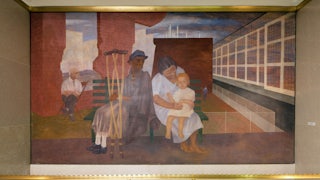
The Trump White House’s desire that government-funded art “remove divisive or partisan narratives,” to quote a letter sent last August to Smithsonian secretary Lonnie G. Bunch III, is nothing new. At the dawn of the Cold War, that same fatuous sentiment was directed against Ben Shahn’s New Deal frescoes The Meaning of Social Security, the most visually arresting of many murals and sculptures decorating the Wilbur J. Cohen Federal Building in Washington, D.C. Gray Brechin, an architectural historian and founder of the nonprofit Living New Deal, described the Cohen to me as “a kind of Sistine Chapel of the New Deal.” It and all the art inside could soon be rubble.
The Cohen lies two blocks west of the United States Capitol and across Independence Avenue from the National Mall. Its principal tenant is Voice of America, which President Donald Trump has been trying to liquidate. A couple of months ago, I broke the story that the Trump administration was racing to sell the Cohen with no regard for the art inside (part one; part two). I now see that I was insufficiently alarmist.
A December 8 story by Bloomberg’s Suzanna Monyak reported that, according to a former official of the General Services Administration, the agency in charge of federal real estate, Trump is already bypassing legally required GSA procedures and soliciting bids to demolish the Cohen, along with three other federal buildings in Washington—the Marcel Breuer–designed Housing and Urban Development headquarters; the building housing the Treasury Department’s Bureau of the Fiscal Service, built in 1919; and the GSA’s own Regional Office Building, which, like the Cohen, is a New Deal–era building housing social-realist murals, in this instance by Howard Weston (though these are on oil and removable). Once the four buildings are demolished, the land will be sold to developers. It won’t likely fetch a high price, because these buildings are all in Washington’s southwest quadrant, where the vacancy rate is above 15 percent. (Anything north of 10 percent is bad.)

The threat to the Cohen is the most urgent because The Meaning of Social Security is probably the most significant work of New Deal public art in Washington. Last week, I finally got to see it up close. Its colors remain astonishingly vibrant eight decades on. (Everybody, I’m told, has that reaction.) Small wonder that, on completion, Shahn called this “the best work I’ve done.” I also saw Philip Guston’s lovely mural Reconstruction and Well-Being of the Family, in the Cohen’s auditorium—a triptych whose panels open up and slide away ingeniously to make way for a movie screen—plus two handsome Seymour Fogel murals, Security of the People and Wealth of the Nation, that stand sentry in what was once the Cohen’s entranceway on Independence Avenue. (Today you enter from the other side, on C Street.)
In the event of demolition, removing the Guston would be a cinch; removing the Fogels more difficult; and removing the Shahn extremely difficult and costly, and perhaps impossible. Painfully aware of this, the GSA recently discussed with Olin Conservation Inc., a private contractor that for decades has done preservation work on the Shahn frescoes, preparation of “feasibility studies for potential removal of some of the art work,” David Olin, the company’s senior conservator, told me. One salient question is whether either of the walls on which the Shahn frescoes are painted is load-bearing. (To my untrained eye, one of them might be.) The GSA press office told me it was not yet able to answer this question, and Olin told me that he also didn’t know.
When I wrote my earlier pieces, the Trump administration had designated the Cohen for “accelerated disposition” (i.e., sale) in 2025. I subsequently learned that—barring Trump flouting several laws and/or bulldozing the Cohen—the timeline was more like two years. That gives preservationists more time to act. Much progress has been made already. A campaign is underway to save the Cohen, led by Mary Okin, assistant director of Living New Deal. An online petition has collected nearly 2,000 signatures; various art and architecture publications and a couple of podcasts have weighed in; and Heather Cox Richardson, The Guardian, and National Public Radio have reported on this threat to New Deal art and architecture.
But now it appears the Trump White House doesn’t want to give preservationists time to mobilize. Its plan to bulldoze the Cohen is described in a court filing in a lawsuit against Trump’s harebrained plans to whitewash the Eisenhower Executive Office Building. In the filing, Mydelle Wright, former D.C.-area director of the Office of Planning and Design Quality for the Public Buildings Service, which is part of GSA, said that on December 5 she was told (presumably by former GSA colleagues) that “the White House, acting on its own and not through GSA, has solicited bids and/or is finalizing a bid package (the last step prior to solicitation) to analyze and recommend for demolition [the] four historic buildings in D.C.” Wright continued:
Key GSA personnel have only just learned of the White House’s activities.… For the first time of which I’m aware, a president is personally involved in facilitating end-runs around the [GSA]’s obligations to the buildings that are our national heritage, and who in the agency is going to tell him “no”?
This is of course outrageous, but from Trump’s point of view it makes a certain amount of sense because the more you learn about efforts to sell the Cohen, the clearer it becomes that doing so will be very difficult if the federal government follows various legally required procedures, as the GSA currently shows every intention of doing. The same is likely true, though to a lesser extent, of the other three federal buildings Trump wants gone.
Trump’s first commissioner of the Public Buildings Service was a MAGA loyalist named Michael Peters. Peters came in pledging to unload 50 percent of the federal government’s real estate portfolio. But the White House concluded Peters was all bluster (“too many unforced errors,” an industry source told the Federal News Service), and he left GSA in July. Peters’s acting replacement, Andrew Heller, is a civil servant who’s served in multiple administrations, and he’s playing it by the book. That likely displeases White House budget director and “Project 2025” architect Russell Vought, who exercises a large and growing influence over Trump’s domestic policies. Vought posted a memo on December 8 recommitting the administration to offloading “unnecessary leases and buildings.”

The ultimate wild card is Trump. Thus far, we don’t know that Trump himself has demonstrated any interest in this demolition, but we do know he has an ungovernable passion for bulldozers. When I posted my previous two articles on the Cohen, the White House still had an East Wing. Now it’s gone. A lawsuit brought by a Virginia couple after the demolition began argued persuasively that Trump was violating, among other statutes, the National Capital Planning Act of 1952 and the National Historic Preservation Act of 1966. But the plaintiffs withdrew their complaint five days later, presumably because the demolition was completed before the court took any action (except to notify them that they’d neglected to pay a filing fee and furnish a required cover sheet).
A May 2025 report by the federal government’s Public Buildings Reform Board recommended the Cohen’s sale “within the timeframes established under” the 2016 Federal Assets Sale Transfer Act, or FASTA, and Vought immediately approved that. But despite the name, FASTA isn’t that fast. It requires three rounds of review by the Public Buildings Reform Board, and the Cohen has been through only two; the third is due next year.
Also, as I’ve noted previously, the Cohen is on the National Register of Historic Places and therefore requires GSA to engage in consultation over any potential “adverse effects,” of which the loss or damage of the New Deal art would seem pretty significant. A series of court decisions, including a district court ruling from last March, has established that even if a building containing New Deal art is sold, the art remains the property of the public.
I’ve explained previously at some length why no buyer of the Cohen building would likely wish to renovate the building; any real estate value lies in the location of the land on which it sits. In brief: The Cohen has never been renovated going all the way back to 1940, and renovating it now would cost (according to a GSA analysis from earlier this year that has not been made public) about $1 billion. The government can afford to perform such a renovation (and that unreleased GSA report offered sound suggestions to refurbish the Cohen that remain by far the best option). But not many private real estate developers would be willing to spend $1 billion on a renovation. (For a more modest example of private investors rehabbing a New Deal building about one-third the Cohen’s size and making its art available to the public, see my October report on some fine Shahn murals at the former Bronx Post Office.)
Ergo: Privatizing the Cohen is virtually synonymous with demolition, if not before the Cohen is sold, then after. If the federal government performs the demolition itself, the Cohen will sell more quickly.
But again: That would be illegal. We haven’t even discussed the preservation laws of local government. Contrary to popular belief, Washington, D.C., possesses one! Rebecca Miller, executive director of the D.C. Preservation League, told me by email that the Cohen is separately landmarked by the District of Columbia government and therefore protected by the DC Historic Landmark and Historic District Protection Act of 1978. So even though the National Historic Preservation Act ultimately allows demolition of a building on its register once it passes into private hands, D.C. law poses a much more serious obstacle. Demolition, Miller explained, “could only take place … by going through D.C.’s rigorous Mayor’s Agent process, where the new owner of the building would need to prove that the public benefit of a project outweighs the preservation loss. The process is lengthy, and very few buildings are razed under the law.”
The Cohen sale is a bit unusual because Congress authorized it last January; usually it’s the executive branch that makes such decisions, consulting Congress along the way. That may, I’m sorry to report, give the Trump administration some legal leeway to skip a few steps, though certainly not all of them. All the more reason to consider that the crucial laws to protect the Cohen will be the local ones.
Congress enacted the Cohen’s sale through a provision tucked last January into a water resources bill by Senator Joni Ernst, Republican of Iowa, and signed by an unwary President Joe Biden days before he left office. Ernst was so eager to demonstrate loyalty to Trump after declining to endorse him before the 2024 Iowa caucuses that she didn’t wait for Trump to assume office to found a DOGE Caucus, and she’s pushed to sell off multiple federal buildings. Still, I can’t tell you why Ernst started with the Cohen, because her staff has been ducking my emails and phone calls for months. I finally sent two of her press contacts the following five questions:
1) Why did Senator Ernst choose, specifically, the Wilbur J. Cohen Federal Building to sell off in last January’s water resources bill?
2) Did Senator Ernst, or any of her staff, visit the Cohen building before introducing her amendment to sell off the Cohen to the water resources bill?
3) Is Senator Ernst aware that there is New Deal art in the building, including frescoes by celebrated artists such as Ben Shahn and Philip Guston? Does she have any notions about what to do with it?
4) Does Senator Ernst know any prospective buyers for the Cohen building, and what their plans might be for the building?
I’ve yet to receive a reply.
I’m especially eager to get an answer to (2) because, as I’ve already noted, the Cohen is all of two blocks from the Capitol. If Ernst or an Ernst staffer ever ambled over to the Cohen, I can’t find anybody at GSA who remembers it. I asked Olin, who probably knows more about the present condition of The Meaning of Social Security than anyone, whether he heard from Ernst or her staff.* He said no.
The language in Ernst’s amendment to the water resources bill gave the GSA two years to sell the building after it’s vacated. I presumed it would be vacated by now, but it isn’t entirely, and even Trump wouldn’t likely demolish a building with civil servants still working inside it. A small number of Voice of America employees remain there, along with some employees from the Health and Human Services’ Office of Inspector General. So (assuming it’s still relevant), GSA’s two-year clock has not yet started ticking.
But I promised to tell you about the last time The Meaning of Social Security was at serious risk—due not to indifference, as today, but to the very Trumpy-sounding complaint that it’s insufficiently upbeat.
“Critics Want Art to Be Appropriate” announced a Washington Post headline in June 1947. In a letter to the Public Buildings Administration (a division of the Treasury Department that had commissioned this and other New Deal artworks), tenants in what today we call the Cohen building complained that Shahn’s frescoes depicted people who “look pathetic” and “are in poor circumstances.”
The strangest part of this story is who these tenants were: employees of the Federal Security Agency, an early precursor to the Health and Human Services Department. Like emergency-room doctors unnerved by the sight of blood, pioneering architects of America’s welfare state took offense at The Meaning of Social Security and wanted it removed. Politics likely played some role. This was the same year President Harry Truman established his notorious loyalty oaths for federal employees; Depression-era leftism was very much out of favor.
The complaining Federal Security Agency employees didn’t want all the Shahn murals removed; they just wanted half. Shahn likely modeled The Meaning of Social Security on Ambrogio Lorenzetti’s two fourteenth-century frescoes, The Allegory of Good and Bad Government in Siena’s Palazzo Pubblico. Along a 70-foot corridor, Shahn’s update depicted on one wall life without Social Security (a destitute-looking child on crutches; unemployed men sitting idly by a railroad track) and on the opposite wall, life with Social Security (men building a house; men driving rivets into girders, and yes, the working class in New Deal painting is mostly male). The Federal Security Agency workers didn’t object to the happy side. But the unhappy side, and most especially that child on crutches, really bugged them.
The controversy drew in Duncan Phillips, founder of Washington’s Phillips Collection. A week after the Post story ran, Phillips wrote in alarm to Museum of Modern Art curator James Thrall Soby, who was then preparing a major MOMA retrospective of Shahn’s work. “I am shocked to hear for the first time that Ben Shahn’s murals in the [Cohen building] are in danger of being covered over or destroyed,” Phillips wrote. “I will write a letter of protest since I agree with you that Shahn is one of our most distinguished artists and his murals among the best executed under the Treasury project.” After much to-ing and fro-ing, a compromise was struck, in which the unhappy side of The Meaning of Social Security was covered with a heavy curtain that remained in place through the 1970s. (I’m indebted for most of these details to Laura Katzman, professor of art history at James Madison University, who wrote a 1995 brochure for GSA’s rededication of The Meaning of Social Security.)
Now Trump is scheming to blow the whole building to smithereens, along with three others. Preservationists may have to secure a court injunction to stop it. Remember the East Wing! Save the Cohen! And if you have a moment, please sign this petition.
* This article originally misidentified Joni Ernst.