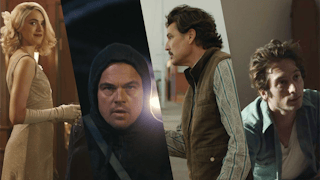
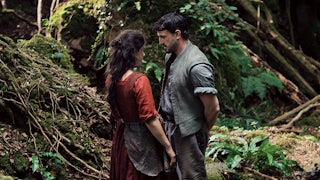
“Matters of great concern should be treated lightly,” intones the eponymous hero of Jim Jarmusch’s sublime Ghost Dog: The Way of the Samurai, about a New York City hit man who has styled himself as a sort of time-warped expatriate of feudal Japan. He lives humbly among his pigeons and under the dual sign of the I Ching and the Wu-Tang, wielding katana and karma alike as precision instruments. Study Jim Jarmusch’s blade and you’ll find that he also likes to cut things fine, rhythmically and philosophically, to the point that his meticulously oscillating movies sometimes barely seem to penetrate his own consciousness, much less the spectator’s.
This is not a put-down: Among the contemporary American filmmakers who might be best categorized as conceptualists—or plausibly proffered up as poets—Jarmusch is surely the gentlest, a surgeon who doubles as his own anesthesiologist. The old cliché that a certain kind of movie—slow, contemplative, and probably not starring The Rock—manifests as a “meditation” on its theme actually applies in Jarmusch’s case, with his love for koans and incantations, be they stilted, sotto voce, or gloriously full-throated. Recall the compulsive needle drops of Screamin’ Jay Hawkins’s “I Put a Spell on You” in 1984’s Stranger Than Paradise, a laconic, bohemian comedy of manners that doubled as the first, and arguably still the most charming, iteration of Jarmusch’s particular sort of sorcery.
The seeming sleepiness of a movie like Jarmusch’s new and prize-winning triptych Father Mother Sister Brother is deceptive and also instructive. The film’s selection as the Golden Lion at last year’s Venice Film Festival over more superficially bold—and overtly topical—art house fare like Bugonia, No Other Choice, or The Voice of Hind Rajab was seen in some quarters as puzzling (or perhaps as a sign of jury president Alexander Payne’s parochial—i.e., American—taste). But there’s something to be said for art that swaps out sensory overload for a more subliminal sort of programming. The effect of Father Mother Sister Brother’s three vignettes—each about 35 minutes long, and each concerning a family whose members are unhappy in their own ways—is simultaneously surreal and recognizable, in a way that intensifies, rather than deadens, our identification. To paraphrase our old pal Ghost Dog, who places stock in the idea that life is but a dream, the world we live in is not a bit different from this.
The opening sequence of Father Mother Sister Brother finds Jarmusch on familiar geographical as well as rhetorical turf; the frozen tundra of exurban New Jersey, the backdrop of Jarmusch’s lovely 2016 drama Paterson. That film, for my money one of Jarmusch’s best, cast Adam Driver as an NJ Transit driver seemingly named after his birthplace; while circumnavigating Paterson, New Jersey, by bus, the taciturn Paterson (no surname given) scribbles verses in his notebook in homage to William Carlos Williamson’s five-part modernist epic titled (you guessed it) Paterson. Here, Driver’s character, Jeff, is once again behind the wheel; he’s ferrying himself and his older sister Emily (Mayim Bialik) to the isolated, dilapidated cottage where their unnamed father (Tom Waits) lives alone. Jeff has been in touch with his dad, and Emily hasn’t; she’s dubious about the older man’s mental health, and about how he’s guilt-tripped his son into subsidizing his existence as an unemployed and intransigent widower. Father doesn’t say much about his life, except to list all the drugs, legal and otherwise, that he swears he’s not taking, and nor does he have much curiosity about theirs. Apparently, he’s getting by.
I say “apparently,” because while the siblings’ visit mostly proceeds according to script—compressing years of alienation and estrangement into a self-fulfilling prophecy; photo albums and small talk over ice water precipitating loaded silences and a hasty exit—there are so many small, weird details, pertaining to both the decor of Father’s place and to his behavior, that this banal series of exchanges starts to vibrate on a more enigmatic frequency. Gradually, small things become matters of great concern. Why is Waits wearing a Rolex? Is it real, or a fake? What about the character’s hermit-like remove from the world? Is that real, or fake? Is he genuinely happy to see them, or just counting the seconds until they depart? Does it have to be either-or?
The mystery train has always been Jarmusch’s preferred mode of conveyance, and lest this description make the opening of Father Mother Sister Brother sound somehow sinister—a thriller about what’s buried behind the proverbial cabin in the woods—the anxieties being mined are distinctly quotidian, though no less unsettling for that. Jarmusch has made quantifiable horror movies before, with the elegant vampire riff Only Lovers Left Alive and zombified satire of The Dead Don’t Die, and if there’s a genre element in Father Mother Sister Brother, it lies in the quasi-science-fictional quality of the proceedings. After part one’s abrupt conclusion with the revelation of a previously hidden object, the film proceeds into a series of twilight zones.
The setup of part two, which shifts the scene to Dublin, is conspicuously similar: two adult siblings (Cate Blanchett and Vicky Krieps) journeying to visit an older, single parent. This time, though, the host is Mother (Charlotte Rampling), a successful romance novelist who likes things just so. The daughters arrive separately, one in her own broken-down car, the other in an Uber driven by her girlfriend; the reason they have to park down the block from the house is that, apparently, Mother doesn’t approve (of the Uber or the girlfriend).
Again, “apparently”: The triangulation of motives and relationships in this segment is so bizarre—with Rampling (like Waits’s character, unnamed) acting at once domineering and diffident to Blanchett’s dowdy bureaucrat Timothea and Krieps’s fashionista influencer Lilith, so that even an attentive viewer could be forgiven for admitting a certain bafflement. (Compounding the confusion is Lilith’s pathological dishonesty, a veritable blizzard of little white lies.) Again, though, the details—the curated array of props, wardrobe, and pet phrases—are so specific that they cut through the befuddlement, doubly so because they’re so obviously borrowed from the previous episode. The more the women withhold information and emotions from one another, the less we worry about conventional disclosures, the more we begin watching their lavishly appointed yet desultory high tea from somewhere in the back of our minds. There’s something Pavlovian going on, with Jarmusch patiently training us to recognize, if not master, his patterns, like a high-definition Rorschach test.
The result is a movie that operates according to the principle of accrual; the effect of its gamesmanship is cumulative. If the return appearance of that fake(?) Rolex watch or a gaggle of spectral, slow-motion skateboarders—or the utterance of incongruous but nagging idioms like “nowheresville” and “Bob’s your uncle”—are uncanny the second time around, the experience of wondering when and how they’ll be deployed in the final third is as close to white-knuckle suspense as Jarmusch gets.
That final installment, which takes place in Paris, is at once the sweetest and the most troubling, pushing death to the forefront; it uses Father and Mother as dearly departed structuring absences. Sister and Brother, meanwhile, are a pair of mixed-race hipster twins, Billy (Luka Sabbat) and Skye (Indya Moore), in Paris (via New York) to collect their parents’ effects from their now-empty apartment in the 11th Arrondissement. Their evident physical and emotional closeness, beautifully acted by Sabbat and Moore (who give the finest performances in a movie of conspicuously A-list stars) belies the unevenness of their duties as caretakers. Billy, it seems, has been doing the literal heavy lifting of boxes into a storage locker, while Skye apologizes—earnestly, if a bit evasively—for being MIA even as she confesses to having not much going on.
Whereas the first two sections are calibrated for cringe comedy with finely tuned tinges of ambiguity, this final part lays its cards on the table (again, literally) in the form of the private items bequeathed to the twins. The melancholy nature of this inheritance—not just of photos and ID cards, but information that contextualizes them—is complicated by the matter of whether Bob and Skye’s folks would have actively chosen to pass these things on had they not died in a plane crash. Would they, like the elders played by Waits and Rampling, have instead remained tight-lipped about themselves and their hidden selves until the end?
As a piece of craftsmanship, Father Mother Sister Brother is predictably impeccable, from the selective angularity of the camera setups to the obvious falseness of its rear-projected driving scenes (Alfred Hitchcock, no slouch at fractured family dynamics, would have been proud). There’s pleasure in the presences of the actors, whether they’re charter members of Jarmusch’s repertory (Waits and Driver) or new to his stable (Blanchett’s full-bodied gormlessness, exacerbated by a comically unflattering coif, has to be seen to be believed). What the pile-up of minor key synchronicities amounts to is, of course, wide open to interpretation, and that’s how Jarmusch likes it. Forty years into a career spent engineering movies that sit snugly side by side along a narrow yet paradoxically spacious corridor—as adjoining compartments on the mystery train—he’s apt to leave things ajar.
The closing images of Billy and Skye exiting the darkened storage complex into the afternoon light suggest either liberation or a suspended sentence—as they both assert repeatedly, a reckoning with the leftover objects in the locker is coming, but they don’t have to worry about it right now. It’s not important, until it is—this attitude is the flip side to Ghost Dog’s and Jarmusch’s unsentimental minimalism. “Matters of small concern should be treated seriously.” Father Mother Sister Brother is a throwaway that’s also a keepsake.