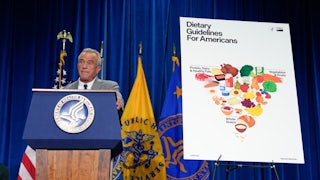
Last month, with great fanfare, Robert F. Kennedy Jr. unveiled the new dietary guidelines for Americans. The advice was muddled—eat more meat but not more saturated fat!—and likely shaped by the very industry influences that Kennedy has vowed to curb. Never mind, though. Its message, “Eat Real Food,” was a certified hit among the faithful of Kennedy’s Make America Healthy Again movement and much of the broader public. And Kennedy is making sure that message is heard. During the Super Bowl, a 30-second spot featuring Mike Tyson crunching on an apple pointed 125 million viewers to the website RealFood.gov.
It’s no wonder the message is working. Today in the United States, Americans spend around $1 trillion each year on medical treatments for diet-related chronic diseases. Poll after poll shows that Americans overwhelmingly want policies to improve school lunches and to make fruits and vegetables more affordable. With MAHA, Kennedy has tapped into the inescapable feeling that something is wrong, and positioned himself as the only leader strong enough to do something about it.
Once upon a time, though, healthy food wasn’t a Republican talking point. In fact, “eat food”—the “real” was implied—has long been a progressive message. Journalist Michael Pollan coined it in 2007 in his ruthlessly efficient (and still excellent) nutrition advice: “Eat food. Not too much. Mostly plants.” Even RFK Jr.’s denigration of ultra-processed foods as “food-like substances”—a term he used at a “Take Back Your Health” event in Nashville last week—is a Pollanism, popularized in his 2008 bestselling book In Defense of Food.
But when Michelle Obama tried to translate that advice into policy, via her “Let’s Move” initiative, she was met by relentless accusations of nanny-statism from Republicans and their supporters. Rush Limbaugh warned that federal agents were inspecting lunch boxes and tried to rebrand Obama’s initiative as “No Child’s Behind Left Alone.” On Fox, Sean Hannity railed that he didn’t “want to be told how many calories are in my Big Mac meal.” (Last year, in an interview with Kennedy, Hannity agreed that “we are poisoning ourselves” with ultra-processed foods.)
Kennedy has appropriated more than just the language of the liberal food reformers. Many of the policies that have made MAHA a political force are long-held progressive ones—like improving school lunches and limiting ultra-processed foods—that have been repackaged with a side of rage. As Republicans ready for the midterms, they see MAHA voters as a critical constituency. Democrats, meanwhile, are conspicuously quiet, seemingly resigned to let RFK and the Trump administration run off with their issue.
“Democrats should be beating Republicans over the head with the truth that we will champion cleaning up our food system, we will champion creating healthier options for families, we will champion the programs that provide healthy fresh foods to local farmers and schools that the Trump administration has cut,” said Senator Cory Booker of New Jersey, adding that he has long felt out in the “wilderness” on these issues.
“Everybody wants to talk about the cost of health care and how to make health care more affordable,” he added. “That is good, but nobody is talking about why the demand for health care is going so high.… There’s a massive opportunity here to connect the dots between health care and the sicknesses and the chemicals that are causing our families to be sick.”
Trump
himself was the first to see the power of MAHA. After successfully pushing
Kennedy out of the presidential race, Trump offered him a place in his
administration, promising to let him “go wild on health.” Since then, he has suggested several times in
his rambling way that MAHA might be key to avoiding a midterm shellacking. “I
read an article today where they think Bobby is going to be really great for
the Republican Party in the midterms,” President Trump joked
at a Cabinet meeting last month. “So I have to be careful that Bobby likes us.”
Polls have proved Trump’s instincts correct. According to a KFF poll, 38 percent of parents support MAHA, including one-third of independents. Even more compelling, a poll from Republican research firm co/efficient estimated that between 4 percent and 6 percent of voters who had not previously supported Trump backed him in 2024 specifically because of MAHA. Included in that group were suburban women, young people, and independents—exactly the voters that Democrats need to win back in the midterms.
When I mentioned this in conversations with Democratic strategists, their responses were puzzling. Apparently, few people crafting the party’s electoral strategy were even considering the issue. “A good point,” one said. “You’re making me think about this,” said another. At a high level, the problem seems to be that Democrats broadly dismiss MAHA supporters as a bunch of conservative crazies and anti-vaxxers—which, to be fair, is how they appear on social media.
But a closer read suggests that is not the case. According to polling from progressive firm Navigator Research, 20 percent of the up-for-grabs electorate is considered “MAHA curious,” meaning they are skeptical of the U.S. health care system but not antagonistic toward doctors or traditional medical institutions. These voters are younger than the general population and include suburban and non–college educated voters—and, notably, do not support vaccine restrictions.
Or to put it more simply, MAHA is a diverse group of disillusioned voters who want more control over their health. “I look at MAHA and see a coalition of food people without a home who are desperate to have someone in a position of power talking about the problems in our food system,” said Sam Kass, who served as Michelle Obama’s senior policy adviser for nutrition policy.
Trump’s own pollsters have come to the same conclusion: “Vaccine skepticism stands as an outlier, rejected by most voters even within the MAHA movement,” according to a December poll by Fabrizio Ward. In contrast, “food policy, a key aspect of the MAHA policy agenda, resonates among most voters in these [congressional swing] districts, across party lines.”
In theory, these voters could be there for the Democratic taking. But Ryan Munce, president of co/efficient, told me that though voters will reward politicians who deliver on MAHA’s promises, “we don’t see any real, meaningful policy and messaging that makes us feel like [Democrats] see this as an opportunity.”
Why are Democrats ceding such a popular issue? There are a few likely reasons. Democrats are notoriously once-bitten-twice-shy about these sorts of things, and may shrink from policies—like championing healthy food—that were effectively mocked as elitist and shouted down 15 years ago. Then, too, they believe they’re already winning on health care, so why talk about ultra-processed foods or pesticides if it could be construed as support for a crank like Kennedy?
There’s also the shortsighted tactical thinking that has plagued Democrats since Trump rode down his golden escalator in 2016. Midterms, one insider told me, are a referendum on the administration, not the moment to sell a new vision—even one you’ve had for the last 20 years, apparently.
But New York City’s new mayor, Zohran Mamdani, has shown that populist food policy can work for leftists. No one was talking about creating publicly funded grocery stores in New York until he floated the idea. A March 2025 poll from the Climate and Community Institute, a progressive think tank, revealed that two-thirds of New Yorkers, including 54 percent of Republicans, support public groceries.
Mamdani’s not the only one to see food policy as a ripe opportunity for Democrats. “I feel like I’m on a constant crusade to engage my colleagues and say you forget the food issue at your peril,” said Maine Representative Chellie Pingree, an organic farmer and veteran champion of food reform. “Because you miss a whole lot of people in your district who you can talk to in a very nonpartisan way about issues you know people are angry about.”
It’s not too late for Democrats to win over MAHA voters. Two of their leaders—including Vani Hari, a.k.a. the Food Babe, and Zen Honeycutt, founder of Moms Across America—have been clear that MAHA votes are up for grabs. “We are not beholden to a political party,” Honeycutt, a former Democrat turned independent who voted Republican in 2024, told me in an email. “We moms vote for those who put health and safety first.”
The most obvious opening for Democrats is affordability. The message: “Eat Real Food” sounds great, but try making it happen at the grocery store. Sixty-nine percent of respondents in a Pew poll last year said increased costs had made it harder for them to “eat healthy.”
Democrats I spoke with agreed that food was one piece of a broader affordability pitch, along with housing and utilities. And to their credit, they have made some efforts to link food prices to Trump’s tariffs. Last September, the Democratic Congressional Campaign Committee launched a website, HouseRepublicanPriceHike.com, to highlight rising prices on staple items like ground beef, sugar, coffee, and beer. But aside from Booker, Pingree, and a handful of others, the party has confined its rhetoric on food to pointing out the hypocrisy of Republicans’ calling for healthier food while simultaneously gutting nutrition-assistance programs like SNAP and school lunch.
Democrats could be going a lot further. Food and food prices are among those rare political issues that voters see (and taste) in their everyday lives. Munce, the GOP strategist, compared food to potholes: “You know if your elected officials are filling them or not.”
A survey last month by Navigator Research showed that 86 percent of both independents and “persuadable” voters said that the cost of groceries caused the most strain on their budgets—above both utilities and health insurance. “Why shy away from talking about something like food that everyone is interacting with all the time?” said Maryann Cousens, Navigator’s senior manager of polling and analytics. “It adds to this narrative that politicians are out of touch.”
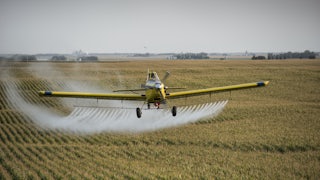
Another way liberals could win over some of the MAHA-curious voters would be to promise to crack down on pesticides. Kennedy’s recent silence on the issue and the Trump administration’s aggressive support for liability shields for the maker of the ubiquitous pesticide Roundup—the question is now before the Supreme Court—have infuriated MAHA loyalists who view curbing pesticides as an urgent matter for food safety. Democratic campaign promises to rein in the international chemical companies that profit at the expense of Americans’ health would show that Democrats are up for a fight. “Food is an issue we haven’t been muscular enough on,” said Celinda Lake, president of Democratic polling firm Lake Research Partners. “Democrats are seen as too weak, not too liberal. We need to take on the villains.”
There’s still time before the midterms for Democrats to reclaim the once-progressive messages that Trump and RFK Jr. have appropriated. A year into Trump’s second term, Republicans don’t own healthy eating. They certainly don’t own health care. Safe and healthy food is a winning bipartisan issue, one that Democrats have at least as much credibility on as Republicans.
As Booker put it, “the MAHA movement is not the Trump administration,” but rather a growing movement that Donald Trump is trying to exploit: “This is a political opportunity to let people know who’s really fighting for them and who’s betraying them.”
The voters are there. The policies are clear. All that’s missing is the will to get in the fight.
This story was produced in partnership with the Food & Environment Reporting Network, a nonprofit investigative news organization.