I have never cared that Grey’s Anatomy or Suits is unrealistic. Yes, I believe that writers should do painstaking research, and that the realistic texture of daily life—whether it’s in an E.R. or a courtroom or a sandwich shop—is something TV creators should value. But it also doesn’t really matter to me if the attorneys on a blue-sky procedural aren’t filing motions correctly. That’s not what I’m there for.
That said, as someone who has lived in and out of higher education for the past 20 years, I have absolutely no tolerance for TV series about the academy. I realize this is rank hypocrisy. In the classroom, I do all I can to disabuse students of an overinvestment in artistic fidelity, whether it’s about the “faithful” adaptation of a cherished novel or the “accurate” depiction of a workplace. I’m currently undergoing an occasionally painful—for me!—semester-long project of convincing a roomful of students that Patrick Somerville’s wildly unfaithful adaptation of Emily St. John Mandel’s beloved novel Station Eleven might actually be better than the book. And yet, I simply can’t get over my feelings about academia unfaithfully represented on-screen.
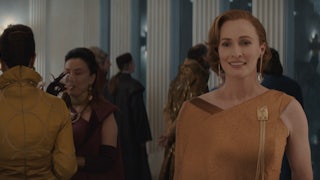
So March has been a bad month for me. In the past several weeks, not one but two new comedies set in English departments on college campuses have debuted: Netflix’s Vladimir and HBO’s Rooster. Both series are rife with uncanny-valley moments for professors watching at home. A new professor is hired midsemester, and his class just starts as soon as he arrives, in medias res. College presidents are strangely involved in the intimate day-to-day affairs of the faculty (even agreeing to serve as dissertation advisers to grad students). Broadly, the profession of literature is presented as a kind of mystical endeavor of appreciation rather than a field of study. (Discussion seminars spend way more time on the question of “relatability” than an average English professor would countenance, for instance.) Classroom scenes feel more like episodes of Surrounded—the Jubilee series where a roomful of angry people line up to ask gotcha questions of the guest expert in the middle—than actual course meetings. Vladimir, in general, has a better eye for telling academic detail than Rooster, but neither feels wholly earnest in its depictions.
All the same, as I would happily say to any complaining lawyer or doctor after watching their profession chopped and screwed on TV: Who cares? Why does it matter?
In terms of dramatic value, it doesn’t. Academic TV series, particularly ones about faculty—including The Chair and Lucky Hank, among recent examples—use shorthand to make the petty and byzantine universe of university bureaucracy understandable to civilians. They rely, even if and when they know better, on the viewer’s preconceived notions of academia to fill in gaps you’d otherwise need a David Simon–ian amount of time and patience to fully and faithfully represent on-screen. They do the same thing to the doctors and the lawyers, so why wouldn’t they do it to the professors?
The pickle is that the average gleefully inaccurate legal procedural is not the same as the average gleefully inaccurate academic drama. The difference is not in the execution or research. It’s about what stories writers think they can use these fields to tell. TV writers write about doctors and lawyers because they are deeply interested in those professions. They may mess up the workplace dynamics or invent procedures and precedents, but the drama of diagnosis, the theater of legal argument, these are subjects of rich possibility for teleplay writers. Watching academic TV shows, it’s hard not to suspect that these writers either don’t care about—or actively loathe—their subjects.
The drama of academia on Vladimir and Rooster seems most focused on the perceived smug hypocrisy of all players involved, from students to teachers. Writers may inadvertently caricature the legal profession en route to exploring everything they find fascinating about it; writers, more often than not, seem interested only in the caricature of academic life. No television program has ever succeeded, or even tried, to represent what a college seminar discussion is actually like; no sitcom has ever captured the boring nastiness of a faculty meeting. Academia’s self-defeating/self-aggrandizing bureaucracies, its permanent adjunct underclass, the way its glad-handing fundraising leaders are almost entirely divorced from the workaday functioning of the campus itself, the teeming workforce of nonunion custodians and security guards and food service workers who service most college campuses—universities are complex, petty, opaque ecosystems where thousands upon thousands of teenagers grow up every year. You’d think that would be interesting to people. Yet, in Vladimir, faculty are either out-of-touch, exploitative libertines or judgmental scolds, and students are woke snowflake know-it-alls who don’t actually know anything about anything. In Rooster, faculty are bumbling lechers or adult children, and students are [checks notes] woke snowflake know-it-alls. Which leaves the question: Why are these shows interested in these people at all?
The answer is sex. I don’t think it’s particularly controversial to say that neither Julia May Jonas (creator of Vladimir and author of the novel upon which it’s based) nor Bill Lawrence and Matt Tarses (creators of Rooster) are all that interested in depicting academia. It’s not the real focus of either series, so much as the politically loaded and socially cramped setting. These shows are, instead, interested in sex, scandal, and the changing terrain around sexuality, consent, and power in the post–#MeToo United States. The campus, for them, is a medium through which to explore this interest.
Of the two shows, Vladimir is better, but Rooster is more self-actualized. In other words, Vladimir tries and only sometimes succeeds at being a pretty ambitious, tonally frisky sex comedy; Rooster tries to do a lot less but hits most of its targets easily.
Vladimir stars Rachel Weisz as an acclaimed novelist and English professor at a small liberal arts college in upstate New York. She teaches one of those legendary, perennially waitlisted, word-of-mouth classes you have to take called “American Women Writers,” and she’s revered by a revolving clique of undergraduate women who follow her around and serve as a kind of informal advisory council. She’s also one-half of a faculty power couple with her husband (John Slattery), a poetry scholar. But when we meet her, all these shiny facets of her bucolic existence are in crisis. Plagued by writer’s block, she is decades behind on the follow-up to her debut novel. Her once-full lectures are now only limply enrolled, and her new students are skeptics rather than devotees. And then there’s her husband. When Vladimir begins, he is in exile, as numerous undergraduates going back years have initiated a disciplinary action against him. John, it seems, has been sleeping with students, and while that behavior may have once given him the cachet of a campus bad boy, times, Vladimir tells us, have changed.
John, the show is at pains to point out, has committed no crimes—all of his partners were of age and nominally consenting—but his actions are now at risk of being declared inappropriate, and thus possibly worthy of censure or even termination. (Lauren Michele Jackson, writing a few years ago about the rise in popular narratives of college professors, wrote, “Hollywood has recently discovered a new way to keep academics on campus without putting audiences to sleep: just ‘cancel’ them.”)
What follows is part farce, part comedy of manners, part campus satire. Vladimir is, despite the seriousness of its thoughts about female desire, male entitlement, female aging, male aging, and intergenerational feminist dissonance, a profoundly wacky show. While John’s hearing proceeds, Weisz’s character—unnamed in the show and the book—becomes sexually obsessed with a new creative writing prof named Vladimir Vladinski (Leo Woodall). Things, literally and figuratively, blow up from there.
Weisz is predictably outstanding in a role that requires her to be essentially the sole focus of the series almost all the time. Vladimir’s decision to have her deliver unreliable narration straight to camera is immediately tiring, but Weisz is excellent at playing both the daffy overconfidence of her character’s delusional self-narration and the subtle mournfulness that we detect when we realize she’s lying to us. The show may not have much new to say about contemporary academia or even campus culture, but Weisz brings to life its staging of the complexity of her reawakening sexuality. And, while the show’s depiction of contemporary undergraduates is condescending at best, Weisz movingly convinces us, both of the power she once had as a teacher, and of the despair she feels at watching herself become obsolete.
Rooster, on the other hand, is a relatively straightforward, league-average Bill Lawrence show. The man who brought us Scrubs and Cougar Town has had quite a career renaissance in the streaming era, as the creator of uplift dramedies Ted Lasso and Shrinking on AppleTV+. Rooster, a star vehicle for Steve Carrell, is Lawrence’s first series for HBO, but it’s quite of a piece with his other two recent hits. Carrell plays Greg Russo, a Carl Hiassen–style popular novelist who reluctantly accepts a visiting writer position at a small liberal arts college in New England so that he can be close to his adult daughter, Katie (Charly Clive). Katie had arrived at Ludlow College a few years earlier, it seems, as the trailing spouse of a hotshot Russian professor (Phil Dunster) named Archie. Archie, however, left her for a graduate student—it’s worth noting here that liberal arts colleges, by definition, don’t have graduate students—and her life is in shambles. By the end of the pilot, she’s accidentally burned down their home, and the only way the college’s president will agree not to fire her is if her dad stays and teaches for the school.
Vladimir presents a somewhat hallucinatory picture of the atmosphere on campus today, but it gets a lot of small things right about academic social life—its creator, Jonas, teaches at Skidmore—from the long-festering power dynamics of department life to the undergraduate fan clubs around popular professors to John’s particular style of misogyny under the guise of feminism. Rooster seems roughly as accurate a portrait of the ivory tower as Shrinking is of private-practice cognitive behavioral therapy or Ted Lasso is of Premier League football. But this show is not even nominally about academia. It’s a workplace comedy set at a college that could easily be set somewhere else.
It is, however, relatively funny, beat by beat. Lawrence and his writers are veteran joke-tellers, and the cast is deep with actors who can ably deliver one-liners, from Carrell and Clive to Danielle Deadwyler to Scrubs alumnus John C. McGinley. Perhaps it’s because I’m more keenly aware of the thinness of its depiction of the collegiate ecosystem, but Rooster feels a bit less substantial—emotionally and narratively—than Lawrence’s other recent successes. Shrinking is a solid traum-com, and, despite the curdling of its latter episodes, Ted Lasso was a sensation for a reason. Lawrence’s gift is writing an ensemble of cartoon characters and somehow convincing us that they have complicated and laudable souls. Rooster is also this kind of sentimental, psychologically fraught cartoon, but it stays a cartoon.
Most people, through no fault of their own, have pretty fantastical ideas about what happens on college campuses. Alumni see everything through the intensely specific experience of their own college years, politicians see campuses as either idealistic training grounds for future leaders or dens of woke iniquity that need to be razed to the ground. Even students and faculty can have a hard time seeing the fishbowl in which they swim. I have colleagues who work in the business school in the building next door, whose experience of our shared workplace is radically different from my own. I teach a handful of senior engineering students every year who take my film class as a “fun” elective, and sitting around a table with 15 other students and talking about movies is not, functionally, recognizable as “college” to many of them. Universities are big, idiosyncratic systems that are, even at a logistical level, really hard to represent to people who are not in them all the time. And every campus is different.
Mostly, that fact is just annoying, but recently it’s become important. During the campus protests around the war in Gaza, readers of newspapers and viewers of 24-hour news were treated to an outlandishly biased, unrecognizable vision of quads in chaos. Peaceful tent encampments filled mostly with thoughtful, conscientious undergrads were depicted as terrorist strongholds, justifying the obscene measures university administrators and law enforcement took against them.
Mainstream newspapers and legacy magazines covered the rise of diversity, equity, and inclusion offices on campus as if deans were conducting kangaroo courts to force professors to teach Toni Morrison. They covered the cancellation of conservative campus speakers as if speech were being violently squashed. And many liberal pundits lionized Charlie Kirk after his death because, even if they didn’t agree with his politics, they did agree, at some level, that the campus left had entered its gaudily excessive Gilded Age. While fatuous and galling when they were published, op-eds like these helped tell a story to educated readers that campuses might actually deserve the kind of material onslaught they’ve received from the Trump administration so far.
Because colleges are messy, internally inconsistent organisms, journalists and commentators find it easier to simplify, to let the conflict between woke kids and skeevy olds stand in for everything else. As Noel Murray wrote in an excellent essay on these two shows recently, there is an urgent need in this country to accurately represent what goes on in academia. Yet, he writes, “Much of our public discourse about education is rooted on false presumptions of what students, teachers, and classes are really like.”
Half-hour streaming comedies like Vladimir and Rooster can’t correct decades of sloppy, snide misinformation on their own, but they can certainly contribute to a public image that is meaningfully skewed in the present moment. It’s not insignificant that, in a moment when right-wing politicians portray doctors as priggish patsies of insurance companies, expertise as an illusion, and medical facilities as pushers of unnatural, invasive care, The Pitt shows in all its grisly glory the best ideals of health care. What would a show about the best ideals of academia even look like? What shape would a defense of higher education take on-screen? Who would be the Dr. Robby of a New England liberal arts school or an urban community college or a state flagship in the process of gutting its arts programs or an underfunded branch campus about to be shut down? It’s hard, it turns out, to even imagine.