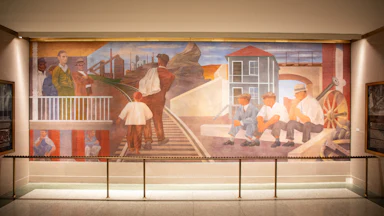
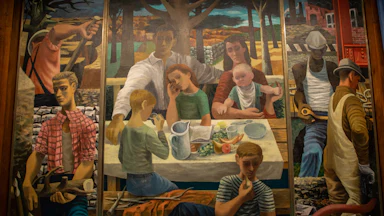
The spendthrift ways of President Donald Trump are not confined to asking Congress for more than $200 billion to keep fighting a war in Iran that he can’t figure out how to end, or to pondering Ted Cruz’s plan to reduce capital gains taxation by somewhere between $169 billion and $1 trillion. More quietly, the Trump administration has this week been conducting a fire sale of government buildings in Southwest Washington. These may soon include the Wilbur J. Cohen Federal Building, which Gray Brechin of the nonprofit Living New Deal aptly calls “the Sistine Chapel of the New Deal” because of its exquisite frescoes and murals by Ben Shahn, Philip Guston, Seymour Fogel, and Jenne and Ethel Magafan.
If the threat to the Cohen building strikes a familiar note, perhaps that’s because I’ve written about it previously (here, here, and here). Alternatively, you may have read about it in The New York Times or The Washington Post. (I’m not too fine a person to observe that only the Post credited The New Republic with breaking this story.) Or maybe you heard about it from the million-member lobby group Social Security Works, which has taken on this cause because the Cohen building was built in 1940 to house the (then-spanking-new) Social Security program. Earlier this month, Democratic Senators Sheldon Whitehouse of Rhode Island and Chuck Schumer of New York wrote the General Services Administration’s acting inspector general inquiring “how GSA plans to continue oversight” of the Cohen building murals “once ownership changes hands entirely to private interests.”
Meanwhile, after touring the Cohen building on Wednesday, Democratic Representative Lloyd Doggett of Texas said, “I really think we need to look at doing more to prevent it from being sold.”
The GSA, the executive branch agency in charge of most federal real estate, lists 47 government buildings around the country for “accelerated disposition.” The Trump White House has been especially keen to unload four of these, all located in Southwest Washington: the Cohen building, the GSA Regional Office Building, the Liberty Loan building, and the Robert C. Weaver Federal Building. On Wednesday, the GSA announced that it had sold the GSA Regional Office Building; in addition The Wall Street Journal and the Washington Business Journal reported that the Liberty Loan building was under contract to be sold.
We know the White House is eager to get rid of these four properties because in December Mydelle Wright, a well-regarded former preservationist for the GSA, stated in an unrelated court proceeding (document here) that the White House, “acting on its own and not through GSA,” solicited bids to demolish them. In response, the GSA issued a non-denial denial that you can read here. Bulldozing these four buildings would be illegal for multiple reasons, not least because the Cohen building and the Weaver building (the latter a Marcel Breuer–designed former headquarters for the Housing and Urban Development Department) are on the National Register of Historic Places, In addition, the Liberty Loan building has been designated eligible for the National Register, which also extends certain protections. Perhaps in deference to these obstacles, or maybe just because news of the planned demolition caused a ruckus in the preservation community, the Trump administration decided not to demolish but to sell.
In announcing sale of the GSA Regional Office Building, GSA administrator Edward C. Forst crowed it would save taxpayers “over $200 million in delinquent maintenance and $5.5 million in annual operating and maintenance costs.” Republican Senator Joni Ernst of Iowa said in a press release that the sale “will save taxpayers over $700 million.” But neither Forst nor Ernst mentioned how much John Q. Taxpayer got for this 940,000-square-foot structure sprawling over 3.4 acres adjacent to a subway stop. There was a reason for that omission.
The GSA Regional Office Building sold (to the residential developer Dalian Development) for $24.26 million. That works out to $26 per square foot, which, conservatively, represents less than one-tenth its market value. The low price reflects not only the federal government’s routinely poor management of asset disposition but also Southwest Washington’s vacancy rate, which, like that for all of Washington, is historically high. The Southwest D.C. vacancy rate stood at 16.5 percent during the last three months of 2025. Anything above 10 percent is bad.
Why would the government sell one federal building (much less four) into such a terrible real estate market? Didn’t I read somewhere that our president used to be in the real estate business? Alas, the MAGA faith preaches that government buildings (and indeed all government assets) are all cost and no value. That works out very nicely for the buyer and very poorly for the taxpayer. We don’t yet know the sale price on the Liberty Loan building, but I’m guessing it was similarly low.
How soon might the Cohen building get sold off? Its circumstances are different from the other three’s. The Cohen building sale was compelled by a January 2025 amendment that Ernst snuck in to a water resources bill for reasons that remain unclear. (Congress does not typically tell GSA which buildings to sell.) The amendment stipulated that the Cohen must be sold “not later than 2 years” after it’s vacated. The building is not yet vacant; some Voice of America and Health and Human Services employees remain.
On the other hand: Nothing in the amendment said the building can’t be sold before it’s vacated (though that, I’m told, would play havoc with normal GSA procedures). The main obstacle to quick action, a former GSA staffer told me, is that the Cohen probably hasn’t yet gone through the consultation process with preservationists required before any sale under Section 106 of the National Historic Preservation Act. “I can’t say 100 percent that they haven’t done 106,” this person said, “but I can say that if they did it” without including the Living New Deal, which GSA previously certified to participate, “it would be incredibly shady and unprecedented.”
I tagged along on Doggett’s tour of the Cohen building Wednesday. Also in attendance were Democratic Representative Paul Tonko of New York (“We’ve got to fight this battle hard,” he told me); Representative Teresa Leger Fernández of New Mexico (she said she’s been working on reauthorization of the National Historic Preservation Act); and assorted staffers for Democratic House and Senate members. David Olin was there too. He’s senior conservator at Olin Conservation Inc., where he’s been looking after the Cohen building murals for 30-odd years. Cohen told me last December that he was in discussions with GSA to perform a feasibility study about removing the Shahns and other artwork. That contract has not yet been signed, Olin told me Wednesday—another reason to doubt the GSA has made much progress yet on the Section 106 process. Still, Olin told the tour group, he knows enough to state that the Shahns are quite fragile and that removing them would require carving them up.
This was my third time visiting the murals in the Cohen building, and, I was pleased to learn, Doggett’s second; he knew about the Shahns well before I did. Doggett showed me language he’d drafted for the next GSA appropriation: “None of the funds provided by this Act shall be available for the sale, leasing, or destruction of the Wilbur J. Cohen Building without guaranteeing the preservation of all artwork contained in the structure of the building.” When I asked Doggett whether he’d consider submitting an amendment flat-out barring the Cohen building’s sale, he said yes. If Congress can tell GSA which buildings to sell, then surely it can tell GSA which buildings not to sell.
Doggett’s in the minority, of course, so his influence (also that of Whitehouse and Schumer on the Senate side) is limited. But Doggett said he was seeking out Republican support. Given that “conservatism” means “to conserve,” I’d hope there’d be some interest. Alternatively, if conservatism is about protecting taxpayers from getting ripped off, there ought to be five or six Republicans who’d oppose selling a 1,045,197-square-foot, Mall-facing building situated two blocks west of the Capitol into the sort of depressed real estate market where government buildings fetch less than one-tenth their actual value. Plus this one has the best New Deal art in Washington, D.C.
![WPA mural, Cohen Building, Washington, D.C.]](https://images.newrepublic.com/f33fa4193119e4085777772c677ba0dd04a6e53b.jpeg?auto=format&fit=crop&crop=faces&q=65&w=384&ar=16%3A9&ixlib=react-9.11.0)
![WPA mural, Cohen Building, Washington, D.C.]](https://images.newrepublic.com/f33fa4193119e4085777772c677ba0dd04a6e53b.jpeg?auto=format&fit=crop&crop=faces&q=65&w=320&ar=16%3A9&ixlib=react-9.11.0)