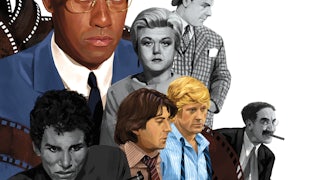
It’s hard to keep loving the movies when we realize how much damage they’ve done. In A Sudden Flicker of Light: A Revisionist History of Movies, longtime critic David Thomson takes a far warier approach than previously to a medium he has adored in print and in private for seven decades now. According to this century-spanning “revisionist history,” film isn’t (as many of us fool ourselves into believing) a gloaming, magical realm of bigger-than-life people, landscapes, and emotions; rather it has, like an excellent cinematographer or cosmetician, feathered over and even romanticized the worst neuroses and most unsavory desires of human life. In other words, by teaching us how to see them, movies simultaneously taught us how to unsee our actual world, and the real, all-too-human lives we lead in it. They have, to paraphrase an earlier Thomson title, brought us the “gift of unreality,” and it may be time to find out if we can still get reality back.
Within the flickering light of cinemas, Thomson writes, “our grasp on life was stimulated but compromised by the invention of the lifelike.… For when we can now fabricate the imagery—we have bypassed light and nature.” The ultimate problem with movies, Thomson argues, is not simply that they divert us from the real world, but that they want to replace it entirely. In his previous books, such as The Big Screen: the Story of the Movies and What They Did to Us, Thomson delivered a more optimistic history of film, as he did in his biographies of Orson Welles, Ingrid Bergman, and Gary Cooper. He assembled a dense nonchronological compendium of smart, absorbing assessments in Have You Seen...?: A Personal Introduction to 1,000 Films; he compiled the highly regarded Biographical Dictionary of Film (he is at his best when recounting the lifelong careers of individual actors and directors); and he achieved cultish success with one of the most unusual meta-novels of the last century, Suspects (1985), a “family romance” detailing the intertwining kinship networks of famous (and sometimes not-so-famous) film characters, from the goody-goody husband of Ilsa in Casablanca, Victor Laszlo (who not so many years after World War II betrays fellow travelers to the House Un-American Activities Committee), to Jack Torrance, the manic-obsessive writer in The Shining. Suspects (like all of Thomson’s books) bristles with countless macabre branches of a film family tree in which buffs might enthusiastically lose themselves.

If all these enjoyable books highlight one fact about Thomson, it’s that his fondness for movies isn’t simply about the stories they tell or the techniques they use to tell them—it’s about the fantasy world they create in our collective imagination. The basic problem for Thomson is that, amid current political horrors, this film world is starting to seem inimical: “Fantasy fills all the available space. And when fantasy overwhelms law and politics, it leaves only the bitter energy of disappointed dreaming. That is our violence. And all we have left?”
Exploring, if not answering, that hanging rhetorical question, is what drives this provocative book. Are movies, and the alternative worlds they offer, “all we have left?” Or, like Jim Carrey’s character in The Truman Show, can we eventually find a way out of them?
In many ways, the figure that haunts Thomson’s deepest concerns in this book is the current American president—along with that sense, shared by many of us, that a culture addicted to entertainment led us to put a reality-TV businessman in the White House. The book’s final sentence couldn’t make Thomson’s dissatisfaction clearer: “For a century the fallacy had reigned that watching [movies] would make us better. Instead of just indifferent.” This is where movies have taken us, Thomson concludes: the reckless elevation of a dangerous buffoon.
Thomson argues that movies were quick off the mark to lead people and civilizations into their flickering light of unreality—especially since filmmaking’s earliest pioneers included the likes of stage magician Georges Méliès (immortalized in film buff–emeritus Martin Scorsese’s 2011 Hugo), who was perhaps the first to discover that the new “reproductive” lens of the camera could be used to swallow up objective visual realities, digest them, and transform them into a duplicitous world of illusion. As Thomson writes:
He had long appreciated that photography was a tricked reality, a medium begging for subterfuge, “effects,” and bare-faced lies. But that potential was accelerated by what the Cinématographe offered. He saw that one image might be superimposed on another; he realized how scale could be played with; he saw that duration could be slowed or hurried; he understood that the fake and the actual could be married without us losing faith in the process. He even recognized that the Cinématographe need not be limited to running forward. Surely it was possible for the film to run through the apparatus backward. Whereupon the sheer daft beauty of life in reverse was revealed. That is still a treat that too few films have the wit to employ.
In Méliès’s many dozens of short films, which were played in music halls to enthusiastic crowds, ghosts appeared and vanished, living bodies were dismembered and put back together again (without any apparent pain to them at all), and in his most famous work, A Voyage to the Moon, a bullet-shaped rocket ship is fired into the whipped cream–like eye of the pie-faced man in the moon. When the ship’s astronauts go outside to explore the lunar surface, they are watched over by mystically appearing and disappearing stars, comets, and attractive young women in leotards and short pants posing as celestial demigoddesses. (There are even some pyrotechnic explosions here and there.) The key to Méliès’s stewardship of this new medium wasn’t simply his flair for illusion as entertainment; it was his conviction that even when audiences were fooled into believing they saw things they didn’t, they wouldn’t “lose faith” in what they saw. In other words, they didn’t mind being fooled. They actually liked it.
But Méliès was not the only notable pioneer who used film to make audiences believe in things that didn’t exist; even “realistic” directors developed their own techniques for misrepresenting reality, or perhaps simply skewing it to their purposes.
While most students and teachers of film history remember D.W. Griffith for directing what Thomson calls the “first fascist picture,” The Birth of a Nation (1915), Thomson attributes that film’s racism largely to its producer, a Baptist preacher and author of The Clansman (1905), the novel on which the film was based. More unforgivable, in Thomson’s eyes, was Griffith’s perfection of deceptive technical skills he had developed in earlier, shorter films. By intercutting between individual characters and expressions and things they saw, he established point of view on the audience’s behalf, teaching them to view the characters in blackface as savage evildoers possessed of wild desires to degrade nobly born white women. At the same time, his use of a dashing actor (the soon-to-be director Raoul Walsh) as John Wilkes Booth provided an early example of how the “medium flatters killers.” The extraordinary success of Birth (200 million people paid to see it worldwide in 1915 and 1916) led to financial consolidation of the first large studio under Louis B. Mayer, an original investor in Birth who came away with enough money to build an empire that was less concerned with the accurate representation of history, and more concerned with turning big profits. Among the “darker meanings” of Birth was that it signaled the “riotous birth of a business.”
The technical innovations of early filmmaking did more than simply tell dishonest stories about history; they convinced audiences to believe in those stories and to help in their manufacture. The early Russian filmmaker Lev Kuleshov (a major influence on Sergei Eisenstein) tested audiences with a series of cuts between the close-up on a famous actor, Ivan Mosjoukine, and shots of “a bowl of soup, a child in a coffin, and a charming woman on a sofa.” The effect was that the audience felt in each case the man was hungry, grieving, and attracted to the woman. The experiment showed how quickly the audience would bring their own sense of inner reality to movies; they didn’t simply believe what they were shown, they contributed their own meaningful connections between shots.
Films had an overpowering effect on the crowds who came to watch them. When sound came along—and with it, the sweeping grandeur of motion picture soundtracks—it made the cinematic world even bigger, richer, and more attractive. With so much power to entrance and misinform audiences, it’s no surprise that the major politicians who first recognized the medium’s usefulness were Hitler and Goebbels, not to mention their chief propagandist, Leni Riefenstahl.
For all its power to manufacture illusions, the film industry was largely marshaled into existence by the relatively poor and uneducated. Most of the major studio heads, such as Louis B. Mayer and Marcus Loew, were the children of Jewish immigrants; and almost all of them had failed at earlier entrepreneurial efforts before they landed, almost as a last resort, in the rapidly booming motion picture business. (As Thomson writes of Loew, who began by investing small amounts of money into any available movie venues he could find: “No one said he favored one film over others; he wanted whatever the crowd wanted.”) William Fox (formerly Fuchs) started off selling newspapers; and the Warners sold shoes and bicycles before selling romantic comedies and swashbucklers.
It was an industry driven by corporate profits over individual creative expression, and so it wasn’t surprising that the first widely proclaimed “genius” of the early studio system was a 20-year-old, chronically ill man named Irving Thalberg, promoted by Carl Laemmle at Universal in 1919, who went to Hollywood to design studios to produce movies the same way Ford’s factories produced cars: large studio sets and sound stages were built for filming the scenes of many different movies, often simultaneously; musicians, writers, and actors were hired on contract to be moved from one set to another like stage furniture; and in a very short time, Thalberg became the first studio head to fire a hot-headed, brilliantly original director by the name of Erich Stroheim (the son of a Jewish hatmaker), and relegate his way-over-budget film, Greed, to the studio cutting room. This event served almost as a template for future “negotiations” between film’s money providers and its greatest creative forces. Many believed (like Groucho Marx) that Thalberg saved the film industry from itself (though sadly, the Marx Brothers never made movies as brilliantly hilarious as Monkey Business (1931) and Duck Soup (1933) after their characters and storylines had been routinized by Thalberg.) Others, like Welles, called him “the biggest villain in the history of Hollywood.”
Over the next several decades, the greatest commercial directors would produce their best (and most influential) work largely outside the studio system, but it wouldn’t be easy. Robert Aldrich, Robert Altman, and Francis Ford Coppola would set up their own studios, only to go bust producing movies that didn’t make enough money. Maverick directors such as John Ford and Howard Hawks managed to keep creatively working only by moving between studios, seeking the right place to make the right movie at the right time. (In his Biographical Dictionary, Thomson claimed that his 10 favorite “desert island” films would all be by Howard Hawks, the master of those Hollywood genres—gangster melodramas, screwball comedies, and Westerns—that weren’t taken seriously until the Cahiers du Cinema crowd rediscovered them in the 1960s.)
Far more common were those directors, from Mervyn LeRoy to Michael Curtiz, however talented, who did what they were told, stapling together preapproved scripts, actors, and sets. When a studio-bound director did achieve “auteur status,” like Frank Capra at Columbia under Harry Cohn, it was due to his gift for making people believe in an America that didn’t exist, a place where homespun philosophers like Mr. Smith (in Mr. Smith Goes to Washington (1939)) could pass legislation by acting “folksy” during an endless congressional filibuster. Or then there’s Capra’s other hometown hero, George Bailey (Jimmy Stewart again), who could count on his modest neighbors to help him oppose the evil, crippled-by-ugliness big American banks in It’s a Wonderful Life (1946). Life was the sort of “plea to the common people,” Thomson writes, that made believable “the airy hope that public conscience and common sense can beat off the threat of corruption and greed.” And of course it doesn’t take more than a couple quick glances around ourselves to realize that, for many decades at least, our “public conscience” has been outmatched by greed maybe 10-to-one.
Thomson finds it difficult to accept how the “screens” of romance and melodrama have seduced us into endlessly feeding off the adventures of people who don’t exist—from Sam Spade and Scarlett O’Hara to Ratso Rizzo and Luke Skywalker. And yet even after they have grown so small they can fit into the palms of our hands, the screens of illusion and delusion have conquered our world, along with our collective ability to make human sense of it. Which is perhaps why so many of our favorite, most unforgettable movies are about voyeurs who are as devoted to the act of observation as we are—such as Jimmy Stewart in Hitchcock’s Rear Window, or Carl Boehm in Michael Powell’s Peeping Tom, or even David Hemmings in Antonioni’s Blow-Up (1966). The voyeur may be the most pertinent image of contemporary human consciousness, at a time when people believe less in what they have experienced firsthand than in what they observe—much like Ronald Reagan, our first (and certainly not last) movie-star president, who “would literally believe he had been at events in World War II because he had done the narration for brisk documentaries about them.”
The screens that surround us are more than mere entertainments; they drain us of attention for anything but them. Flat or curved, pixelated or Technicolor, handheld or wall-mounted, they are almost everywhere, and wherever we don’t find them, we devise ways to bring them with us—into the streets, our jobs, and even the bathroom. We no longer take them into our homes; rather, the screens are now taking us home with them, where presumably every bit of information we possess will be incorporated into artificial intelligence–driven systems of knowledge, perception, and infinitely streamable nonsensical stories.
It’s hard to believe there is a film buff worth his or her popcorn who hasn’t already enjoyed Thomson’s work, and this latest volume confirms all of his familiar, well-practiced skills. He is incapable of writing an uninteresting sentence or an inelegant paragraph and he sparks off lovely epigrammatic ideas on almost every page. At one point he writes: “And so we let the lifelike distract us from life. That is how we became fantasists, all set in our solitary ways.” At another, he describes the movie Psycho as “a rat that got into my house in 1960 and that I have never managed to exterminate or train.”
His enthusiasm for great (and even not so great) movies is contagious; in fact, it’s not possible to read this new volume without cranking up the old DVD player several times to rewatch movies—such as Sturges’s The Lady Eve, or Tourneur’s Out of the Past, or Truffaut’s The 400 Blows, or the first two Godfather movies—along with his remarks about them. In fact, the only weakness about this “revisionist history” is that while Thomson expresses clear and convincing opinions about the dark roads down which movies have led us over the last century and a quarter, he continually gets distracted by his career-long love of the medium, and gets his readers lost along with him.
“For several decades,” Thomson writes, “people went to the movies without knowing what the picture was. The way now we can’t face the day without scanning our phone.” It’s a pretty distressing idea, and probably accurate. Just as the early twentieth century’s moviegoers would “submit to,” more than “choose,” their trips to the movie theater, we have now, each in our miniature psycho-theater, learned to submit to whatever arrives on the screens of our phones and laptops. We have become a nation of watchers who don’t care what it is we watch so long as we are watching. It’s a vision of doom that isn’t best represented by a mushroom cloud but by the pale, complacent, well-fed face of Chauncey Gardiner in Being There. “I like to watch,” Chauncey reiterates, again and again. As if there could be anything else left to say.