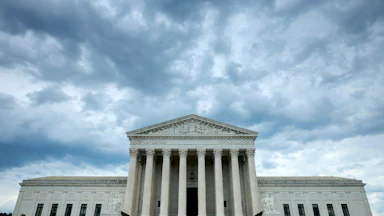
The Second Amendment protects the right to “keep and bear arms.” But what counts as “arms”? The Supreme Court will answer that question this term when it hears a challenge to state assault-weapons bans.
Gun rights groups have spent almost two decades trying to get the Supreme Court to hear a case like Viramontes v. Cook County, which centers on assault-weapon bans in Illinois’s largest county and Connecticut. The justices consolidated Viramontes with a near-identical case from the latter state. For convenience’s sake, I’ll use the term “assault weapons” throughout this article to describe a wide range of banned rifles. Please do not email me about the terminology debates.
The underlying dispute is fairly simple: The plaintiffs want to own rifles banned by the state laws in question, but cannot lawfully do so. They argue that this restriction violates their Second Amendment right to bear arms. “Under this Court’s precedents, there can be no doubt that AR-15 platform and similar semiautomatic rifles are in common use and therefore protected by the Second Amendment,” they told the justices in a brief filed last month.
Connecticut and Cook County, on the other hand, claim that the bans fall well within their power to “strictly regulate” certain types of weapons, especially those that are the “weapon of choice for criminals and terrorists.” The Cook County district attorney’s office told the justices in a court filing earlier this year that this regulatory power extends to weapons that are “fundamentally incompatible with ancient common-law principles of moderate, proportionate self-defense” and are “not commonly borne in public for a lawful purpose.”
In a way, both sides are right. The Supreme Court has said that guns are presumptively considered “arms” for Second Amendment purposes. It has also held that certain types of “arms” can be regulated and even banned by state, local, and federal laws. Whether the AR-15 and other assault weapons fall into the latter category is what the justices must decide.
The basic dispute traces back to the foundation of modern Second Amendment jurisprudence. In the 2008 case D.C. v. Heller, the Supreme Court recognized an individual right to bear arms in the Second Amendment for the first time. That case involved a D.C. man who wanted to own a handgun for self-defense in his home.
The court also recognized that this right was “not unlimited,” as Justice Antonin Scalia put it in his majority opinion. Scalia described a range of existing gun restrictions that would be presumptively constitutional in the post-Heller world. Lower courts have often relied on this portion of Heller to uphold limits on where people can bring guns and who can lawfully own them. One of those Scalian restrictions was for unusual weapons.
“We also recognize another important limitation on the right to keep and carry arms,” he wrote for the court. “[United States v.] Miller said, as we have explained, that the sorts of weapons protected were those ‘in common use at the time.’ We think that limitation is fairly supported by the historical tradition of prohibiting the carrying of ‘dangerous and unusual weapons.’” Scalia indicated that this applied to “weapons that are most useful in military service—M-16 rifles and the like.”
Miller was a 1939 Supreme Court case involving the National Firearms Act, which (among other things) banned the transportation of certain weapons across state lines. The defendants had been charged with transporting sawed-off shotguns, which were widely associated with criminality at the time. They argued the ban violated their Second Amendment rights. The Supreme Court disagreed, concluding instead that the amendment only protects guns with a “reasonable relationship to the preservation or efficiency of a well regulated militia.”
On those grounds, lower courts have generally upheld assault-weapon bans for the last two decades. Eleven states currently have some kind of assault-weapon ban on the books. So does the District of Columbia, which I’ll come back to later. Congress enacted a federal ban on assault weapons in 1994, but it lapsed without reauthorization in 2004.
Those laws have existed alongside a major shift in the Second Amendment over the last two decades, and especially in the last few years. In 2023, the Supreme Court laid out a new two-step test for Second Amendment cases that first asked whether the challenged law was covered by the “plain text” of the Second Amendment, then looked at historical analogues if it was.
In these cases, the lower courts still concluded that assault weapons were not “arms” for Second Amendment purposes. The Seventh Circuit Court of Appeals had previously cited Scalia’s reasoning in Heller and applied it again to the Viramontes lawsuit. It and other lower courts have concluded that assault weapons are similar enough to “M-16s and the like” to qualify as “dangerous and unusual.”
Gun-rights advocates, however, hope to constitutionalize AR-15s by emphasizing their popularity. “The controlling question here is whether a given type of arm is ‘in common use today,’” the plaintiffs wrote, quoting from Bruen. (Emphasis theirs.) “The inquiry therefore is one that accounts for the American people’s judgment regarding what sorts of arms are appropriate for typical, lawful possession according to contemporary social and technological conditions.”
What counts as “typical”? What are “contemporary social and technological conditions”? How do the American people exercise their “judgment”? The plaintiffs fall back on opinion surveys and market data. The AR-15, they note, “is the most popular rifle in America.” Exact ownership numbers are difficult to determine, so researchers and pollsters typically extrapolate figures by polling gun owners. A major survey earlier this month, for example, estimated that around 30 percent of gun owners own an AR-15 or similar rifle. That would equal about 26.4 million owners in a country of 340 million people, the survey estimated.
Read another way, assault weapons do seem fairly unusual. Fewer than one-third of gun owners own one. They are not the principal weapon for personal self-defense outside the home and they are of dubious utility inside the home, as well. (A handgun is much easier to store and wield against a home intruder, for example.) It is telling that a different poll cited by the plaintiffs noted that 74 percent of assault weapon owners purchased one “in case law and order break down,” which is far afield from common or everyday use.
To privilege raw ownership numbers and polling surveys when determining whether a type of gun is in “common use” is also incongruous with how the conservative justices have approached other constitutional rights. A core principle of the court’s Eighth Amendment jurisprudence since the 1958 ruling Trop v. Dulles is that the definition of “cruel and unusual punishment” is not fixed, but rather shaped by “evolving standards of decency that mark the progress of a maturing society.”
Legal conservatives often loathe this principle and have occasionally called for it to be overturned in favor of a fixed meaning set in 1789. Trop, Scalia once fumed in a 2015 concurring opinion, “has caused more mischief to our jurisprudence, to our federal system, and to our society than any other that comes to mind.” (A slight exaggeration.) Conservative justices have also criticized the use of opinion surveys to gauge “evolving standards” on Eighth Amendment issues, with then–Chief Justice William Rehnquist arguing that the acts of state legislatures are the best indicators of public consensus.
Perhaps the most striking argument comes from a brief filed by the National Association for Gun Rights. The brief, written by former Virginia Attorney General Ken Cuccinelli, argued that the Second Amendment’s purpose is “deterring tyranny.” This is a common argument among gun rights advocates but one that rarely makes its way into legal reasoning. The Supreme Court has only obliquely addressed that concept in bare passing, when it referred in Heller to the early modern English concept of the right to bear arms as “an individual right protecting against both public and private violence.”
“The objection that tyranny is a Founding-era abstraction fails on this Court’s own account of the Fourteenth Amendment,” Cuccinelli wrote. “American tyranny has typically been local and racial and the disarmed were its victims. McDonald recounts the Black Codes’ arms confiscations, the militia disarmaments, and Congress’s response in the Freedmen’s Bureau Act, which expressly secured ‘the constitutional right to bear arms.’”
Cuccinelli also noted that a “perennial objection” to this principle is that “modern military technology has rendered the citizen militia obsolete, and the constitutional check on tyranny with it.” He argued instead that it served as a deterrent. “A deterrent need to be used is not obsolete,” Cuccinelli wrote. “It is working—unless the government may first ban the arms that make it credible.” It is worth noting here that the AR-15 and similar rifles have only existed since 1959.
I have written before on this pop constitutional concept, which is essentially a purported Second Amendment right to murder civil servants and assassinate elected officials. Other briefs make no mention of this tyranny-deterrence principle because of its obvious flaws. For one thing, tyranny is entirely subjective: More than a few Americans thought the public health measures enacted to fight the Covid-19 pandemic were tyrannical, for example. It is awkward to articulate to Supreme Court justices, who have faced an extraordinary uptick in violent threats and at least one incident where someone drove up to a justice’s house with a handgun after plotting to assassinate them.
This principle also runs counter to other Second Amendment precedents that emphasize how the right to bear arms only extends to lawful purposes. The lawful-purposes framing can itself be slippery—a constitutional right conditioned on statutory lawfulness is a half-right at best—but is even trickier if imposed as a defense against tyranny. Armed resistance to government authority may be morally justified in some circumstances, but it is always unlawful by definition. Had the British captured the Founders, they would have almost certainly been hanged.
There is also a strong counterexample to Cuccinelli’s historical narrative: the January 6, 2021, attack on the Capitol. A mob of the president’s supporters attacked Capitol Hill five years ago hoping to stop the counting of electoral votes that would confirm President Joe Biden’s victory. They succeeded, but only temporarily.
Investigators later discovered that members of the Oath Keepers had stashed a cache of weapons, including AR-15s, in nearby Virginia. The far-right group’s leaders had decided against bringing them into the District of Columbia because of the capital’s strict gun laws. Oath Keepers founder Stewart Rhodes later said that they “should have brought rifles” after the insurrection failed. Had he and the president succeeded in crippling Congress and disrupting the electoral transition of power, many would have called what remained tyranny.
I doubt the Supreme Court will address this tyranny-deterrence concept directly in this case. But it is nonetheless worth noting because it is so common outside the marble hallways of the Supreme Court. Many people use rifles for hunting or sport and keep handguns around for self-defense. The AR-15’s legitimate purposes, on the other hand, are much narrower unless one anticipates—and perhaps even desires—some kind of societal collapse.
“Under Heller, the decision whether a type of arm is too dangerous for ordinary Americans to possess is one that the people are entitled to make, not one that courts are empowered to make for them,” the plaintiffs wrote. “That is the fundamental principle animating the common use test.” That much is true. The American people have already made that decision in 11 states—through their elected representatives, not by responding to surveys or by boosting a gun manufacturer’s profit margins.