Breaking News
Breaking News
from Washington and beyond

New House Speaker Conveniently Can’t Remember His Past Homophobia

Mike Johnson has an extensive record attacking LGBTQ rights—and suddenly, he doesn’t want to talk about it.

Mike Johnson
Drew Angerer/Getty Images

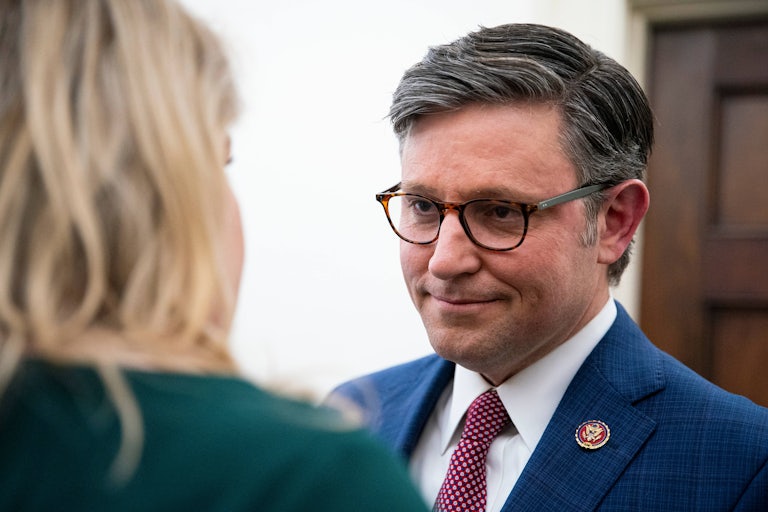
Newly elected House Speaker Mike Johnson is trying to distance himself from his deeply homophobic track record by claiming he can’t remember much of it.

During an interview on Fox News, Johnson was asked about comments he made while he was an attorney for the far-right Christian advocacy group Alliance Defending Freedom. During his tenure as senior attorney and spokesperson for ADF, he called homosexuality “sinful” and “destructive,” advocated against same-sex marriage, and pushed for the criminalization of gay sex.

Hearing his own comments repeated back to him by Fox’s Sean Hannity, Johnson said simply, “I don’t even remember some of them.”

Quickly moving on from the “I forgot” defense, Johnson argued that making homophobic statements was just a part of his job in defending the state marriage amendments, which defined marriage as between a man and a woman.

“I was a religious liberty defense lawyer, and I was called to go in and defend those cases in the court,” he said.

“I am a rule-of-law guy,” Johnson said. “When the Supreme Court issued the Obergefell opinion that became the law of the land, I respect the rule of law,” referring to the case that made same-sex marriage legal.

Despite his attempt to revise history, Johnson’s record speaks for itself. In September 2004, for example, the future House speaker wrote an op-ed for a local paper in Shreveport, Louisiana, in which he called homosexual relationships “unnatural,” “harmful,” and “dangerous.”

Johnson isn’t trying to be confusing. He admitted to Hannity that if people want to know what this “rule-of-law guy” believes, “go pick a Bible off your shelf and read it.”

Trump’s New York Fraud Trial Just Got a Very Fun New Witness

Ivanka Trump, welcome to the stand.

Ivanka Trump in the background looks at Donald Trump (blurred, foreground)
Mark Makela/Getty Images

Ivanka Trump may have a new job in her father’s real estate empire: help dissolve it.

On Friday, a federal court judge ruled that the Trump heiress cannot block the subpoena calling her to testify against her father and brothers, Eric Trump and Donald Trump Jr., in their $250 million New York fraud case.

“A trial is a search for the truth,” Manhattan Supreme Court Justice Arthur Engoron said before ruling against her.

Ivanka Trump has until November 1 to appeal the decision, after which she will be required to take the witness stand.

The businesswoman was originally expected to be named as a defendant in the fraud trial, though a New York appeals court struck down her inclusion, ruling that the claims against her were too old.

Judge Arthur Engoron issued a summary judgment in September that found New York Attorney General Letitia James had already proved Trump misvalued his properties and committed business fraud, soon after dissolving the business certificates of Trump’s companies. What remains to be seen in the trial is whether Trump violated other laws and, ultimately, what kind of financial penalty he might have to pay.

Mike Johnson: Guns Don’t Kill People, Hearts Kill People

The new House speaker had an unbelievable answer when asked about the mass shootings in Maine.

Mike Johnson
Al Drago/Bloomberg/Getty Images

While other GOP leadership stuck to their usual “thoughts and prayers” mantra for the victims of the Lewiston, Maine, shooting, the newly minted speaker of the House tried out a new gun control dismissal tactic.

In a one-on-one interview with Sean Hannity on Thursday, Speaker Mike Johnson made an old Republican line new again, claiming that it’s not guns that kill people—it’s their hearts.

“At the end of the day, the problem is the human heart. It’s not guns, it’s not the weapons,” Johnson said. “At the end of the day, we have to protect the right of the citizens to protect themselves, and that’s the Second Amendment. That’s why our party stands so strongly for that.”

“This is not the time to be talking about legislation. We’re in the middle of that crisis right now,” Johnson added.

It’s no surprise the Republicans’ House speaker is dismissing gun control and gun violence so quickly after a mass shooting.

And for what it’s worth, his push to allow citizens to protect themselves in mass casualty events isn’t backed by the data. Between 2000 and 2021, fewer than 3 percent of 433 active attacks in the U.S. ended with a civilian firing back, according to data collected by the Advanced Law Enforcement Rapid Response Training Center at Texas State University, which described active attacks as shootings of one or more people in which law enforcement are called to the scene while violence is still ongoing.

Wednesday’s assault in Lewiston left 18 people dead, the largest death toll so far out of 565 mass shootings this year, according to the Gun Violence Archive. Law enforcement agencies are still scouring the woods of southern Maine in a desperate search for the suspect, believed to be Robert Card, a certified firearms instructor who received extensive combat training from the Army Reserve Unit, reported CNN.

Footage Reveals How the Koch Network Plans to Gut Federal Agencies

New footage shows senior operatives from several Koch entities gleefully discussing their next targets.

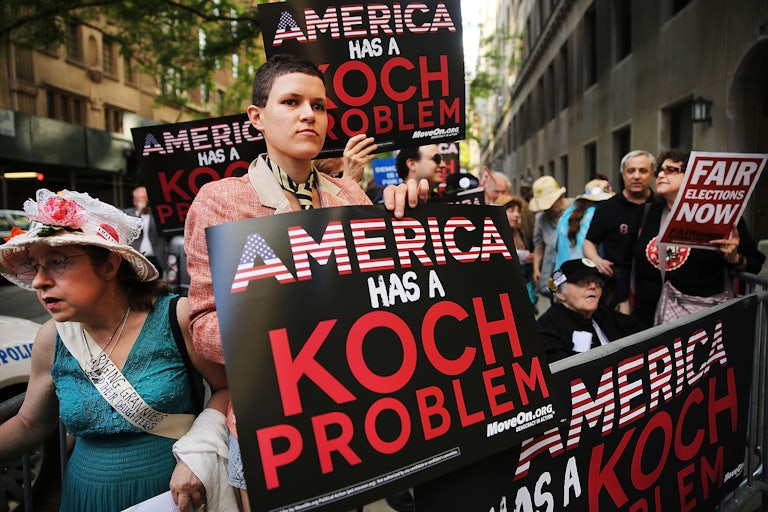
Protesters hold signs that read "America has a Koch problem"
Spencer Platt/Getty Images
Activists protest near the Manhattan apartment of billionaire and Republican financier David Koch on June 5, 2014.

Dead or alive, the Koch brothers continue to have an iron grip on American politics.

The Koch network, an arm of right-wing organizations cultivated by David and Charles Koch, have been working overtime to gut federal agencies that impact Koch Industries’ bottom line, driving a coordinated campaign to bring lawsuits targeted at deregulation to the conservative supermajority on the Supreme Court, according to an investigation by The Guardian.

In a 37-minute panel discussion obtained by Documented, senior employees at Koch-affiliated entities described the court’s new makeup as a “landscape opportunity” that they’re “doubling down on.”

“That’s why we are partnering with organizations that can get the right cases to the Supreme Court,” said Casey Mattox, a legal strategist at the Koch advocacy group Americans for Prosperity.

Some of the issues at stake are pollution, consumer protections from predatory lenders, and workers’ rights. Koch Industries, which makes most of its money in the energy, trade, and chemicals industries, is the second-largest privately owned firm in the United States, with annual revenues exceeding $125 billion.

The initiative appears to have already done the trick, with two cases attempting to curtail the government’s ability to regulate corporations already before the court in its 2023–24 term, thanks to the backing of Koch-linked groups, reported the outlet.

Read more at The Guardian.

Federal Court Deals Blow to Georgia Republicans’ Racist Congressional Map

Georgia Republicans have just suffered a major setback.

Cheney Orr/Bloomberg/Getty Images

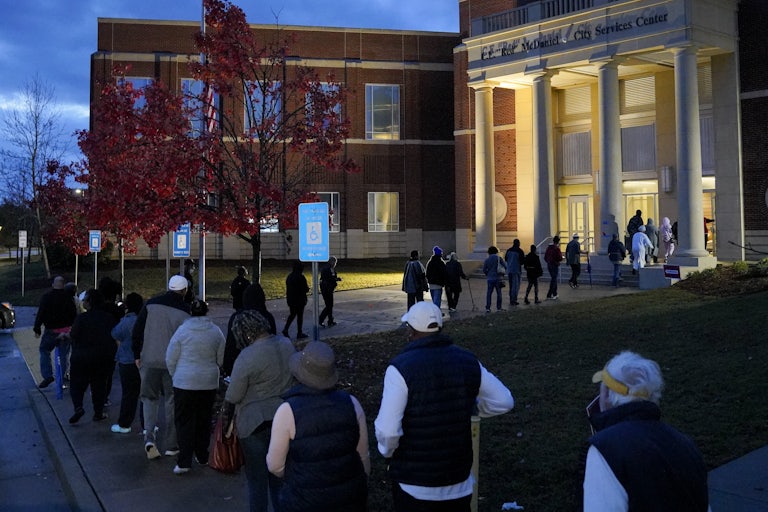
Georgia’s legislature will literally have to return to the drawing board after a federal court ruled that the state’s discriminatory congressional maps broke the law.

The new maps, which must be redrawn before the 2024 election, will be required to include one Black-majority federal congressional district, as well as two new Black-majority districts in Georgia’s state Senate and five new Black-majority districts in its House.

Thursday’s ruling consolidates three cases brought against Georgia Secretary of State Brad Raffensperger, which argued that Georgia’s political leaders were not adequately representing the Black communities that fueled the state’s population growth over the last decade.

In a 516-page order, U.S. District Court Judge Steve Jones ruled against Raffensperger, deciding that the GOP-drawn maps violated the Voting Rights Act of 1965.

Jones noted that although Georgia has made “great strides” in increasing the political opportunities of Black voters since the law was enacted, “the Court determines that in certain areas of the State, the political process is not equally open to Black voters.”

“For example, in the past decade, all of Georgia’s population growth was attributable to the minority population, however, the number of majority-Black congressional and legislative districts remained the same,” Jones wrote.

The state is expected to appeal the decision, though that effort may fall flat for Republicans. Similar attempts to save GOP-gerrymandered maps have failed in Florida and Alabama.

Other legal challenges to congressional maps are underway across the country, including in Arkansas, Kentucky, Louisiana, New Mexico, South Carolina, Tennessee, Texas, and Utah, reported the Associated Press.