Breaking News
Breaking News
from Washington and beyond

Witness: We Were Begging Trump’s Entire Family in Classified Docs Case

Newly unsealed documents show how Trump’s whole family got dragged into his alleged mishandling of classified documents.

Boxes of classified documents are stacked in a bathroom at Mar-a-Lago
U.S. Department of Justice/Getty Images

A newly unsealed FBI interview with an unidentified Trumpworld character unearths some eyebrow-raising details regarding Donald Trump’s classified documents case—namely, that family members were told to beg him to return the sensitive material back to the federal government.

In late October/early November of 2021, the unidentified individual pleaded with the former president, telling him that “whatever you have, give it all back,” according to the FBI memo, made public Monday.

But attempting to reason with Trump directly didn’t work. Instead, Trump “wanted to know how anyone knew of the issue.” When he was informed it was all documented in writing, he replied “we’ll check and think about it.”

So, in lieu of that, the unidentified individual claimed they tapped several people around the president in a coordinated effort to get Trump to return the documents, believing that hearing a ubiquitous call to return the federal property would influence Trump to actually do so. That included reaching out to some of his children.

The message was, essentially, “there are issues with the boxes. They belong to the government, talk to your dad about giving them back, It’s not worth the aggravation,” according to the FBI memo.

While the names of the individuals interviewed or involved in the scheme were redacted prior to the interview’s release, other Trumpworld individuals have already speculated as to who could have been behind or involved in the scheme to return the trove of documents to the government. According to former Trump fixer Michael Cohen, that may have been Ivanka Trump and Jared Kushner.

Trump has since outright admitted to taking the sensitive records. In a prerecorded interview on Newsmax, Trump claimed point blank that he actually did take the classified documents, describing the process of shamelessly packing them away while leaving office.

“I took ’em very legally,” Trump said. “And I wasn’t hiding them.”
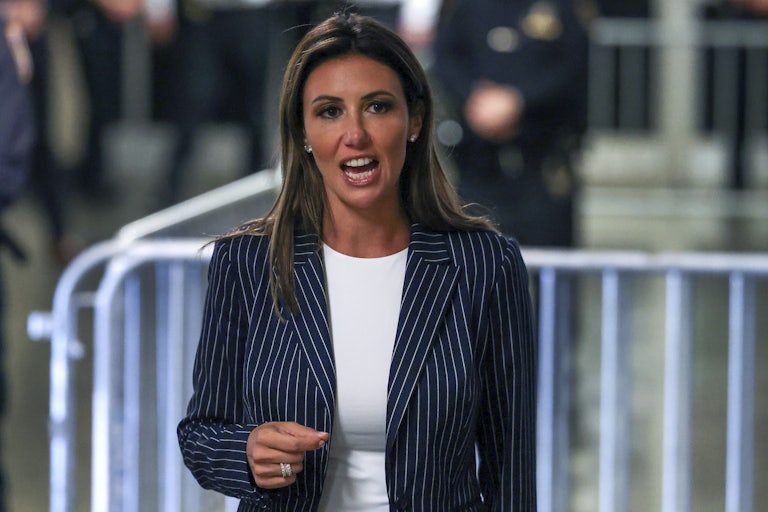
Alina Habba Shows Up at Trump’s Trial and Suddenly Makes Things Worse

Habba decided she would help her boss by appearing to admit he was guilty.

Alina Habba speaks
Yuki Iwamura/Pool/Getty Images

Donald Trump’s attorney Alina Habba should be more careful speaking.

Habba, who is not representing Trump in his hush-money trial, still showed up at the Manhattan courthouse on Monday to offer her opinion. “We’re here because of something that happened when he was in the White House that wasn’t even wrong,” she told reporters.

“You hire lawyers to solve problems, lawyers solve those problems, you pay them. That’s it!” Habba said, in language reminiscent of Trump’s rally speeches.

Whether they solved problems or not, Trump’s payments in 2016 to his lawyer and fixer at the time, Michael Cohen, allegedly were made to ensure that adult film actress Stormy Daniels kept quiet about her affair with the then-presidential candidate. Trump now faces 34 felony charges for allegedly falsifying business records with the intent to further an underlying crime.

Habba’s vehement defense of Trump may impress him, but they don’t deny a crime, nor the facts of the case. In fact, it almost sounds like she’s admitting he paid Cohen to keep Daniels quiet.

Habba often goes to crazy lengths to defend the former president, whether it’s claiming that he dozed off in court because “he reads a lot” or comparing him to Nelson Mandela. She even, in trying to defend Trump in a safe audience on Fox News, almost admitted that he could be bought by foreign countries to pay off his debts.

Habba’s words on Monday are not the first time she has seemingly displayed ignorance of the law, either. She has claimed the New York state law requirement that Trump attend every day of his trial is a violation of “due process,” and she was rebuked in court 12 times in one day in the E. Jean Carroll defamation case. She even had to abandon her attempt to have the Carroll case dismissed.

This Damning Trump Tape Will Be Used Against Him in Hush-Money Trial

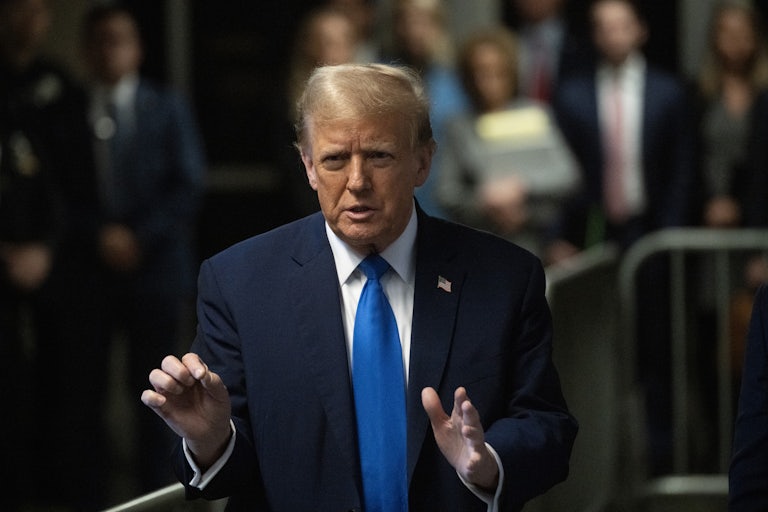
Prosecutors will play a recording of a phone call between Donald Trump and Michael Cohen.

Donald Trump gestures as he speaks
Victor J. Blue/Pool/Getty Images

Just before the 2016 election, Michael Cohen secretly taped a phone conversation with Donald Trump discussing how he would pay off former Playboy model Karen McDougal. Now, prosecutors for the Manhattan District Attorney’s Office say they intend to use the audio in court.

“You will get a chance to hear that recording during this trial,” said Manhattan district attorney prosecutor Matthew Colangelo on Monday, according to MSNBC’s Adam Klasfeld. “You’ll hear the defendant’s own voice, on tape, working out the intended agreement.”

Like adult film actress Stormy Daniels, McDougal was also victim to a catch-and-kill scheme by longtime Trump friend David Pecker, the former publisher of the National Enquirer and former CEO of its parent company, American Media Inc., to suppress stories of Trump’s extramarital affairs by purchasing the rights to the stories and then never allowing them to be published. On her end, McDougal was paid $150,000 by the publisher for her story.

“I need to open up a company,” Cohen can be heard saying on a copy of the two-minute tape, which was first released in 2018. “For the transfer of all of that info regarding our friend David. I’m going to do that right away.”

“Give it to me,” Trump responded. “We’ll pay with cash.”

Trump is accused of using Cohen to sweep an affair with Daniels under the rug ahead of the 2016 presidential election. The trial is expected to last several weeks. He faces 34 felony charges in this case for allegedly falsifying business records with the intent to further an underlying crime. Trump has pleaded not guilty on all counts.

Trump's past actions are coming back around:

Here’s What the Columbia University Protests Have Started Elsewhere

Columbia students’ protest in support of Palestine has sparked solidarity demonstrations across the country.

People protest in support of Palestine on Columbia University's campus
Charly Triballeau/AFP/Getty Images
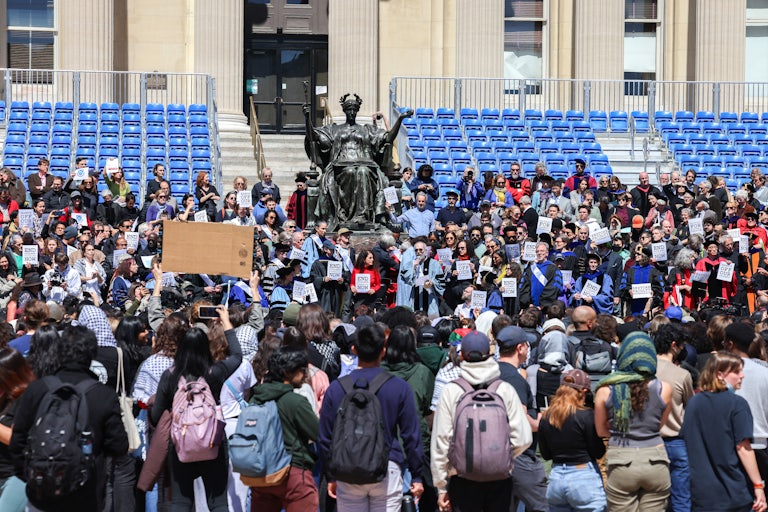
Students and faculty at Columbia University protest in support of Palestine on April 22, 2024

Columbia University tried to squash a pro-Palestine protest on their campus last week, but it hasn’t worked. In fact, it has prompted solidarity protests across the country.

On Monday, 47 demonstrators were arrested at Yale University after taking part in pro-Palestine protests urging the university to divest from weapons manufacturers. Protesters had also set up an encampment on campus Friday night.

Halfway across the country, student protesters at the University of Michigan set up an encampment on the university’s famous Diag, also demanding their school divest from businesses with financial ties to Israel.

Over the weekend, protests sprang up in Boston-area universities, including MIT, Tufts University and Emerson College, with students setting up encampments on each campus. Students at the New School in Manhattan set up a “liberated zone” on campus on Sunday to show solidarity with Columbia’s protesters, and New York University students staged a march.

These demonstrations came a few days after Harvard University students rallied in support of Columbia students, with the university’s famous Harvard Yard closed until Friday to seemingly prevent a student encampment there. Students at the University of North Carolina also set up tents on Friday in solidarity.

Columbia sent city police officers onto campus last week to break up the encampment, resulting in the arrest of more than 100 students. In an effort to keep a lid on things, the school canceled in-person classes on Monday. One Columbia professor, Shai Davidai, who has attracted criticism over alleged threats to pro-Palestine students and calls to bring in the National Guard to shut down the protests, was also told to stay away from campus Monday.

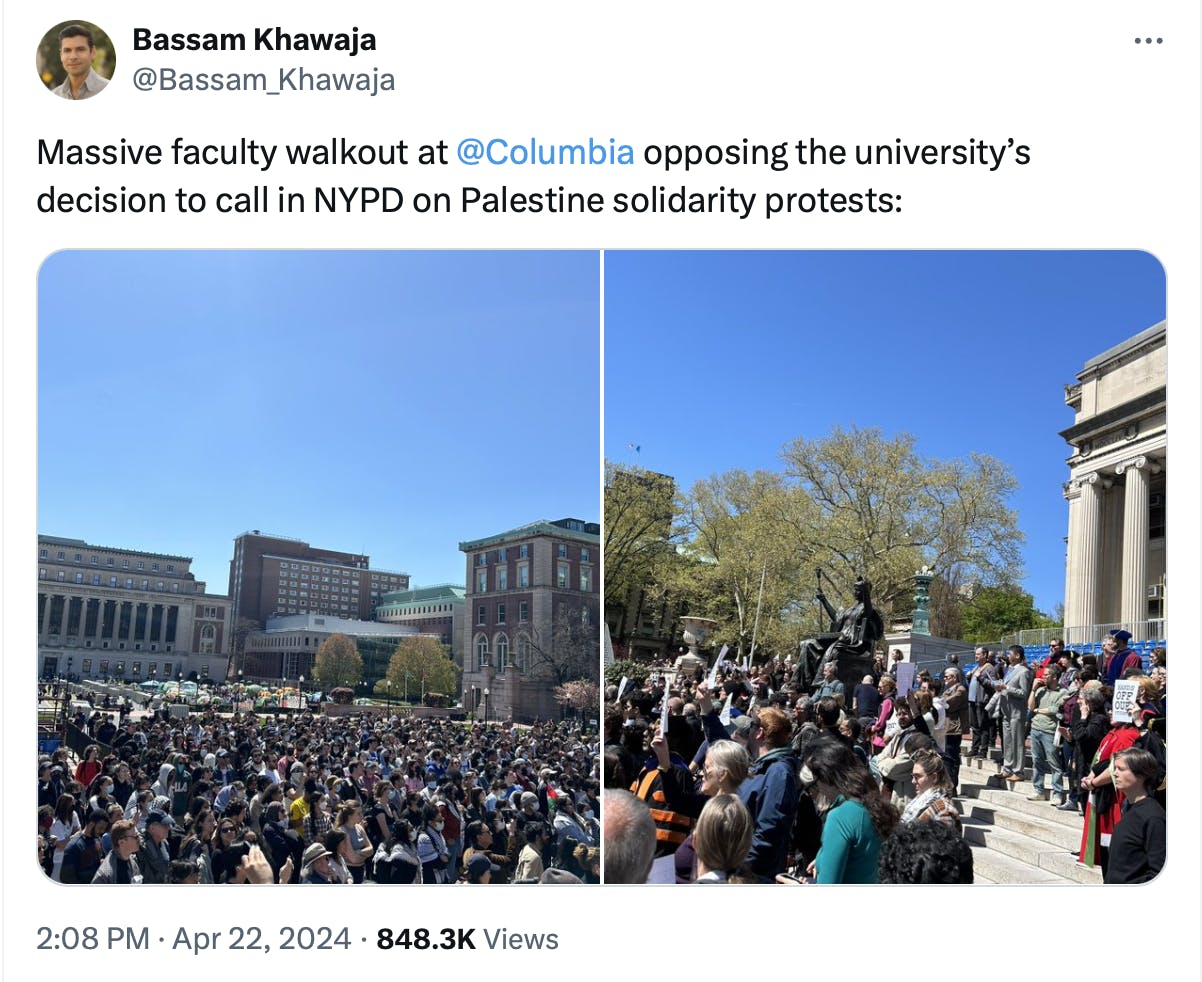
In response to the canceled classes, several Columbia faculty members led a class walkout. The day before, 54 Columbia law school professors sent an open letter to the university condemning the school’s decision to authorize a police raid and suspend student protesters.

Screenshot of a tweet
Screenshot

At Barnard College, which is affiliated with Columbia, three student admissions representatives, who work in the university admissions office, give tours, and speak with prospective students and families, resigned in protest Sunday over the university’s treatment of protestors.

It’s becoming increasingly clear that Columbia University’s attempt to shut down protests has only brought them more attention—and spread the movement to different universities. If police crackdowns continue, the pictures and heavy-handed actions could echo protests over the Vietnam War decades ago, including at Columbia.

Sotomayor Asks One Damning Question in Supreme Court Homelessness Case

The Supreme Court is considering how far cities can go in banning homeless people from sleeping outside—and Justice Sonia Sotomayor simplified the entire case to a brilliant hypothetical.

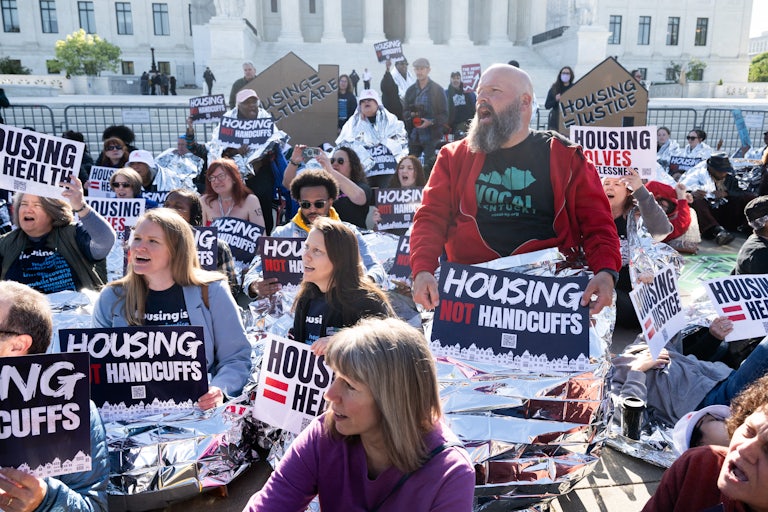
People protest outside the Supreme Cour twith signs that read "Housing not handcuffs"
SAUL LOEB/AFP/Getty Images

The Supreme Court on Monday heard arguments on perhaps the most consequential case on homeless policy in decades, weighing how far cities can go in criminalizing people for sleeping outside.

And liberal Justice Sonia Sotomayor kicked things off with a particularly damning hypothetical.

Under a law punishing people for sleeping outside, would people who stargaze outside not be punished? What about people who fall asleep on the beach? Or babies in public with blankets over them?

Sotomayor’s line of questioning in City of Grants Pass, Oregon v. Johnson highlighted the obvious flaws in the 2019 law that the court is considering. The town of Grants Pass, which has no public homeless shelters, effectively banned homelessness by imposing escalating fines starting at $180 on those who sleep outside. One of the original plaintiffs in the case against the city had over $5,000 in penalties before she died.

The Supreme Court’s decision in this case will determine whether localities can criminalize homelessness by punishing those who sleep out on streets using tents, blankets, or even a piece of cardboard. The court must weigh if doing so when no beds are available violates the Eighth Amendment and constitutes cruel and unusual punishment.

And like Sotomayor, the other liberal justices weren’t so impressed.

The Grants Pass legal team tried to argue that homelessness is “conduct,” something someone does, rather than “status,” something that someone is. But justice Elena Kagan pushed back saying matter of factly “homelessness is a status, it’s a status of not having a home.”

“Sleeping is a biological necessity,” she added. “It’s sort of like breathing, you could say breathing is conduct too but presumably you would not think it’s okay to criminalize breathing in public.” For a homeless person who has no place to sleep, Kagan continued, sleeping in public is the same as breathing in public.

“It seems both cruel and unusual to punish people for acts that constitute basic human needs,” Justice Ketanji Brown Jackson told lawyer Theane Evangelis, whose previous legal work for Uber and Grubhub has been described as “keeping the wheels of the gig economy turning.”

As the hearing continued, both Sotomayor and Jackson became increasingly incensed with Evangelis, who complained about the crime and unsanitary nature of unsheltered encampments, which she called harmful and dangerous.

“Suppose the city decided that it was going to execute homeless people... It would solve the problems that you are talking about,” Jackson quipped.

“Where do we put them if every city, every village, every town lacks compassion and passes a law identical to this, where are they supposed to sleep?” asked Sotomayor. “Are they supposed to kill themselves not sleeping?”

Evangelis continued that homelessness is a difficult and complicated problem.

But as Sotomayor responded: “What’s so complicated about letting someone somewhere sleep outside with a blanket if they have nowhere to sleep?”