Breaking News
Breaking News
from Washington and beyond

Supreme Court Shocks Everyone by Saving Abortion Pill—for Now

The conservative-majority court ruled against a challenge to mifepristone, one of the medications used to induce an abortion.

People hold up pro-abortion protest signs outside the Supreme Court
Anna Moneymaker/Getty Images

The Supreme Court decided Thursday that an anti-abortion group does not have legal standing to sue the Food and Drug Administration over mifepristone, guaranteeing national access to abortion medication under U.S. law.

A coalition of anti-abortion doctors and activists challenged access to mifepristone in November 2022, alleging that the FDA had overstepped its role by taking several steps that expanded access to the drug in 2016. The plaintiffs, represented by the right-wing Christian organization Alliance Defending Freedom, sought to overturn the FDA’s approval and have mifepristone pulled from the market.

In a unanimous opinion, the court ruled that the group had no standing to sue the federal agency and that it had failed to demonstrate how it was personally harmed by the drug’s existence on the market.

“Under Article III of the Constitution, a plaintiff’s desire to make a drug less available for others does not establish standing to sue. Nor do the plaintiffs’ other standing theories suffice. Therefore, the plaintiffs lack standing to challenge FDA’s actions,” Justice Brett Kavanaugh wrote, later specifying that “citizens and doctors do not have standing to sue simply because others are allowed to engage in certain activities—at least without the plaintiffs demonstrating how they would be injured by the government’s alleged under-regulation of others.”

Mifepristone and misoprostol comprise the two-step prescription referred to as “the abortion pill.” Together, they account for more than half of all the abortions in the United States, according to a 2022 report by the Guttmacher Institute.

The case, FDA v. Alliance for Hippocratic Medicine, was the biggest challenge to national reproductive access since the court’s conservative supermajority overturned Roe v. Wade in June 2022. The battle truly kicked off in April the following year, when a Trump-appointed judge in Texas halted access to the drug.

Four months later, the Fifth U.S. Circuit Court of Appeals sided with the plaintiffs, ruling that while the pill was safe for market, the FDA had improperly approved expanded access. Those steps included allowing women to access mifepristone 10 weeks into pregnancy instead of seven, lowering the standard dosage, and allowing the prescription to be accessed via telemedicine.

To be clear, the Supreme Court’s decision hinges on the legality of the case, not on whether people have a right to bodily autonomy. The high court ruled that the Fifth Circuit’s decision failed to find a basis in the U.S. Constitution.

“The plaintiffs have sincere legal, moral, ideological, and policy objections to elective abortion and to FDA’s relaxed regulation of mifepristone,” Kavanaugh wrote. “But under Article III of the Constitution, those kinds of objections alone do not establish a justiciable case or controversy in federal court. Here, the plaintiffs have failed to demonstrate that FDA’s relaxed regulatory requirements likely would cause them to suffer an injury in fact. For that reason, the federal courts are the wrong forum for addressing the plaintiffs’ concerns about FDA’s actions.”

Instead, Kavanaugh suggested that the plaintiffs take their issues to the president, setting up another fight to maintain abortion access should Donald Trump win in November.

By and large, most Americans support abortion access. In a 2023 Gallup poll, just 13 percent of surveyed Americans said that abortion should be illegal in all circumstances. Meanwhile, 34 percent said it should be legal under any circumstances, and an additional 13 percent said it should be legal in most circumstances.

This story has been updated.
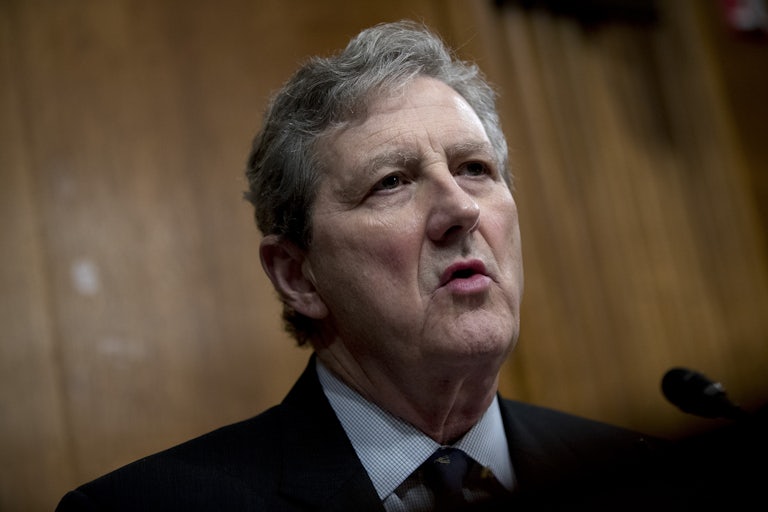
Watch: Witness Brilliantly Shuts Down GOP Senator’s Abortion Question

Jocelyn Frye of the National Partnership for Women & Families did not have time for Senator John Kennedy’s deceptive line of questioning.

Senator John Neely Kennedy speaking
Andrew Harrer/Bloomberg/Getty Images

“Well, Senator, first of all, don’t ask a question if you don’t want to know the answer.” Wise words were offered on Wednesday by Joceyln Frye, president of National Partnership for Women & Families, during testimony to a congressional subcommittee on the freedom to travel for abortion care.

The comments came as Frye was asked by Republican Senator John Neely Kennedy about a woman who allegedly asked for an abortion at 34 weeks.

“Should the mother at that juncture have the right—clearly a viable child—to abort the child?” Kennedy asked Frye, who quickly shut down the entire premise.

“One percent of abortions happen at 21 weeks or later,” says Frye. “So I think the premise of your question sets up a conversation about abortion that is unfair. It is rarely—is that ever the instance. Most, the vast majority of pregnancies and abortions that are considered late in a pregnancy have to do with severe, devastating medical circumstances.”

“And I understand your point. Senator, I understand your point. But with all due respect, I also think the chances of people sort of getting all the way through a pregnancy, and just sort of saying, ‘I don’t want it,’ it’s disrespectful to women.”

Kennedy is an anti-abortion conservative who proudly touts an “A” rating from the anti-abortion Susan B. Anthony List. Kennedy has often gotten shut down for asking questions detached from reality and espousing anti-abortion disinformation.

Last week, all but two Senate Republicans voted against protecting the right to contraception, as conservative lawmakers steadily chop away at access to abortion care and Trump continues to platform extreme anti-abortion stances.

More on the war on women and gender minorities:

Trump’s F-Bomb Rant to Mike Johnson Sparks Desperate GOP Moves

Trump begged the House speaker to save him after his hush-money conviction.

Mike Johnson stands behind Donald Trump as he speaks at a podium
Joe Raedle/Getty Images

After a jury found him guilty on 34 felony counts, Donald Trump knew exactly who to call for a solution: House Speaker Mike Johnson.

In a conversation reportedly laced with F-bombs, Trump urged the Louisiana Republican to find  a political solution for his legal comeuppance, Politico reported Thursday.

“We have to overturn this,” Trump told a sympathetic Johnson, according to Politico

Johnson already believed that the House had a role to play in overturning Trump’s conviction, but since that call, he’s practically done backflips to make it happen. During an interview on Fox and Friends last month, Johnson urged the Supreme Court to “step in” and overturn the jury’s verdict.

“I think that the justices on the court—I know many of them personally—I think they are deeply concerned about that, as we are. So I think they’ll set this straight,” Johnson said, before effectively promising to viewers that the nation’s highest court would step in to make the ruling go away. “This will be overturned, guys, there’s no question about it; it’s just going to take some time to do it.”

The House Speaker is looking to unravel Trump’s other criminal charges, as well. Johnson is reportedly examining using the appropriations process to target special counsel Jack Smith’s probe, and is already in talks with Judiciary Committee Chair Jim Jordan to do so. It’s a near reversal of a position he took early last month, when Johnson told Politico that a similar idea proposed by Georgia Representative Marjorie Taylor Greene would be “unworkable.”

“That country certainly sees what’s going on, and they don’t want Fani Willis and Alvin Bragg and these kinds of folks to be able to continue to use grant dollars for targeting people in a political lawfare type of way,” Jordan told the publication.

But other Republicans aren’t exactly on board with the idea of defunding the special counsel—even if they disagree with the case against Trump.

“I don’t think it’s a good idea unless you can show that [the prosecutors] acted in bad faith or fraud or something like that,” Idaho Representative Mike Simpson told Politico. “They’re just doing their job—even though I disagree with what they did.”

Another, unnamed Republican went even further in torching the effort, claiming that attacking Smith’s case would completely undermine their calls against Democrats for “weaponizing” the justice system to their political benefit.

Southern Baptists’ Vote on IVF Is Terrifying Sign of What’s to Come

The anti-IVF movement is not a fringe idea on the right anymore.

An embryologist at her IVF station
David L. Ryan/The Boston Globe/Getty Images

The Southern Baptist Convention voted Wednesday to oppose in vitro fertilization, signaling a dangerous shift in conservative stances on the procedure.

The move by the country’s largest and most powerful Protestant denomination, passed by 11,000 “messengers” at its annual convention, declared that IVF “most often participates in the destruction of embryonic human life” and calls on the denomination to “only utilize reproductive technologies” taking into account “the unconditional value and right to life of every human being.”

The resolution also included a clause decrying the creation of surplus embryos and their destruction in the course of treatment. Instead, it called for the adoption of “frozen embryos in order to rescue those who are eventually to be destroyed.”

The vote is an indication of how accepted it has become on the right to pursue restrictions and outright bans on IVF. Millions of Americans who have trouble conceiving children rely on the procedure each year, including many conservatives, and polls show it to be supported by most Americans overall. But most evangelicals and anti-abortion activists, if not all, believe that life begins at conception, and IVF often results in fertilized eggs being discarded.

In February, the Alabama Supreme Court issued a shocking decision that ruled frozen embryos were people under state law, effectively making IVF procedures tantamount to murder in the state. Alabama Republicans as well as Republicans across the country then scrambled to reassure the public that the procedure would not be banned or restricted. Ever since then, Democrats have sought to legally protect IVF, while Republicans have waffled, including Donald Trump.

As it happens, Democrats in Congress are seeking to hold a vote on such legislation, hoping to deal a political blow to the GOP and divide the party even further as some Republicans pursue piecemeal efforts of their own. It seems the issue of IVF may soon join the polarized issue of abortion rights, with Democrats and Republicans taking a side and fighting it out over elections and in the courts.

Only One Republican Voted Against Holding Merrick Garland in Contempt

Here’s the only Republican brave enough to call out the rest of this party on the political ploy.

U.S. Attorney General Merrick Garland speaking
Chip Somodevilla/Getty Images

The House voted on Wednesday to hold U.S. Attorney General Merrick Garland in contempt of Congress in a 216-207 vote on party lines. Only one Republican was brave enough to vote against the conservative-fueled order of contempt: Representative Dave Joyce.

“As a former prosecutor, I cannot in good conscience support a resolution that would further politicize our judicial system to score political points,” a statement from the Ohio representative reads. “The American people expect Congress to work for them, solve policy problems, and prioritize good governance. Enough is enough.”

The contempt vote was held after Garland refused to hand over audio of a privileged interview between Biden and special counsel Robert Hur regarding a classified documents case against Biden. Republicans have pursued audio of the interview unsuccessfully as part of their ongoing efforts to catch Biden in a snare.

Biden asserted executive privilege over the recordings, a move which reportedly came at the request of Garland himself. The Justice Department had earlier expressed concerns that releasing the audio would provoke a “frenzy” of deepfakes, or audio recordings falsely attributed to Biden’s interview with Hur used to disseminate false information.

Congress already has transcripts of the audio in question—making this just the latest example of Republicans’ attempt to drum up attacks on Garland and the Biden administration more broadly. Only one GOP representative spotted the obvious political ploy.