Breaking News
Breaking News
from Washington and beyond

Oklahoma Court Shuts Down Tulsa Race Massacre Lawsuit on Reparations

Oklahoma Supreme Court has ruled that the deadly white supremacist riot was not a “public muisance.”

Tulsa race massacre survivors Viola Fletcher and Hughes Van Ellis sit in a crowd with other Black people
MANDEL NGAN/AFP/Getty Images
Tulsa race massacre survivors Viola Fletcher and Hughes Van Ellis, June 2021

The Oklahoma Supreme Court on Wednesday dismissed a case seeking reparations for the Tulsa Race Massacre, the last remaining option for survivors and their family to secure recompense for the deadly attack that continues to haunt the Greenwood community of Tulsa. The court ruled that the last two survivors of the deadly massacre failed to prove that the city of Tulsa—both during and after the white supremacist riot in 1921 in which a racist mob destroyed their neighborhood and murdered more than 100 Black people—violated Oklahoma’s “public nuisance” laws.

In their original filing, survivors Hughes Van Ellis, Viola Fletcher, and Lessie Benningfield claimed the city of Tulsa’s response to the Tulsa Race Massacre caused them to “continue to face racially disparate treatment and City-created barriers to basic human needs, including jobs, financial security, education, housing, justice, and health.” The survivors’ complaint also condemned the city for using the Tulsa Race Massacre, specifically the phrase “Black Wall Street,” to entice tourism to the area. Profits from massacre-related tourism, survivors allege, was not passed on to the community of Greenwood, instead using branding and recognition of the Tulsa Race Massacre to fill the city of Tulsa’s coffers. (Since the original filing, Ellis died at the age of 102.)

Oklahoma law defines a nuisance as “unlawfully doing an act, or omitting to perform a duty, which…annoys, injures, or endangers the comfort, repose, health, or safety of others.” The law also defines a nuisance as an act that “offends decency” or “renders other persons insecure in life or in the use of their property.” According to Oklahoma law, a public nuisance is all of that, but simultaneously impacts an entire community or “any considerable number of persons.”

According to the dismissal issued by Oklahoma Supreme Court judge Caroline Wall, the survivors of the Tulsa Race Massacre failed to “state a justiciable public nuisance claim under Oklahoma law.” The court also argued that the survivors didn’t have standing for their complaint because the people in charge of Tulsa during the massacre had all “long since passed away,” claiming it was an overreach to extend liability to city officials today for the actions of their predecessors.

“Expanding public nuisance liability to include lingering social inequities from historical tragedies and injustices runs the risk of creating a new ‘unlimited and unprincipled’ form of liability wherein both State and non-State actors could be held liable for their predecessors’ wrongdoing,” the ruling reads.

In a statement to News 9, the City of Tulsa touted policies and development projects undertaken in Greenwood, the site of the Tulsa Race Massacre:

The City of Tulsa respects the court’s decision and affirms the significance of the work the City continues to do in the North Tulsa and Greenwood communities. Through economic development and policy projects, the 1921 Graves Investigation, and a renewed community vision for the Kirkpatrick Heights & Greenwood Master Plan, the City remains committed to working with residents and providing resources to support the North Tulsa and Greenwood communities.

Prior to Wednesday’s dismissal, legal representation for survivors told CNN in April that this appeal was their last shot at possible recompense for surviving the atrocities of the Tulsa Race Massacre. “There is no going to the United States Supreme Court. There is no going to the federal court system,” said Attorney Damario Solomon-Simmons. “This is it.”
Mitch McConnell Doesn’t Care Too Much if Trump Leads Another January 6

The Senate minority leader is reminding everyone that he’s a coward when it comes to Donald Trump.

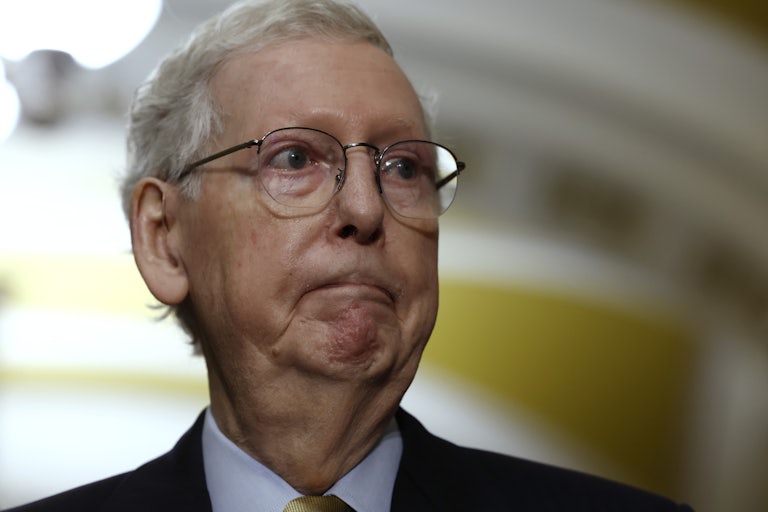
Senator Mitch McConnell makes a weird frowning face
Anna Moneymaker/Getty Images

Senator Mitch McConnell still doesn’t have the courage to confront Donald Trump for his actions on January 6, 2021.

In the Capitol Wednesday, CNN’s Manu Raju asked the Senate minority leader if he planned to confront the convicted felon and presumptive Republican presidential nominee regarding issues between the two over the Capitol insurrection, in a planned meeting with congressional Republicans Thursday. McConnell made it clear that he would not.

“I said three years ago, right after the Capitol was attacked, that I would support our nominee, regardless of who it was, including him,” McConnell said. “I said earlier this year I support him. He’s earned the nomination by the voters all across the country. And of course I’ll be at the meeting tomorrow.”

It’s quite telling that McConnell didn’t mention Trump’s name in his answer. In March, McConnell broke his silence and finally endorsed Trump for president—but only after his last opponent, Nikki Haley, dropped out of the race. Less than two weeks after the Capitol insurrection, McConnell criticized Trump on the Senate floor and accused him of instigating the riot.

“The mob was fed lies,” McConnell said. “They were provoked by the president and other powerful people, and they tried to use fear and violence to stop a specific proceeding of the first branch of the federal government, which they did not like.”

But McConnell still didn’t vote to impeach Donald Trump in February 2021, saying that a former president could not face trial in the Senate. In a speech after the vote, he called Trump “morally responsible” for the January 6 riot, called Trump’s actions “a disgraceful, disgraceful dereliction of duty,” and noted that Trump was still subject to the country’s laws while out of office.

All of this adds up to a pattern of inaction from McConnell regarding January 6 as well as Trump. McConnell, who plans to step down as minority leader in November, has joined the rest of the GOP in dismissing and ignoring the Capitol riot. McConnell has many personal reasons to turn against Trump, from the former president calling him a “dumb son of a b----” to Trump making racist attacks against his Asian American wife, Elaine Chao, despite Chao serving as Trump’s secretary of transportation. But that would mean McConnell would have to make a moral stand and put politics aside, which is not in his character.

Ron DeSantis’s Latest Pathetic Attempt to Mimic Trump Fails Miserably

A Florida appeals court slapped down DeSantis’s effort to invoke executive privilege.

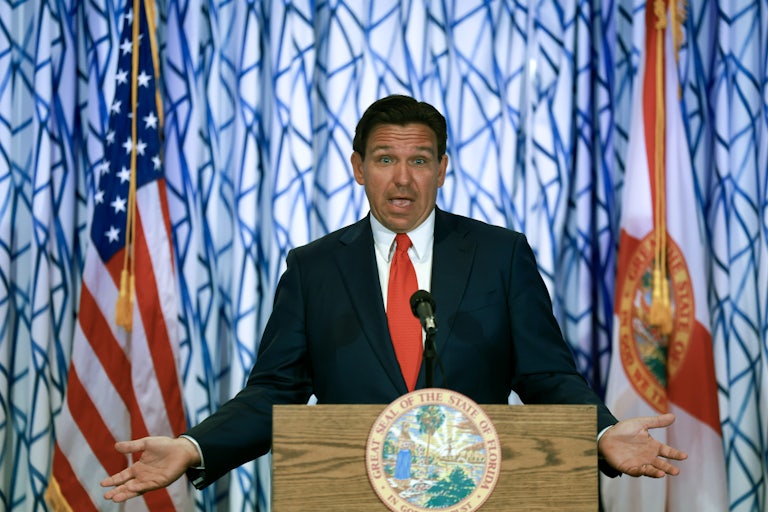
Ron DeSantis gestures as he stands at a podium
Joe Raedle/Getty Images

As much as Governor Ron DeSantis would like to be the unquestioned ruler of the Sunshine State, he just doesn’t have that privilege. Executive privilege, that is.

A panel of judges from Florida’s 1st District Court of Appeals ruled Wednesday that DeSantis cannot invoke executive privilege to avoid releasing records on his judge selectionsnot unlike his idol, former President Donald Trump, who has been banking on executive privilege and presidential immunity to shield him from an array of lawsuits

DeSantis had mentioned in August 2022 that a group of “six or seven pretty big legal conservative heavyweights” had helped him select state Supreme Court justices. When DeSantis refused to name names, someone filed a records request with his office. His office denied the request, citing executive privilege, so the person anonymously filed a lawsuit to have the records released. 

There is no law establishing executive privilege in Florida, but Leon County Circuit Judge Angela Dempsey still ruled in DeSantis’s favor in February 2023. The plaintiff appealed the court’s decision, and a panel of three appellate judges heard the case last month. Lawyers for the Florida governor again argued that the information was protected under executive privilege, as it related to his constitutional duty to appoint judges, a line of argumentation that could have had major repercussions on the efficacy of public records requests.  

But the panel of judges found that the governor was majorly overplaying his hand. 

“After denying the petition for procedural reasons, the (lower) court unnecessarily considered the merits of the petition and ruled the identities of the legal conservative heavyweights are protected by executive privilege,” wrote Judge Clay Roberts in Wednesday’s ruling. “We expressly decline to rule on the propriety of this ruling as it was irrelevant and unnecessary.” 

Judges Stephanie Ray and Susan Kelsey joined Roberts in his opinion. 

This doesn’t mean, however, that DeSantis will have to comply with the records request. The judges found that the plaintiff’s reason for remaining anonymous was too “vague” and their records request was not specific enough. 

“Appellant broadly requested records between many people during an unspecified period of time. While the records custodian could possibly intuit some contextual parameters, the core information Appellant sought was a list of names Governor DeSantis referenced in a particular interview,” the ruling said. 

The silver lining remains that someone has finally put a check on DeSantis’s power, while he continues to manufacture his voter suppression machine and transform Florida state law into a banner for his culture war

MTG Doubles Down on Unhinged Electric Vehicle Stance

Looks like Marjorie Taylor Greene is trying to make her latest conspiracy theory come true.

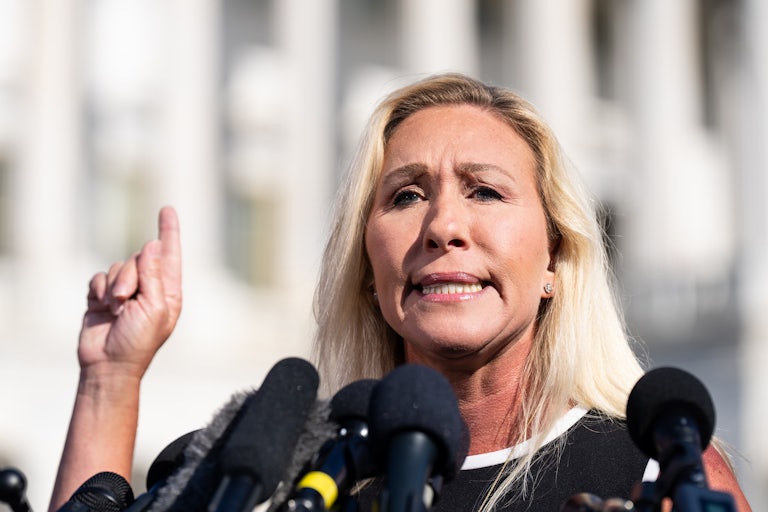
Marjorie Taylor Greene gestures as she speaks into microphones
Bill Clark/CQ-Roll Call, Inc/Getty Images

Representative Marjorie Taylor Greene still doesn’t seem to understand how electric vehicles work.

The Georgia Republican introduced a confusing amendment to the 2025 defense budget Wednesday, withholding funding from the electric car industry. But Greene couldn’t seem to specify why that was important.

“My amendment would basically say that no funds should be authorized to or to be appropriated in this act or otherwise made available for the Department of Defense for fiscal year 2025, may be used for electric vehicles or electric vehicle charging infrastructure,” Greene said. “My amendment would ensure that no funds are authorized in this year’s NDAA on electric vehicles or electric vehicle charging infrastructure.”

The word salad follows a similar electric vehicle–related gaffe that Greene made during Donald Trump’s Las Vegas rally on Sunday, when she tried—but failed—to make electric cars sound like a problem that’s hurting people’s wallets.

“If you think gas prices are high now, just wait until you’re forced to drive an electric vehicle,” she shouted.

That quip defied explanation, especially considering that not only are gas prices actually down this month, but by design, electric vehicles don’t actually rely on fossil fuels to run and therefore cost less to juice up.

Read about Green’s original comments:

Stable Genius Trump Pitches Idiotic Idea on Bitcoin Mining

Does Donald Trump actually understand how cryptocurrency works?

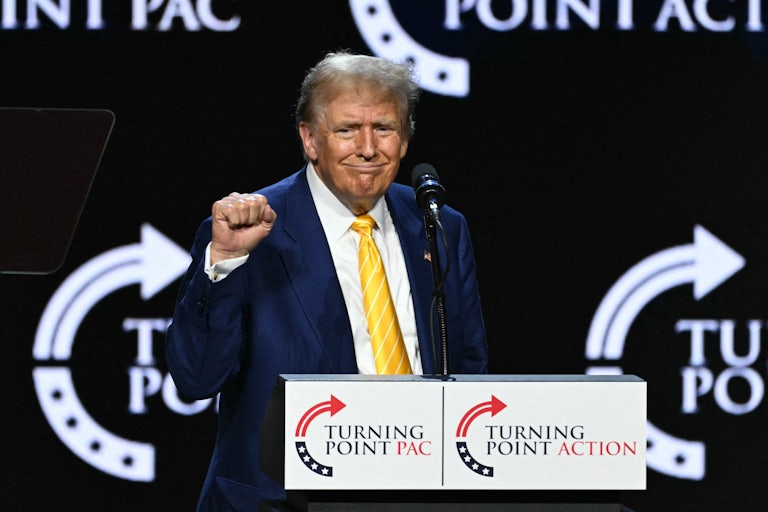
Donald Trump holds up his fist as he stands at a podium
Jim Watson/AFP/Getty Images

Donald Trump wants to bring Bitcoin mining back to the U.S.—but it’s not entirely clear that he knows what cryptocurrency even is, or how massively its production strains a country’s infrastructure.

“VOTE FOR TRUMP! Bitcoin mining may be our last line of defense against a CBDC,” the presidential candidate wrote Wednesday on Truth Social, referring to a “central bank digital currency,” or a digital version of the American dollar.

“Biden’s hatred of Bitcoin only helps China, Russia, and the Radical Communist Left,” Trump continued. “We want all the remaining Bitcoin to be MADE IN THE USA!!! It will help us be ENERGY DOMINANT!!!”

But promising to make Bitcoin mining exclusively American wouldn’t exactly be a good thing for the nation, and the very premise of the proposal calls into question whether Trump actually understands what he’s talking about. Mining Bitcoin involves using a decentralized global system of computers to process a blockchain—a long sequence of ones and zeros that effectively translates into a digital public ledger to verify the authenticity of a sale.

Once a Bitcoin is bought and sold, a new line of information is added to the blockchain. Mining Bitcoin requires a computer to solve extremely complex mathematical problems in order to process that chain. In exchange, the miner receives a predetermined amount of the digital currency as payment.

Around the world, Bitcoin miners use approximately 348 terawatt hours of energy (the prefix “tera-” meaning trillions) per year. That means that crypto mining alone consumes more energy annually than most countries in the world use for all residential and commercial activity, including the United Kingdom, Italy, Mexico, Saudi Arabia, and Australia, according to data aggregated by Visual Capitalist.

As it stands, the majority of Bitcoin mining already takes place in the U.S., accounting for 37.8 percent share of the entire network by hashrate (a computational measure of a cryptocurrency’s blockchain). That’s been the case since the summer of 2021, when China—which previously represented 75 percent of the hashrate—initiated a crackdown on the digital asset, fearing that the highly volatile currency could undermine their nation’s monetary system.

Ultimately, Trump’s promise that more crypto mining would make the country “energy dominant” simply doesn’t make sense. Mining Bitcoin doesn’t produce energy, as Trump’s call for “energy dominance” would imply. Instead, it requires a massive but incredibly unpredictable amount of energy to produce.

It’s unclear just how much energy crypto mining consumes, as the cryptocurrency lobby has actually fought hard to keep the industry’s energy expenditures under wraps. In March, the Department of Energy settled a lawsuit brought by Riot Platforms, halting an “emergency survey” that sought to quantify the amount of energy used by crypto miners while agreeing to erase all energy consumption data that had been collected up until that point.

But the infrastructure strain can be pictured in other ways: In August, taxpayers in Texas paid Riot $31 million not to mine in an effort to stave off rolling blackouts and spare the state’s electric grid.

Trump’s promise may, however, benefit a different sector entirely: the fossil fuel industry, which currently accounts for most of the energy creation in the U.S. and, as a by-product, fuels the majority of mining data centers. Approximately 96 percent of Riot’s energy was supplied by fossil fuels, despite the miner’s claims that it supports the use of renewable energy, according to an analysis by WattTime, a nonprofit tech company.

So his new stance on Bitcoin might make sense after all, given how much of an effort Trump has made recently to cozy up to oil and gas executives.

More about Trump’s relationship with crypto: