Breaking News
Breaking News
from Washington and beyond

Trump Begs Supreme Court for Immunity in Desperate Pre-Ruling Meltdown

Donald Trump is freaking out over the Supreme Court’s impending immunity decision.

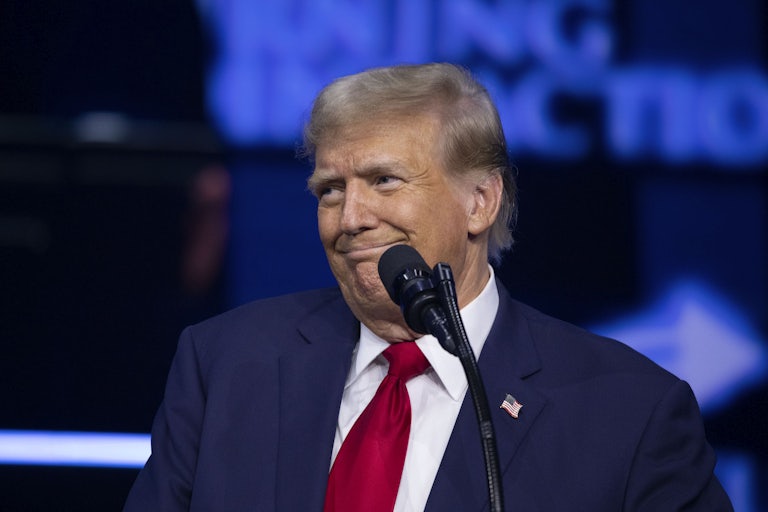
Donald Trump looks speaks, brows furrowed, as a crowd surrounds him.
Anna Moneymaker/Getty Images

Donald Trump’s Sunday scaries manifested in pathetic fashion Sunday night, as Trump took to Truth Social to beg the Supreme Court to give him “strong presidential immunity” ahead of an impending decision by the court on Monday morning that will determine the fate of his federal election interference case.

“Without Presidential Immunity, a President of the United States literally could not function!” Trump lied Sunday night on Truth Social. “It should be a STRONG IMMUNITY, where proper decisions can be made, where our Country can be POWERFUL and THRIVE, and where Opponents cannot hold up and extort a Future President for Political Gain.”

“It is a BIG decision, an important decision, a decision which can affect the Success or Failure of our Country for decades to come. We want a GREAT Country, not a weak, withering, and ineffective one,” Trump added. “STRONG PRESIDENTIAL IMMUNITY IS A MUST!”

If the Supreme Court sides with Trump, the decision will effectively end special prosecutor Jack Smith’s case against Trump—leaving him with just his 34 felonies (for now). Trump celebrated a ruling by the Supreme Court last week that significantly weakened a statute used to charge more than 300 Capitol rioters and that Trump himself is also charged with. However, as Slate noted, that decision crystallized charges against Trump—despite the gains it gave to his loyalist, rioting followers.

Trump has repeatedly floated pursuing criminal cases against his political rivals and vowing revenge. Only recently has Trump adjusted his meaning to claim “the best revenge is the success and prosperity of all Americans.”

Trump has sought absolute immunity from criminal charges, arguing in part that criminal charges for criminal actions he took while president would have a chilling effect on future presidents. In February, the D.C. Court of Appeals rejected that argument, and during oral arguments, the Supreme Court in April seemed similarly skeptical of the argument.
Steve Bannon Is Finally Going to Prison

Amid a flood of bad news, here is a small good thing.

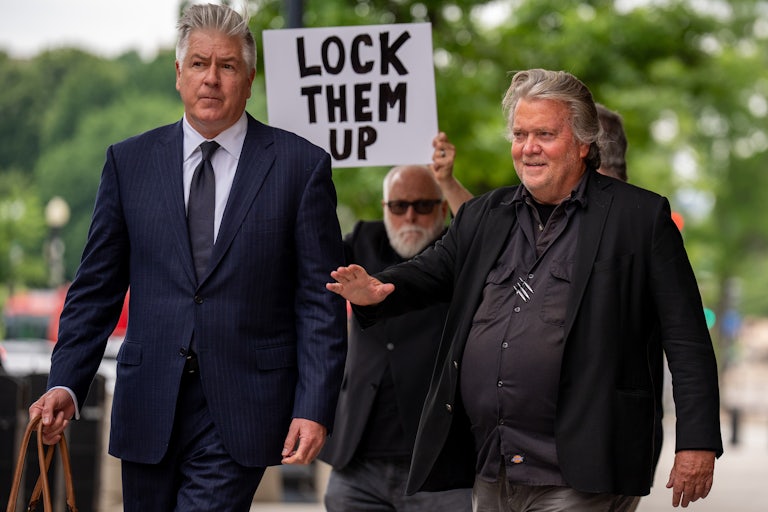
Steve Bannon and his lawyer walk in front of a man holding a "Lock Them Up" sign.
Andrew Harnik/Getty Images
Steve Bannon and his attorney before a recent court appearance

Steve Bannon will have to go to prison even as he awaits an appeal of his contempt of Congress guilty verdict, the Supreme Court ruled Friday, denying his application for release.  

The onetime Trump adviser and host of the War Room podcast on Real America’s Voice has desperately been trying to avoid prison ever since his conviction by a federal jury in 2022 for refusing a subpoena from the House January 6 committee’s investigation into the Capitol insurrection. Several Republicans have gone to bat for Bannon in recent days, attempting some outlandish legal maneuvers.  

Speaker Mike Johnson and other Republican leaders formally disavowed the January 6 committee in a secret vote Tuesday night, in an attempt to allow lawmakers to file a legal brief for Bannon on behalf of Congress. In a subsequent move, Representative Barry Loudermilk filed a brief with the Supreme Court arguing that if any witness in a congressional investigation thinks a subpoena isn’t valid, they can ignore it. Their cumulative efforts appear to have failed.  

Earlier this month, a federal judge ordered Bannon to report to prison after the U.S. Circuit Court of Appeals for the District of Columbia upheld his conviction. The Supreme Court was a long shot, last-ditch effort for Bannon. Because he faces charges in the state of New York over a border wall fraud scheme, Bannon is not going to go to a minimum-security “Club Fed” facility, as he would prefer, but a less cushy low-security prison for nonviolent offenders.  

In prison, Bannon won’t be able to continue his usual activities, such as interfering in other countries’ politics as well as the upcoming U.S. election. He won’t be able to host his podcast and let far-right Republicans rant about whatever they want. Now, after escaping prison once thanks to a Trump pardon over the border wall fraud scheme, he will soon be behind bars. 

Where Was This Joe Biden at Thursday’s Debate?

At a rally in North Carolina on Friday, Biden was lucid and sharp. But can he do enough to convince voters he’s actually up to the task of being president?

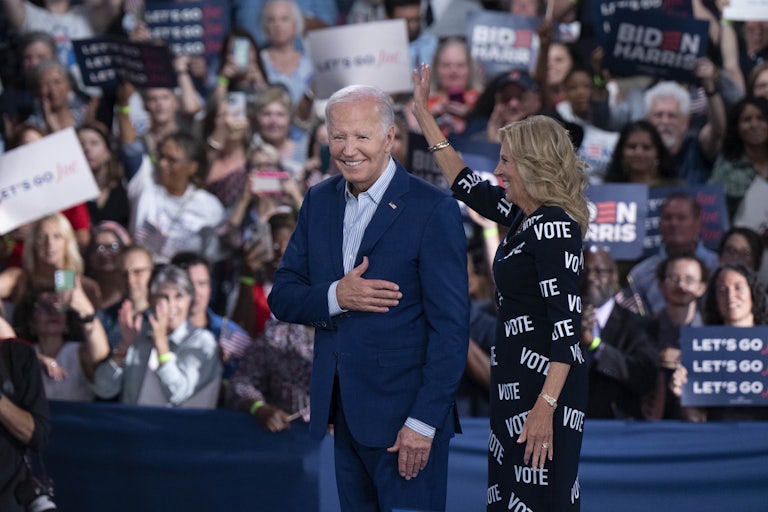
Joe Biden smiles and holds his hand over his chest as he appears before a large crowd at a political rally
Allison Joyce/Getty Images
Joe Biden at a rally in North Carolina on Friday

Less than 24 hours after President Joe Biden’s disastrous performance at the first presidential debate, the commander in chief spoke clearly, coherently, and energetically at a rally in North Carolina. This appearance, meant to soothe Democrats’ freshly ratcheted anxieties, left many with a new question: Where the heck was this version of Biden when 48 million voters were watching him on CNN?  

“Did you see Trump last night? My guess, he set—I mean this sincerely—a new record for the most lies told in a single debate,” said Biden, who was nearly shouting, a huge departure from his unsettlingly quiet demeanor the night before. 

“He lied about the great economy he created. He lied about the pandemic he botched, killing millions of people. He closed businesses, he closed schools. Losing their homes, people all over this country. America was flat on his back,” Biden continued. 

He was briefly interrupted by someone yelling from the audience, possibly a protester, but they were quickly drowned out with vigorous chants from the audience: “Four. More. Years.”

Biden continued, “I had to remind [Trump] that he oversaw a record increase in murder rates in 2020, and on my watch, violent crime has hit a 50-year low.” This was the kind of well-reasoned fact-check that had been sorely missing from Biden’s performance the night before, when Trump repeatedly referenced alleged violent crimes committed by undocumented immigrants, a racist lie meant to stoke fear in the electorate, which had received no on-air refute. 

“Donald Trump isn’t just a convicted felon—Donald Trump is a one-man crime wave,” Biden said. 

It seems that Biden does draw some of his energy from his audience—and, it must be said, some of his coherence from a teleprompter—and without these present at the debate, his strong condemnations came out more as whimpers, and his answers repeatedly trailed off into nothing.

In front of the crowd on Friday, Biden even addressed his weak performance from the debate. 

“Folks, I don’t walk as easy as I used to, I don’t speak as smooth as I used to, I don’t debate as well as I used to. But I know what I do know. I know how to tell the truth,” Biden said, drawing massive cheers from the audience.

“I know right from wrong, and I know how to do this job. I know how to get things done. And I know what millions of Americans know: When you get knocked down you get back up!”

After his lackluster performance on Thursday night, Biden attempted to remind Americans what is at stake—freedom, democracy, and America itself—with a renewed energy and vigor. It’s unlikely, however, that it will be enough to reverse the many calls for him to drop out, or to de-escalate frustration among voters as the panic subsides. 

If Biden had the ability to speak strongly on policy and refute Trump’s lies, it would’ve been nice if he’d done it last night, before dealing a brutal  blow to his presidential bid. 

Trump Celebrates Supreme Court’s Huge January 6 Ruling

Donald Trump is thanking the Supreme Court for helping him and his biggest supporters.

Donald Trump smiles weirdly at something off camera. A mic stands before him.
Bill Pugliano/Getty Images

Trump took to Truth Social Friday afternoon to celebrate the news that the Supreme Court rejected a statute used for one charge against Capitol rioter Joseph Fischer, declaring the 6–3 ruling a “BIG WIN!” and “Big News!” His victory lap appears tied to how the court’s decision helps his own federal election interference case, or how it helps other January 6 rioters—but either way, his celebrations may be short-lived.

The Supreme Court ruled Friday that a statute federal prosecutors were using to charge January 6 rioters wasn’t applicable due to the order in which the relevant subsection of the statute appears. Dissenting against the decision, conservative justice Amy Coney Barrett noted the ruling was based on textual backflips to justify the decision.

Half of the charges in Trump’s federal election interference case are based on the statute the Supreme Court just reinterpreted, with Friday’s decision giving a leg up to the already-convicted felon. But that win may have a steep downside if his interference case ever goes to trial: According to Slate, the Supreme Court’s decision on Friday confirmed that submitting false evidence in an official proceeding does violate federal law. Trump is accused of helping to orchestrate a scheme where his allies submitted fraudulent elector letters on his behalf to win the 2020 election.

The Supreme Court’s ruling may also affect cases against more than 300 Capitol rioters charged with obstruction—but they’re not getting off scot-free. Rioters have faced charges of trespassing, assault on an officer, and seditious conspiracy. In Fischer’s case, his obstruction charge is just one of several that includes civil disorder, impeding police officers, entering and remaining in a restricted building, disorderly conduct and demonstrating in a Capitol building. Fischer’s case has been sent back to lower courts to determine if the obstruction charge is still valid.

In response to the Supreme Court decision, Attorney General Merrick Garland released a statement noting that no one involved in the January 6 Capitol riot has been charged with only the obstruction statute.

“The vast majority of the more than 1,400 defendants charged for their illegal actions on January 6 will not be affected by this decision,” Garland wrote. “There are no cases in which the Department charged a January 6 defendant only with the offense at issue in Fischer.”

Los Angeles’s Mayor Was Contemplating a Mask Ban. She Just Got Covid.

Karen Bass floated banning masks for protesters days before coming down with Covid-19.

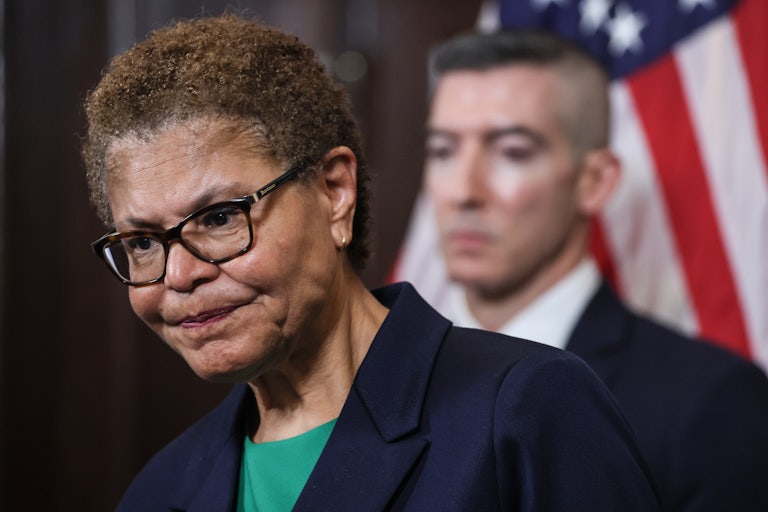
Karen Bass looks at the ground and scowls.
Robert Gauthier/Los Angeles Times/Getty Images
Los Angeles Mayor Karen Bass

Los Angeles Mayor Karen Bass began the week by suggesting that her city consider a new mask ban for protesters, and ended it by testing positive for Covid-19.

After protesters clashed outside a synagogue in Pico-Robertson, which held an event for a company known for selling high-end properties in Israel’s illegal settlements in the West Bank, Democratic leaders quickly denounced the chaos and began working on ways to make everything a lot less safe for protesters.

President Joe Biden called it “dangerous, unconscionable, antisemitic, and un-American,” but said nothing about the auctioning of stolen Palestinian land in Israeli settlements, which the international community has widely agreed is illegal. “Americans have a right to peaceful protest. But blocking access to a house of worship—and engaging in violence—is never acceptable,” he wrote.

The incident came on the heels of other large protests across the country, which had left Governor Kathy Hochul and New York City Mayor Eric Adams eyeing the reinstatement of a mask ban for protesters, both saying they felt the anonymity masking provides had emboldened protesters to commit violence. Meanwhile, the city is undergoing a renewed wave of Covid-19, which neither politician deigned to consider.

Bass appeared to have taken her lead from those two: At a press conference with local Jewish leaders Monday, the mayor said she would seek “several points of clarity” from the city’s attorney “around what are the parameters with protests: when permits are needed, whether or not people should be masked, and establishing clear lines of demarcation between what is legal and what is not.”

Although she did not offer a specific proposal, she pushed that the city ought to review “the idea of people wearing masks at protests.”

California has also seen a recent surge of Covid-19 cases, and a study in June found that viral levels of Covid-19 in the state’s wastewater had crossed a point of “high activity.”

Only a few days later, her office announced that she tested positive for Covid-19 and will be attending her meetings remotely, a luxury that many workers in this country are no longer afforded.

Bass’s ironic diagnosis is undercut by the fact that for many, especially immunocompromised people, Covid-19 still presents real dangers and carries long-lasting health risks. As the federal government has neglected to keep restrictions for the benefit of the worst-off, states and local governments have been granted the power to keep their citizens safe, and are across the board dropping the ball.