Breaking News
Breaking News
from Washington and beyond

Team Trump Wants to Destroy Key Safety Rule Hated by Tesla

Tesla’s “self-driving” cars may be about to get a whole lot more dangerous.

Donald Trump and Elon Musk
Brandon Bell/Getty Images

Elon Musk’s efforts ingratiating himself into Trumpworld are about to pay off.

Donald Trump’s presidential transition team has recommended that the president-elect quash a crash reporting requirement for self-driving vehicles. In an internal document obtained by Reuters, the team described the safety reporting condition as a mandate for “excessive” data collection, advising that the president-elect abolish the requirement entirely.

Doing so would radically alter the playing field for the burgeoning automated vehicle industry, decreasing transparency and making it more difficult for federal regulators to spark inquiries into dangerous practices. And Tesla would be the new policy’s biggest benefactor.

The electric vehicle company, which Musk heads, has reported the majority of automated vehicle crashes, more than 1,500, to federal safety regulators. And a Reuters analysis of data from the National Highway Traffic Safety Administration, or NHTSA, found that Tesla’s crash data accounted for 40 out of 45 of the fatal crashes reported through October 15.

Critics and law enforcement groups, including the Justice Department, have torched the company’s “autopilot” and “full self-driving” claims, arguing that the branding has misled investors and consumers into believing that the cars are fully autonomous when they still require an active driver behind the wheel.

In a statement to Reuters, the NHTSA noted that the crash reporting data is “crucial” to evaluating the safety of these emerging technologies. Former agency employees noted to the outlet that such data was essential to investigations that led to a 2023 recall of some 125,000 Tesla vehicles over a seat belt defect.

“NHTSA said it has received and analyzed data on more than 2,700 crashes since the agency established the rule in 2021. The data has influenced 10 investigations into six companies, NHTSA said, as well as nine safety recalls involving four different companies,” according to Reuters.

Musk’s involvement in crafting the transition team’s policy could not be determined, and it’s still unclear if Trump actually intends to strip the requirement.
Jeff Bezos Bends the Knee to Trump as Amazon Plans Hefty Donation

Jeff Bezos, like all the other billionaires, is trying to win over the president-elect.

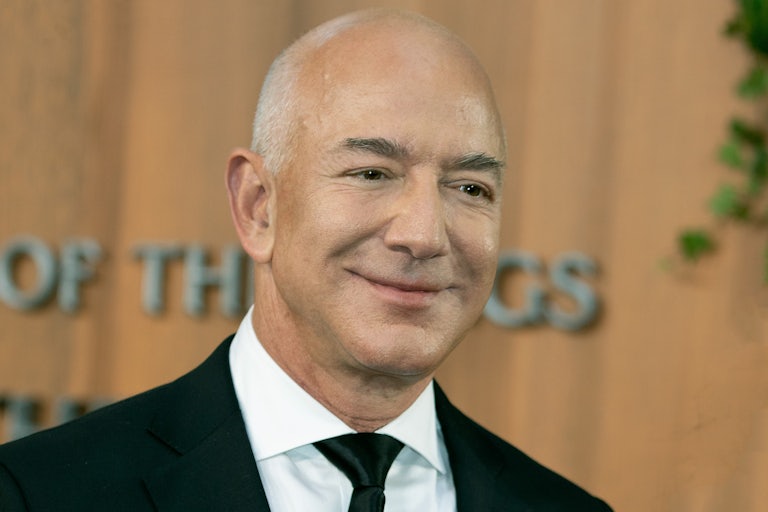
Jeff Bezos
Dave J Hogan/Dave J. Hogan/Getty Images

Jeff Bezos is planning to donate $1 million to Donald Trump’s inauguration committee, in the latest installment of tech billionaires sucking up to the president-elect.

The Wall Street Journal reported Thursday that Bezos, who just last month chose to spike The Washington Post’s endorsement of Kamala Harris in the name of so-called neutrality, is plotting to pour cash into the group planning Trump’s victory parties.

Bezos and his company decided to make the contribution earlier this week and notified Trump’s team that the money was coming, according to one person familiar with the matter. “Bezos is donating through Amazon,” one person close to Bezos told the Journal.

Earlier this week, Mark Zuckerberg, another tech billionaire who has taken to fawning over Trump (only after the president-elect publicly threatened him with imprisonment) also donated $1 million to the inauguration committee. For that reason alone, it’s difficult to imagine these donations as anything other than “obeying in advance.”

Amazon is also slated to stream the inauguration on Prime Video, which will be a separate in-kind donation valued at $1 million, according to one of the people familiar with the matter.

Why is a Democratic Senator Fawning Over Elon Musk?

Richard Blumenthal—a progressive senator from Connecticut—has spent the last few days gushing over the tech billionaire and arch Trump loyalist. What’s really going on?

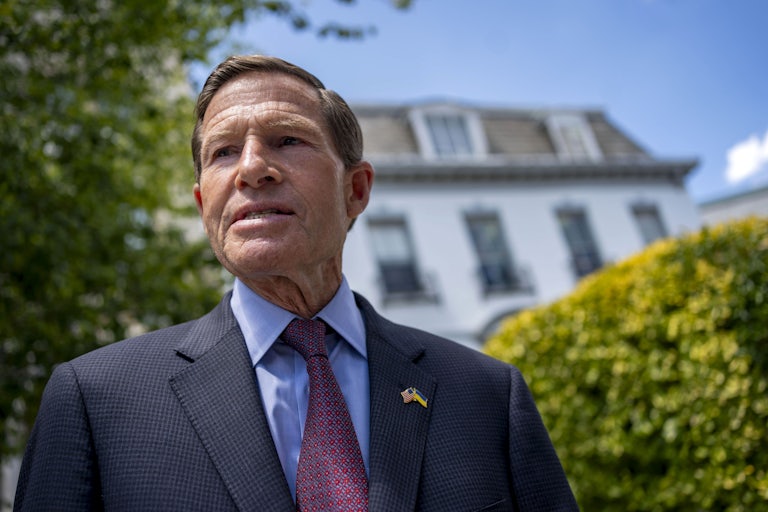
Richard Blumenthal stands outside, in front of some bushes and a house.
Bonnie Cash/Getty Images
Richard Blumenthal in July

Senator Richard Blumenthal, a Democrat, gushed over Elon Musk Thursday, calling the technocrat billionaire who helped elect Donald Trump “the foremost champion of free speech in the tech industry.”

Blumenthal’s compliment for the far-right troll king came less than a week after he and Republican Senator Marsha Blackburn released a statement announcing that they had collaborated with X, Musk’s social media company, on changes to their new bill, the Kids Online Safety Act. That bill, by their own admission, featured a number of changes that had been spearheaded by the increasingly toxic social media platform.

“Led by X, the new changes made to the Kids Online Safety Act strengthen the bill while safeguarding free speech online and ensuring it is not used to stifle expression,” Blumentahl and Blackburn wrote in a statement. “These changes should eliminate once and for all the false narrative that this bill would be weaponized by unelected bureaucrats to censor Americans.

“We thank Elon and Linda for their bold leadership and commitment to protecting children online and for helping us get this bill across the finish line this Congress,” the pair added, implying that Musk and X’s CEO Linda Yaccarino had been directly involved in the process.

X has been supporting the KSOA, which has already passed the Senate, since the summer, so Blumenthal’s obvious posturing raises some concerns and questions. It is possible, of course, that this is all just politics: The Democratic senator is simply making nice with a powerful player with a sizable platform who could easily become a huge problem for both him and his currently bipartisan bill. It is possible, however, that Blumenthal is trying to play a longer game, hoping to influence the man who both stands to influence everything in the incoming Trump administration and who currently influences everyone (or at least everyone on X) via the endless stream of pro-Trump, right-wing propaganda he posts. That, however, is a losing battle for obvious reasons: Musk has little affinity—to put it mildly—for progressives like Blumenthal, Democrats in general, or the policy goals of any left-leaning group or politician. Attempting to influence Musk, moreover, is a mug’s game. For every Democrat in his ear, there are a hundred (likely more) arch MAGA loyalists. 

Democrats like Blumenthal might better spend their time warning their constituents of the creeping power of technocrats like Musk, who are plotting to dismantle essential features of the federal government via draconian cuts to public services and welfare programs, while pushing legislation that would effectively allow them to regulate their own industries and policies that would make them vastly richer than they already are.  

Here’s How Kari Lake’s VOA Appointment Could Crumble

The right-wing conspiracy theorist could turn the respected international broadcaster into a propaganda arm. Thankfully, her appointment is far from guaranteed.

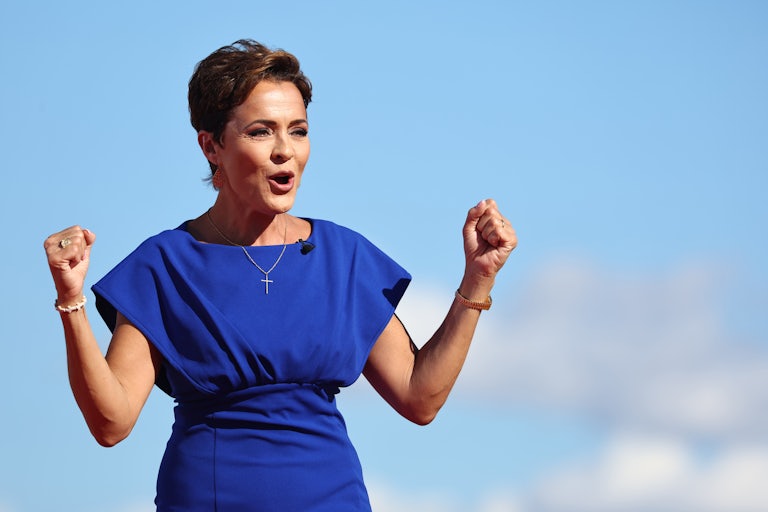
Kari Lake stands on stage and holds up both her fists.
Mario Tama/Getty Images
Kari Lake in October

Donald Trump’s sudden appointment of one of his staunchest allies, two-time failed MAGA candidate and former news anchor Kari Lake, to run the federally funded international broadcasting service Voice of America has resulted in widespread concern and outrage, amid fears that she could transform it into a reactionary propaganda arm of the Trump presidency. Lake, for her part, has done little to assuage those fears.

“I am honored that President Trump has asked me to lead the Voice of America,” Lake wrote in a statement on social media. “@VOANews is a vital international media outlet dedicated to advancing the interests of the United States by engaging directly with people across the globe and promoting democracy and truth.

“Under my leadership, the VOA will excel in its mission: chronicling America’s achievements worldwide,” she continued.

But rules passed in 2020 could get in the way of her plans. Recent regulations prevent the head of the U.S. Agency for Global Media from hiring or firing Voice of America’s network leadership without the express approval of the International Broadcasting Advisory Board, a seven-person panel composed of presidential appointees, reported former Washington Post journalist Paul Farhi.

Of course, Trump has also not yet appointed anyone to lead the U.S. Agency for Global Media, further stretching the possibility of Lake’s appointment to the public network.

Meanwhile, Trump’s appointees to the not-yet-existent Department of Government Efficiency have promised to leverage recent Supreme Court decisions to slash and burn spending on beloved domestic public broadcasters. In a joint op-ed by Elon Musk and Vivek Ramaswamy published in The Wall Street Journal last month, the duo said they would cut $500 million a year from the Corporation for Public Broadcasting, which funds NPR and PBS, among other seismic blows to national programs.

NATO Chief Has a Dire Warning About Europe’s Future

Mark Rutte, who has led the alliance since October, says it needs to shift to a “wartime mindset” as Russia’s threat continues to grow.

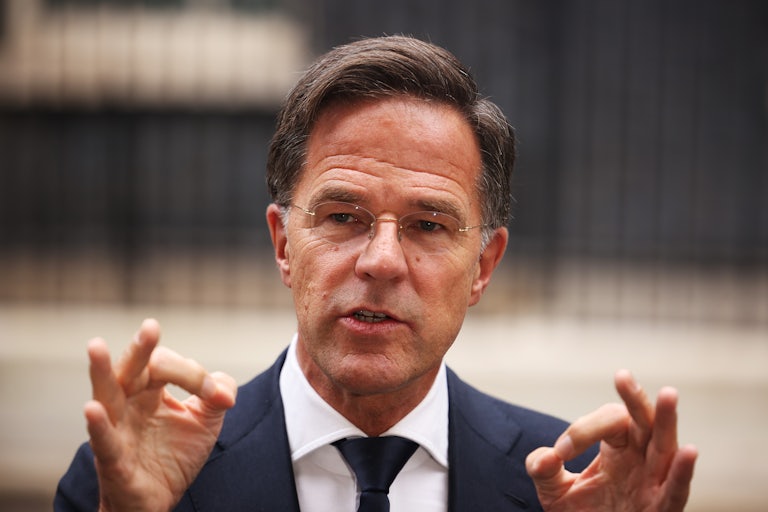
Mark Rutte speaks while making two OK gestures with his hands.
Dan Kitwood/Getty Images
NATO Secretary General Mark Rutte

NATO chief, Mark Rutte, warned members on Thursday that the international alliance must shift to a “wartime mindset,” predicting years of conflict with Russia as the superpower batters down Ukrainian forces.

“Russia is preparing for long-term confrontation, with Ukraine and with us,” Rutte said during a speech in Brussels in which he highlighted the short distance to where “Russian bombs are falling … Iranian drones are flying,” and “North Korean soldiers are fighting,” he said, referencing the complexity—and global nature—of conflict with Russia.

“We are not ready for what is coming our way in four to five years,” the secretary general continued. “It is time to shift to a wartime mindset, and turbocharge our defense production and defense spending,”

Raising the 32-nation alliance’s 2 percent defense spending is, according to Rutte, a “top priority.” Rutte, a former Dutch prime minister, called on NATO members to “stop creating barriers” between one another and their industries, calling it “simply unacceptable” that European banks and pension funds were refusing to invest in defense spending.

At one point during his speech, Rutte spoke directly to the defense industry, promising that more money was on its way while daring weapons manufacturers to “innovate and take risks.”

On the other side of the conflict, Russia has approved a draft budget that plans to increase its military expenditures through 2027 to more than 6.2 percent of the country’s gross domestic product. Rutte, however, predicts that could grow even more, to as much as 8 percent of the country’s GDP.

“That’s a third of Russia’s state budget—and the highest level since the Cold War,” Rutte said. “And Russia’s defense industry is producing huge numbers of tanks, armoured vehicles, and ammunition. What Russia lacks in quality, it makes up for in quantity—with the help of China, Iran, and North Korea.” Troops from North Korea—and military hardware and technology from China and Iran—have helped Russia recover from the heavy losses it has suffered in Ukraine, a shrinking pool of available recruits, and growing apathy about the war as it drags on.

President-elect Donald Trump has long threatened America’s withdrawal from the Western military and trade alliance, sparking condemnation from some of his former allies. In February, Trump claimed he once told a European leader that he’d allow Russia to “do whatever the hell they want” to NATO allies if they didn’t “pay” their “bills.” (NATO dues are determined by guideline rather than mandate, and the United States has never been shortchanged by other members. The Cold War organization has “no ledger that maintains accounts of what countries pay and owe,” according to former Obama staffer Aaron O’Connell, who explained to NPR in 2018 that “NATO is not like a club with annual membership fees.”)

While Trump’s former national security adviser John Bolton cast doubt on the incendiary story, he didn’t question his desire to nix the strategic alliance. “Look, I was there when he almost withdrew, and he’s not negotiating,” Bolton said at the time. “His goal here is not to strengthen NATO, it’s to lay the groundwork to get out.”

One of Trump’s biggest and boldest campaign promises was that he would immediately end the Russian invasion of Ukraine—though his philosophy on how to achieve that was suspiciously scant of details and, at times, veered toward solutions that would invariably aid Russia. In June, meanwhile, Trump said he would be open to an increase in U.S. weapons aid to Ukraine so long as it shows up for peace talks with Russia, reported Reuters.

Trump’s advisers envisioned that the peace talks—which Trump promised to facilitate after reentering the White House—would also quietly include Ukraine seceding large, resource-rich regions of the country that is currently occupied by Russian forces. The concept was drawn up by retired Lt. Gen. Keith Kellogg and Fred Fleitz, both former chiefs of staff in Trump’s National Security Council. Such a deal would put NATO in a precarious position.

Russia has made considerable advances in recent months, but its growing reliance on allies suggests that it is stretched perilously thin. An end to the war in Ukraine—particularly one that gives it much of the territory it desires—would be an enormous gift to the country and would put it on NATO’s doorstep. Article 5 of NATO’s treaty says that an attack on any member of the alliance will be treated as an attack on all NATO members: Should Russia look to invade Poland or one of the Baltic nations next, it could quickly spiral into a devastating global conflict.