Breaking News
Breaking News
from Washington and beyond

The Trump Administration is Gaslighting Us About the Tariff Apocalypse

Administration officials keep insisting that everything is fine, even as the economy lurches off a cliff.

White House Press Secretary Karoline Leavitt talks to reporters outside the White House
Chip Somodevilla/Getty Images
White House press secretary Karoline Leavitt

The Trump administration is urging nervous voters to “trust” it in response to the impending economic fallout from the President’s tariffs on virtually all foreign imports.

“To anyone on Wall Street this morning I would say trust in President Trump,” press secretary Karoline Leavitt said on CNN Thursday morning. “This is a president who is doubling down on his proven economic formula from his first time. We saw a wages increase, we saw inflation come down. We had a Trump energy boom, we had the largest tax cuts in history, and that’s exactly what the president intends to do.… The United States of America is no longer going to be cheated by foreign nations around the world.”

The trade war that the president announced on Wednesday as “Liberation Day” has already tanked the stock market. The country is lurching into a recession, and there is little indication that things will improve anytime soon. Indeed, the tariffs announced on Wednesday are little more than a spiteful policy intended to stick it to friend and foe alike, ostensibly for the purpose of reinvigorating American manufacturing. This is virtually impossible, as these aggressive reciprocal tariffs will most certainly drive up prices for manufacturers and consumers across the country. But the administration would rather have you believe that the economic impact won’t be that bad, or even noticeable.

“What can you tell the American people that—they just can’t afford an extra $3 here and there—about the government making up the difference from them?” Lawrence Jones asked Vice President JD Vance on Thursday morning. “Will costs go up at some point, will this just be temporary? Are we talkin’ three months or six months?”

“We know a lot of Americans are worried. So we are working very hard to bring prices down,” Vance said. “What I ask folks to appreciate here is that we are not gonna fix things overnight.… We know people are struggling, we’re fighting as quickly as we can to fix what was left to us. But it’s not gonna happen immediately. But we really do believe that if we pursue the right deregulation, we pursue those energy cost-reducing policies, yes people are gonna see it in their pocketbook, they’re also gonna benefit from the fact that foreign countries can’t take advantage of us anymore, that means their jobs are gonna be more secure.”

Neither Vance nor Leavitt actually explain how actions like hitting China with a 34 percent tariff will bring prices down for the everyday American, or how this country will be a self-sufficient producer in just a few years. This backtracking and gaslighting is a far cry from Trump’s promise to “immediately bring prices down, starting on day one.”
Trump Left a Key Country Out of His Extreme Tariffs

Donald Trump has levied tariffs on nearly the entire world—except for a select few countries.

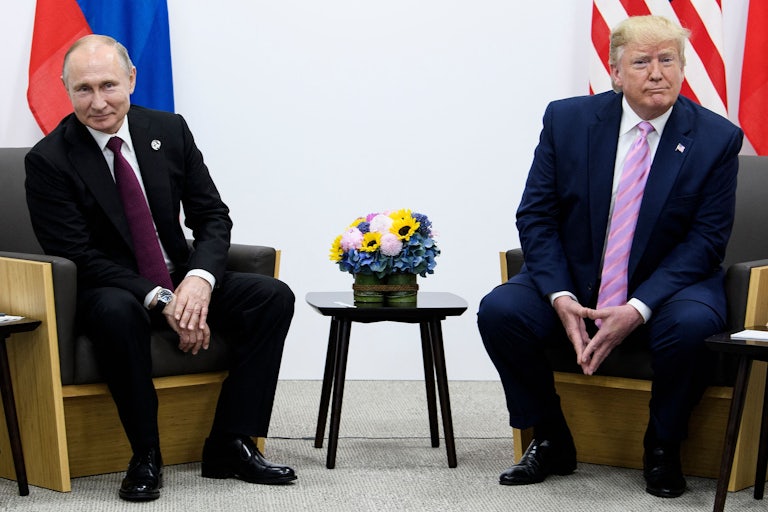
Vladimir Putin and Donald Trump smile and sit next to each other
Brendan Smialowski/AFP/Getty Images

In the scores of countries hit by Donald Trump’s sweeping tariffs announced Wednesday, one was mysteriously—but not surprisingly—absent: Russia.

White House press secretary Karoline Leavitt told Axios Wednesday that Moscow had been spared from Trump’s tariffs because U.S. sanctions already “preclude any meaningful trade.”

Similarly, Treasury Secretary Scott Bessent told Fox News that it wasn’t necessary to place tariffs on Russia because after its full-scale invasion of Ukraine in 2022, trade between the U.S. and Russia had effectively dried up.

But the claim that the U.S. doesn’t trade with Russia isn’t remotely true. In 2024, the U.S. imported $3 billion worth of goods from Russia, which was down from $4.6 billion the year before.

While this number may be small in comparison to key trading partners such as Canada, which imported a whopping $412.7 billion worth of American goods in 2024, it is still significantly more trade than with other countries that Trump levied steep tariffs against.

For example, Saint Pierre et Miquelon, a small French island territory off the coast of Canada, was hit with a whopping 50 percent tariff on imports to the U.S. The island, which has a population of roughly 5,000 people, imported only $100,000 worth of U.S. goods in 2024 and exported roughly $3.4 million worth of goods back.

If that’s not low enough, Trump even listed several uninhabited islands as receiving a 10 percent tariff on imports to the United States: Heard Island and the McDonald Islands, an Australian territory that is listed as a UNESCO World Heritage site for its “complete absence of alien plants and animals, as well as human impact.”

Clearly, a lack of trade was not an actual consideration in the Trump administration’s decision to levy tariffs, though Leavitt claimed that existing sanctions were also why Cuba, Belarus, and North Korea were not included on the list.

With Leavitt’s excuse falling flat, it seems increasingly likely that Trump has attempted to carve out a back door for Russian President Vladimir Putin to continue to do business with the U.S. as it makes an economic enemy out of every other country in the world.

Canada and Mexico were also absent from the list because Trump had already hit them with 25 percent tariffs on all U.S. imports, according to Leavitt.

Here’s How Trump Calculated His Tariffs—and It’s Ridiculous

The math just isn’t mathing.

Donald Trump holds up a chart showing tariff rates for different countries during a White House Rose Garden press conference
Demetrius Freeman/The Washington Post/Getty Images

The Trump administration seems to have destroyed global economies overnight while misunderstanding basic economics.

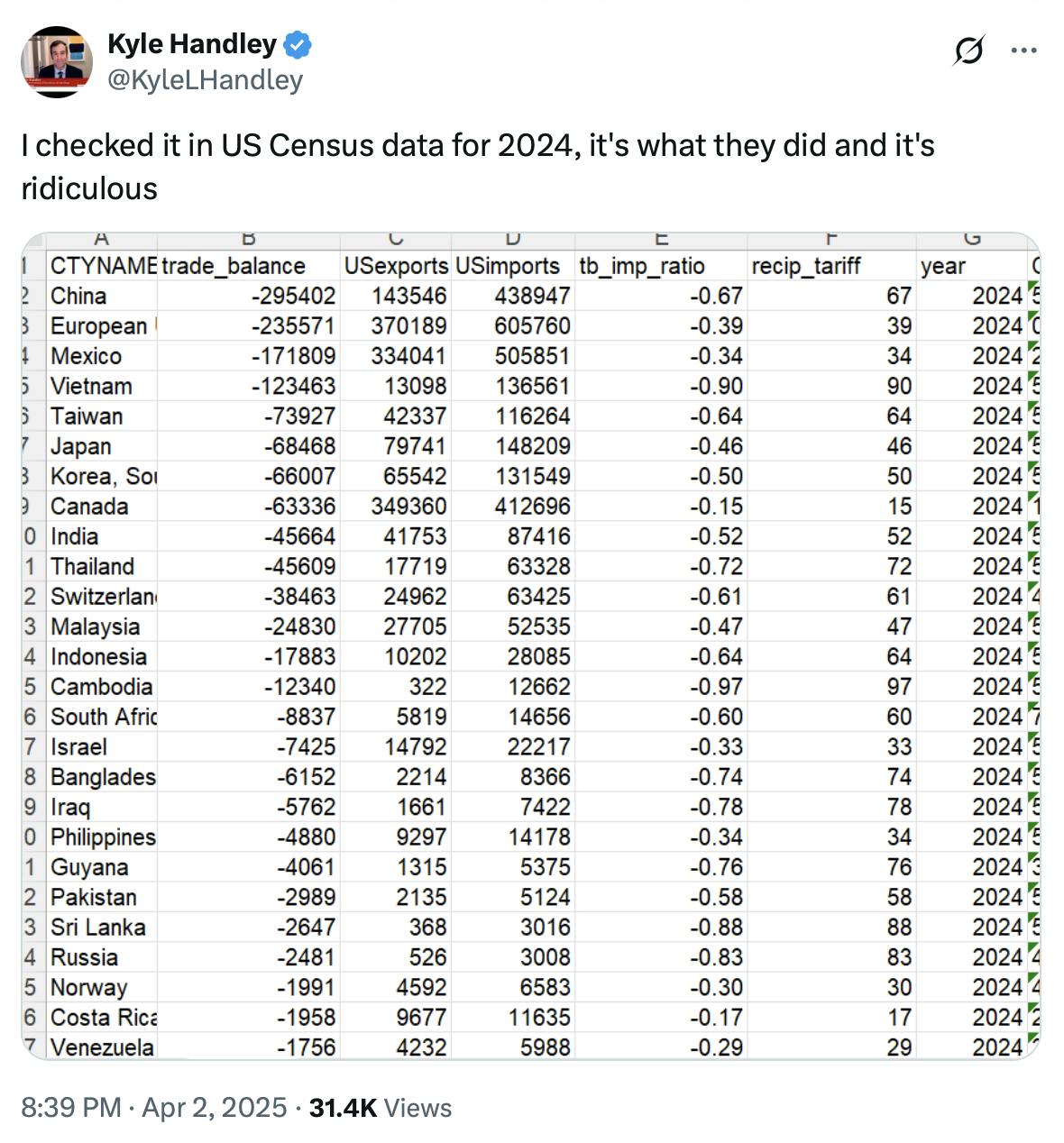
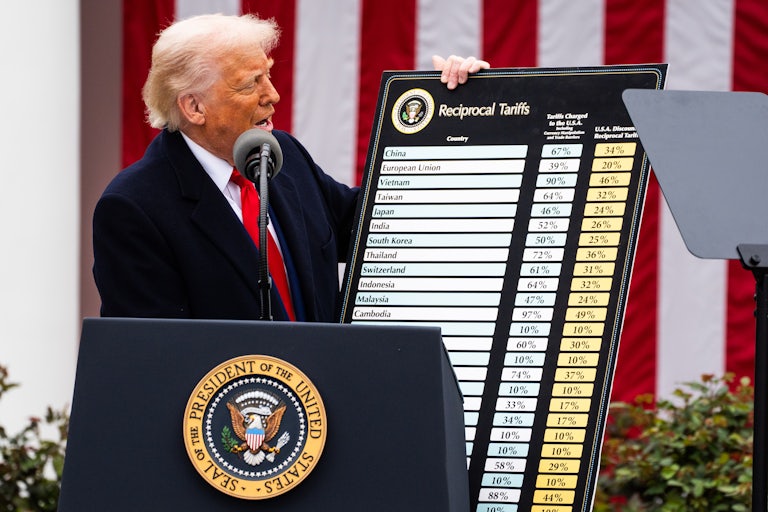
In the wake of Donald Trump’s tariff announcement Wednesday, former New Yorker financial writer James Surowiecki pointed out that a column on Trump’s tariff sheet labeled “tariffs charged to the U.S.A.” was likely founded on bad math.

“They didn’t actually calculate tariff rates + non-tariff barriers, as they say they did. Instead, for every country, they just took our trade deficit with that country and divided it by the country’s exports to us,” Surowiecki argued. “So we have a $17.9 billion trade deficit with Indonesia. Its exports to us are $28 billion. $17.9/$28 = 64 percent, which Trump claims is the tariff rate Indonesia charges us.”

“What extraordinary nonsense this is,” he added.

That would mean that the Trump administration imposed earth-shattering tariff hikes on the rest of the world without looking at the whole picture. Mainly, that the administration calculated the tariffs charged by other countries by only looking at goods provided, rather than the combined value of goods and services—something that “most economists seem to think is an odd way to calculate tariffs,” according to BBC Verify’s Shayan Sardarizadeh.

Screenshot of a tweet
Screenshot

The White House initially refuted the tariff theory. White House Deputy Press Secretary Kush Desai posted on X that “we literally calculated tariff and non tariff barriers.” But in an attempt to prove his point, Desai grabbed a formula from the US Treasury website that actually proved Surowiecki’s.

Sardarizadeh broke it down. “∆τᵢ = (x-m) / (ε x φ x m),” he shared. “The formula includes ‘x’ for exports and ‘m’ for imports.”

“But it also has ‘ε’ for ‘price elasticity of import demand’, set at 4 by the Treasury; multiplied by ‘φ’ for ‘elasticity of import prices’, set at 0.25 by the Treasury, which means they basically cancel out each other as 4 x 0.25 = 1,” Sardarizadeh continued. “So, in effect, all you’re left with in the formula is exports - imports / imports, which is what X users and journalists had accurately pointed out all along.”

But the administration’s bad math only matters so much to the tariff-heavy agenda. Even in countries where the trade deficit was less than 10 percent, or even in countries where there was a surplus, Trump still tacked on a 10 percent tariff.

Stable Genius Trump Just Put Tariffs on a U.S. Military Base

Donald Trump imposed tariffs on an island inhabited only by American soldiers.

Donald Trump presses his lips together during a press conference in the White House Rose Garden
Chip Somodevilla/Getty Images

Donald Trump announced a range of tariffs on nearly every country in the world—including, inexplicably, some practically uninhabited islands, one of which is home to a U.S. military base.

The British Indian Ocean Territory, a small cluster of islands in the South Indian Ocean, was hit with 10 percent tariffs on U.S. imports from the Trump administration Wednesday as part of its Liberation Day announcement.

The islands are mostly uninhabited, save for approximately 3,000 U.S. and U.K. military personnel who are stationed at a joint Navy Support Facility on the island Diego Garcia. Trump’s tariffs would mostly affect the service members there. Another roughly 1,200 people live on the country’s Chagos Archipelago.

As one might expect from the name, the territory is owned by the United Kingdom, which Trump hit with a 10 percent tariff, relatively low compared to other countries.

Trump also announced 10 percent tariffs on the Heard Island and McDonald Islands, an uninhabited Australian territory that was listed as a Unesco World Heritage site for its “complete absence of alien plants and animals, as well as human impact.” Australia was saddled with a 10 percent tariff, as well.

It’s unclear whether the tariffs on these territories would compound to 20 percent. Crucially, it’s unclear that anyone thought about this at all.

Online, some speculated that the tariffs were doled out according to internet domains, and that because the Heart Island and McDonald Islands use a different domain (.hm) than Australia, (.au) they were considered different countries. That seemed to be the only explanation for levying a tariff on a territory that has no economy to speak of.

Trump Says Tariffs Could Have Stopped the Great Depression

Donald Trump has found a bonkers new defense for his extreme tariffs.

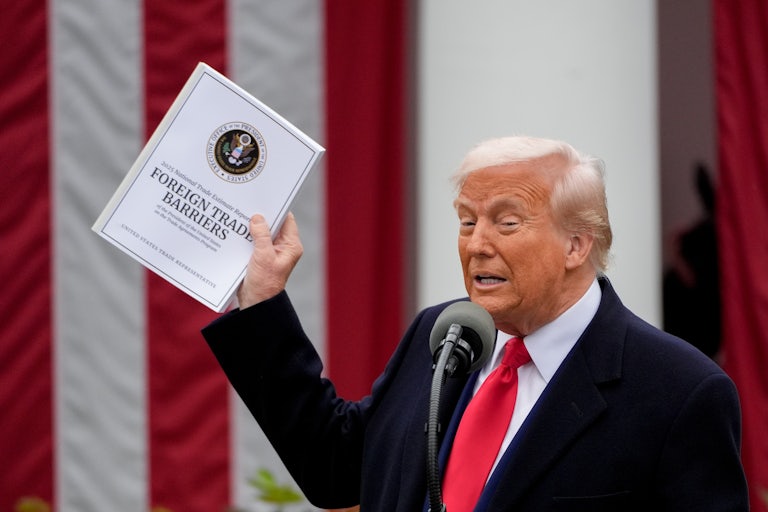
Donald Trump holds up a booklet on "foreign trade barriers" while speaking to reporters in the White House Rose Garden
Kent Nishimura/Bloomberg/Getty Images

Donald Trump claimed Wednesday that the United States entered the Great Depression as a result of turning its back on the policy of placing tariffs on other countries in favor of an income tax.

During a winding speech to mark the so-called Liberation Day, Trump presented an alternative history where steep tariffs, like the ones he’d come to celebrate, could have prevented the worldwide economic disintegration of the early twentieth century.

“From 1789 to 1913 we were a tariff-backed nation, and the United States was proportionately the wealthiest it has ever been,” Trump said, adding that the U.S. was “collecting so much money, so fast, we didn’t know what to do with it!

“Then, in 1913 for reasons unknown to mankind, they established the income tax so citizens, rather than foreign countries, would start paying the money necessary to run our government,” he said.

“Then in 1928 it all came to a very abrupt end with the Great Depression, and it would have never happened if they had stayed with the tariff policy; it would have been a much different story,” Trump said. “They tried to bring back tariffs to save our country, but it was gone. It was gone. It was too late, nothing could have been done.”

Trump’s revisionist history is designed to promote his economic agenda—not reflect what actually happened. Not only could tariffs not have prevented the Great Depression, they made it even worse.

In 1913, as the result of struggling farmers and Democrats advocating to establish an income tax, Republicans put up an income tax amendment, hoping that it would be rejected—it wasn’t, and the Sixteenth Amendment became law.

At the same time, Congress passed the Underwood Simmons Tariff Act that lowered tariff rates from 40 percent to 27 percent, in a Democrat-backed effort to promote free trade. Crucially, tariffs were raised again in 1921, after Republican President Warren Harding entered the White House and began a reinvigorated era of protectionism.

In 1930, Congress passed the Smoot-Hawley Tariff Act, which raised tariffs in all sectors and is considered to have exacerbated the worldwide economic downturn that lasted from 1929 until 1939, by undermining international trade and affording little protection to domestic producers.

Smoot-Hawley was disastrous not only for the U.S. economy, tanking U.S. exports to Europe from $2,341 million in 1929 to just $784 million in 1932, but also for global trade, which declined by a whopping 66 percent between 1929 and 1934, according to  the U.S. Office of the Historian. The effects of Smoot-Hawley were so awful that it marked the end of steep tariffs in American trade policy for the rest of the twentieth century.

Trump’s baseless insistence that lowered tariffs led to the Great Depression is representative of his entire economic policy, and just how untethered from reality it has become.

Read more about Trump’s tariffs: