Breaking News
Breaking News
from Washington and beyond

Trump Announces Wild Breakdown of Tariffs on Closest Allies

Donald Trump is imposing a different set of tariffs on each country. And they’re all extreme.

Donald Trump holds up a large chart labeled "Reciprocal Tariffs" for each country while speaking at his so-called “Liberation Day” event at the White House on April 2. The first rows are China, European Union, Vietnam, Taiwan, and Japan. The left column shows the tariffs that country imposes and the right column shows Trump’s proposed tariffs on the country.
Chip Somodevilla/Getty Images
Donald Trump holds up a chart on tariffs for each country while speaking at his so-called “Liberation Day” event at the White House on April 2.

President Trump pulled out a chart to help illustrate his aggressive, country-specific tariff plans during his “Liberation Day” speech on Wednesday.

“We’re gonna be charging a discounted reciprocal tariff of 34 percent [on China],” Trump said, holding up the large black, blue, and yellow chart that Commerce Secretary Howard Lutnick dutifully brought to him onstage. “In other words, they charge us, we charge them. We charge them less, so how can anybody be upset? They will be, because we never charge anybody anything. But now we’re gonna charge.”

Trump confirmed there will be 25 percent tariffs on all car imports, in addition to the specific tariffs he plans to levy against each of our trading partners on the grounds that they’ve been “ripping us off.”

The chart notes plans for tariffs on a list of countries including:

  • 34 percent tariffs on China
  • 20 percent tariffs on the European Union
  • 49 percent tariffs on Cambodia
  • 37 percent tariffs on Bangladesh
  • 44 percent tariffs on Sri Lanka
  • 46 percent tariffs on Vietnam

The tariffs will affect more than 100 U.S. trading partners, but Canada and Mexico are conspicuously left off the list. Many of the targeted countries are some of the poorest in the world.

“We’re going to build our future with American hands, with American heart, with American steel, and we’re gonna build it with American pride like we used to,” Trump said later in his speech.

These tariffs—intended to revitalize domestic manufacturing—have shocked the market and will likely make multiple goods much more expensive for those American manufacturers, and for consumers.

This story has been updated.
Trump Notches Huge Win as Yet Another Law Firm Caves

Law firms are lining up to bow to Donald Trump.

Donald Trump walks outside the White House
Yuri Gripas/Abaca/Bloomberg/Getty Images

Yet another law firm has come to an agreement with Donald Trump’s administration, after the president began targeting major law firms that hired lawyers he didn’t like or took up cases and clients he claimed went against his agenda.

Trump shared a statement on Truth Social Wednesday announcing that Milbank LPP agreed to perform $100 million worth of pro bono legal services on “initiatives supported by the president and Milbank,” including partners of “diverse political ideologies,” and representing the “full political spectrum, including Conservative ideals.

“Milbank shall not deny representation on the basis of the political affiliation of the prospective client, or because of opposition to any government official,” read the statement.

Similarly to the other firms that have struck a deal with the Trump administration, Milbank agreed not to engage in DEI hiring practices, in accordance with Trump’s executive order barring the supposedly discriminatory programs.

The deal comes as the Trump administration has targeted several other major law firms, alleging that they’d committed wrongdoing by defending clients in cases about racial discrimination, elections, and immigration. Trump threatened to have their security clearances revoked and government contracts terminated unless they complied with his demands.

Crucially, Milbank wasn’t targeted by the Trump administration but had “approached” the government stating its “resolve to help end the Weaponization of the Justice System and the Legal Profession,” according to the statement. Last week, Skadden, Arps, Slate, Meagher & Flom also preemptively agreed to bend the knee to Trump. Even though they hadn’t been the direct target of Trump’s vendetta, these law firms demonstrate the chilling effect of Trump’s executive orders.

Willkie Farr & Gallagher, another major law firm, which happens to employ Doug Emhoff, announced a similar deal earlier Wednesday, leading to calls for the former second gentleman to resign.

Two other major firms, WilmerHale and Jenner & Block, challenged the Trump administration’s threat to revoke their security clearances as an unprecedented attack on the Sixth Amendment and a blatant attempt to chill the legal profession from taking up cases that aren’t aligned with his political agenda. Another law firm, Perkins Coie, which was targeted for representing Hillary Clinton’s 2016 presidential campaign, challenged a similar order last month and was granted a temporary injunction against the Trump administration’s threat to revoke clearances and access.

Last month, Paul, Weiss, Rifkind, Wharton & Garrison caved to the administration and offered $40 million in free legal services, revoked its own DEI practices, and sold one of its own lawyers down the river, simply because he’d once investigated Trump for alleged financial crimes. Last month, Trump also targeted the firm Covington & Burling, suspending the security clearances of lawyers who had worked with former special prosecutor Jack Smith.

Here’s How Many Sketchy Signal Groups Mike Waltz Has

Donald Trump’s national security adviser is apparently a national security disaster.

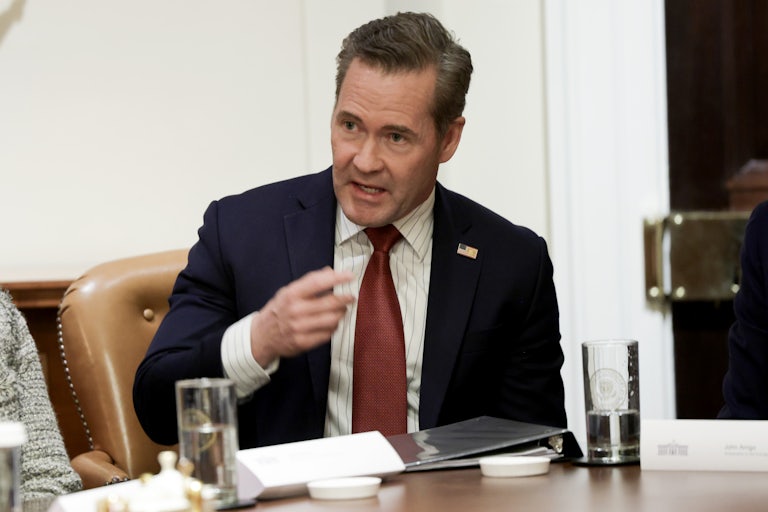
National Security Adviser Mike Waltz gestures while speaking in a meeting at the White House
Win McNamee/Getty Images

Signalgate seems to have been the norm for national security adviser Mike Waltz, rather than the exception.

Waltz’s team had set up at least 20 Signal group chats dedicated to discussing international crises, Politico reported Wednesday. His staff “regularly” leaned on the retail app to coordinate work on issues in Ukraine, China, Gaza, the Middle East, Africa, and Europe, according to four people who had been added to the chats.

All four sources that spoke with the publication said they witnessed instances of “sensitive information” being discussed, reported Politico’s White House bureau chief Dasha Burns.

Waltz’s emerging national security scandals have made him less than popular in the White House. Last month, Waltz made Donald Trump furious by accidentally inviting a journalist to a Cabinet group chat on Signal about bombing Yemen.

In the days after the initial scandal broke, Wired reported that an account sharing the intelligence official’s name had seemingly left his Venmo profile public. In doing so, Waltz disclosed the names of hundreds of his personal and professional associates, including government officials and lobbyists.

Last week, the German newspaper Der Spiegel reported that Waltz was among several senior administration officials who had their personal data, such as account passwords, email addresses, and personal cell phone numbers, listed online.

If that weren’t bad enough, The Washington Post reported Tuesday that Waltz and his team had been relying on Gmail—a platform even less secure than Signal—to discuss “sensitive military positions and powerful weapons systems relating to an ongoing conflict.”

A Harvard CAPS/Harris poll released Sunday suggested that 60 percent of polled Americans felt that the administration’s decision to use Signal to conduct highly sensitive government business was “wrong”—that included 73 percent of Democrats, 65 percent of independents, and 43 percent of Republicans.

A YouGov survey published last week found that 53 percent of nearly 6,000 polled Americans felt that the Trump administration’s Signal leak was “very serious,” while another 21 percent described it as “somewhat serious.”

It remains to be seen how Americans will feel about the other 19 Signal chats.

Trump’s Mass Deportation Chaos Gets Brutal Review in New Poll

Most Americans hate Trump’s haphazard deportations of immigrants.

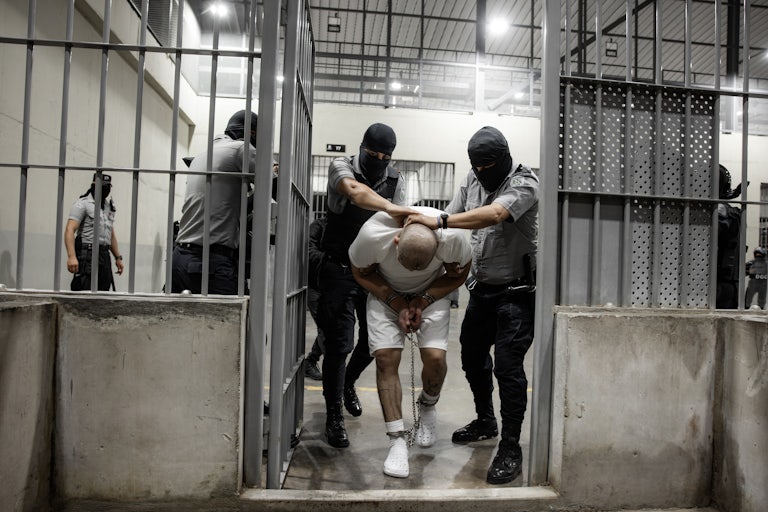
Masked men shove a hundcuffed man behind bars at El Salvador’s megaprison after he was deported from the United States.
Salvadoran Government/Getty Images

Donald Trump’s mass deportation efforts, which have skirted numerous laws and denied due process to immigrants, are very unpopular with the American people. 

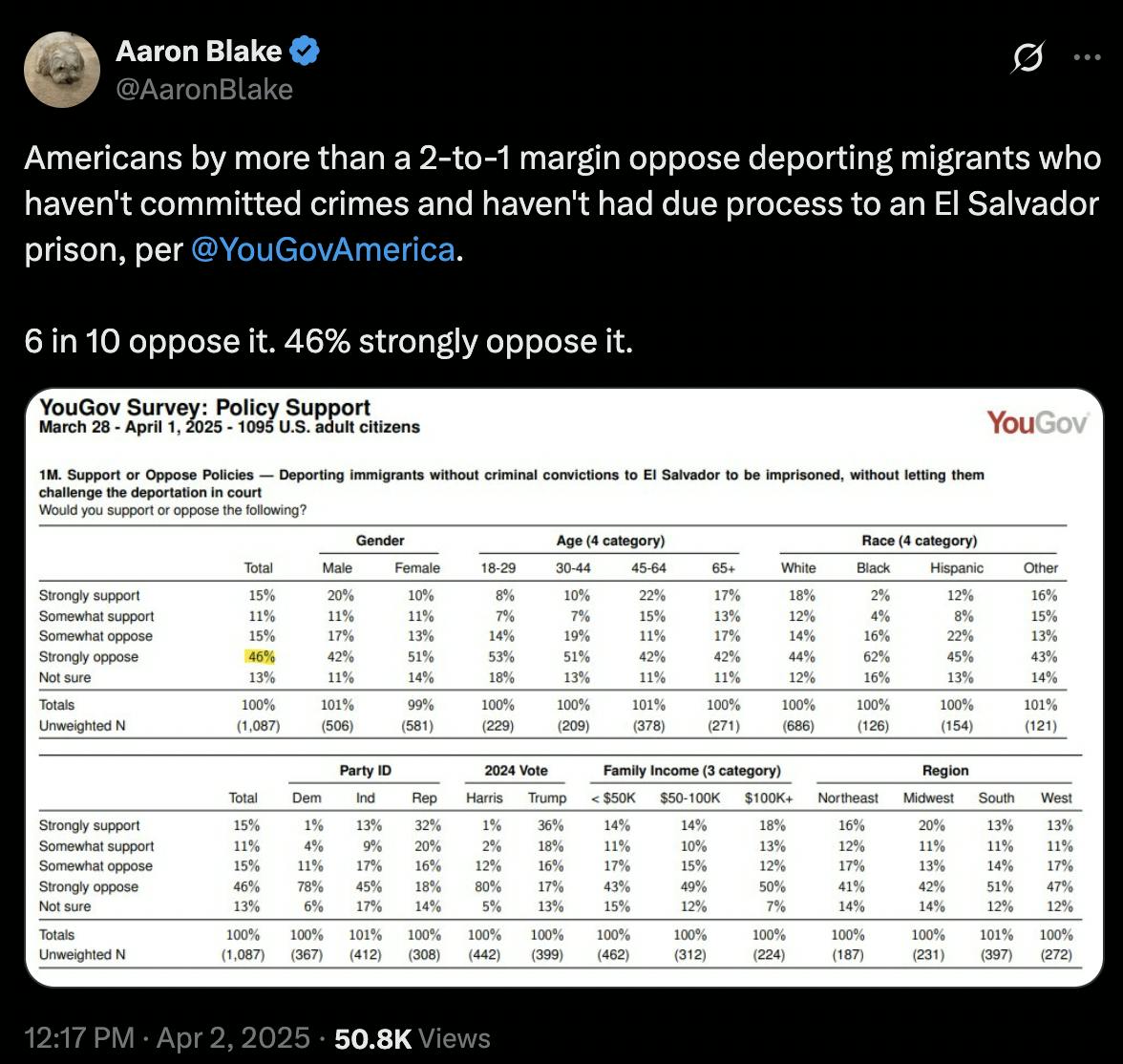
A new poll from YouGov states that 60 percent of respondents oppose deporting immigrants without criminal convictions to El Salvador without them having a chance to challenge their deportation in court, and 46 percent strongly oppose it. But the opposition to Trump’s El Salvador plan breaks down on party lines: 89 percent of Democrats and 62 percent of independents oppose it, while just 34 percent of Republicans do. 

X screenshot Aaron Blake
@AaronBlake
Americans by more than a 2-to-1 margin oppose deporting migrants who haven't committed crimes and haven't had due process to an El Salvador prison, per @YouGovAmerica
.

6 in 10 oppose it. 46% strongly oppose it.

(with screenshot of poll results)

The plan has been rebuked in federal court and resulted in restraining orders against the Trump administration, which is trying to ignore them by invoking the Alien Enemies Act. In one case, a person with no criminal record, Venezuelan national Kilmer Armado Abrego Garcia, was deported to El Salvador due to an administrative error, and press secretary Karoline Leavitt continued to insist he was a hardened gang member with no evidence. Administration officials are even reluctant to fix their mistake.  

The Trump administration has bragged about deporting dangerous members of violent gangs such as MS-13 and Tren de Aragua, but in reality has based those allegations on weak evidence, such as tattoos. Homeland Security Secretary Kristi Noem even used El Salvador’s Centro de Confinamiento del Terrorismo prison as a sick backdrop for a propaganda video that she posted on social media. 

Not content with one illegal deportation plan, Trump wants to start deporting immigrants to other countries, discussing plans with Benin, Eswatini, Kosovo, Libya, Moldova, Mongolia, and Rwanda. But given how unpopular deporting immigrants to El Salvador is, sending migrants to other legal black holes is not likely to gain the president any supporters and will likely hurt his poll numbers further. With recent elections not going his way, the sensible thing for Trump to do would be to slow down, but he’s not known for doing that.

Trump Press Secretary Reacts to Report That Musk Is on His Way Out

Karoline Leavitt has responded to the news that Trump warned his own Cabinet that Elon Musk won’t be around for much longer.

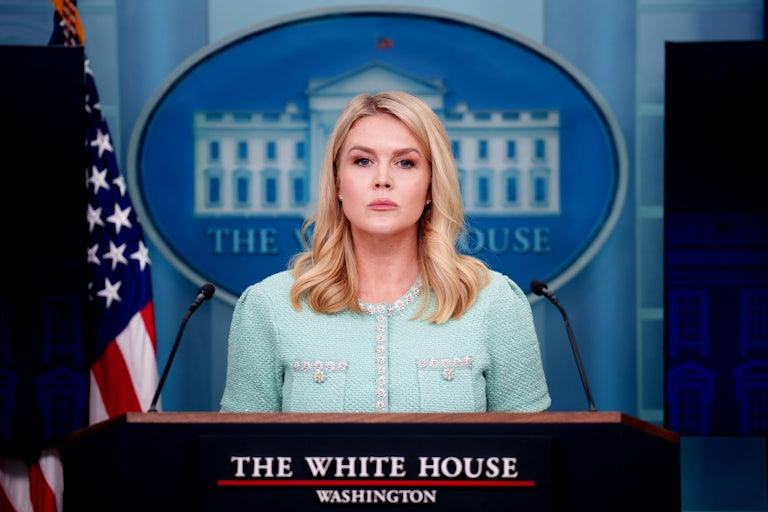
White House press secretary Karoline Leavitt in the White House press briefing room.
Andrew Harnik/Getty Images

White House press secretary Karoline Leavitt thinks that reports of Elon Musk’s potential leave of absence from the Trump administration are “garbage.”

A story Wednesday from Politico’s Rachael Bade posits that Trump has communicated to his inner circle that although he isn’t displeased with Musk’s performance as the federal government’s malevolent auditor, the two men mutually decided that it was time for Musk to “return to his businesses and take on a supporting role,” according to three anonymous insiders.

Some speculate that Musk’s current business failings are the cause for the shift. Others note that it might be intended to preempt any future liability Musk and his strangeness may pose to the administration. Either way, Leavitt swears that none of it is true.

“This ‘scoop’ is garbage,” Leavitt wrote on X about an hour after Bade’s story broke. “Elon Musk and President Trump have both *publicly* stated that Elon will depart from public service as a special government employee when his incredible work at DOGE is complete.”

There are no further details on the timeline of Musk’s departure, what exactly Musk’s “supporting role” would be, or how it’s any different from what he’s doing now.