Breaking News
Breaking News
from Washington and beyond

Epstein Lawyer Alan Dershowitz’s Latest Target: A Farmers Market

Dershowitz thinks a pierogi seller who refused him service is part of a culture that is “worse than McCarthyism.”

Alan Dershowitz walks outside a Manhattan court room beside Rudy Giuliani
Sarah Yenesel/EPA/Bloomberg/Getty Images
Alan Dershowitz at Donald Trump’s 2024 fraud trial

Alan Dershowitz has fought many battles over the course of his legal career. He has fought on behalf of O.J. Simpson, Jeffrey Epstein, and Donald Trump. Now he will fight for himself—against a pierogi seller at a Martha’s Vineyard farmers market who was mean to him.

During Wednesday’s episode of the Dershow podcast (that’s what it’s actually called), the constitutional attorney announced his intent to sue a pierogi vendor at the West Tisbury Farmers Market in Massachusetts after the man refused to fork over the dumplings.

“I don’t approve of your politics, I don’t approve of who you’ve represented, I don’t approve of who you support,” Dershowitz recalled the man saying.

Dershowitz recounted that he’d earned strange looks from the same man when he’d visited the stall the week before wearing a T-shirt identifying him as a “Proud Zionist.”

“The clear implication was that he opposed me because I defended Donald Trump and because I was a Zionist,” Dershowitz claimed.

In a video of the incident posted to social media, a police officer informed a distraught Dersh that private establishments have the right to refuse service. While private establishments are barred from discrimination on the basis of sex, race, or religion, political affiliation is not a protected attribute, and neither is defending an alleged sex trafficker with ties to the president.

Three different vendors had made complaints about Dershowitz, the officer said.

On his podcast, Dershowitz said that he would sue the farmers market to adopt a policy to sell to everyone.

He also explained that the insidious bigotry he’d experienced had spread even beyond the farmers market stall: His books had been banned from the libraries, and he’d been  blacklisted from speaking at the synagogue.

“It’s worse than McCarthyism of the 1950s, because McCarthyism of the 1950s went after the people themselves—the communists, the lawyers who represented the communists,” he said. “In Chilmark, they go after my wife, they go after my children, they go after my grandchildren, and they take it out on everybody.”

This isn’t the first time that Dershowitz has claimed McCarthyism has come for Martha’s Vineyard. In 2018, he penned an op-ed for The Hill claiming that he had been shunned from the island’s social scene.
Does Trump’s Interior Secretary Know What a Battery Is?

Doug Burgum seemed baffled by the concept of solar energy, which he apparently thinks doesn’t work at night.

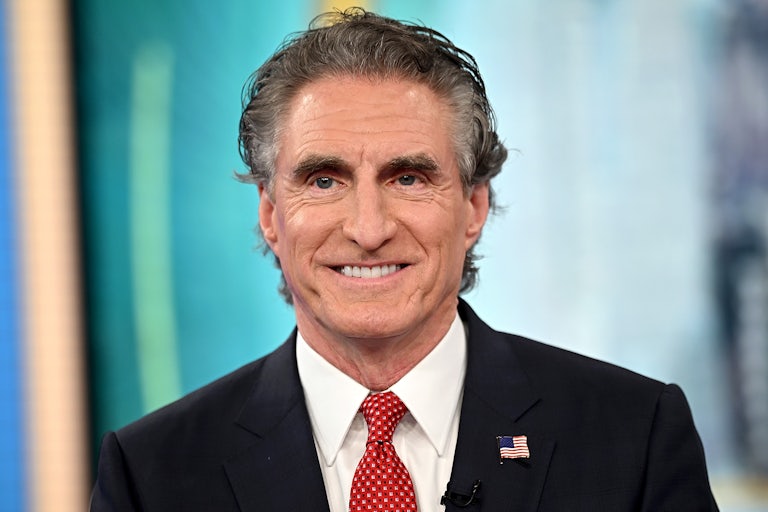
Doug Bergum smiles in a TV studio
Photo by Steven Ferdman/Getty Images
Doug Bergum in 2024

Interior Secretary Doug Burgum thinks that solar energy is a bad idea because sometimes it’s night.

During an appearance on Fox Business Thursday morning, Burgum showcased his dim understanding about wind and solar energy while railing against green energy subsidies.

“We’ve had times where, in the last couple of days, in spite of the hundreds of billions of dollars this country has spent on wind, we only had like 1 percent, or 2 percent of electricity being generated by wind,” Burgum said. “And of course, when the sun goes down, you have a catastrophic failure called sunset and there’s no solar energy produced, and yet we’re subsidizing these things that are intermittent, unreliable, and expensive.”

It was Burgum’s easy dismissal of the earth’s primary energy source as “intermittent” or “unreliable” that rang particularly ridiculous, leading some online to question whether the failed presidential candidate had forgotten about the existence of batteries.

In North Dakota, where Burgum previously served as governor, renewable energy, including wind and solar, account for more than 40 percent of the state’s electricity, according to recent data from the Energy Information Administration.

While Burgum backs Trump’s efforts to strip renewable energy projects as part of the path toward energy dominance, China has doubled down on its solar power investments.

Earlier this month, Trump issued an executive order to “end market distorting subsidies” for green energy projects, directing Treasury Secretary Scott Bessent to take actions to “strictly enforce the termination of the clean electricity production and investment tax credits.” That order flew in the face of the president’s own behemoth budget bill, which included an amendment to ease the phaseout of tax credits for solar and wind energy under the Biden-era Inflation Reduction Act until 2027. It’s tough luck trusting the president.

This week, the Interior Department announced that it would end “special treatment for unreliable energy sources, such as wind,” in accordance with Trump’s directives. The department would also conduct a “careful review of avian mortality rates,” following the president’s many rants that windmills kill birds, which they do, but no more than fossil fuel operations—or house cats. Earlier this week, the president also claimed that offshore windmills were driving whales “loco.”

Mexican President Gets Trump to Cave Yet Again on Tariffs Deadline

The “world’s leading Trump whisperer” strikes again.

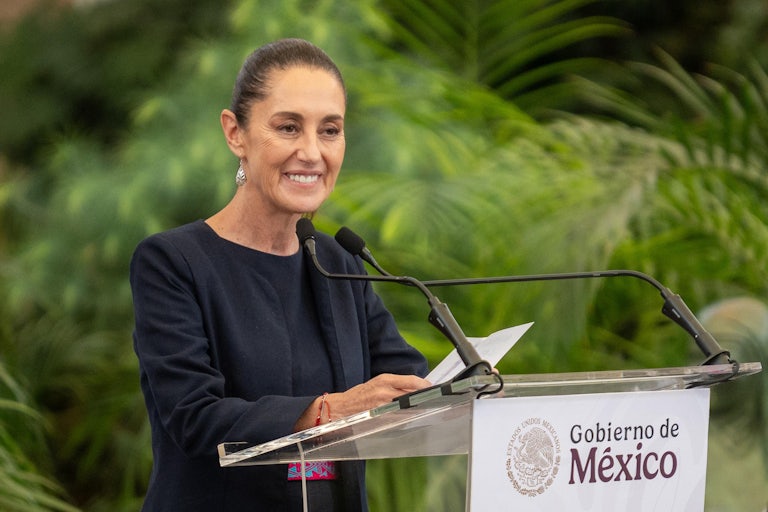
Mexico President Claudia Sheinbaum
Juan Abundis/ObturadorMX/Getty Images

Mexico’s President Claudia Sheinbaum has, yet again, managed to punt Donald Trump’s on-again, off-again tariff deadline down the road.

“I have just concluded a telephone conversation with the President of Mexico, Claudia Sheinbaum, which was very successful in that, more and more, we are getting to know and understand each other,” wrote Trump on Truth Social on Thursday. “The complexities of a Deal with Mexico are somewhat different than other Nations because of both the problems, and assets, of the Border,” he continued.

“We have agreed to extend, for a 90 Day period, the exact same Deal as we had for the last short period of time, namely, that Mexico will continue to pay a 25% Fentanyl Tariff, 25% Tariff on Cars, and 50% Tariff on Steel, Aluminum, and Copper. Additionally, Mexico has agreed to immediately terminate its Non Tariff Trade Barriers, of which there were many,” Trump wrote, without specifying what “Non Tariff Trade Barriers” would be affected.

Sheinbaum now has 90 more days of the current tariff levels to reach a trade deal with the U.S., according to Trump’s post.

Trump had promised Friday, August 1 as the deadline for implementing a 30 percent tariff on America’s southern neighbor and largest trading partner. But despite his assurances that this deadline is a hard one, Sheinbaum has succeeded in negotiating her way out of the ultimatum.

It’s not the first time: In March, Trump delayed tariffs against Mexico and Canada after a conversation with Sheinbaum, calling her a “very wonderful woman.” The deft negotiation on Sheinbaum’s part earned her the nickname of “world’s leading Trump whisperer” from The Washington Post.

As of now, the Friday deadline remains for countries around the world to come to a deal with Trump or risk incurring so-called “reciprocal” tariffs of up to 50 percent. But whether these tariffs will actually go into effect is yet to be seen—and the finance sector doesn’t seem too convinced. Back in April, after the president announced his shocking “Liberation Day” tariffs across the globe, stocks plummeted and many economists promised a recession.

But then Trump backed down, earning his policies the nickname “TACO”: Trump Always Chickens Out. This time, the boy who cried tariffs has yet to strike fear into the heart of the market, with Wall Street investors predicting—well, exactly what just happened.

Pam Bondi Rewrites DOJ Funding Rules to Benefit White People

Trump’s Justice Department is taking its war on DEI to a new level.

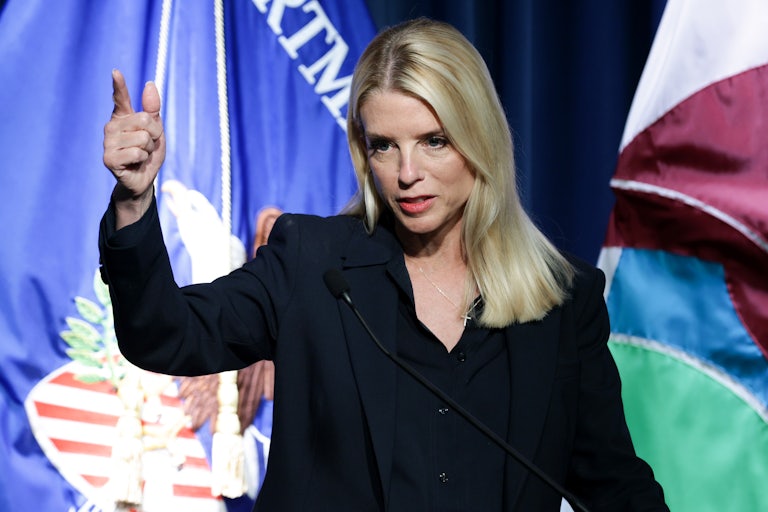
Pam Bondi
Alex Wong/Getty Images

Attorney General Pam Bondi on Wednesday issued a memo ordering recipients of federal funding to scrap a stunning array of “diversity, equity, and inclusion” initiatives—including antidiscrimination protections.

It’s the latest move by the Trump administration to eliminate DEI programs meant to address inequities stemming from historical injustices such as discrimination, on the grounds that they themselves amount to discrimination.

The new guidance, per Bondi, applies to all federally funded entities or those “otherwise subject to federal antidiscrimination laws, including educational institutions, state and local governments, and public and private employers.” It describes various practices they must do away with in order to comply with the administration’s interpretation of civil rights law and maintain federal funding.

The memo offers specific examples. To give a taste: A state agency that prioritizes awarding contracts to women-owned or minority-owned businesses will be engaged in unlawful practices. As will institutions that mandate or “implicitly prioritize” “diverse slate” hiring or selection practices.

Also to be eliminated are scholarships, internships, and other programs limiting eligibility to certain protected groups (the memo offers the example of a “Black Student Excellence Scholarship”), as well as employee training programs that “single out, demean, or stereotype individuals” (for example, by including phrases like “toxic masculinity”).

According to the memo, college lounges or other facilities designated for students belonging to certain identity groups, “even if access is technically open for all,” can constitute unlawful segregation. But “while compelled segregation is generally impermissible,” Bondi adds, allowing transgender people to use bathrooms or participate on sports teams according to their gender identity “can also violate federal law.”

A Random House in Virginia Just Won $1.26 Billion From ICE

How did this even happen?

U.S. Department of Homeland Security seal
Kevin Carter/Getty Images

A $1.26 billion contract to build the nation’s largest detention center was awarded to a little-known Virginia company—which doesn’t even have an office.

On July 18, the Acquisition Logistics Company won a federal contract to build and operate a detention center in El Paso County, Texas, at the Fort Bliss Army base.

But according to The Richmonder, the company is “not a household name”: Its website is largely inaccessible without a login, it only has 39 employees (according to ZoomInfo), and its headquarters is listed as a regular house in a suburban Richmond neighborhood called Tuckahoe.

Acquisition Logistics Company was awarded the contract through a government program that directs federal dollars to small businesses, according to Bloomberg. Founded by a retired Navy officer in 2008, it specializes in supply chain management, mostly for the U.S. military, and has had previous, far smaller contracts with the Defense Department.

The company’s CEO and founder, Kenneth Wagner, and COO Darrin Armentrout didn’t respond to The Richmonder’s request for comment. When called, Wagner picked up the phone—and promptly hung up.

The 5,000-bed Texas tent camp they are tasked with building would be the biggest in the nation, and has unsurprisingly sparked concerns among immigration advocates.

“It’s very hard to imagine how soft-sided facilities could satisfy even the low detention standards that are reflected in ICE’s most recent standards,” Emma Winger, deputy legal director at the American Immigration Council, told Bloomberg in July.

Advocates like Winger have serious reason to doubt the setup: Recent reports from ICE detention facilities paint a horrifying and inhumane picture of the conditions, with immigrants treated “like dogs” at several Florida facilities. For scale, “Alligator Alcatraz,” Trump’s hastily erected, bug-infested tent camp, has 700 beds. The El Paso camp would have over seven times that.

And in addition to the inherent inhumanity of imprisoning people in modern-day concentration camps, the new behemoth center would be run by a company with no experience managing a detention facility, nor handling a project of this financial weight: This contract would be 442 times larger than the size of Acquisition Logistics Company’s last published contract, according to The Richmonder.