Breaking News
Breaking News
from Washington and beyond

Tuberville Wants to Ban International Students From These Countries

Republican Senator Tommy Tuberville thinks international students are “funding our own demise.”

Senator Tommy Tuberville points a finger at the camera as he walks in the Capitol.
Graeme Sloan/Bloomberg/Getty Images

During a Thursday Fox Business appearance, Alabama Senator and gubernatorial candidate Tommy Tuberville announced that he’s introducing a bill to ban international students from Iran, China, and North Korea.

Tuberville recalled attending a recent graduation ceremony whose program, he said, included “40 Chinese nationals [getting] their degree in engineering and cyber,” leading him to the conclusion: “We are funding our own demise.”

“We have to do everything we possibly can to penalize universities that drop the ball on this agenda because if we don’t do that, we are not going to educate our kids,” Tuberville said.

The senator also claimed that international students are displacing American students, who “apply, but they can’t get in because there’s no slots for them, because of all the foreign nationals coming in.” To that end, he said his bill includes provisions to limit the total number of international students, while the focus is to keep students from rival countries out.

“We want to make sure we limit the number that comes in,” he said. “But we surely want to limit our adversaries. We want to do away with Iran, North Koreans, or Chinese nationals getting into this country and learning how to destroy the United States of America and our allies.”

Tuberville’s proposal to exclude students on the basis of national origin is so paranoid and nativist as to be absurd. A flood of North Korean students isn’t exactly a serious concern for the United States, which has, reportedly, not since the 2015–2016 school year welcomed a number of students from the People’s Republic that exceeds the single digits.

It’s also simply untrue that foreign students impede the education of American students, as evidence indicates that they are a great boon to the U.S. higher education system.

As the Brookings Institution notes, international students constitute a small minority of U.S. enrollment while contributing disproportionately to college and university budgets, namely in paying higher tuition. They also greatly support their surrounding communities. Removing international students, then, would hurt the economy, “add much to the trade deficit, harm many college budgets, and badly damage businesses in many college towns.”

Further, by subsidizing the cost of domestic students, “international students actually raise domestic enrollment,” according to a 2017 study by economist Kevin Shih, who analyzed periods where foreign enrollment underwent significant booms and busts. Shih estimates that when enrollment increases by 10 additional international students, domestic enrollment increases by about eight—a pattern that holds true as well for enrollment decreases.
Trump’s Tariff Plan Suddenly at Risk One Day Before Deadline

Federal judges are questioning Trump’s power to impose tariffs whenever he wants.

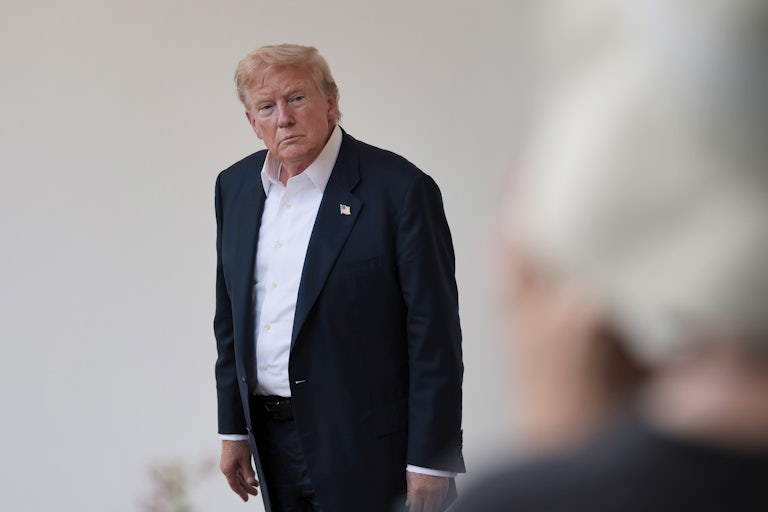
Donald Trump leaning forward slightly with hunched shoulders.
Anna Moneymaker/Getty Images
Why does Donald Trump stand like this?

One day before Donald Trump’s worldwide tariffs are slated to go into effect, an appeals court is scrutinizing his use of an “emergency” law to justify the sweeping duties.

On Thursday, the U.S. Court of Appeals for the Federal Circuit heard oral arguments on the legality of the tariffs—a high-stakes lawsuit, brought by 12 Democrat-led states and five small businesses, which could derail the president’s tariff scheme.

Since February, Trump has justified his tariffs by citing the International Emergency Economic Powers Act, or IEEPA, a law from 1977 that allows the president to issue economic sanctions in an emergency situation: specifically, to counter an “unusual and extraordinary threat.” Trump’s use of the law allows him to sidestep Congress, which is granted the power to impose tariffs by the Constitution.

He’s the first-ever president to impose tariffs by invoking the emergency law—something many of the appeals judges pointed out.

“It’s just hard for me to see that Congress intended to give the president in IEEPA the wholesale authority to throw out the tariff schedule that Congress has adopted after years of careful work and revise every one of these tariff rates,” said Judge Timothy Dyk. “It’s really kind of asking for an extraordinary change to the whole approach,” he continued.

The act has forced Trump to create so-called emergencies that his tariffs must mitigate. In March, Trump said that the fentanyl emergency was the reason behind his tariffs on Canada, China, and Mexico. In April, he upped the ante and levied a 10 percent global baseline tariff, naming the emergency in question as the trade deficit.

But one judge, Raymond Chen, pushed back on that reasoning: “Can the trade deficit be an extraordinary and unusual threat when we have had trade deficits for decades?”

Overall, CNN reports that 10 out of 11 judges on Thursday were skeptical of the president’s use of the act, questioning why Trump is leaning on a law that makes no reference to tariffs and has never before been used to levy them.

Judge Jimmie Reyna asked, “But IEPPA has been rarely used, hasn’t it? It’s been over 50 years since it’s been used?”

He continued, “IEEPA doesn’t even say tariffs, doesn’t even mention them.”

The U.S. Court of International Trade sided against the president in May, and the administration quickly appealed. The appeals court has allowed Trump’s tariffs to remain in place while the case is being challenged. Depending on the court’s ruling—which, as of now, is not looking too good for Trump—the tariffs’ future could be left in the increasingly partisan hands of the Supreme Court.

Epstein Lawyer Alan Dershowitz’s Latest Target: A Farmers Market

Dershowitz thinks a pierogi seller who refused him service is part of a culture that is “worse than McCarthyism.”

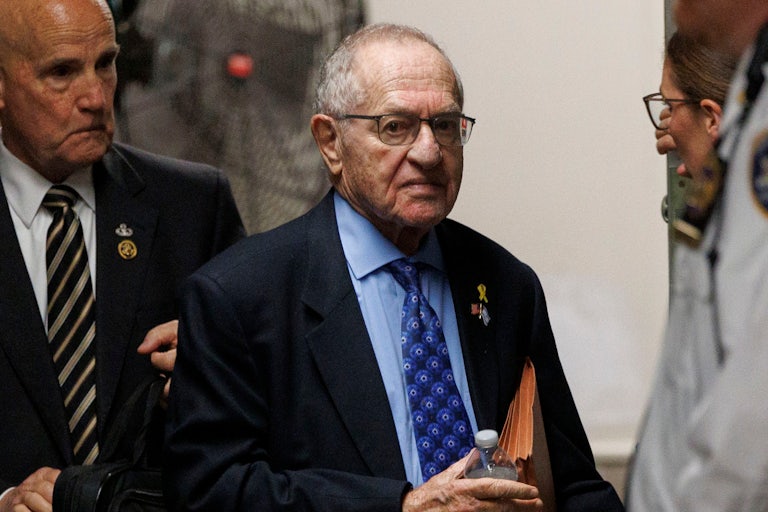
Alan Dershowitz walks outside a Manhattan court room beside Rudy Giuliani
Sarah Yenesel/EPA/Bloomberg/Getty Images
Alan Dershowitz at Donald Trump’s 2024 fraud trial

Alan Dershowitz has fought many battles over the course of his legal career. He has fought on behalf of O.J. Simpson, Jeffrey Epstein, and Donald Trump. Now he will fight for himself—against a pierogi seller at a Martha’s Vineyard farmers market who was mean to him.

During Wednesday’s episode of the Dershow podcast (that’s what it’s actually called), the constitutional attorney announced his intent to sue a pierogi vendor at the West Tisbury Farmers Market in Massachusetts after the man refused to fork over the dumplings.

“I don’t approve of your politics, I don’t approve of who you’ve represented, I don’t approve of who you support,” Dershowitz recalled the man saying.

Dershowitz recounted that he’d earned strange looks from the same man when he’d visited the stall the week before wearing a T-shirt identifying him as a “Proud Zionist.”

“The clear implication was that he opposed me because I defended Donald Trump and because I was a Zionist,” Dershowitz claimed.

In a video of the incident posted to social media, a police officer informed a distraught Dersh that private establishments have the right to refuse service. While private establishments are barred from discrimination on the basis of sex, race, or religion, political affiliation is not a protected attribute, and neither is defending an alleged sex trafficker with ties to the president.

Three different vendors had made complaints about Dershowitz, the officer said.

On his podcast, Dershowitz said that he would sue the farmers market to adopt a policy to sell to everyone.

He also explained that the insidious bigotry he’d experienced had spread even beyond the farmers market stall: His books had been banned from the libraries, and he’d been  blacklisted from speaking at the synagogue.

“It’s worse than McCarthyism of the 1950s, because McCarthyism of the 1950s went after the people themselves—the communists, the lawyers who represented the communists,” he said. “In Chilmark, they go after my wife, they go after my children, they go after my grandchildren, and they take it out on everybody.”

This isn’t the first time that Dershowitz has claimed McCarthyism has come for Martha’s Vineyard. In 2018, he penned an op-ed for The Hill claiming that he had been shunned from the island’s social scene.

Does Trump’s Interior Secretary Know What a Battery Is?

Doug Burgum seemed baffled by the concept of solar energy, which he apparently thinks doesn’t work at night.

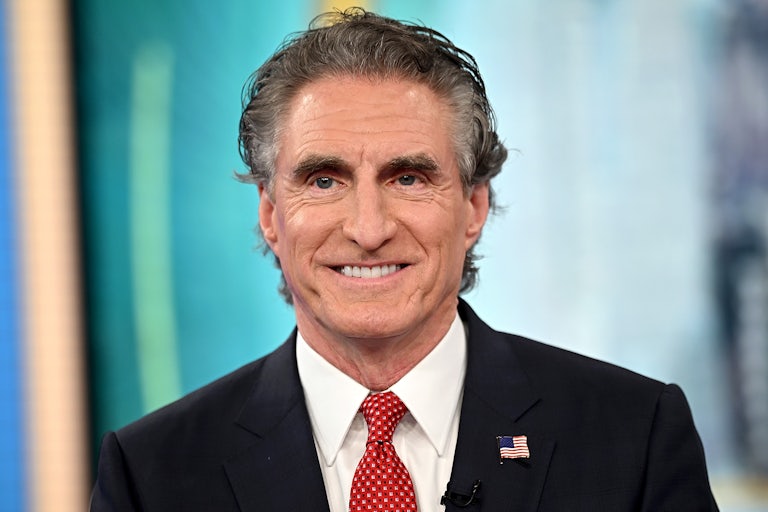
Doug Bergum smiles in a TV studio
Photo by Steven Ferdman/Getty Images
Doug Bergum in 2024

Interior Secretary Doug Burgum thinks that solar energy is a bad idea because sometimes it’s night.

During an appearance on Fox Business Thursday morning, Burgum showcased his dim understanding about wind and solar energy while railing against green energy subsidies.

“We’ve had times where, in the last couple of days, in spite of the hundreds of billions of dollars this country has spent on wind, we only had like 1 percent, or 2 percent of electricity being generated by wind,” Burgum said. “And of course, when the sun goes down, you have a catastrophic failure called sunset and there’s no solar energy produced, and yet we’re subsidizing these things that are intermittent, unreliable, and expensive.”

It was Burgum’s easy dismissal of the earth’s primary energy source as “intermittent” or “unreliable” that rang particularly ridiculous, leading some online to question whether the failed presidential candidate had forgotten about the existence of batteries.

In North Dakota, where Burgum previously served as governor, renewable energy, including wind and solar, account for more than 40 percent of the state’s electricity, according to recent data from the Energy Information Administration.

While Burgum backs Trump’s efforts to strip renewable energy projects as part of the path toward energy dominance, China has doubled down on its solar power investments.

Earlier this month, Trump issued an executive order to “end market distorting subsidies” for green energy projects, directing Treasury Secretary Scott Bessent to take actions to “strictly enforce the termination of the clean electricity production and investment tax credits.” That order flew in the face of the president’s own behemoth budget bill, which included an amendment to ease the phaseout of tax credits for solar and wind energy under the Biden-era Inflation Reduction Act until 2027. It’s tough luck trusting the president.

This week, the Interior Department announced that it would end “special treatment for unreliable energy sources, such as wind,” in accordance with Trump’s directives. The department would also conduct a “careful review of avian mortality rates,” following the president’s many rants that windmills kill birds, which they do, but no more than fossil fuel operations—or house cats. Earlier this week, the president also claimed that offshore windmills were driving whales “loco.”

Mexican President Gets Trump to Cave Yet Again on Tariffs Deadline

The “world’s leading Trump whisperer” strikes again.

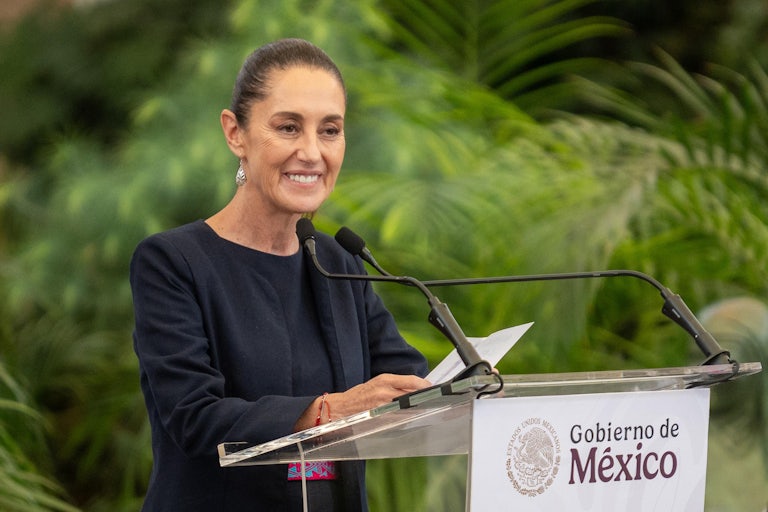
Mexico President Claudia Sheinbaum
Juan Abundis/ObturadorMX/Getty Images

Mexico’s President Claudia Sheinbaum has, yet again, managed to punt Donald Trump’s on-again, off-again tariff deadline down the road.

“I have just concluded a telephone conversation with the President of Mexico, Claudia Sheinbaum, which was very successful in that, more and more, we are getting to know and understand each other,” wrote Trump on Truth Social on Thursday. “The complexities of a Deal with Mexico are somewhat different than other Nations because of both the problems, and assets, of the Border,” he continued.

“We have agreed to extend, for a 90 Day period, the exact same Deal as we had for the last short period of time, namely, that Mexico will continue to pay a 25% Fentanyl Tariff, 25% Tariff on Cars, and 50% Tariff on Steel, Aluminum, and Copper. Additionally, Mexico has agreed to immediately terminate its Non Tariff Trade Barriers, of which there were many,” Trump wrote, without specifying what “Non Tariff Trade Barriers” would be affected.

Sheinbaum now has 90 more days of the current tariff levels to reach a trade deal with the U.S., according to Trump’s post.

Trump had promised Friday, August 1 as the deadline for implementing a 30 percent tariff on America’s southern neighbor and largest trading partner. But despite his assurances that this deadline is a hard one, Sheinbaum has succeeded in negotiating her way out of the ultimatum.

It’s not the first time: In March, Trump delayed tariffs against Mexico and Canada after a conversation with Sheinbaum, calling her a “very wonderful woman.” The deft negotiation on Sheinbaum’s part earned her the nickname of “world’s leading Trump whisperer” from The Washington Post.

As of now, the Friday deadline remains for countries around the world to come to a deal with Trump or risk incurring so-called “reciprocal” tariffs of up to 50 percent. But whether these tariffs will actually go into effect is yet to be seen—and the finance sector doesn’t seem too convinced. Back in April, after the president announced his shocking “Liberation Day” tariffs across the globe, stocks plummeted and many economists promised a recession.

But then Trump backed down, earning his policies the nickname “TACO”: Trump Always Chickens Out. This time, the boy who cried tariffs has yet to strike fear into the heart of the market, with Wall Street investors predicting—well, exactly what just happened.