Breaking News
Breaking News
from Washington and beyond

ICE Barbie Says Antifa Is as Bad as ISIS in Deranged White House Event

Homeland Security Kristi Noem said this with a completely straight face.

Homeland Security Secretary Kristi Noem speaks at the White House antifa roundtable.
Anna Moneymaker/Getty Images

Secretary of Homeland Security Kristi Noem believes antifa is “just as dangerous” as ISIS.

In a White House roundtable discussion on “antifa” Wednesday, Noem spoke alongside President Donald Trump, Attorney General Pam Bondi, FBI Director Kash Patel, press secretary Karoline Leavitt, and a number of right-wing journalists and influencers about the president’s order designating antifa as a domestic terrorist organization.

“Their agenda is to destroy the American people and our way of life,” Noem said. “This network of antifa is just as sophisticated as MS-13, as [Tren de Aragua], as ISIS, as Hezbollah, as Hamas, as all of them. They are just as dangerous. They have an agenda to destroy us just like the other terrorists we’ve dealt with for many, many years, and today is the day that we have a president that won’t tolerate it.”

Just to catch everyone up, “antifa” is not an organized group, certainly not one with a “network as sophisticated as … ISIS.” During Trump’s first term, FBI Director Chris Wray told Congress that antifa was “not a group or an organization,” but a “movement” or “ideology.”

That hasn’t stopped the president’s sycophantic circle from blaming the movement for everything from the “decimation” of cities like Portland to the killing of Charlie Kirk.
Popular MAGA Influencer Illegally Donated to a Political Campaign

Rumen Naumovski has never even been to the United States.

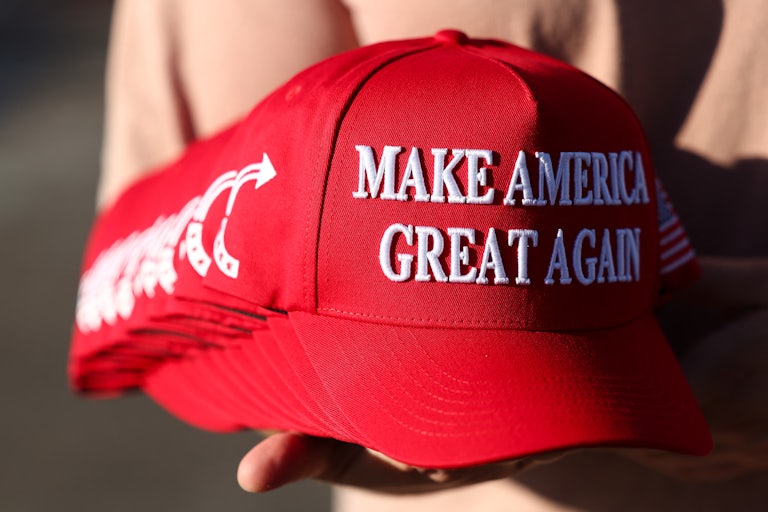
A person holds a stack of Make America Great Again hats.
Charly Triballeau/AFP/Getty Images

A prominent MAGA influencer with millions of followers who has “never stepped foot in the United States” illegally donated to a QAnon congressional candidate, independent journalist Jacqueline Sweet reported for Rolling Stone Wednesday.

Rumen Naumovski is behind Resist the Mainstream, a right-wing content farm that has accrued more than 450,000 followers on X since September 2021. He also runs the X account Defiant L’s, a right-wing meme and news account with more than four million followers that has been lauded by X owner Elon Musk as “one of the best accounts.”

In 2022, Naumovski illegally donated more than $3,000 to support far-right congressional candidate Ron Watkins, who has been accused of being “Q” himself. While Naumovski owns an American-based media company, he still resides in North Macedonia, and admitted in a February opinion piece for The Daily Wire that he’d actually “never set foot in the United States.”

Naumovski’s two donations totaling $3,127 were the largest reported contribution to Watkins’s campaign in the first quarter of 2022, according to Open Secrets. And in the weeks following the donations, Watkins urged his followers on social media to join Resist the Mainstream’s Telegram channel multiple times.

Both donations were made in February 2022 and are attributed to an address in St. Petersburg, Florida, at a registered agent’s office for Raww Digital LLC, the marketing firm that owns Resist the Mainstream. Naumovski owns Raww Digital LLC, but his personal address is listed in Veles, North Macedonia.

Watkins eventually returned the money in April 2022. Naumovski told Rolling Stone that he had no idea he’d needed a green card to make donations to a political campaign. Foreign nationals are in fact barred from making contributions for a political campaign.

Media Matters reported in 2023 that a dozen influencers connected to the QAnon movement boosted Resist the Mainstream and that, despite being taken on and off mainstream social media platforms, the right-wing network had accrued a massive following in alternative spaces—platforms such as Truth Social, Rumble, Gab, and Gettr.

Naumovski’s social media accounts have become fixtures in the online landscape of MAGA Republicans, and their posts have been shared by figures including Andy Biggs, Dan Crenshaw, Eli Crane, Mike Lee, and Nancy Mace, as well as other prominent MAGA influencers. The accounts have shared content pushing election fraud conspiracies about noncitizen voting, a nonissue that has been repeatedly debunked.

In Naumovski’s case, it’s more than clear that there are some noncitizens attempting to interfere in U.S. politics—but they come in the form of anonymous influencers churning out right-wing content and conducting hordes of followers.

Guess Which Two Cabinet Members Trump Advisers Hate the Most?

Donald Trump’s advisers are pretty clear on who they think will get fired first.

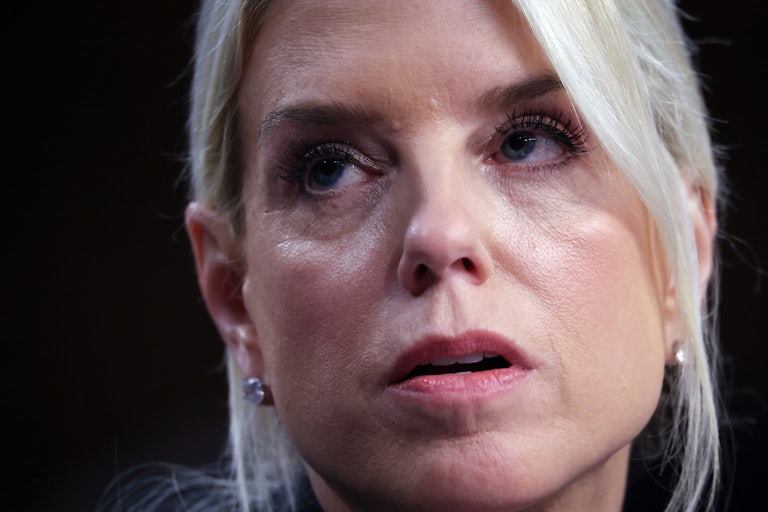
Attorney General Pam Bondi looks up while speaking in a Senate hearing
Win McNamee/Getty Images

Even the Trump administration doesn’t like Pam Bondi.

The attorney general has been at the epicenter of some of Trump 2.0’s biggest scandals. In the last several months, Bondi has purged antitrust officials at the Justice Department, refused to answer critical questions in defiance of Senate oversight hearing protocol, and—most egregious to the White House—sparked MAGA outrage when her own agency issued a memo contradicting her on the existence of Jeffrey Epstein’s so-called “client list.”

All considered, Bondi now ranks as the White House’s least favorite Cabinet secretary, according to an informal survey of several presidential advisers by Wired’s Inner Loop newsletter.

“Worst, Bondi,” they begin. “2/ Bondi. 3/ Bondi. 4/ Bondi. 5/ HegsethRFKTulsiNoem.”

Just one secretary shared the unwelcome spotlight: Commerce Secretary Howard Lutnick, who, like Bondi, has also fumbled the administration’s talking points about the president and his pedophilic sex trafficker ex–“best pal.” Breaking from the DOJ’s narrative, Lutnick described Epstein to the New York Post podcast as “the greatest blackmailer ever.” He also didn’t bother trying to make Trump’s cozy association with Epstein more palatable. Lutnick referred to Epstein as a repugnant creep while recalling an instance in which he was invited by Epstein to tour his infamous East 71st Street townhouse.

“I say to him, ‘Massage table in the middle of your house? How often do you have a massage?’” Lutnick told the Post. “And he says, ‘Every day.’ And then he gets, like weirdly close to me, and he says, ‘And the right kind of massage.’

“In the six to eight steps it takes to get from his house to my house, my wife and I decided that I will never be in the room with that disgusting person ever again,” he added.

None of the Trump advisers surveyed by Wired were willing to speak about the Trump-Epstein connection, or connect the dots between Bondi and Lutnick’s sagging popularity with their handling of the scandal.

The Epstein story has remained an anomaly in Trump’s political career. For the better part of a decade, the MAGA leader became adjusted to an undyingly loyal base that rarely skews from or challenges his political vision. But Trump’s proximity to Epstein and the disgraced financier’s heinous crimes has been an outlier, prompting doubts that have undercut Trump’s influence with large swaths of his followers.

The White House’s official spokesperson brushed off the Wired story, suggesting instead that Trump’s Cabinet are beyond reproach within MAGA’s inner folds.

“The entire premise of this story is ridiculous—which is to be expected for Wired,” White House spokesperson Abigail Jackson said in a statement. “The President’s entire cabinet is working to flawlessly execute his agenda to Make America Great Again and he is pleased with each of their successes and hard work.”

Why Was The Atlantic’s David Frum Working With Israel’s Ambassador?

Hacked emails reveal the magazine editor’s shady work with Israel’s U.N. ambassador.

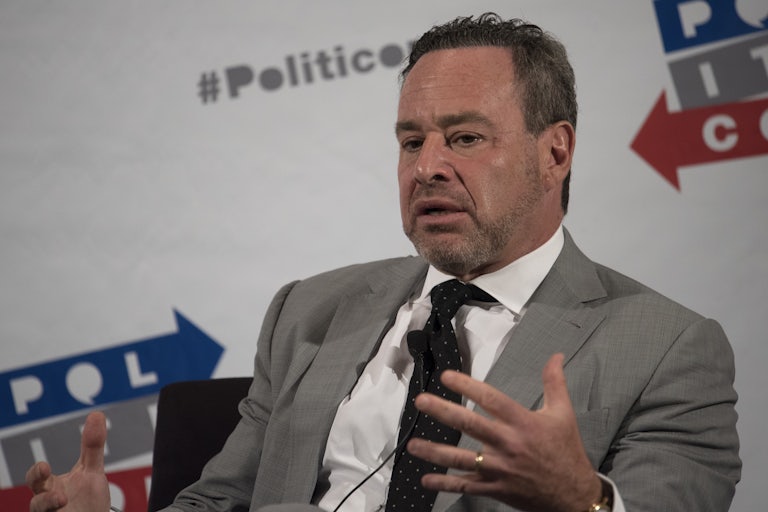
David Frum speaks at a panel.
Ronen Tivony/NurPhoto/Getty Images)
David Frum in 2017

David Frum, a senior editor at The Atlantic, helped ghostwrite a speech for the Israeli U.N. ambassador in 2014—at the same time as he profiled the ambassador for the magazine.

Frum’s galling, undisclosed conflict of interest was exposed via the ambassador’s hacked emails, first reported by Ryan Grim and Murtaza Hussain for Drop Site.

In 2014, Israel was in the midst of waging war in Gaza, ultimately killing over 2,200 Palestinians and wounding over 11,000. It was Israel’s most devastating campaign against the Palestinians since the 1967 war, according to UNRWA. As the country faced criticism for its conduct, allies like Frum reached out to Israeli government officials to offer their support in spinning the narrative, according to Drop Site.

In Frum’s case, he could offer more to the Israeli cause than just money or positive news coverage: Before coming to The Atlantic, he had been a speechwriter for George W. Bush.

Frum contacted Ambassador Ron Prosor on July 31, 2014, during the height of the war, in an email titled, “an earlier draft of that speech I sent you.” The speech, seemingly meant to be delivered to the U.N. Security Council, described the war as “the most tenacious challenge to the free world in decades,” and asked Americans to continue to support Israel. “This version was drafted by Seth Mandel of Commentary, with whom I’ve been working,” Frum wrote in his email.

Only one day before, Frum had contacted Prosor from a different email address, with a different request: to interview him for The Atlantic. The ensuing profile praised Prosor for his “toughness,” and painted a sympathetic portrait of Israel as unfairly maligned on the global stage. “In many ways, and on many days, it feels as if the whole UN system is concerned with the monitoring and critiquing of one small member nation,” Frum wrote.

It’s not known whether Prosor delivered Frum’s speech at the U.N. (Frum was competing with British journalist Douglass Murray for the honor, the leak also reveals). But to secretly draft a speech for a foreign government official, all the while rapturously profiling him from a place of presumed journalistic objectivity, is an egregious ethical breach.

Frum is still at The Atlantic, where he recently published a piece arguing against recognizing Palestine as a state.

In response to this story, The Atlantic’s Anna Bross told TNR in a statement, “David was not an employee of The Atlantic in 2014. He did not write the speech referenced in the 2014 email. He advised a friend, pro bono.

“This was 11 years ago. David has since become an employee of The Atlantic, and like all our editorial staff, follows our rigorous standards for the disclosure of potential conflicts. Of course, our staff writers are not allowed to advise political, corporate or diplomatic figures, pro bono or otherwise.”

While Frum may not have technically been an employee, as The Atlantic claims, he did hold the title of Senior Editor at the magazine while working on contract in 2014, at the time that he sent those emails to Prosor.

This story has been updated.

Editor’s Pick:

The New York Times Wins Right to Obtain Info Musk Wanted Kept Private

Elon Musk has suffered a major blow in a lawsuit over his government clearances.

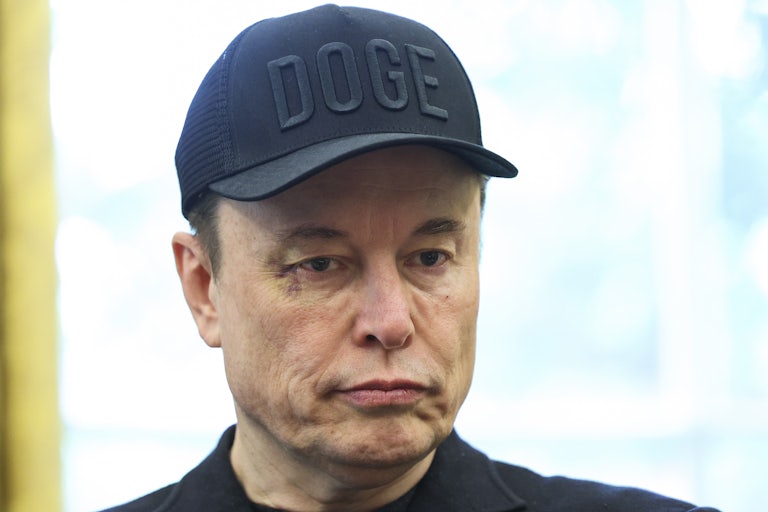
Elon Musk looks down while standing in the Oval Office
Tom Brenner/The Washington Post/Getty Images

The Pentagon has to provide The New York Times information about Elon Musk’s security clearances, a federal judge ruled Wednesday—and the billionaire’s own posting habits helped decide the case.

In September 2024, the Times filed a Freedom of Information Act request seeking “a list of security clearances” granted to Musk, including “any details about the extent and purview of each of the clearances.”

The Defense Counterintelligence and Security Agency, which handles security clearances, denied access, arguing that the “privacy interest” of Musk “outweighs disclosure.” Shortly thereafter, the Times took the DCSA to court.

U.S. District Judge Denise Cote ruled that Musk himself had reduced his privacy interest by publicly boasting that he holds a “top secret clearance”—and discussing his drug use (including ketamine and marijuana) and contacts with foreign leaders (including Russian President Vladimir Putin), both of which are factors that the DCSA is supposed to consider for security clearance decisions.

“His posts on X on these topics have collectively garnered over 2 million views,” Cote observed.

Moreover, the judge noted, the Times’ request was far from sweeping, covering only a single two-page list of the security clearances of the billionaire, who, as the former head of Trump’s Department of Government Efficiency, was granted “special government employee” status.

Outweighing Musk’s privacy interests is public interest in “whether the leader of SpaceX and Starlink holds the appropriate security clearances,” Cote said. Also, “courts have repeatedly recognized a public interest in understanding the thoroughness, fairness, and accuracy of government investigations and operations.”

Musk’s admissions about ketamine and the Kremlin “only enhance the public interest in disclosure,” the judge wrote, and the document could “provide meaningful insight” into the DCSA’s vetting processes.

If there are any further concerns about Musk’s privacy, Cote stated, the government can propose redactions for a private review by the court by next Friday.