Breaking News
Breaking News
from Washington and beyond

Ted Cruz Warns GOP of “Political Peril” After No Kings Protests

Even Cruz knows Republicans are in trouble come 2026.

Senator Ted Cruz
Chip Somodevilla/Getty Images

Republican Senator Ted Cruz warned his party of “political peril” in 2026 if the GOP doesn’t take the No Kings protests seriously. 

“Unquestionably we should take political peril seriously,” Cruz said on Monday on Bloomberg Television. “I think it’s bad for America when one of our two major political parties has gotten so extreme and radical the way the Democrats are. They’re a party that is unified behind hate for Donald Trump.” 

While the first part of Cruz’s warning falls into the same hyperbolic rhetoric that the GOP has been pushing about No Kings being an antifa meetup, the second half rang surprisingly true. 

“In terms of the midterms in 2026, it’s dangerous.… Substantively Republicans have a lot to campaign on,” he continued, citing things like the drop in illegal border crossings and the release of Israeli hostages. “That being said … there is a lot of energy, there is a lot of anger on the left, and elections can be dangerous when one side is mobilized, is angry.  I’ll tell you in terms of fundraising, the Democrats are raising a lot more money because their radicals hate Trump so much. And look, angry, energized voters show up to vote. And I do worry just about ordinary voters who are happy or complacent who say, ‘Gosh, Trump won, things are good, I don’t need to show up and vote.’ There’s no doubt that if one side shows up and the other doesn’t, that that leads to a bad election.” 

Even as they overexaggerate and misrepresent the Democrats—whose leadership is clearly center-left, at best—Cruz’s point shows that Republicans are paying attention to the size and scope of the No Kings rallies. But they just still can’t seem to figure out why everyone is so upset with President Trump. 
Republicans Set to Tank Trump Nominee After Nazi Texts Revealed

Senate Majority Leader John Thune said he hopes Trump withdraws the nomination of Paul Ingrassia.

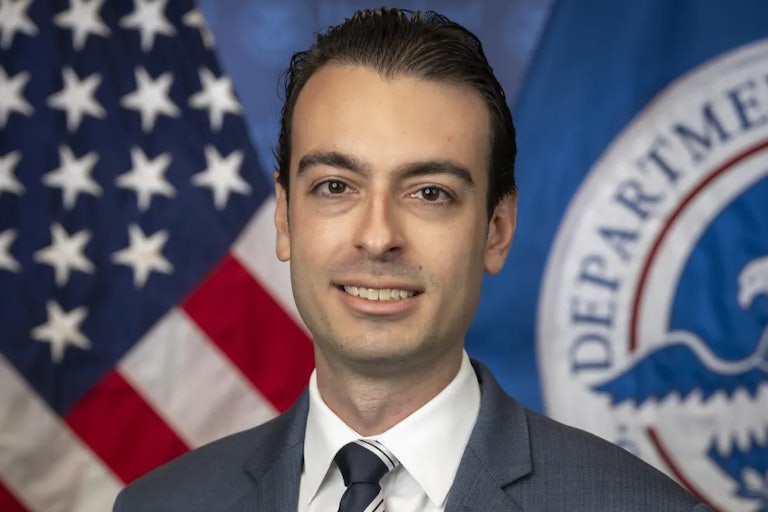
Paul Ingrassia's official DHS portrait
Department of Homeland Security

Paul Ingrassia—President Donald Trump’s nominee to head the Office of Special Counsel—may not be confirmed after his racist and antisemitic messages were unearthed Monday by Politico, leading some Republican senators to repudiate him.

In the private text messages, Ingrassia, a MAGA attorney and podcaster, said he has a “Nazi streak” and that he believes Martin Luther King Jr. Day ought to be “tossed into the seventh circle of hell.” He also called for an end to other holidays that celebrate Black history, which he referred to using an Italian slur for Black people.

While Ingrassia has an extensive public record of MAGA extremism, these private messages were a bridge too far for some Senate Republicans.

One of them is Majority Leader John Thune, who told reporters Monday night that Ingrassia is “not going to pass,” and that he hopes the White House withdraws his nomination.

Senator Rick Scott similarly said, “I don’t plan on voting for him.” Senator James Lankford told reporters he has “tons of questions for him when he comes on Thursday, but I can’t imagine supporting that.” Senator Ron Johnson told HuffPost he hopes the Trump administration pulls the nomination as well.

Prior to the scandal, Senator Thom Tillis already said he would oppose Ingrassia’s nomination, citing the nominee’s comments about the January 6 Capitol riot, as well as “a number of other things.”

Assuming full Democratic opposition, Ingrassia can only afford to lose three Republican votes before Vice President JD Vance would have to step in to break the tie. Four Republicans opposing him would tank the nomination.

Scott, Johnson, Lankford are also all on the 15-member (8 Republicans, 7 Democrats) Senate Homeland Security and Governmental Affairs Committee, which has a confirmation hearing for Ingrassia scheduled for Thursday. Ingrassia needs a simple majority of the panel’s votes to advance his nomination to the full Senate.

Pardoned January 6 Rioter Arrested for Plot to Kill Hakeem Jeffries

This isn’t the first instance of a January 6 insurrectionist pardoned by Donald Trump being arrested again—and it likely won’t be the last.

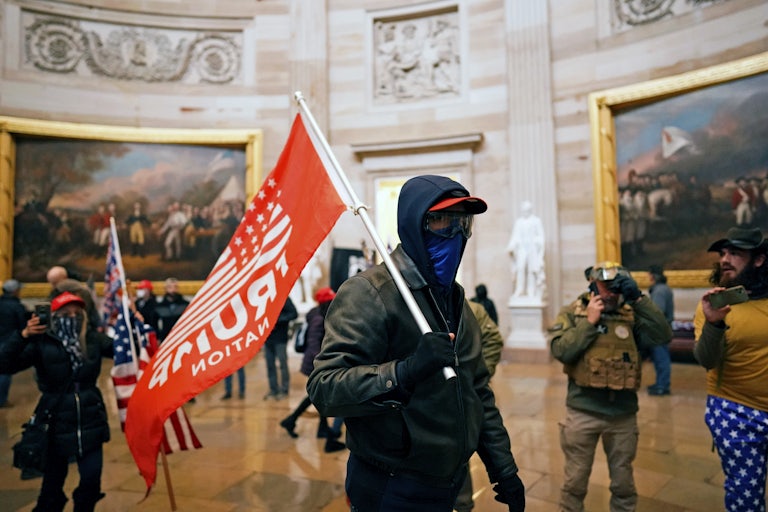
A masked January 6 rioter waves a large red Trump flag inside the Capitol.
Kent Nishimura/Los Angeles Times/Getty Images
A rioter inside the Capitol on January 6, 2021

A Trump-pardoned January 6 insurrectionist was arrested last week for threatening to kill House Minority Leader Hakeem Jeffries, in a chilling example of the right-wing political violence the GOP has been downplaying.

CBS reports that Christopher Moynihan—sentenced in 2022 to 21 months in prison for his role in the Capitol riot and fully pardoned by Trump—was arrested on Sunday after he sent texts about plans to “eliminate” Jeffries at an Economic Club event in New York City on Monday.

“Hakeem Jeffries makes a speech in a few days in NYC I cannot allow this terrorist to live,” he allegedly wrote. “Even if I am hated, he must be eliminated, I will kill him for the future.”

Moynihan has been charged with a felony for making a terroristic threat, and will make his first court appearance on Thursday.

“Following a thorough investigation, Moynihan was arrested and arraigned before the Town of Clinton Court,” a New York State Police statement read. “He was remanded to the Dutchess County Justice and Transition Center in lieu of $10,000 cash bail, a $30,000 bond, or an $80,000 partially secured bond.”

Moynihan is not the first January 6 insurrectionist to spoil their pardon with more run-ins with the law. Rioter Zachary Alam was arrested just weeks after his pardon for allegedly breaking and entering a Richmond, Virginia, home. And rioter Matthew Huttle was shot dead at a traffic stop by police after allegedly “raising a firearm at police.”

Not only are many of the insurrectionists going right back to committing alarming crimes, they’re continuing to directly contribute to right-wing violence.

Comey Accuses Trump of Basing Case Against Him on “Personal Bias”

James Comey has moved to dismiss Donald Trump’s indictment against him.

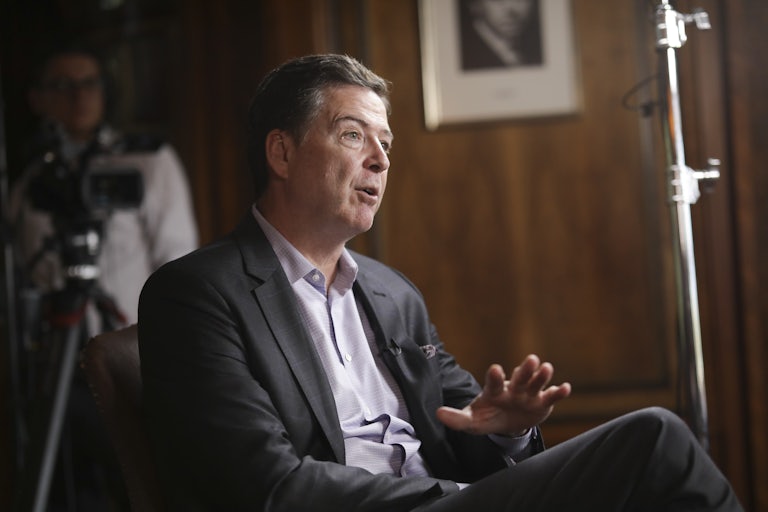
Former FBI Director James Comey gestures and speaks while sitting in a chair
Alex Kraus/Bloomberg/Getty Images

Former FBI Director James Comey is hoping to get the indictment against him dismissed by proving President Donald Trump is on a vindictive quest to send him to prison. Easy enough, right?

In a 51-page filing Monday, Comey’s legal team called for the government’s charges against the former Trump ally to be dismissed because of the president’s “vindictive animus.” Last month, the former FBI director was charged with lying to Congress regarding his testimony to Senator Ted Cruz in a 2020 Senate Judiciary Committee hearing.

“Such a vindictive and selective prosecution violates the First Amendment, Due Process Clause, and equal protection principles,” the filing stated, noting that the case should be dismissed “with prejudice,” meaning that the verdict could not be appealed by the government.

The filing evoked the laundry list of times that Trump had made public statements attacking Comey since he was ousted from FBI leadership in 2017. Since then, Comey has openly criticized Trump during the 2020 and 2024 presidential elections, writing in his memoir that Trump was “unethical, and untethered to truth and institutional values.”

“In response to Mr. Comey’s protected speech, President Trump has resorted to personal attacks and calls to retaliate against Mr. Comey through punishment and imprisonment,” the filing stated. Comey’s legal team wrote there was “objective evidence” that Trump harbored genuine animus toward their client, based on the president’s clear “personal bias.”

As recently as September, Trump mistakenly posted on social media a private message to Attorney General Pam Bondi directing Comey’s prosecution, and the president has all but admitted his direct involvement in the proceedings. Not to mention that Comey’s name appeared on the “enemies list” penned by Trump’s new FBI Director Kash Patel. In any case, Trump’s hatred for Comey has been long-standing and well documented.

In a second filing Monday, Comey’s attorneys argued that the case should be nullified because Lindsey Halligan, Trump’s former personal lawyer, whom he recently installed as the interim U.S. attorney for the Eastern District of Virginia, had been “defectively” appointed.

“The United States cannot charge, maintain, and prosecute a case through an official who has no entitlement to exercise governmental authority,” the motion said.

Democrats and Republicans Get Same Shutdown Request From Constituents

Americans on both sides of the aisle are ready to hold firm, and things could get messy.

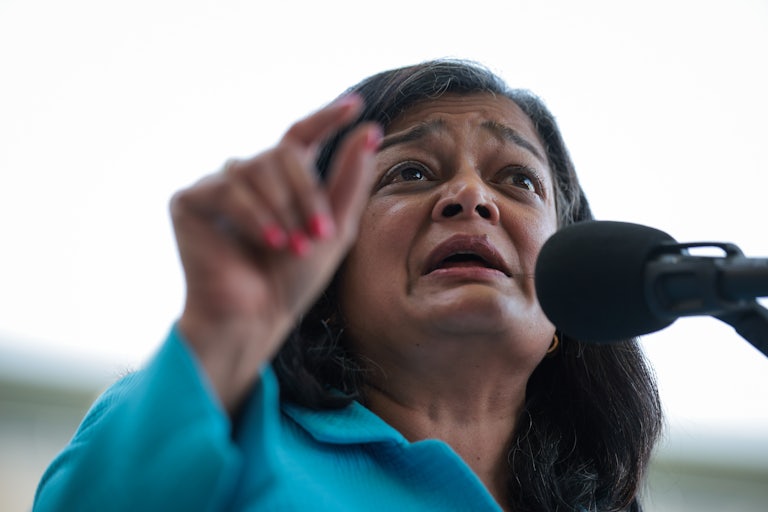
Representative Pramila Japayal gestures while speaking into a microphone
Kayla Bartkowski/Getty Images

Americans don’t want their representatives to bow to the pressures of the government shutdown.

Politicians on both sides of the aisle are hearing the same message from their constituents, whether they’re in vulnerable districts or partisan strongholds, reported MSNBC Monday: “Keep up the fight.”

“Almost to a T, I hear from people that they want us to keep fighting for them, that they want us to stand up and they don’t want us to cave,” Democratic Washington Representative Pramila Jayapal told the network.

The pressure would suggest that Americans are not interested in having their parties reach a resolution to continue funding the government. Instead, they’d rather the shutdown carry on.

“It won’t surprise you, being from a red state, that most of the calls are encouraging Republicans to stand their ground and keep up the fight,” GOP Indiana Senator Todd Young told MSNBC.

More than 700,000 federal employees have been furloughed under the auspices of the shutdown, according to a report from the Bipartisan Policy Center. Congress has yet to pass either a stop-gap funding measure or full-year appropriations bill to bring the shutdown to a close. Meanwhile, the Trump administration has axed thousands of federal employees.

Monday marked the twentieth day that the government has stayed shuttered as Republicans and Democrats disagree over how to fund Trump’s “big, beautiful” budget, which included details to slice billions from Obamacare subsidies and Medicaid.

Democrats—and their constituents—have insisted that party representatives hold firm until they can find a way to salvage the subsidized health care programs. But a major hitch looms on the horizon: Open enrollment for Obamacare plans begins on November 1. If the shutdown is not resolved by then, millions of Americans will be forced to make a decision about their health coverage without knowing whether premiums will come down.

Democratic Maryland Representative Jamie Raskin told MSNBC that “the vast majority of people I’m hearing from and seeing insist that we hang tough to resolve the health care crisis and the government shutdown at the same time.”

“We don’t have the luxury of choosing here,” Raskin said.

The issue, remarkably, has not gotten a lot of play in congressional offices around the country. Politicians on both sides of the aisle remarked to MSNBC that they were surprised by the minimal volume of calls about the shutdown their offices have received.

“I know there are a lot of Americans who are anxious about the shutdown, but I just don’t know that, until the last couple of days, there’s been a whole lot of engagement,” Young told MSNBC last week.