Breaking News
Breaking News
from Washington and beyond

Here’s the Sick Reason Trump Banned Epstein From Mar-a-Lago’s Spa

But it appears Donald Trump kept up his relationship with Jeffrey Epstein for years afterward.

A bus stop in London, England, shows a photo of Jeffrey Epstein and Donald Trump alongside a quote from Trump’s birthday note to Epstein
Leon Neal/Getty Images

Three years after Virginia Giuffre left her job as Mar-a-Lago’s pool attendant to “work” for Jeffrey Epstein, another employee at the club spa issued an allegation that hampered the prodigious sex trafficker’s access to Donald Trump’s Palm Beach resort.

Epstein wasn’t actually a member, but Trump told his employees to treat him like one. The financier was a frequent client at the club’s spa, where his appointments were arranged by Ghislaine Maxwell, so much so that he was allowed house calls at his neighboring estate by the spa’s masseuses, according to new reporting by The Wall Street Journal.

That privilege came to a jarring end in 2003, when an 18-year-old beautician returned from one of the house visits complaining that Epstein had attempted to pressure her into sex.

Managers at the club spa then wrote a letter to Trump, urging him to ban Epstein from Mar-a-Lago. The letter was well received, and Trump told the spa management to “kick him out,” according to the Journal.

Prior to his death, pedophilic sex trafficker Epstein described himself as one of Trump’s “closest friends.” The socialites were named and photographed together on several occasions and were caught partying with underaged girls in New Jersey casinos. Epstein was invited to Trump’s wedding to Marla Maples in 1993, and in 2002, Trump told New York Magazine that Epstein was a “terrific guy.”

The same year that the beautician accused Epstein of coercing her, Trump participated in a 50th birthday book for Epstein, penning a letter in which he referred to the disgraced financier as his “pal” and waxed poetic about their shared “secret.”

Trump shocked the country in July when he admitted that he had thrown Epstein out of Mar-a-Lago when he became aware that Epstein was abducting the resort’s underage female employees, and that Trump knew Giuffre—one of Epstein’s most prominent accusers—was one of the “stolen” girls.

But it appears Trump’s “kick him out” directive only referred to the spa, as Epstein wasn’t formally banned from Mar-a-Lago until October 2007, after he reportedly acted inappropriately toward a club member’s daughter. That same month, Epstein’s account was listed as “closed” in Mar-a-Lago’s books.

Even still, a nixed membership did not mean that Epstein was totally absent from the club. Also in October 2007, an article from The New York Post reported that Epstein denied the Mar-a-Lago ban, claiming that he had been invited to an event that year.
Trump Effect Continues: Democrats Land Historic Win in Key Red State

Renee Hardman is the first Black woman elected to the Iowa state Senate.

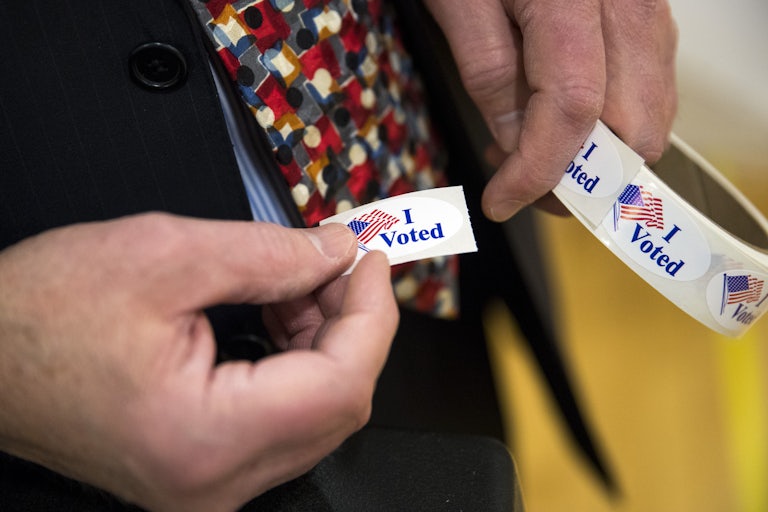
A person holds "I voted" stickers
Adam Glanzman/Bloomberg/Getty Images

Democrats have won big in Iowa, as they’ll send Renee Hardman to the state Senate with 71.5 percent of the vote, a whopping 27 points more than Kamala Harris won in the state by last year.

Hardman’s Tuesday night win also prevents Republicans from gaining a supermajority in the chamber. Hardman is the first Black woman elected to the Iowa state Senate.

A Democratic victory that large in a red state mirrors recent historic results elsewhere, and may indicate that voters may be fatigued or are just outright rejecting anything to do with President Donald Trump. Those results include Abigail Spanberger and Mikie Sherrill’s gubernatorial victories in Virginia and New Jersey. But a victory in a small, downballot race such as Hardman’s shows that disapproval of Trump and his administration may be hitting closer to home as the government fails to end endless wars and make the country more affordable.

Earlier this year, Democrats also won big in Erie County, Pennsylvania, which narrowly supported Trump in the 2024 election, and defeated a 36-year Republican incumbent in Virginia’s 66th state House district. Democrats in Georgia managed to win two statewide races for public service commissioner, their first nonfederal statewide wins since 2006.

And even in the deep Southern state of Mississippi, Democrats were able to break the supermajority in the state Senate by flipping three seats after 13 years, taking away Republicans’ ability to override the governor’s veto and easily propose constitutional amendments.

All that is to say that these results should have Trump very worried about how negatively Americans are feeling about his second term, even those who voted for him in 2024. If this holds, it could be a major issue for the GOP come 2026 midterms.

You Won’t Believe What One of the Boats Trump Struck Was Carrying

Donald Trump’s strikes aren’t taking out his intended targets—and are terrorizing a local community.

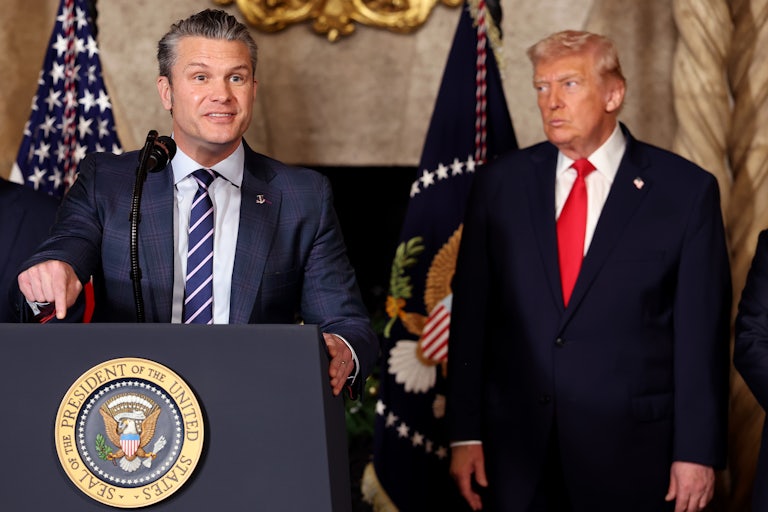
Defense Secretary Pete Hegseth gestures and speaks at a podium while Donald Trump stands behind him, watching
Tasos Katopodis/Getty Images

Detritus from one of the Caribbean boat strikes has washed up on the Colombian peninsula, and it’s not what the White House claimed.

The boats apparently wrecked in a November 6 strike arrived on Colombia’s Indigenous-governed Guajira Peninsula two days later with two mangled bodies and torched jerrycans. But at least one of the vessels also carried evidence of the drugs it was smuggling onboard, reported The New York Times: emptied packets of marijuana.

The Trump administration has justified its unfettered air strike campaign on the basis that small watercraft in the Caribbean were funnelling fentanyl into the U.S. To further legitimize the militaristic response—which so far has killed at least 107 people since early September—the president purported that the boats were run by “narcoterrorists” from Venezuela, and designated fentanyl as a “weapon of mass destruction.”

But marijuana, a drug synonymous with the “peace and love” movement of the 1960s, is about as far from a tool of war as you can get. The substance is already legal in the vast majority of the U.S.: 40 states permit its use for medicinal purposes, while 24 states allow residents to get high for any reason whatsoever.

Earlier this month, Trump himself signed an executive order to expedite the process of reclassifying weed from a Schedule I drug—which are considered to have high abuse rates with little to no medical application—to a Schedule III drug under the Controlled Substances Act.

Overall, there seems to be little evidence that the boats have been headed toward the United States. In a classified meeting with U.S. lawmakers two weeks ago, Defense Secretary Pete Hegseth and State Secretary Marco Rubio revealed that the Trump administration was aware the boats were bound for Europe rather than America. They also disclosed that the administration had no intelligence indicating that fentanyl was coming out of Venezuela, but rather that some of the boats were believed to be carrying cocaine.

“Halfway House for Bigots”: Everyone Hates Trump’s Failed Appointee

Paul Ingrassia has rubbed people the wrong way everywhere he went—including in his new job at the GSA.

Paul Ingrassia puts his hand on his chest while speaking to reporters
Pete Kiehart/The Washington Post/Getty Images

Paul Ingrassia, the failed Trump nominee with a self-described “Nazi streak,” has been making enemies at the General Services Administration—where he crash landed after even Senate Republicans rejected his bid to head the Office of Special Counsel due to his leaked countless racist, bigoted messages.

“I don’t know what he is or is not, but no one cares for him,” one anonymous GSA staffer told Politico in a story published Tuesday, adding that Ingrassia hasn’t been given anything “meaningful” to do because “[GSA] leadership doesn’t really want him.”

“What are we? A halfway house for bigots who can’t find jobs anywhere else in this administration?” another staffer said, going on to mention how incredibly unqualified Ingrassia was compared to his predecessor, Russell “Rusty” McGranahan. “Rusty was well qualified and served the administration well. I just want the government to be staffed with experienced people who are taken seriously.”

The Trump administration, however, seems to think Ingrassia is just the man for the job.

“Paul Ingrassia is a well-regarded attorney who has provided outstanding service to President Trump and will continue to do so as GSA’s acting general counsel,” GSA spokesperson Marianne Copenhaver said. “The GSA has complete confidence in his ability to further both its mission and the president’s priorities.”

For the uninitiated: Ingrassia made headlines back in October for a series of deeply hateful statements he made in a group chat.

“No moulignon holidays.… From kwanza [sic] to mlk jr day to black history month to Juneteenth,” he wrote in one text, using an Italian slur for Black people in the beginning of the message. “Every single one needs to be eviscerated.”

“MLK Jr. was the 1960s George Floyd and his ‘holiday’ should be ended and tossed into the seventh circle of hell where it belongs,” he said in another text. He also mentioned that he had a “bit of a Nazi streak” and to “never trust a chinaman or Indian. NEVER.”

Ingrassia was also accused of sexually harassing a coworker at the Department of Homeland Security.

This is the man the Trump administration deemed to be “well-regarded”—although it’s clear that his peers think otherwise.

Susie Wiles’s Vanity Fair Interview Continues to Haunt Her

Donald Trump’s chief of staff has landed in more hot water over that interview.

White House Chief of Staff Susie Wiles
Salwan Georges/The Washington Post/Getty Images

White House Chief of Staff Susie Wiles might have revealed more than she ought to about the Epstein files.

The Vanity Fair profile on the president’s famed “ice maiden” has continued to haunt the administration weeks after its publication, in large part thanks to Wiles’s candid responses. Now, Democratic Senators Sheldon Whitehouse and Dick Durbin have demanded answers regarding a particularly lurid detail that came out of the article: Wiles’s apparent familiarity with the contents of the Epstein files.

In a joint letter made public Tuesday, Whitehouse and Durbin questioned which components of the investigation she had reviewed, how she obtained the sensitive material, and “under what authority” she gained access to it.

The lawmakers asked Wiles a series of questions, requesting her responses by January 5.

“Had material in the file you reviewed been presented to a grand jury? When did you first gain access to ‘the Epstein file’ and what was the schedule of your review of it? For what purpose did you gain access to this information?” they inquired.

The duo also questioned if she had shared any of the information with Donald Trump, and asked her to explain what role she had in “any process related to the review, redaction, withholding, or release of material in the ‘Epstein file,’ including any processes involving the Department of Justice or Federal Bureau of Investigation.”

The wide-ranging profile on Wiles’s first year atop the Trump administration sent shockwaves through the political establishment earlier this month, and offered many Americans their first intimate glimpse into the inner machinations of Trump’s White House. Over the course of “many on-the-record conversations,” several of which took place after church on Sundays, documentary filmmaker and author Chris Whipple depicted a Cabinet structure that could not exist without Wiles and her unparalleled knack for translating the president’s agenda.

But her loose lips about her Cabinet coworkers have stirred up quite a bit of trouble in the workplace. Some of those comments include claiming that Trump has “an alcoholic’s personality,” and flagging that Vice President JD Vance’s shift into MAGAworld was opportunistic and “sort of political.”