Breaking News
Breaking News
from Washington and beyond

Now We Know Why Trump Saved TikTok

Pro-Trump TikToks are doing very well on the app.

Trump does a thumbs up
Nathan Howard/Getty Images
Donald Trump at Fort Bragg last week

The president’s total 180 on TikTok was, in no small part, due to the machinations of Turning Point USA founder Charlie Kirk.

Donald Trump had opposed the social media behemoth for years. Long before Democrats hopped on board with the idea, Trump challenged the app’s presence in the United States based on flimsy national security concerns, attempting to instate a total ban on the video-sharing app. But in the wake of Trump’s 2024 win, Kirk—whose efforts rallying young voters significantly aided the president’s cause—managed to change Trump’s mind.

That November 2024 meeting involved Kirk, Trump, TikTok CEO Shou Zi Chew, and a slideshow with a swath of visual graphics that Kirk knew would sway the incumbent Republican. Kirk and Chew wanted to stall the impending congressional ban on the app, and they succeeded by appealing to the president’s vanity.

One slide, obtained by Axios, depicted the number of views Trump had accrued on the platform. It was staggering: a cumulative 3.8 billion eyes had watched content related to the president. Meanwhile, his Democratic opponent, former Vice President Kamala Harris, was remarkably less popular, generating 1.3 billion views.

Their closest competition was, according to the slide, Kirk himself, Fox News, Tucker Carlson, and pop phenomenon Taylor Swift.

“I’m more popular than Taylor Swift,” Trump remarked, according to Axios.

Trump then rang his son, Barron, to crow over the stat, according to MAGA insiders who spoke with the digital publication.

The undertaking was almost too successful, so much so that it’s caused retrograde amnesia among Trump’s allies. In truth, Trump attempted to eradicate TikTok via an executive order before he left office in 2020, but that effort appears to be in the past. Jason Miller, a senior adviser to Trump during his campaign, told Axios that the president had always been a fond supporter of the app due to its ability to reach young voters.

“He’d say all the time: ‘You guys are missing it! These young people, they love TikTok. They’re on it all day long,’” Miller told Axios. “And he’d recount stories of Barron talking about it, and also younger people who work with him and for him.”
Last month, TikTok changed ownership in order to avoid the stalled U.S. ban, switching hands from ByteDance to a consortium of U.S.-led investors, including Oracle, Silver Lake, and MGX. Together, those three hold an 80.1 percent majority stake in TikTok’s U.S. operations, according to a company announcement. ByteDance still retains a 19.9 percent minority stake.
Noem Pisses Off Coast Guard by Using Their Resources for Deportations

In one instance, Homeland Security Secretary Kristi Noem pulled a Coast Guard plane off a search and rescue mission.

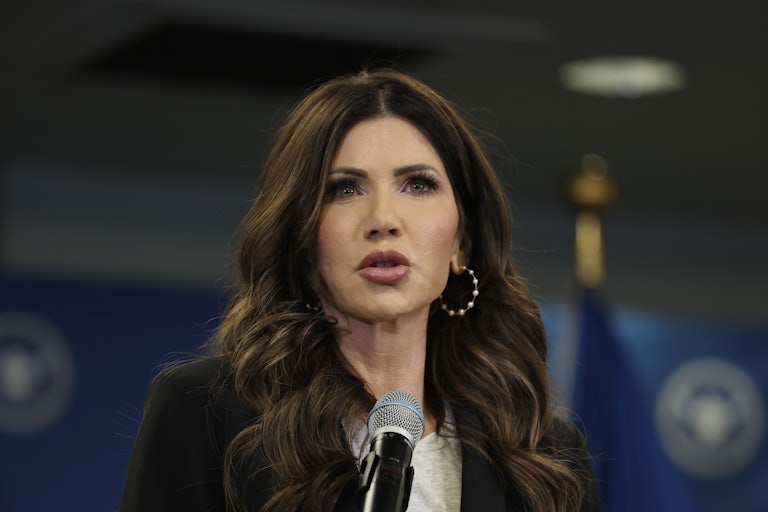
Homeland Security Secretary Kristi Noem
Joe Raedle/Getty Images

Secretary of Homeland Security Kristi Noem is under fire for using Coast Guard resources to aid in deportations.

The Coast Guard is the only military branch overseen by DHS, and Noem’s decisions have caused tension with some of the branch’s leaders. Under Noem, the Coast Guard’s aircraft have been used for deportations 10 times as much as under the previous administration, according to sources who spoke with NBC.

“It puts so much stress on the Wing,” a Coast Guard official told the outlet, referencing the branch’s air units. 

Noem’s prioritization of deportations has changed the way the military branch operates. One decision she made was to shift Coast Guard resources from a search and rescue mission to find a missing service member last year, shortly after Noem was confirmed as secretary. 

When a 23-year-old Coast Guard member went overboard in the Pacific Ocean while serving on cutter Waesche in February 2025, officials scrambled planes and ships to the ocean to find the service member, including a Coast Guard C-130 that was supposed to transport detained immigrants from California to Texas. When Noem learned of this, she personally told Admiral Kevin Lunday, the acting commandant of the Coast Guard, to pull the plane away from the search and rescue mission and back to deportation duty. 

A regional commander pulled two other C-27 planes to transport the detainees in order to keep the C-130 in the search mission for an additional hour. But ultimately, after a 190-hour search covering 19,000 square miles, the missing service member wasn’t found. 

Search and rescue operations, which used to be the branch’s core mission, now have a diminished priority in the Coast Guard. They are now below counternarcotics and training, as well as deportations, in priority, according to unnamed officials. The branch’s leadership has raised concerns in internal discussions and with people outside of the agency.  

Back in May, Noem’s top adviser and rumored boyfriend, Corey Lewandowski, berated Coast Guard flight staff for leaving behind Noem’s heated blanket when she had to switch planes due to a maintenance issue, even firing the pilot of the first plane before rehiring him because there weren’t any other pilots to take Noem home. One former Coast Guard official said that incidents like these contribute to “a general atmosphere of ‘keep your head down; you don’t want to be on the firing line.’”

Colbert Exposes CBS for Collaborating With the Trump Administration

The network pulled Stephen Colbert’s interview with Texas Democratic Senate candidate James Talarico amid pressure from the FCC.

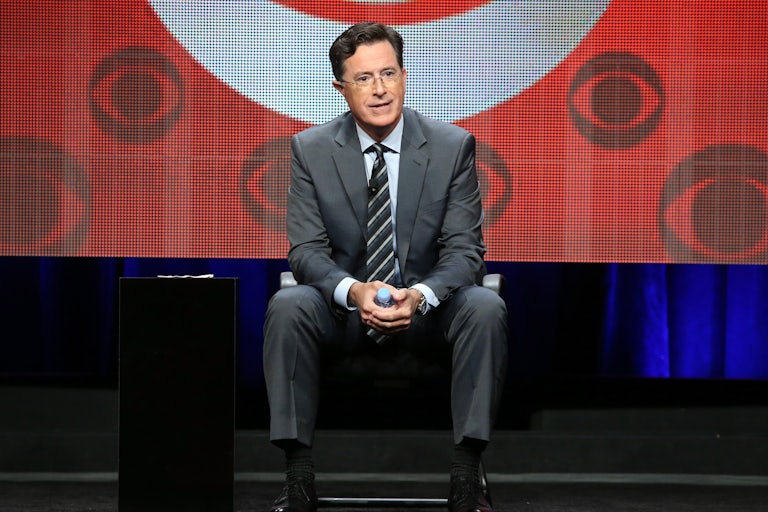
Stephen Colbert sits in front of a screen featuring several CBS logos
Frederick M. Brown/Getty Images
Stephen Colbert in August

The Late Show’s Stephen Colbert called out CBS on Monday for blocking his interview with a political candidate—and figured out a sneaky way around the Federal Communications Commission’s new rule targeting late-night talk shows, according to Deadline.

Colbert made the unprecedented move Monday to introduce his late-night talk show guest—who would not be joining him: James Talarico, a Democratic Senate primary candidate from Texas.

“He was supposed to be here, but we were told in no uncertain terms by our network’s lawyers, who called us directly, that we could not have him on the broadcast,” Colbert explained. “Then I was told, in some uncertain terms, that not only could I not have him on, I could not mention me not having him on.

“And because my network clearly does not want us to talk about this,” Colbert said, “let’s talk about this.”

In January, the FCC published new guidance stating daytime and late-night talk shows were not exempt from the rule requiring them to provide equal time for candidates across the political spectrum. They had previously been spared under an exemption for “bona fide news.”

The FCC claimed it had “not been presented with any evidence” that any television talk show currently on air would qualify for the bona fide news exemption, nor would any program “motivated by partisan purposes.”

Colbert referred to a clip of FCC Chair Brendan Carr—a helpful lackey for President Donald Trump’s crackdown on free speech—discussing Colbert and fellow late-night host Jimmy Kimmel. “If Kimmel or Colbert want to continue to do their programming, and they don’t want to have to comply with this requirement, then they can go to a cable channel or a podcast or a streaming service, and that’s fine,” Carr said.

So Colbert took his advice and posted his interview with Talarico straight to YouTube.

“This is the interview Donald Trump didn’t want you to see,” Talarico wrote in a post on X Tuesday. “His FCC refused to air my interview with Stephen Colbert. Trump is worried we’re about to flip Texas.”

ABC’s The View is currently under investigation by the FCC for speaking with Talarico.

Trump Uses Civil Rights Leader Jesse Jackson’s Death to Attack Obama

Donald Trump thought this was the perfect time to brag about himself ... and attack the former president.

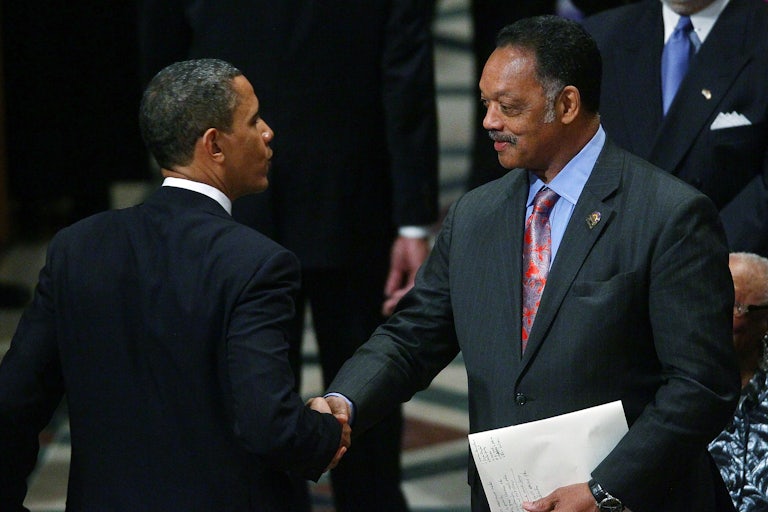
Jesse Jackson shakes hands with Barack Obama.
Win McNamee/Getty Images
President Barack Obama greets Jesse Jackson at the funeral service for civil rights leader Dorothy Height at the Washington National Cathedral, on April 29, 2010, in Washington, D.C.

President Trump used the death of civil right activist Jesse Jackson to take a cheap shot at former President Barack Obama—and to pat himself on the back for not being racist.

“The Reverend Jesse Jackson is Dead at 84. I knew him well, long before becoming President. He was a good man, with lots of personality, grit, and ‘street smarts.’ He was very gregarious - Someone who truly loved people! Despite the fact that I am falsely and consistently called a Racist by the Scoundrels and Lunatics on the Radical Left, Democrats ALL, it was always my pleasure to help Jesse along the way,” Trump wrote on Truth Social Tuesday morning.

“Jesse was a force of nature like few others before him,” he continued. “He had much to do with the Election, without acknowledgment or credit, of Barack Hussein Obama, a man who Jesse could not stand. He loved his family greatly, and to them I send my deepest sympathies and condolences. Jesse will be missed! President DONALD J. TRUMP.”

Jackson, a Martin Luther King Jr. protege perhaps best known for his Rainbow/PUSH Coalition activism of the 80s and 90s, passed away early Tuesday morning at the age of 84. A cause of death was not given but his family said he died peacefully surrounded by loved ones.

And while the president is not exaggerating about his past relationship with Jackson, his family put out a much more thoughtful public eulogy.

“Our father was a servant leader—not only to our family, but to the oppressed, the voiceless, and the overlooked around the world,” their statement read. “We shared him with the world, and in return the world became part of our extended family.”

And for what it’s worth, Jackson and Obama did have a contentious relationship at times. While Jackson was an early supporter of Obama’s, he was very critical of his lack of emphasis on Black issues, accusing the then-senator in 2007 of “acting like he’s white” with his weak response to the overcharging of six Black teenagers in the Jena 6 case. (He later said his comments were taken out of context.) And in 2008, Jackson was overheard on a hot mic chastising Obama for his rightward shift, saying, “See, Barack’s been, ahh, talking down to black people on this faith-based ... I want to cut his nuts off.”

He endorsed Obama nonetheless, crying when he learned that he would become the first Black president. He then endorsed Hillary Clinton in 2016 and Bernie Sanders in 2020.

This story has been updated.

John Fetterman Hits New Low in Quest for Donald Trump’s Approval

The Pennsylvania Democrat backed voter ID legislation to combat a nonexistent voter fraud problem.

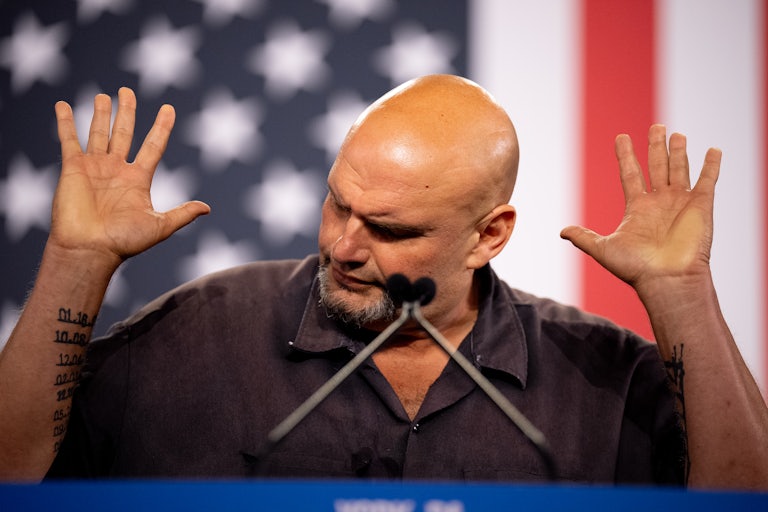
John Fetterman holds up his hands and looks down and to the side in front of an American flag
Andrew Harnik/Getty Images
John Fetterman in 2024

Ex-progressive Senator John Fetterman is bucking his party yet again, but this time the fallout could drastically impact the results of future elections.

The Pennsylvania turncoat came out in favor of voter ID legislation, revealing that he would support a clean bill if it required voters to show identification before they cast their ballot. The issue is currently gaining momentum in the Senate under the banner of the Safeguarding American Voter Eligibility, or SAVE, Act. Democrats have branded the voter restriction initiative “Jim Crow 2.0”

“I would never refer to the SAVE Act as like Jim Crow 2.0 or some kind of mass conspiracy,” Fetterman told Fox News’ Kayleigh McEnany. “But that’s part of the debate that we were having here in the Senate right now. And I don’t call people names or imply that it’s something gross about the terrible history of Jim Crow.”

The SAVE Act would require Americans to present their birth certificate or passport in order to register to vote, and would further require voters to bring physical identification with them to the ballot box.

That’s not only completely unnecessary considering that it’s already illegal for nonvoters to participate in U.S. elections, but could also prove disastrous for married women, adding additional hurdles for individuals who have changed their names since their birth certificate was issued.

Donald Trump already tried and failed to implement voter ID in June. At the time, a federal judge excoriated the president’s efforts, arguing that adding layers of difficulty to the voting process would only serve to harm eligible voters by adding significant barriers before they can cast their ballots.

Since he lost the 2020 election, Trump and his allies have obsessed over contrived claims of voter fraud—a statistical nonissue in U.S. elections. For instance, a statewide audit out of Georgia, the epicenter of Trump’s baseless theory, revealed in September that just 20 noncitizens out of 8.2 million residents existed on the state’s voter roll, just 0.00024 percent of the state’s voting population. Out of those 20, only nine participated in elections, years ago, before ID was required as a part of the voter verification process. The other 11 individuals were registered but never actually voted, according to Secretary of State Brad Raffensperger.

But Fetterman—who mind-bogglingly ran on the progressive ticket—has had a penchant for Trumpian politics since he moved to Washington.

“It’s not like a radical idea,” Fetterman told Fox. “It’s not something—and there already are many states that show basic IDs. So that’s where we are in the Senate.”

Critics argue that restrictions on the front end of the electoral process—such as one-day voting, mail-in ballots, and requiring day-of voter ID—would minimize voter turnout and limit the American democracy’s ability to represent its constituents. This would especially be true in high-density areas like the nation’s biggest cities, where those stipulations would significantly drain resources (i.e., by increasing the number of volunteers required) and require more time to process, potentially leading to more delays that Republicans could weaponize to further restrict voter access.

Civil Rights Groups Sue to Protect Georgia Voter Data Seized by FBI

NAACP and a collection of other groups want to protect voter data after the FBI raid in Fulton County.

An FBI agents walks to his car.
Yasin Ozturk/Anadolu/Getty Images

The federal government is being sued by civil rights organizations to protect voter data seized by the FBI in a raid at a Fulton County, Georgia, elections building last month.

The NAACP, the Lawyers’ Committee for Civil Rights Under Law, the Georgia Coalition of the People’s Agenda, and other groups filed a lawsuit in the U.S. District Court for the Northern District of Georgia Sunday to “prohibit the Trump administration from misusing the voter information” it seized as part of the raid.

Donald Trump has long claimed the 2020 election was stolen from him despite no evidence of voter fraud. Georgia was won by President Biden in that election, and as a result, the Trump administration last month launched an investigation into Fulton County, the largest and most Democratic-leaning county in the state.

“Having already failed to overturn the valid results of the 2020 presidential election by invoking false claims of widespread voter fraud, promoting fake electors, and inciting a violent insurrection, Trump and his minions are refusing to give up the ‘lost cause,’ trampling even more voting and privacy rights in the process,” said Damon Hewitt, the president and executive director of the Lawyer’s Committee, in a statement. “Ironically, this is happening in the same jurisdiction where Trump pressured state elections officials to ‘find 11,870 votes’ in an effort to declare himself the victor in 2020.”

The Georgia raid has raised concerns that Trump is trying to manufacture a justification to take over elections in battleground areas, especially considering that Director of National Intelligence Tulsi Gabbard was inexplicably present and found to be giving updates to Trump the next day. The president claims the raid happened on the orders of Attorney General Pam Bondi, who hasn’t cleared things up.

Gabbard has spent the last several months investigating long-debunked claims of voter fraud from the 2020 election, a departure from her supposed job overseeing U.S. intelligence. Under her watch, the FBI seized close to 700 ballots and other election materials from Fulton County, including tabulator tapes from scanners that count votes, electronic ballot images created when ballots were counted and then recounted, and all voter rolls.

This new lawsuit joins another legal action filed by the county earlier this month to return all seized materials. Meanwhile, Trump and his Republican allies continue to push for a federal takeover of elections, with the president threatening to push through voter I.D. even without Congress. It seems that the future of free and fair elections rests on whether the courts can stop the Trump administration.

Trump Blames Popular Black Democrat for Potomac River Sewage Spill

Trump’s National Park Service is supposed to be working with DC Water to fix the issue, so of course he’s blaming someone else entirely.

Splitscreen of Donald Trump and Wes Moore
Getty x2
President Donald Trump and Maryland Governor Wes Moore

President Trump is blaming Maryland Governor Wes Moore for sewage pollution in the Potomac River, something Moore has no control over. 

“There is a massive Ecological Disaster unfolding in the Potomac River as a result of the Gross Mismanagement of Local Democrat Leaders, particularly, Governor Wes Moore, of Maryland,” Trump wrote on Truth Social Monday afternoon. “A sewer line breach in Maryland has caused millions of gallons of raw sewage to be dumped directly into the Potomac River, a result of incompetent Local and State Management of Essential Waste Management Systems. This is the same Governor who cannot rebuild a Bridge. It is clear Local Authorities cannot adequately handle this calamity.” 

Trump added that he is “directing Federal Authorities to immediately provide all necessary Management, Direction, and Coordination to protect the Potomac, the Water Supply in the Capital Region, and our treasured National Resources in our Nation’s Capital City.” 

Environmental Protection Agency head Lee Zeldin reposted Trump’s message. 

It sounds like Trump heard “sewage emergency in Maryland” and took the opportunity to shit on a popular Black Democrat and potential 2028 presidential candidate without doing his research.  

“He’s just blatantly lying about this,” The Independent’s Andrew Feinberg wrote on X. “The pipe is maintained by ⁦DC Water⁩ and runs along the Clara Barton Parkway, which is maintained/run by the National Park Service. It has nothing to do with ⁦Governor Wes Moore⁩.”

A massive overflow of sewage spewed into the Potomac River in January after a large pipe burst, leading to contamination in Washington, D.C., Virginia, and Maryland. Federal authorities were already involved before Trump’s Truth Social post Monday, as the National Park Service has been closely working with DC Water to address the issue.

The Francis Scott Key Bridge in Maryland, which Trump was likely referring to in his post, collapsed in 2024 when a cargo boat struck one of its piers, and is projected to open back up in 2030. 

The Pentagon Just Sent a Terrifying Message to AI Companies

It warned Anthropic it will “pay a price” if it continues to demand its products have safeguards.

Secretary of Defense Pete Hegseth clenches his fists and screams in front of an American flag
Andrew Harnik/Getty Images

Donald Trump’s so-called Department of War is threatening to cut ties with Anthropic because it won’t help the Pentagon conduct mass surveillance on Americans or make fully autonomous weapons that the administration can use however it likes.

A senior Trump administration official told Axios Monday that the Pentagon was fed up after Anthropic refused unfettered use of its AI systems. “Everything’s on the table,” including cutting ties altogether, the official said.

An “orderly replacement” would have to be found, if they ended the relationship, the official added.

Last summer, Anthropic signed a contract with the Pentagon valued up to $200 million—but the company set hard boundaries against its systems being used to develop weapons, conduct surveillance, or facilitate violence. For months, the Pentagon has sought to negotiate with Anthropic to let the military use its tools for “all lawful purposes,” including weapons development and intelligence gathering, without being forced to argue individual use cases.

In January, tensions came to a head after an executive at Anthropic reportedly reached out to an executive at Palantir to ask whether it had used the company’s Claude AI assistant as part of the U.S. military raid to capture Venezuelan President Nicolás Maduro. (Spoiler alert: It did.)

“It was raised in such a way to imply that they might disapprove of their software being used, because obviously there was kinetic fire during that raid, people were shot,” the senior official told Axios.

A spokesperson for Anthropic denied that such a conversation had taken place in a statement to Axios, saying the company had “not discussed the use of Claude for specific operations with the Department of War. We have also not discussed this with any industry partners, outside of routine discussions on strictly technical matters.”

“Anthropic’s conversations with the DoW to date have focused on a specific set of Usage Policy questions—namely, our hard limits around fully autonomous weapons and mass domestic surveillance—none of which relate to current operations,” the spokesperson added.

Chief Pentagon spokesman Sean Parnell suggested to The Wall Street Journal that the Department of War’s relationship with Anthropic was under review. “Our nation requires that our partners be willing to help our warfighters win in any fight,” Parnell said.

Meanwhile, Anthropic appears to only be wading further into politics. Last week, the company announced that it would pledge $20 million toward Public First, a super PAC that will oppose groups funded by the company’s rival OpenAI.

George W. Bush Torches Trump in Presidents’ Day Message

Bush praised virtues from “self-control and courteousness to modesty and diplomacy,” in an essay about George Washington that was also clearly a message about the current occupant of the White House.

George W. Bush does his little smirk thing at Trump's inauguration. He's standing with his wife Laura, who is smiling.
Ricky Carioti/Pool/Getty Images
George W. Bush at Trump’s inauguration in January 2025

Former President George W. Bush won’t defy the “code of silence” that prevents ex-U.S. leaders from publicly chastising their successors, but he’s apparently not opposed to throwing shade.

In a Presidents’ Day essay published Monday by the pro-democracy institution More Perfect, Bush’s adoring gaze toward the qualities of America’s first president only served to underscore just how unpresidential the current administration has become.

Bush waxed poetic on several of George Washington’s qualities, but paid particular attention to ones that are currently in short supply. Those included “humility,” a deep appreciation for history, a reverence for knowledge superior to his own, and an unwillingness to retain power “for power’s sake.”

“Our first president could have remained all-powerful, but twice he chose not to,” Bush wrote. “In so doing, he set a standard for all presidents to live up to.”

Bush also dissected Washington’s commitment to a code of conduct that was considered, at the time, to be the “gentlemanly arts.” Washington, according to Bush’s research, “schooled himself” by copying “the 110 maxims from Rules of Civility and Decent Behavior in Company and Conversation,” a text authored by French Jesuits in the late sixteenth century.

“Many of the qualities that came to be associated with Washington’s leadership, from self-control and courteousness to modesty and diplomacy, can be traced to that short book on manners,” Bush wrote.

Washington’s repeated decisions to step down from power were critical lessons for the nation, according to Bush, who argued that Washington’s decision to step down as commander of the U.S. Army after the Revolution, and his later decision to end his presidency after two terms,  “ensured America wouldn’t become a monarchy, or worse.”

The message carried particular weight considering that Donald Trump has continually contested election results in fruitless grasps at power, including an attempt to overthrow the 2020 presidential election and threats to run for president a third time, against the constraints of the law.

But Washington’s performance—and his commitment to building a lasting governmental foundation—was paramount not just to his success but to the future of the Oval Office and the country, according to the forty-third president.

“Our first leader helped define not only the character of the presidency but the character of the country,” Bush wrote. “Washington modeled what it means to put the good of the nation over self-interest and selfish ambition. He embodied integrity and modeled why it’s worth aspiring to. And he carried himself with dignity and self-restraint, honoring the office without allowing it to become invested with near-mythical powers.”

Kansas Mayor Who Voted for Trump as Noncitizen Faces Felony Charges

Joe Ceballos has the support of his small town, where he has lived since he was a teenager.

A "Vote Here" sign at a polling place.
Christian Monterrosa/Bloomberg/Getty Images

A small-town Kansas mayor is in trouble for voting illegally as a noncitizen—but he has the support of his town.

Joe Ceballos was recently reelected mayor of Coldwater, Kansas, by a comfortable 101-20 margin. But just hours before the results came in, Ceballos, a legal permanent U.S. resident, was charged in state court with three counts of election perjury and three counts of voting without being qualified.

The Trump administration gleefully highlighted the case as it reinforced right-wing claims of widespread voter fraud. Homeland Security spokesperson Tricia McLaughlin included Ceballos’s picture and a copy of his signature on a voter registration form on a press release, saying, “This alien committed a felony by voting in American elections.”

But the town of Coldwater, almost entirely Republican, is rallying around their mayor, who voted for Donald Trump in the last three elections and has lived in the town since he was a teenager. Ceballos, 55, came to the United States at the age of 4 from Mexico, moving around a lot with his family before settling in Coldwater, close to Kansas’s border with Oklahoma. He received his green card in 1990.

Ceballos told The New York Times that he has never been back to Mexico since he left. While he used to help police as a Spanish interpreter, he doesn’t speak the language very well these days. According to the Times, by all appearances he is a Kansan—he drives a Ram truck, has a slight Southern Plains accent, and wears cowboy boots.

“I still strongly believe in Trump’s immigration laws about, ‘Let’s get the bad guys out of here.’ You know, they’re murderers, they killed people, they molested people, let’s get them out of here,” Ceballos said to the publication. “But I feel like I don’t fit that category. And I feel like that’s how they’re treating me.”

Ceballos has a misdemeanor battery conviction from 1994 for a fight involving multiple people, which he said was related to his first marriage. He doesn’t seem to have had any brushes with the law since then. After he was charged with voting illegally, he resigned. But the people of Coldwater have come to his defense, with ads being placed in the local newspaper to support Ceballos at his court hearing, which was so well attended that it was standing-room only.

Kansas Attorney General Kris Kobach, who has railed against voter fraud for more than a decade, is trying to make an example out of Ceballos. At a news conference announcing the charges against Ceballos, he said, “Noncitizen voting is a real problem. It is not something that happens once in a decade. It is something that happens fairly frequently.”

In reality, noncitizen voting occurs very rarely in the U.S., with very few cases. Ceballos freely admits that he voted illegally, but he said he didn’t know that he couldn’t vote as a permanent resident and that he had never been told that he couldn’t. Last year, he applied to become a citizen, and he answered “yes” to a federal official in an interview who asked if he had ever voted. That, Ceballos says, is when everything went downhill.

Now Ceballos fears he will be found guilty and deported to Mexico, away from his family, or picked up by ICE before he even returns to court. Will the president he voted for take an interest, or use him as a poster child for voter fraud and justify his deportation?