Trump Accidentally Reveals His Iran War Wasn’t Necessary
Donald Trump claimed Iran was building nuclear weapons, but he fell short of proving the U.S. was actually under threat.

Iran had to be attacked because the U.S. was “very nearly under threat” by its advanced weapons systems, according to the president.
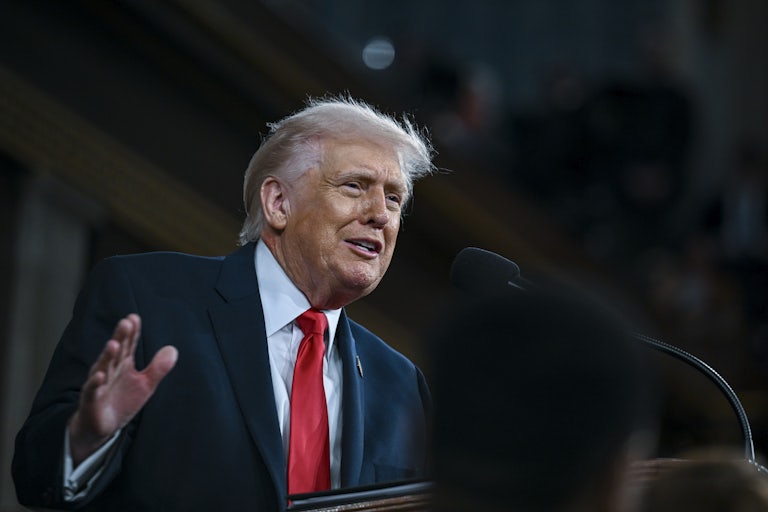
Addressing the war for the first time during a Medal of Honor ceremony on Monday, Donald Trump claimed that Iran’s “pursuit of nuclear weapons” posed an immediate threat to the American public—even though he declared last year that his June attacks on Iran’s nuclear facilities had “completely and totally obliterated” the country’s nuclear program.
“The United States military continues to carry out large-scale combat operations in Iran to eliminate the grave threats posed to America by this terrible, terrorist regime,” Trump said Monday.
“In addition, the regime’s conventional ballistic missile program was growing rapidly and dramatically, and this posed a very clear, colossal threat to America and our forces stationed overseas. The regime already had missiles capable of hitting Europe and our bases, both local and overseas, and would soon have had missiles capable of reaching our beautiful America.
“An Iranian regime armed with long-range missiles and nuclear weapons would be an intolerable threat to the Middle East, but also to the American people,” Trump continued. “Our country itself would be under threat, and it was very nearly under threat.”
So far, four American soldiers have been killed in the conflict, as have more than 20 Iranian officials, including Supreme Leader Ayatollah Ali Khamenei.
Trump has yet to formally speak to the American people about the war—a major departure from his predecessors, who almost universally recognized the need to justify the need for military intervention with an immediate speech to the public. Woodrow Wilson did so the same day he asked Congress to declare war against Germany during World War I, while Franklin D. Roosevelt gave a national address hours before the country declared war during World War II.
Even Harry Truman, who proceeded with the Korean War without the authorization of Congress—much like Trump—delivered a radio address to the American public shortly after he ordered U.S. air and naval forces to assist South Korea.
The current Middle East mobilization is the Trump administration’s second attempt to destroy Iran’s nuclear program, which the White House has claimed is for weapons development. The first attack took place on June 22.
At the time, Trump celebrated that the strike had eviscerated Iran’s nuclear program, publicly rejecting a battle damage assessment by the Pentagon that determined that the impact of the missile barrage on the larger program was minimal and had only set Iran’s nuclear program back by a few months. The White House has thus far failed to explain the discrepancy, or why it needs to spend more taxpayer funds attacking a site that purportedly has already been demolished.
Before the June attack, Iran had argued that it was seeking uranium for peaceful purposes, such as expanding its nuclear energy program. The nation has undergone years of nuclear site inspections by the International Atomic Energy Agency, and mere weeks before the U.S. bomb strike had allowed the agency’s inspectors to remain in the country, according to the U.N. entity.
Trump scrapped a potential nuclear deal with Iran during his first term, pulling out of the Joint Comprehensive Plan of Action in May 2018.