Breaking News
Breaking News
from Washington and beyond

U.S. Shoots Down Three of Its Own Fighter Jets as Iran War Spirals

CENTCOM reported that three fighter jets were shot down in friendly fire.

Four F-15E Strike Eagles
U.S. Air Force/Getty Images
In this handout photo in an undisclosed location, U.S. airmen prepare to load GBU-31 munition systems onto F-15E Strike Eagles within the U.S. Central Command area of responsibility, in support of Operation Hawkeye Strike in Syria, on December 18, 2025.

Three U.S. fighter jets were shot down over Kuwait in what the U.S. Central Command described as a “friendly fire incident.” Each pilot involved reportedly ejected from their jet and survived.

“At 11:03 p.m. ET, March 1, three U.S. F-15E Strike Eagles flying in support of Operation Epic Fury went down over Kuwait due to an apparent friendly fire incident. During active combat—that included attacks from Iranian aircraft, ballistic missiles, and drones—the U.S. Air Force fighter jets were mistakenly shot down by Kuwaiti air defenses,” CENTCOM wrote in a statement. “All six aircrew ejected safely, have been safely recovered, and are in stable condition. Kuwait has acknowledged this incident, and we are grateful for the efforts of the Kuwaiti defense forces and their support in this ongoing operation.”

X screenshot OSINTdefender @sentdefender Both the Pilot and Weapons Systems Officer (WSO) onboard the U.S. Air Force F-15E Strike Eagle that crashed this morning over Kuwait due to a “friendly fire” incident, appear to have survived, being found by locals and transferred to local authorities in Kuwait. (photo and video)

The news immediately raised both skepticism and concern for competency.

“Friendly fire does happen. But three F-15Es? Downstream effects of ops tempo + lack of training + faulty mission planning + panic,” Air Force veteran and former Representative Denver Lee Riggleman III wrote on X. “I mission planned F-15Es for a living in the USAF.… Our military is IN Kuwait on permanent station in multiple locations. This is operational incompetence.”

“‘Friendly fire’ shooting down, not one, but three US F15 jets is an insane way to say you got fu€ked by Iran,” Lebanese activist Hadi Nasrallah claimed.

“The claim all three US warplanes were brought down by ‘friendly fire’ deserves further scrutiny,” Drop Site News’s Jeremy Scahill said. “CENTCOM also noted that the planes went down ‘During active combat—that included attacks from Iranian aircraft, ballistic missiles, and drones.’”

Whether claims of friendly fire are true or an attempt to cover up devastating incompetence, it’s clear that the Trump administration is moving wastefully and recklessly in its war on Iran. It has already killed hundreds of innocent Iranian men, women, and children, and the war has also resulted in four U.S. troop deaths.
Trump Is Using Interviews to Brainstorm Next Steps in Iran

Donald Trump has no clue what to do next in Iran.

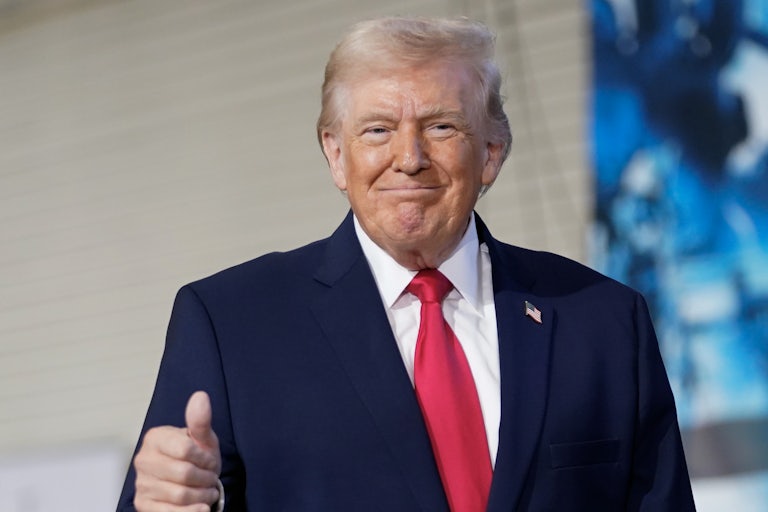
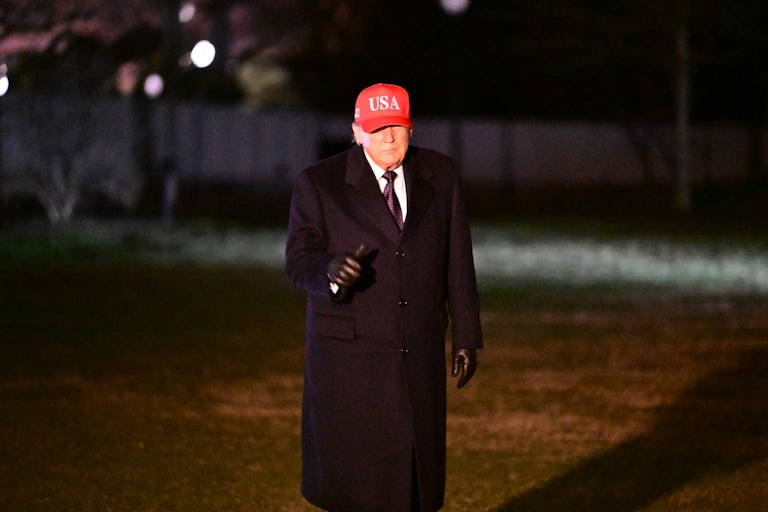
Donald Trump gives a thumbs up while walking outside the White House
Kyle Mazza/Anadolu/Getty Images

Donald Trump declared war against Iran over the weekend, killing dozens of people in the country’s senior leadership in the process, including Supreme Leader Ayatollah Ali Khamenei. Yet Trump still doesn’t have a clear reason for doing so—or a plan for what to do next.

The attack was initially advertised as an attempt at regime change, but the president has reportedly called droves of journalists in the days since in various attempts to revamp his message.

“Trump is basically calling up every journalist in his phone to workshop different timelines and goals for his war,” reported The Economist’s Gregg Carlstrom.

Carlstrom noted that Trump had offered four remarkably different responses to America’s major media companies. He told The Washington Post that the aim of the war would be “freedom for the people” of Iran. Meanwhile, he told The New York Times that he had “three very good choices” for who could take control of Iran. Then, he told ABC News that the “attack was so successful it knocked out most of the candidates” for leadership.

“It’s not going to be anybody that we were thinking of because they are all dead. Second or third place is dead,” Trump told ABC’s Jonathan Karl.

Trump also told the Times that the war might end in “four to five weeks,” though that was way off base from the “two or three days” estimate he offered Axios.

“I can go long and take over the whole thing, or end it in two or three days and tell the Iranians: ‘See you again in a few years if you start rebuilding [your nuclear and missile programs],’” Trump told Axios in a phone interview from Mar-a-Lago, adding that regardless of his decision, it would take the Iranians “several years” to recover from the attack.

The Wall Street Journal reported that Trump initially stated that the Iranian mission was about “threat reduction,” then about “getting a deal,” then about “regime change” again. “And that was just on Sunday,” reported the paper’s Alex Ward.

“He doesn’t sound convinced by any of it. He’s throwing spaghetti at the wall. Ultimately I suspect he just wants to say he ‘solved’ a problem that has vexed every American president since Jimmy Carter,” wrote Carlstrom. “But there’s no clear idea what that looks like and no plan for how to get there. And there are plenty of possible scenarios in which Trump declares victory and leaves the region with an absolute mess.”

The confusion left even the president’s staunchest allies confused about the purpose of the war.  South Carolina Senator Lindsey Graham tried to make sense of the mission in an interview with NBC News’s Meet the Press, though he did not succeed.

“Is hope the plan for the future of Iran?” asked host Kristin Welker on Sunday, quoting one of Trump’s social media posts.

“No, the future of Iran is going to be determined by the Iranian people. The new Iran, whatever it is … our goal is to make sure it cannot become, again, the largest state sponsored terrorism—that’s a win for us,” Graham said.

“But is there a plan, senator? Is there a plan to make sure that happens? Is there a plan—does the president have a plan to make sure that happens?” Welker said.

“No! It’s not his job or my job to do this,” Graham said, audibly distressed. “How many times do I have to tell you?”

So far, four Americans have been killed in the Iranian air strikes, according to U.S. military officials, while several U.S. jets were shot down by Kuwaiti friendly fire.

As of Monday morning, Trump still has yet to address the American people regarding the war—a major departure from his predecessors, who immediately recognized the need to justify the need for military intervention. Woodrow Wilson spoke to the public the same day he asked Congress to declare war against Germany during World War I, while Franklin D. Roosevelt gave a national address hours before the country declared war during World War II.

Even Harry Truman, who proceeded with the Korean War without the authorization of Congress—much like Trump—delivered a radio address to the American public shortly after he ordered U.S. air and naval forces to assist South Korea.

Pentagon Destroys Trump’s Main Defense on Iran Strikes

It turns out President Trump’s rationale for striking Iran isn’t true.

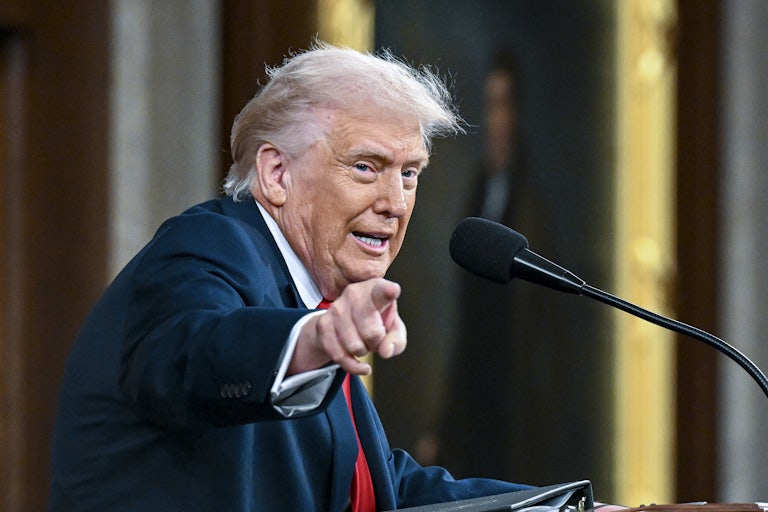
Donald Trump speaking at a lectern
Kenny Holston/Pool/Getty Images

Iran was not planning to attack U.S. military personnel or bases in the Persian Gulf unless Israel struck first, sources in the Pentagon told Congress Sunday.

The revelation undercuts the White House’s claim the day before that Iran was an imminent threat to the U.S. with plans to strike American targets first. Senior Trump administration officials claimed Saturday that Iran was planning to begin attacks against American military bases in the Middle East with many casualties. At the time, CNN reported that this claim had no intelligence basis.

Iran has its own missile program and supports groups outside of the country such as Hezbollah in Lebanon, the Houthis in Yemen, and multiple militias in Iraq. White House officials used these factors to back up its claim, but other sources told the news outlet that this still didn’t justify the U.S. hitting Iran first.

When asked about the Department of Defense contradicting the White House, an administration spokesperson, Dylan Johnson, avoided the question and said that the DOD had “briefed the bipartisan staffs of several national security committees in both chambers for over 90 minutes on the military action in Iran.”

The briefings only discussed Iran’s allied groups in the region and its missile program, and didn’t mention any intelligence about Iran attacking the U.S. first, sources also told Reuters.

All of this shows bungled planning by the Trump administration for its military action against Iran. Four U.S. soldiers have been killed thus far and five seriously wounded, with other military personnel suffering minor shrapnel injuries and concussions. By Trump’s admission, any plans for succession in Iran after its supreme leader, Ayatollah Khamenei, was killed on Saturday were dashed because multiple successors were also killed.

What happens now? Apparently Trump is workshopping possible plans with outside journalists. Meanwhile, countless Iranian civilians are dead, including at least 165 at an elementary school, and the death toll in the region will only increase as this ill-advised, haphazard war continues.

Trump Uses Questions on Iran Attack to Hype Up His Latest Renovations

Donald Trump refused to answer questions any questions about the war.

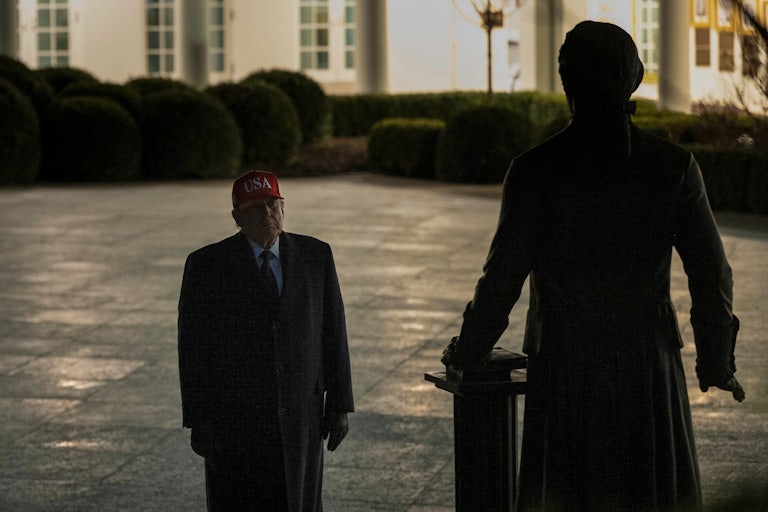
Donald Trump stands in the White House Rose Garden and looks at a statue of Thomas Jefferson
Brendan Smialowski/AFP/Getty Images

President Donald Trump dodged questions about his illegal war with Iran to praise two new statues in his paved-over Rose Garden.

Arriving back at the White House Sunday evening, Trump was peppered with questions from reporters about his illegal—and sudden—aerial bombing campaign in Iran. But Trump declined to answer, and turned his attention instead to some new statues of Thomas Jefferson and Benjamin Franklin in the Rose Garden, CNN reported.

“What are the objectives for Iran?” asked one reporter.

“Mr. President, who do you want to lead Iran?” asked another.

“Unbelieveable statutes, you see,” Trump mused. “Unbelievable statues.”

Trump then wandered away, as the reporters continued to shout questions after him. “Mr. President, what’s your message to the families of the service members who were killed?”

No response came.

Trump’s refusal to answer questions betrays more than a total lack of leadership—it reveals his complete lack of compassion for the American people, who overwhelmingly disapprove of a war with Iran.

Speaking Sunday in a pretaped video about three U.S. soldiers killed in the attack, Trump said, “Sadly, there will likely be more before it ends. That’s the way it is.”

U.S. Central Command confirmed Monday that a fourth service member died due to injuries sustained in the operation.

More than 550 people were killed during a series of U.S. and Israeli strikes in Iran, including 150 people, many of whom were children, at a girls’ elementary school.

Trump’s Effort to Steal the Midterms Is Getting Serious

MAGA groups have drafted an executive order that would allow the president to take over the country’s elections.

Donald trump does a thumbs up
Nathan Howard/Getty Images

Anti-voting activists are circulating an unconstitutional executive order draft that they argue could allow Donald Trump to take control over the country’s electoral systems ahead of the 2026 midterms.

The 17-page order, titled “Establishing Security, Integrity, and Transparency for United States Elections with Protections Against Foreign Interference,” was originally penned in April 2025. It argues that Trump could declare a national emergency to circumvent the national security “threats” posed by America’s electoral process.

The pitch appears to be contingent on a new component of MAGA’s 2020 presidential election conspiracy, blaming China for the alleged election interference.

The party, and its leaders, have already baselessly attacked mail-in voting and accused the country’s largest electoral software companies—Smartmatic and Dominion—of rigging their machinery to assist President Joe Biden. Both companies sued the media entities and Trump allies that touted the thoroughly debunked conspiracy, securing enormous financial settlements once it became clear that there was no fodder to fuel the bogus allegations.

“There is now clear and compelling evidence from court cases and forensic analysis that these threats have not been mitigated but instead have intensified,” the order reads. “Persons located, in whole or in part, outside the United States, and assisted by certain domestic accomplices, have exploited unmitigated vulnerabilities through unauthorized remote access to election equipment and related infrastructure despite claims from certain vendors, election officials and media assets that this is not possible.”

The order further blames the “manipulation of tabulated results,” the “casting of illegitimate ballots,” and “ineligible voter registrations” on the creation of the proposed executive order, arguing that the alleged violations constitute “an unusual and extraordinary threat to the national security and foreign policy of the United States.”

That, according to the memo, is apparently enough justification to interfere with the country’s elections—until states comply with a broad list of demands that include requiring all intended voters to provide proof of “identity, U.S. citizenship, and current, permanent residency.”

When pressed about the possibility of actually following through on the MAGA-proposed effort, Trump asked reporters Friday: “Who told you that?”

“No,” Trump continued, noting that he was not looking into the idea. “I’ve never heard about it.”