Breaking News
Breaking News
from Washington and beyond

GOP Rants About TSA Shutdown Right After Voting Against Funding TSA

They are blaming their Democratic colleagues for the lack of funding.

Senator Katie Britt gestures while speaking at a podium
Anna Moneymaker/Getty Images

Alabama Senator Katie Britt condemned Democrats for not funding the Transportation Security Administration just days after she voted against her Democratic colleagues’ attempt to fund the agency. 

“TSA officers have gone 74 days without a paycheck in FY26 because of Democrats’ two shutdowns. This is absolutely unacceptable,” Britt wrote on X Monday. “Democrats need to end their political posturing, stop using our TSA agents as political pawns, and fully fund DHS.”

But just last week, it was Britt who blocked the Democrats’ effort to fund TSA. 

The Department of Homeland Security is currently shut down, with Democrats demanding new policies to rein in federal immigration enforcement agencies. In an attempt at compromise, Washington Senator Patty Murray asked Wednesday for unanimous consent for a measure to fund TSA, FEMA, the U.S. Coast Guard, and other essential agencies under the Department of Homeland Security. But Britt objected. 

“We have political games being played by our Democratic colleagues instead of putting the people of this nation first,” Britt said at the time. “Mr. President, what we’ve just seen put forth by the senator from Washington would effectively defund our law enforcement officers that are charged with keeping Americans safe.”

But clearly, it is Britt who would like to keep TSA agents unpaid for political leverage. 

Senate Republicans have voted six separate times against Democrats’ attempts to fund essential agencies run by the Department of Homeland Security. That’s not stopping them from blaming the long airport lines on their Democratic counterparts. 

“For the third time in six months, TSA officers are working without pay because of Democrat shutdowns. American livelihoods aren’t a political game. Fund DHS now,” Wyoming Senator Cynthia Lummis wrote on X Monday. 

But just days prior, while debating against the measure to fund TSA officers, it appears the answer seemed less clear to her.  “We’re in a terrible conundrum here,” she said on the Senate floor. 
Read more about the Department of Homeland Security:

Crowd Gasps as Trump Exposes GOP Congressman’s Terminal Diagnosis

The president revealed a Republican congressman’s private health information.

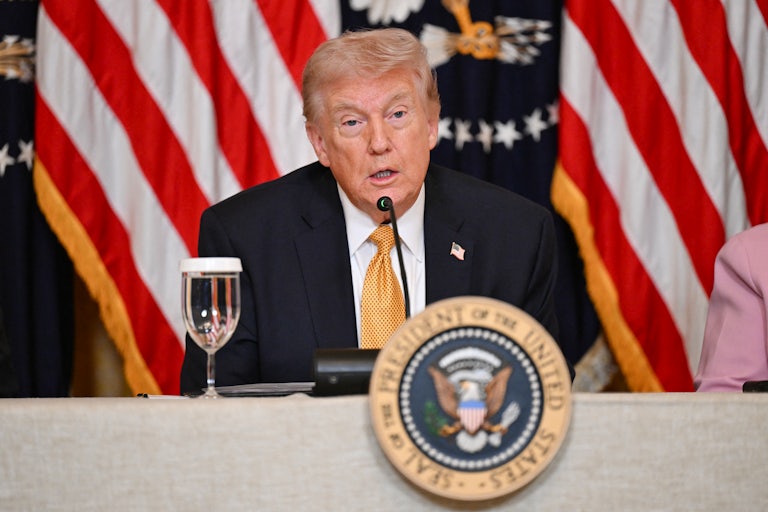
President Donald Trump speaks into a mic while seated behind the presidential seal.
Annabelle GORDON/AFP/Getty Images
President Donald Trump speaks during a lunch with Kennedy Center board members in the East Room of the White House, March 16.

President Trump just told the entire world that GOP Representative Neal Dunn is supposed to be “dead by June”—information that was previously private.

Trump approached the topic on Monday while complaining about the slim Republican majority in the House as Speaker Mike Johnson sat next to him on a panel regarding renovations at the newly renamed Trump-Kennedy Center.

“He’s got a majority of two … for a period of time we had it up to four. And then we had a death. And death is very bad when you’re the speaker and you have a majority of two or three. But we had a death, and we had another death, and we had some things. But we’re looking very strong,” Trump said.

“We had one man who was very ill. He looked like he wasn’t gonna make it. I don’t know, I won’t mention his name. Should I? Do people know his name? Do you wanna mention it?” he continued, turning to Johnson, who shrugged awkwardly. “Huh? Do you wanna mention it? He’ll be proud? Go ahead, tell ’em the story.”

Johnson, visibly uncomfortable, turned his microphone on as Trump laughed. “Thank you Mr. President. Congressman Neal Dunn of Florida had had some real health challenges, and it was very serious, and had had a pretty grim diagnosis,” he said. “And I mentioned it to the president, and I said Congressman Dunn is a real champion and a patriot because he’s still coming to work. And if others got this diagnosis they would be apt to go home and retire—”

“What was the diagnosis?” Trump interjected, looking expectantly as if Johnson was about to drop the punchline of an inside joke.

“It was, um—I mean, I think it was a terminal diagnosis,” Johnson said, trying to avoid revealing any more personal medical information about Dunn.

“He would be dead by June,” Trump declared.

“OK, that wasn’t public, but yeah, OK. It was grim, that’s what I was gonna say—”

“With a heart problem by the way. This was a heart problem.”

Johnson went on to explain that Dunn got some kind of special care from Trump’s presidential doctors at Walter Reed Hospital’s emergency surgery wing. “The man has a new lease on life, he acts like he’s 30 years younger, and he walked into the conference meeting, and we thought we’d seen a ghost.… He thanks the president for his leadership and intervention.”

“Mike called me, and he said, ‘Sir we’re up by three, but we’re gonna lose one by June.… Number one, it was bad, ’cause I liked him. Number two, it was bad because I needed his vote,” Trump said. “He said, ‘Mike, I’m gonna last this out for the president and you. And however long I live—I mean it looks like June is the time—but however long I live, I’m gonna be voting for you.’”

What an incredibly bleak, shallow thing to say about a member of your own party who was apparently on the brink of death. Trump himself seemed to realize this.

“And just, you know, because I don’t wanna have a terrible story about this, I did it for him first, and for the vote second. But it was a close second, actually. But I did it for the vote second.”

This came as Trump announced Monday morning on Truth Social that White House chief of staff Susie Wiles—who was sitting right next to him during the panel—was diagnosed with breast cancer.

Trump Announces His Notorious Chief of Staff Has Breast Cancer

Meanwhile, Trump continues to decimate funding for cancer research.

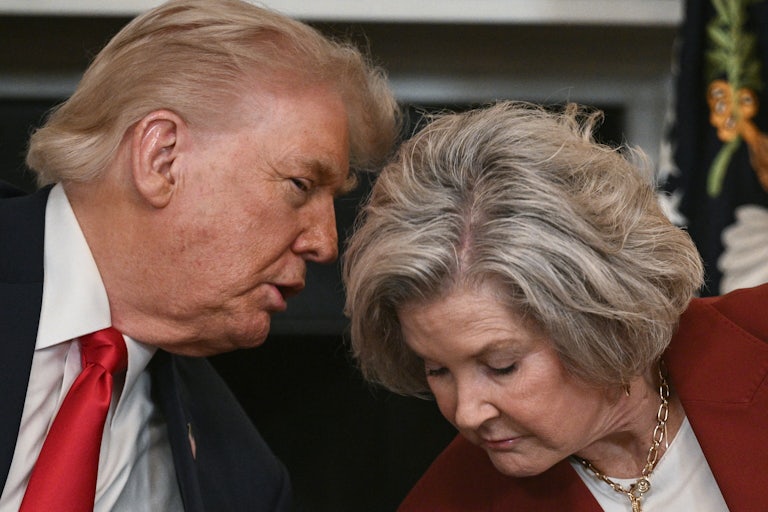
President Donald Trump speaks with White House chief of staff Susie Wiles
BRENDAN SMIALOWSKI/AFP/Getty Images
President Donald Trump speaks with White House chief of staff Susie Wiles during an “Invest America” roundtable discussion in the State Dining Room of the White House, June 9, 2025.

Donald Trump announced Monday that White House chief of staff Susie Wiles has early stage breast cancer, and will be completing much of her treatment on site at the White House.

“She has a fantastic medical team, and her prognosis is excellent! During the treatment period, she will be spending virtually full time at the White House, which makes me, as President, very happy!” Trump posted on Truth Social. “Her Strength and her Commitment to continue doing the job she loves, and does so well, while undergoing treatment, tells you everything you need to know about her.”

Meanwhile, the Trump administration has cut or frozen hundreds of millions of dollars in medical research funding, including $273 million worth of cancer research grants at the National Institutes of Health. The president’s health and environmental policies also seem to encourage the spread of the disease, loosening restrictions on substances linked to cancer and discouraging vaccines preventing illnesses that could lead to cancer.

By the president’s own admission, Wiles is getting good treatment. As a White House employee, she likely has access to the best cancer doctors in the world. Meanwhile, ordinary Americans, who already have the most expensive health care in the world, are having to deal with rising premium costs, massive cuts to Medicare and Medicaid, and a grim future for cancer research. If only the president cared about the people he is supposed to lead as much as his top aide.

This story has been updated.

Start the Countdown: Trump Official Says Iran War Will End in 2 Weeks

Scott Bessent is the first administration official to put an end date on the war—only to contradict himself moments later.

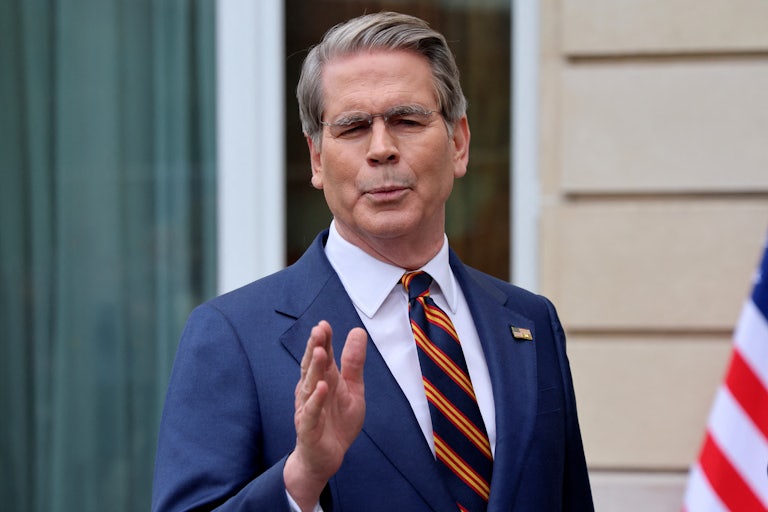
Treasury Secretary Scott Bessent gestures while speaking to reporters
Ludovic MARIN/AFP/Getty Images

The treasury secretary has pitched his own timeline for the Iran war.

When asked by CNBC on Monday when the armed conflict would end, Scott Bessent insisted: “two weeks.”

“Two weeks,” Bessent repeated. “I know the media likes to move things along, we see these headlines—and that’s part of the Iranian strategy. It’s very unfortunate that because of a dislike for President Trump—not you, but a lot of the mainstream media—are trying to make this into some crisis that it’s not.”

It was not immediately clear what informed Bessent’s deadline, though his confidence in the long-term gains of the lethal conflict was not so steady.

“And on the other side of this, if you look at longer-dated crude [oil prices], you look at future inflation expectations, they’re both very well anchored and, you know, this will end,” Bessent continued.

He then proceeded to contradict himself: “I don’t know how many weeks it will be, but on the other side of this, the world will be safer and we will be better supplied.”

Bessent is one of the first Trump administration officials to publicly pin down a potential end date for the war (even if he appeared to retract it soon after). In private, U.S. and Middle Eastern officials reportedly believe the conflict will continue for the next six months. That could change drastically, however, considering that Donald Trump and his allies are reportedly discussing putting boots on the ground in Iran—a drastic escalation that could embroil the U.S. in the conflict for much, much longer.

Americans are just as conflicted on the war’s chronology. A Quinnipiac University poll conducted March 6–8 found that 71 percent of registered voters believe that the war will last longer than a few months, with 26 percent of voters convinced the war will last longer than a year.

On Thursday, Bessent was abruptly yanked in the middle of a sit-down interview with Sky News to visit the Situation Room at the president’s request. “The president wants you right away,” an off-camera aide commanded. Bessent was visibly flustered when he returned about two hours later, volunteering unprompted details about one of his children’s supposed interest in joining the Iran war.

Israel and the U.S. opened fire on Iran on February 28, sparking a regional conflict that has so far killed 13 U.S. soldiers and more than 20 Iranian officials, including Ayatollah Ali Khamenei.

The war has also claimed the lives of more than 1,200 Iranian civilians, including dozens of children at a girls’ school in the country’s south. Some 3.2 million people have been displaced, as U.S.-Israeli strikes have damaged more than 42,000 civilian sites—such as homes, hospitals, and schools—across Iran, according to Iranian government spokesperson Fatemeh Mohajerani.

Trump Turns to Migrant Workers Amid Farm Labor Crisis

The Trump administration has finally accepted that its immigration crackdown is causing a labor crisis.

A migrant worker wears a large hat and stands alone in a farm.
CHANDAN KHANNA/AFP/Getty Images
A migrant worker on a farm in Homestead, Florida, on April 25, 2025

Donald Trump’s solution to the farmworker shortage caused by his violent mass deportation campaign is to embrace migrant labor.

The New York Times reports that the Trump administration is making it cheaper to hire migrant farmworkers on temporary visas under the H-2A program. It’s a blatant admission that the White House’s promise that deporting more immigrants would help American workers with better wages and lower unemployment was a farce.

“The farm economy is in a difficult situation, and President Trump is utilizing all the tools available to ensure farmers have what they need to be successful,” said Agriculture Secretary Brooke Rollins.

Under the new policy, hourly rates for workers on H-2A visas have been lowered by $1–$7 depending on the state, with farmers now being allowed to calculate housing as part of the workers’ compensation. With this dramatic reduction in workers’ pay, the United Farm Workers of America, a union representing thousands of workers across the country, has filed a lawsuit claiming that American farmworkers will be pushed out while earning a lot less.

“These actions are going to displace domestic farmworkers who have been working in the fields and putting food on dinner tables for decades, and bring a work force that is even more vulnerable to abuse,” Teresa Romero, the union’s president, told the Times. She noted that exploitation and trafficking is already a problem for many migrant workers.

Anti-immigration organizations like the Center for Immigration Studies are also against the move, with Mark Krikorian, the group’s executive director, writing in November that such changes would encourage more immigration and reduce automation.

The Trump administration seems to be hoping its supporters, other than farmers struggling for labor, won’t notice this and will continue to think the White House is carrying out its deportation agenda, which is otherwise so extreme it has been compared to ethnic cleansing. Meanwhile, its own myths about deportations helping the economy are unraveling.