Breaking News
Breaking News
from Washington and beyond

Trump Spirals Over Israeli Attack on Gas Field, as Iran War Escalates

Donald Trump apparently didn’t see these consequences coming.

Donald Trump looks down while walking down the stairs from Air Force One.
Alex Wong/Getty Images

Donald Trump disavowed Israel’s air strikes against Iran’s South Pars gas field, claiming that the U.S. “knew nothing” about the attack.

The president tried to wash his hands of Israel’s late-night assault, which marked a major escalation in the Iran war. Moments later, however, Trump promised that he, too, would “massively blow up” Iran’s gas field if Tehran did not stop attacking Qatar.

“Israel, out of anger for what has taken place in the Middle East, has violently lashed out at a major facility known as South Pars Gas Field in Iran,” Trump wrote in a post on Truth Social late Wednesday. “A relatively small section of the whole has been hit. The United States knew nothing about this particular attack, and the country of Qatar was in no way, shape, or form, involved with it, nor did it have any idea that it was going to happen.”

Trump further claimed that Iran was not aware that Israel was behind the attack, and instead retaliated against Qatar’s energy infrastructure.

The South Pars gas field is one of the largest natural gas reserves in the world. It is located offshore in the Persian Gulf and is shared between Iran and Qatar. The field contains an estimated 1,800 trillion cubic feet of usable gas and supplies countries all over the world. For context, the enormous reserve is estimated to contain enough gas to meet global demand for 13 years.

Israel’s ambush will only serve to add more pressure on the global gas supply. Energy prices soared last week after Iran closed the Strait of Hormuz, a waterway through the Middle East that funnels approximately one-fifth of all crude oil shipments. The price of Brent crude, a global oil benchmark, surged from a pre-attack low of $106 per barrel to as much as $118 per barrel by Thursday morning.

U.S. diplomats don’t see how Trump could have been left in the dark on Israel’s sudden bombardment. Dan Shapiro, the former U.S. ambassador to Israel posted on X late Wednesday that there was “zero, I mean zero, chance” that Israel would have struck the energy target without giving U.S. Central Command “full visibility.”

Later that evening, reports emerged that both Israeli and American officials had confirmed that the U.S. knew in advance about the attack, but that Trump changed his tune once Iran struck Qatar, according to Axios.

“NO MORE ATTACKS WILL BE MADE BY ISRAEL pertaining to this extremely important and valuable South Pars Field unless Iran unwisely decides to attack a very innocent, in this case, Qatar—In which instance the United States of America, with or without the help or consent of Israel, will massively blow up the entirety of the South Pars Gas Field at an amount of strength and power that Iran has never seen or witnessed before,” Trump continued in his post. “I do not want to authorize this level of violence and destruction because of the long term implications that it will have on the future of Iran, but if Qatar’s LNG is again attacked, I will not hesitate to do so.”

Trump told reporters Tuesday that he would withdraw from the war “in the very near future,” but that he wasn’t ready to leave yet. Leaving may not be a feasible option anytime soon, however. The president’s allies noticed a shift in regional power earlier this week, warning that while the early days of the war may have indicated an immediate victory, prolonged U.S. involvement in the conflict has dramatically increased the likelihood of boots on the ground. The changing tide has fueled concern that Trump could draw the country into yet another open-ended Middle East conflict.

Israel’s latest attack has left key Trump officials at a loss for words. At a press conference early Thursday morning, Defense Secretary Pete Hegseth couldn’t seem to muster up an explanation for why the U.S. was continuing to fight this unpopular war alongside such a volatile ally.

“Why are we helping Israel prosecute this war if they are pursuing their own objectives?” asked a reporter from the far-right outlet The Gateway Pundit.

“We hold the cards, we have objectives, those objectives are clear,” Hegseth said. “We have allies pursuing objectives as well. The truth speaks for itself.… POTUS has made it clear, very clear.”
Pete Hegseth Demands Everyone Thank Trump for Kicking Off Global Chaos

The defense secretary was shocked that people weren’t thrilled with the Iran war.

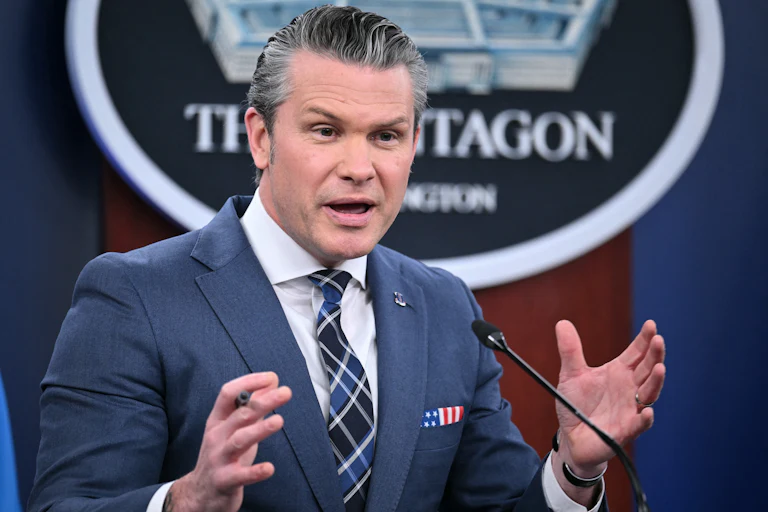
Defense Secretary Pete Hegseth gestures while speaking at a podium
Mandel NGAN/AFP/Getty Images

Defense Secretary Pete Hegseth whined Thursday that the world should be grateful for President Donald Trump’s disastrous war in Iran.

Speaking during a press briefing, Hegseth turned his cultish rantings on, well, everybody.

“The world, the Middle East, our ungrateful allies in Europe, even segments of our own press should be saying one thing to President Trump: thank you,” Hegseth said. “Thank you for the courage to stop this terror state from holding the world hostage with missiles while building or attempting to build a nuclear bomb. Thank you for doing the work of the free world.”

The actual content of Hegseth’s request for gratitude was almost as preposterous as the plea itself.

Trump’s war hasn’t prevented Iran from “holding the world hostage with missiles”—in fact, his actions have invited retaliatory attacks on vessels in the Strait of Hormuz that have brought global trade to a screeching halt, and sent energy prices skyrocketing. Should Americans be thanking Trump for sending gas prices close to $4 a gallon, with no hope of bringing them down anytime soon?

Trump’s war hasn’t stopped Iran from building or attempting to build a nuclear bomb. The U.S. intelligence community’s annual global threat assessment found that Iran’s nuclear enrichment program was already “obliterated” and that “there were no efforts since then to try and rebuild their enrichment capability.” Should Americans be thanking Trump for launching an increasingly expensive military campaign against a threat that was not actually imminent?

Hegseth’s childish antagonism of U.S. allies simply underlines how desperate things have become. Those “ungrateful allies” in Europe are the very same ones that Trump is begging to help him clean up his mess in the Strait of Hormuz. And allies in the Middle East are the same ones being targeted by Iran, as Israel strikes energy infrastructure on which Gulf nations rely, with Trump unable to rein them in. Should our allies get on their knees and kiss Trump’s feet for the chaos he’s sown, or his reckless, feckless approach to starting massive global conflict?

Fed Reserve Chair Says Trump’s Policies Mostly to Blame for Inflation

Jerome Powell says there’s a clear reason inflation isn’t slowing down.

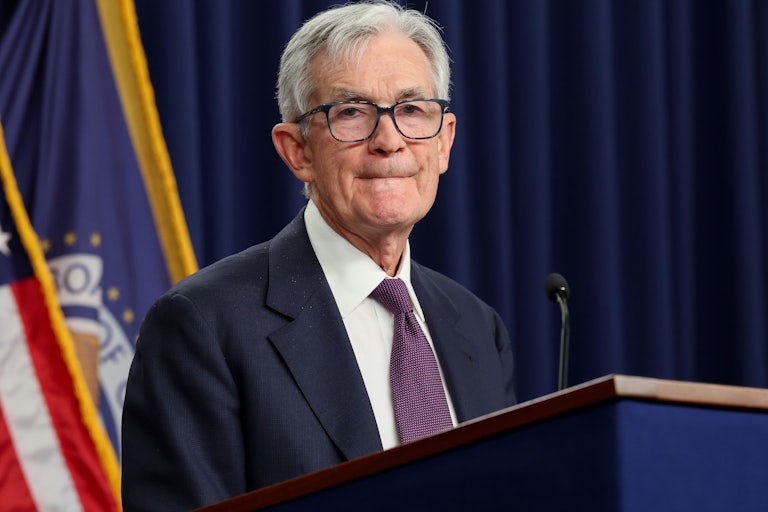
Federal Reserve Chair Jerome Powell purses his lips while standing behind a podium.
Anna Moneymaker/Getty Images
Federal Reserve Chair Jerome Powell takes questions following the Federal Open Markets Committee meeting on March 18.

Federal Reserve Chair Jerome Powell once again confirmed the obvious—that President Trump’s impulsive tariffs and his war on Iran are responsible for skyrocketing prices.

“If you look at total core inflation, it’s about 3 percent. And some big chunk of that, between a half and three quarters, is actually tariffs,” Powell said at a Wednesday press conference.

Powell also cast blame upon Trump’s war on Iran, which has caused oil and gas prices to rise to their highest national levels in years.

“Near-term measures of inflation expectations have risen in recent weeks, likely reflecting the substantial rise in oil prices caused by the supply disruptions in the Middle East,” he said earlier in the conference.

Powell blamed these policies while announcing the Federal Reserve would leave interest rates unchanged. “The forecast is that we will be making progress on inflation; not as much as we had hoped, but some progress on inflation,” he said.

The Trump campaign can’t blame growing inflation on former President Biden forever, and the issue will persist long after Powell leaves. It’s clear that their president’s policies are responsible for the frustrated cries of millions of Americans who were already struggling financially. Powell’s admission only further cements Trump’s apathy towards the affordability issues.

Democrat Reveals Epstein File That Blows Huge Hole in Trump’s Story

Democratic Representative Dan Goldman shared a previously redacted email that contradicts Trump’s story on how he stopped being friends with the sexual predator.

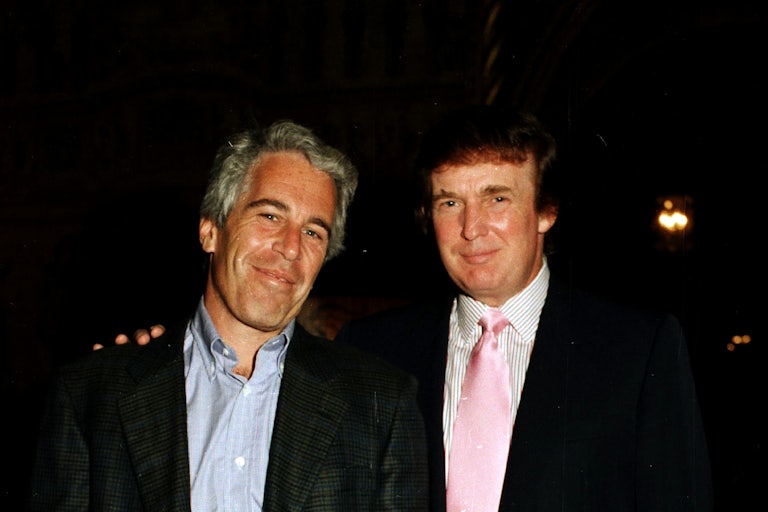
Jeffrey Epstein and Donald Trump smile while standing next to one another. Trump places his hand on Epstein's shoulder.
Davidoff Studios/Getty Images
Jeffrey Epstein and Donald Trump at the Mar-a-Lago estate, Palm Beach, Florida, February 22, 1997.

Democratic Representative Dan Goldman revealed an unredacted document from the Epstein files on the House floor Wednesday, saying that it directly contradicts Donald Trump’s account of his relationship with the billionaire sex offender.

The document is an October 2009 email containing information about a conversation between one of Epstein’s attorneys, Jack Goldberger, and an attorney for Trump, Alan Garten. The email was initially released to the public in redacted form. In the unredacted version, as Goldman highlighted, Goldberger wrote that Garten said Epstein was never asked to leave Trump’s Mar-a-Lago country club in Florida as he was not a member, but may have been a guest.

Screenshot Boston Smalls @smalls2672 EFTA00740636 Unveiled Unredacted on House Floor by Dan Goldman. Trump never threw Epstein out of Mar-a-Lago like he claims and has been reported on.

This directly contradicts Trump’s claim that he kicked Epstein out of the resort in 2004 due to his poaching of Mar-a-Lago employees. Goldman claimed that the document was being deliberately withheld by the Department of Justice, violating the Epstein Files Transparency Act that Trump signed into law in November.

“This document here was redacted to the public. It was unredacted to Congress and it completely disputes everything that Donald Trump has said about Jeffrey Epstein,” Goldman said, displaying a blown-up poster of the email. “Now, why is this important? Because if the attorney general is covering up this information that she then reveals to Congress, what else is she covering up about Donald Trump’s involvement in the Epstein files?”

Bondi is already under fire for allegedly mismanaging the release of the Epstein files, and has been subpoenaed by the Republican-led House Oversight Committee to appear for a deposition April 14. This latest revelation is only going to make her seem more guilty of slow-walking and covering up damning information about Trump and Epstein.

JD Vance Admits Gas Prices Are About to Get Ugly: “Rough Road Ahead”

The Trump administration doesn’t know how to respond to skyrocketing gas prices thanks to the Iran war.

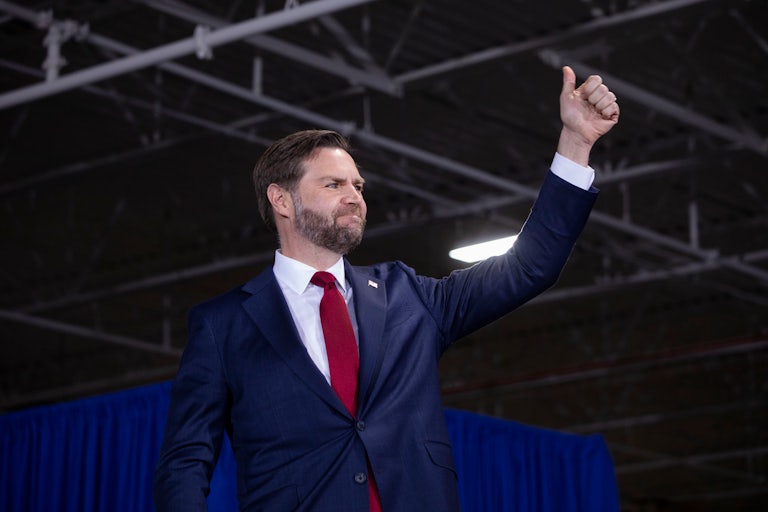
JD Vance gives a big thumbs up and smiles
Bill Pugliano/Getty Images
Vice President JD Vance walks onstage before delivering remarks at a manufacturing plant on March 18.

Vice President JD Vance admitted there’s a “rough road ahead” with regard to skyrocketing gas prices caused by the war on Iran, which still has no clear end in sight.

“We’re seeing gas prices here climbing at home, in particular here in metro Detroit with what’s going on in Iran and the impacts on the Strait of Hormuz,” a reporter asked Vance at a Wednesday press conference in Michigan. “What is the administration doing to help keep gas prices down, and where do you see gas prices going in the near future?”

“Well, the president of the United States has been crystal clear about this. Look, gas prices are up. And we know they’re up. And we know that people are hurting because of it. And we’re doing everything we can to make sure they stay lower,” Vance replied. “The president said this and I certainly agree with it. This is a temporary blip, OK?”

Vance then went on to blame former President Joe Biden rather than elaborate on how exactly the Trump administration would be bringing gas prices down.

“Frankly [gas prices] aren’t even as high as they were during certain parts of the Biden administration because of what’s going on in the Middle East. It’s not gonna last forever. We’re gonna take care of business, we’re gonna come back home. And when that happens you’re gonna see energy prices come back down.... But yeah, we’ve got a rough road ahead of us for the next few weeks, but it’s temporary.”

This comes just one day after Ken Hassett, the director of the National Economic Council, proudly declared that the Iran war’s negative impact on the average U.S. consumer is “the last” of the administration’s concerns.

Trump Team Spirals Over Bombshell Report Exposing Cuba Plans

The Trump administration is pissed about a New York Times story that details a plan to target the Cuban president.

Secretary of State Marco Rubio
Brendan SMIALOWSKI/AFP/Getty Images
Secretary of State Marco Rubio

The Trump administration is spiraling over a New York Times story that says it is pushing Cuban President Miguel Díaz-Canel to step down as a requirement for negotiations between the U.S. and Cuba to move forward.

The Times reported Monday, citing four anonymous sources, that U.S. negotiators want economic hard-liner Díaz-Canel to go in order to open up the country’s economy. The report has infuriated Trump administration officials, who are disputing the reporting.

Secretary of State Marco Rubio, who is personally handling Cuba, said Tuesday night on X, “The reason so many in US media keep putting out fake stories like this one is because they continue to rely on charlatans & liars claiming to be in the know as their sources.”

Charlie Stadtlander, a spokesperson for the newspaper, responded to Rubio Wednesday morning, saying that the Times reached out to the State Department “well before publication and received no disagreement with the information we were bringing to light.”

“Neither you nor anyone else has presented a factual dispute to the reporting,” Stadtlander stated. “Our reporting is real, and accurate.”

X screenshot NYT Communications “Secretary Rubio: As our article states, this reporting is based on conversations with four people familiar with the U.S. talks with Cuba. Our journalists reached out to your State Department for comment well before publication and received no disagreement with the information we were bringing to light. Neither you nor anyone else has presented a factual dispute to the reporting. Our reporting is real, and accurate.” — Charlie Stadtlander, a spokesperson for The New York Times

Hours later, White House communications director Steven Cheung jumped in and insulted the Times on X, saying, “The only people who are privy to Cuba are President Trump and Marco Rubio. Your lazy reporters relied on uninformed sources who know nothing about what’s going on.”

What Rubio and Cheung are mad about is unclear. Trump told reporters last month that he thinks that there could be a “friendly takeover” of Cuba, and, unprompted, told CNN just a week later that “Cuba is going to fall pretty soon.” Maybe Rubio and Cheung, amid the administration’s various regime change plots, are mad that the Times got inside information that they didn’t want revealed to the public.

Kash Patel Brags That the FBI Is Buying Your Location Data

The FBI director said the gross invasion of privacy had led to “valuable intelligence.”

FBI Director Kash Patel leans back while sitting in a Senate hearing
Kevin Dietsch/Getty Images

The leader of the FBI admitted Wednesday to unconstitutionally buying location data monitoring the general public.

The confession emerged during a heated exchange with Democrat Senator Ron Wyden, who asked FBI Director Kash Patel if he would pledge to refrain from such purchases.

“Can you commit this morning to not buying Americans’ location data?” asked Wyden.

“The FBI uses all tools … to do our mission,” Patel said. “We do purchase commercially available information that’s consistent with the Constitution and the laws under the Electronic Communications Privacy Act. It’s led to some valuable intelligence for us to be utilized with our private and partner sectors.”

“So you’re saying that the agency will buy Americans’ location data?” Wyden said. “I believe that’s what you’ve said in some kind of intelligence lingo.”

“Doing that without a warrant is an outrageous end run around of the Fourth Amendment. It’s particularly dangerous given the use of artificial intelligence to comb through massive amounts of private information,” the Oregon lawmaker noted.

The Fourth Amendment protects people in America from unlawful search and seizures by the government, mandating that law enforcement officials obtain search warrants, which require a legal standard of probable cause. That standard remains true for any attempted information collection by government agencies, which typically have to convince a judge to authorize a search warrant before they can access such details from tech or phone companies.

Patel’s tacit approval of his administration’s intrusions into the personal details of everyday Americans illustrates that the agency not only failed to meet that standard—but also that the current leader appears to not understand the gravity of the violation.

Wyden was one of four lawmakers who last week introduced the bipartisan Government Surveillance Reform Act, which among other things would explicitly require surveillance agencies to seek judicial warrants from data brokers. It would also prohibit “warrantless backdoor searches,” would prohibit the targeting of foreigners as “a pretext for spying on the Americans with whom they are communicating,” and “prohibits the collection of domestic communications.”

In a statement, Representative Warren Davidson noted that Section 702 of the Foreign Intelligence Surveillance Act had been “stretched far beyond its original purpose” to the point that it effectively permits “unconstitutional warrantless searches of American citizens and their private communications.”

“The bipartisan Government Surveillance Reform Act counters these abuses by requiring a warrant to search Americans’ data and by closing the data broker loophole that allows the federal government to spy on citizens by purchasing private data that would otherwise require a warrant or subpoena,” the Ohio Republican wrote.

Tulsi Gabbard Refuses to Say Whether Iran Was Imminent Nuclear Threat

The director of national intelligence backed herself into a corner over the supposed threat.

Director of National Intelligence Tulsi Gabbard presses her lips together and looks down during a Senate hearing
Win McNamee/Getty Images

Tulsi Gabbard wouldn’t say Wednesday that Iran presented an “imminent threat,” claiming it wasn’t the director of national intelligence’s job to actually assess threats.

During a hearing before the Senate Intelligence Committee to discuss the intelligence community’s annual threat assessment report, Georgia Senator Jon Ossoff questioned Gabbard about the White House’s claim that Donald Trump’s illegal war in Iran was “a military campaign to eliminate the imminent nuclear threat posed by the Iranian regime.”

“Was it the assessment of the intelligence community that there was an imminent nuclear threat posed by the Iranian regime?” Ossoff asked.

“The intelligence community assessed that Iran maintained the intention to rebuild and to continue to grow their nuclear enrichment capability,” Gabbard replied.

The Georgia Democrat repeated his question, and Gabbard pivoted.

“Senator, the only person who can determine what is and is not an imminent threat is the president—” Gabbard said.

“False,” Ossoff said, before reminding Gabbard that the hearing on worldwide threats was her opportunity to present intelligence that was “timely, objective, and independent of political considerations.”

Intelligence officials, including Gabbard, are charged with determining the credibility and severity of national security threats and passing that information to the president, who then has the power to declare a national emergency, according to U.S. law. The intelligence community’s actual findings, however, directly contradicted Trump’s determination of an imminent threat, as well as his administration’s inexplicable claims that Iran had the capability to build multiple nuclear weapons.

Gabbard would have Americans believe it is a matter of opinion whether a threat is imminent. Evidence of any actual danger is not required.

“You’ve stated today that the Intelligence Community’s assessment is that Iran’s nuclear enrichment program was ‘obliterated’ and that ‘there were no efforts since then to try and rebuild their enrichment capability,’” Ossoff continued, referring to Gabbard’s written remarks (during the start of the hearing, she tried to omit this portion).

“Was it the intelligence community’s assessment that, nevertheless, despite this ‘obliteration,’ there was an ‘imminent nuclear threat posed by the Iranian regime?’ Yes or no?” he repeated.

“It is not the intelligence community’s responsibility to determine what is and is not an imminent threat. It is up to the president based on a volume of information that he receives,” Gabbard replied.

“It is precisely your responsibility,” Ossoff said, pointing back to her own opening statement, where she’d promised to represent the intelligence community’s “assessment of threats.” How had she become so unqualified within the course of a day?

Gabbard retreated into word salad. “Once again, senator, the intelligence community has provided the inputs that make up this threat assessment. It is the nature of the imminent threat that the president has to make that determination,” and so on.

Ossoff accused Gabbard of evading the question, “because to provide a candid response to the committee would contradict a statement from the White House.”

Meanwhile, Gabbard couldn’t explain why Trump appeared not to understand the actual stakes of the conflict he started—Iran’s retaliation, or the closure of the Strait of Hormuz.

Democrats Take Aim at Kristi Noem’s Alleged Lover in New Probe

Three senior House Democrats asked the Department of Homeland Security to preserve documents related to Corey Lewandowski.

Corey Lewandowski stands with his left hand on his chin and his right hand under his left elbow
Andrew Harnik/Getty Images
Corey Lewandowski

Ex–Homeland Security Secretary Kristi Noem’s love life is getting placed under the microscope.

The ranking Democrats of three House committees called on DHS’s inspector general to investigate Noem’s rumored beau, ex–special employee Corey Lewandowski, and his influence over the national security agency’s contracts. 

In a separate joint notice, they also wrote directly to DHS, demanding that agency staffers “preserve all communications and internal records” related to Lewandowski, including social media messages, Signal chats, and other private or personal communications pertaining to DHS matters.

The signed Democrats were Representatives Robert Garcia (Oversight Committee), Rick Larsen (Committee on Transportation and Infrastructure), and Bennie Thompson (Homeland Security Committee).

The trio accused Lewandowski of serving as Noem’s “shadow chief of staff,” a position that they said was beyond the scope of his authority as a special government employee.  They specifically requested “all communications and internal records concerning Mr. Lewandowski’s role within the Department, as well as the Department’s practices, policies, and procedures related to contracting, personnel, and the handling of classified materials.”

The memo is just another escalation of the party’s wide-ranging probe into Lewandowski’s behavior. In August, Garcia tasked Noem with explaining Lewandowski’s ongoing tenure at the agency, despite his lapsed employment status. The following month, Garcia wrote again, demanding Lewandowski’s financial disclosures, which he claimed should be made available to the public on the basis that he “meets the qualifications to be a public filer.”

Lewandowski has been tied into the president’s inner fold for years. He served as Donald Trump’s first campaign manager in the 2016 presidential race, and has since remained a loyal “devotee.”

Noem’s alleged affair with Lewandowski was one of the worst-kept secrets in Washington. The pair are practically inseparable, and have been spotted grinding on each other at parties and leaving each other’s apartments, despite the fact that they are both married to other people.

The arrangement became such a MAGA meme that the ousted DHS secretary was actually mocked for taking her husband to a black-tie White House event last month instead of Lewandowski.

Tulsi Gabbard Reveals How Little Intel Trump Is Getting on Iran

Senior intel officials can’t explain why Trump is so shocked by Iran’s retaliation tactics in the war.

DNI Director Tulsi Gabbard
Kevin Dietsch/Getty Images

Contradictory answers from Director of National Intelligence Tulsi Gabbard and CIA Director John Ratcliffe during a Wednesday Senate hearing raise questions regarding the frequency and substance of President Trump’s intelligence briefings amid the Iran war. 

“Does the president take a daily brief from the intelligence community?” Senator Angus King asked, following a long silence from both officials. “This is a yes or no question.”

Ratcliffe eventually replied that he briefs the president “probably on average 10 to 15 times a week,” as Gabbard remained silent.

The point-blank question followed a lengthy exchange in which both officials were unable to explain why Trump was so shocked by Iran’s response to the war.

“There seems to be a discrepancy between what the intelligence community has reported over the years and what the president has said in terms of this action,” King said. “For example, Senator Wyden read the report from a year ago that strikes against neighboring states and action to close the Strait of Hormuz was predicted by the intelligence community. Yet the president says nobody knew. And my question is, did you tell him?” 

An awkward silence passed as neither Gabbard nor Ratcliffe moved to answer the very direct question. 

“Anybody wanna answer that question?” 

“So with regard to briefings, the president gets briefings constantly about intelligence. Now the comments that you talked about, I had not heard,” said Ratcliffe. “What I can tell you is Iran had specific plans to hit U.S. interests and energy sites across the region. And that’s why the Department of War and the Department of State took measures for force protection and personnel protection in advance of Operation Epic Fury.” 

“Any predictions to the president about the Strait of Hormuz? All you gotta do is look at a map, and you’ll see the vulnerability of the Strait of Hormuz,” King continued. “Was that part of the briefing, Director Gabbard?” 

“I think Director Radcliffe made the point here is that this has long been an assessment of the I.C. that Iran would likely hold the Strait of Hormuz as leverage—” 

“My question is, was that communicated to the president in the lead-up to this action?”

“And it’s because of that long-standing assessment that the I.C. has continued to report that the Department of War took the preemptive planning measures that it did,” Gabbard replied.

“They’ve stated that they did not plan for the Strait of Hormuz; the president said, ‘Who knew that was gonna happen?’”

King was likely referring to Trump’s repeated comments over the last week that he was surprised by Iran’s retaliation. On Monday, Trump again claimed that nobody expected Iran’s attacks on Qatar, the UAE, and other Gulf states. “Nobody. No no no no. The greatest experts—nobody thought they were going to hit,” Trump said. And on Sunday, CNN reported that the Pentagon had severely underestimated the negative impacts of a blockade on the strait, even as preparing for that same event had been “a bedrock principle of US national security policy for decades.” This massive oversight would indeed point to discrepancies in Gabbard’s and Ratcliffe’s vague answers. If the president was receiving regular and thorough intel briefings, why has the Iranian blockade of the strait been such a shock?

Trump’s continued flailing on the strait—from claiming he doesn’t need help getting oil tankers through it to begging European allies for help doing just that, to threatening to abandon the strait altogether—suggest that the briefings senior intel officers claim happen so frequently may not have resonated.