Breaking News
Breaking News
from Washington and beyond

Trump Team Spirals Over Bombshell Report Exposing Cuba Plans

The Trump administration is pissed about a New York Times story that details a plan to target the Cuban president.

Secretary of State Marco Rubio
Brendan SMIALOWSKI/AFP/Getty Images
Secretary of State Marco Rubio

The Trump administration is spiraling over a New York Times story that says it is pushing Cuban President Miguel Díaz-Canel to step down as a requirement for negotiations between the U.S. and Cuba to move forward.

The Times reported Monday, citing four anonymous sources, that U.S. negotiators want economic hard-liner Díaz-Canel to go in order to open up the country’s economy. The report has infuriated Trump administration officials, who are disputing the reporting.

Secretary of State Marco Rubio, who is personally handling Cuba, said Tuesday night on X, “The reason so many in US media keep putting out fake stories like this one is because they continue to rely on charlatans & liars claiming to be in the know as their sources.”

Charlie Stadtlander, a spokesperson for the newspaper, responded to Rubio Wednesday morning, saying that the Times reached out to the State Department “well before publication and received no disagreement with the information we were bringing to light.”

“Neither you nor anyone else has presented a factual dispute to the reporting,” Stadtlander stated. “Our reporting is real, and accurate.”

X screenshot NYT Communications “Secretary Rubio: As our article states, this reporting is based on conversations with four people familiar with the U.S. talks with Cuba. Our journalists reached out to your State Department for comment well before publication and received no disagreement with the information we were bringing to light. Neither you nor anyone else has presented a factual dispute to the reporting. Our reporting is real, and accurate.” — Charlie Stadtlander, a spokesperson for The New York Times

Hours later, White House communications director Steven Cheung jumped in and insulted the Times on X, saying, “The only people who are privy to Cuba are President Trump and Marco Rubio. Your lazy reporters relied on uninformed sources who know nothing about what’s going on.”

What Rubio and Cheung are mad about is unclear. Trump told reporters last month that he thinks that there could be a “friendly takeover” of Cuba, and, unprompted, told CNN just a week later that “Cuba is going to fall pretty soon.” Maybe Rubio and Cheung, amid the administration’s various regime change plots, are mad that the Times got inside information that they didn’t want revealed to the public.
Kash Patel Brags That the FBI Is Buying Your Location Data

The FBI director said the gross invasion of privacy had led to “valuable intelligence.”

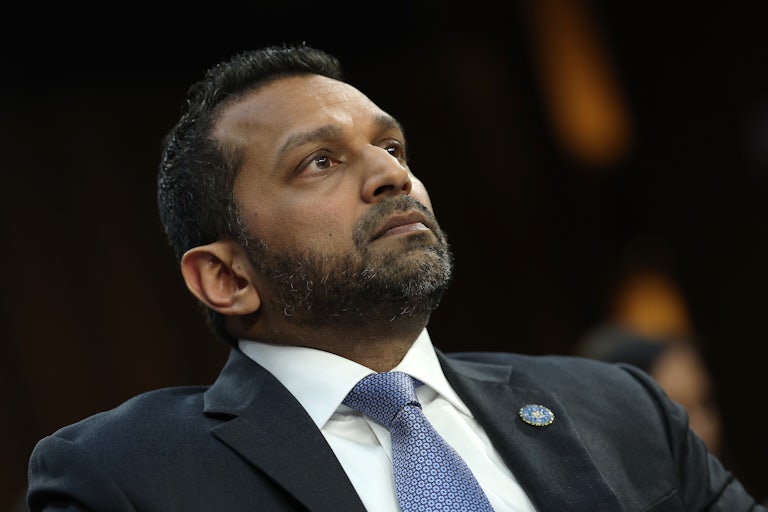
FBI Director Kash Patel leans back while sitting in a Senate hearing
Kevin Dietsch/Getty Images

The leader of the FBI admitted Wednesday to unconstitutionally buying location data monitoring the general public.

The confession emerged during a heated exchange with Democrat Senator Ron Wyden, who asked FBI Director Kash Patel if he would pledge to refrain from such purchases.

“Can you commit this morning to not buying Americans’ location data?” asked Wyden.

“The FBI uses all tools … to do our mission,” Patel said. “We do purchase commercially available information that’s consistent with the Constitution and the laws under the Electronic Communications Privacy Act. It’s led to some valuable intelligence for us to be utilized with our private and partner sectors.”

“So you’re saying that the agency will buy Americans’ location data?” Wyden said. “I believe that’s what you’ve said in some kind of intelligence lingo.”

“Doing that without a warrant is an outrageous end run around of the Fourth Amendment. It’s particularly dangerous given the use of artificial intelligence to comb through massive amounts of private information,” the Oregon lawmaker noted.

The Fourth Amendment protects people in America from unlawful search and seizures by the government, mandating that law enforcement officials obtain search warrants, which require a legal standard of probable cause. That standard remains true for any attempted information collection by government agencies, which typically have to convince a judge to authorize a search warrant before they can access such details from tech or phone companies.

Patel’s tacit approval of his administration’s intrusions into the personal details of everyday Americans illustrates that the agency not only failed to meet that standard—but also that the current leader appears to not understand the gravity of the violation.

Wyden was one of four lawmakers who last week introduced the bipartisan Government Surveillance Reform Act, which among other things would explicitly require surveillance agencies to seek judicial warrants from data brokers. It would also prohibit “warrantless backdoor searches,” would prohibit the targeting of foreigners as “a pretext for spying on the Americans with whom they are communicating,” and “prohibits the collection of domestic communications.”

In a statement, Representative Warren Davidson noted that Section 702 of the Foreign Intelligence Surveillance Act had been “stretched far beyond its original purpose” to the point that it effectively permits “unconstitutional warrantless searches of American citizens and their private communications.”

“The bipartisan Government Surveillance Reform Act counters these abuses by requiring a warrant to search Americans’ data and by closing the data broker loophole that allows the federal government to spy on citizens by purchasing private data that would otherwise require a warrant or subpoena,” the Ohio Republican wrote.

Tulsi Gabbard Refuses to Say Whether Iran Was Imminent Nuclear Threat

The director of national intelligence backed herself into a corner over the supposed threat.

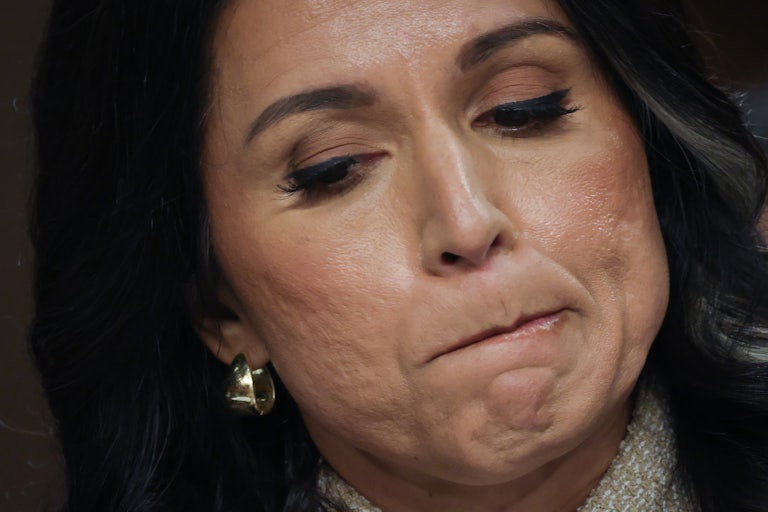
Director of National Intelligence Tulsi Gabbard presses her lips together and looks down during a Senate hearing
Win McNamee/Getty Images

Tulsi Gabbard wouldn’t say Wednesday that Iran presented an “imminent threat,” claiming it wasn’t the director of national intelligence’s job to actually assess threats.

During a hearing before the Senate Intelligence Committee to discuss the intelligence community’s annual threat assessment report, Georgia Senator Jon Ossoff questioned Gabbard about the White House’s claim that Donald Trump’s illegal war in Iran was “a military campaign to eliminate the imminent nuclear threat posed by the Iranian regime.”

“Was it the assessment of the intelligence community that there was an imminent nuclear threat posed by the Iranian regime?” Ossoff asked.

“The intelligence community assessed that Iran maintained the intention to rebuild and to continue to grow their nuclear enrichment capability,” Gabbard replied.

The Georgia Democrat repeated his question, and Gabbard pivoted.

“Senator, the only person who can determine what is and is not an imminent threat is the president—” Gabbard said.

“False,” Ossoff said, before reminding Gabbard that the hearing on worldwide threats was her opportunity to present intelligence that was “timely, objective, and independent of political considerations.”

Intelligence officials, including Gabbard, are charged with determining the credibility and severity of national security threats and passing that information to the president, who then has the power to declare a national emergency, according to U.S. law. The intelligence community’s actual findings, however, directly contradicted Trump’s determination of an imminent threat, as well as his administration’s inexplicable claims that Iran had the capability to build multiple nuclear weapons.

Gabbard would have Americans believe it is a matter of opinion whether a threat is imminent. Evidence of any actual danger is not required.

“You’ve stated today that the Intelligence Community’s assessment is that Iran’s nuclear enrichment program was ‘obliterated’ and that ‘there were no efforts since then to try and rebuild their enrichment capability,’” Ossoff continued, referring to Gabbard’s written remarks (during the start of the hearing, she tried to omit this portion).

“Was it the intelligence community’s assessment that, nevertheless, despite this ‘obliteration,’ there was an ‘imminent nuclear threat posed by the Iranian regime?’ Yes or no?” he repeated.

“It is not the intelligence community’s responsibility to determine what is and is not an imminent threat. It is up to the president based on a volume of information that he receives,” Gabbard replied.

“It is precisely your responsibility,” Ossoff said, pointing back to her own opening statement, where she’d promised to represent the intelligence community’s “assessment of threats.” How had she become so unqualified within the course of a day?

Gabbard retreated into word salad. “Once again, senator, the intelligence community has provided the inputs that make up this threat assessment. It is the nature of the imminent threat that the president has to make that determination,” and so on.

Ossoff accused Gabbard of evading the question, “because to provide a candid response to the committee would contradict a statement from the White House.”

Meanwhile, Gabbard couldn’t explain why Trump appeared not to understand the actual stakes of the conflict he started—Iran’s retaliation, or the closure of the Strait of Hormuz.

Democrats Take Aim at Kristi Noem’s Alleged Lover in New Probe

Three senior House Democrats asked the Department of Homeland Security to preserve documents related to Corey Lewandowski.

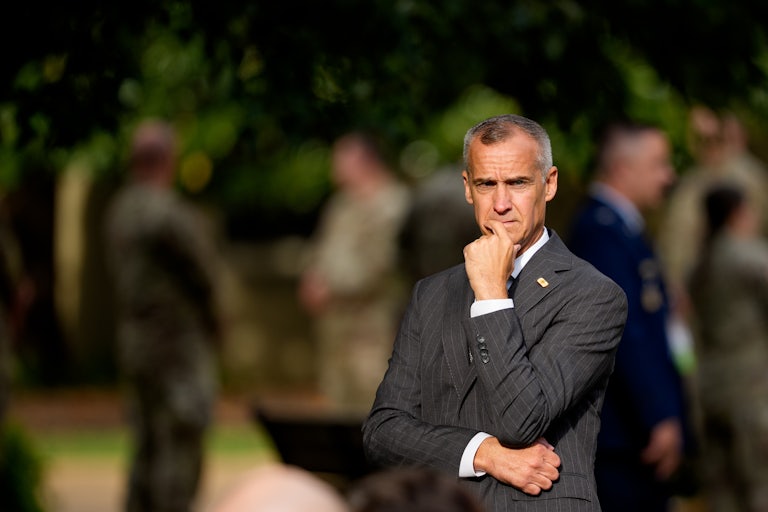
Corey Lewandowski stands with his left hand on his chin and his right hand under his left elbow
Andrew Harnik/Getty Images
Corey Lewandowski

Ex–Homeland Security Secretary Kristi Noem’s love life is getting placed under the microscope.

The ranking Democrats of three House committees called on DHS’s inspector general to investigate Noem’s rumored beau, ex–special employee Corey Lewandowski, and his influence over the national security agency’s contracts. 

In a separate joint notice, they also wrote directly to DHS, demanding that agency staffers “preserve all communications and internal records” related to Lewandowski, including social media messages, Signal chats, and other private or personal communications pertaining to DHS matters.

The signed Democrats were Representatives Robert Garcia (Oversight Committee), Rick Larsen (Committee on Transportation and Infrastructure), and Bennie Thompson (Homeland Security Committee).

The trio accused Lewandowski of serving as Noem’s “shadow chief of staff,” a position that they said was beyond the scope of his authority as a special government employee.  They specifically requested “all communications and internal records concerning Mr. Lewandowski’s role within the Department, as well as the Department’s practices, policies, and procedures related to contracting, personnel, and the handling of classified materials.”

The memo is just another escalation of the party’s wide-ranging probe into Lewandowski’s behavior. In August, Garcia tasked Noem with explaining Lewandowski’s ongoing tenure at the agency, despite his lapsed employment status. The following month, Garcia wrote again, demanding Lewandowski’s financial disclosures, which he claimed should be made available to the public on the basis that he “meets the qualifications to be a public filer.”

Lewandowski has been tied into the president’s inner fold for years. He served as Donald Trump’s first campaign manager in the 2016 presidential race, and has since remained a loyal “devotee.”

Noem’s alleged affair with Lewandowski was one of the worst-kept secrets in Washington. The pair are practically inseparable, and have been spotted grinding on each other at parties and leaving each other’s apartments, despite the fact that they are both married to other people.

The arrangement became such a MAGA meme that the ousted DHS secretary was actually mocked for taking her husband to a black-tie White House event last month instead of Lewandowski.

Tulsi Gabbard Reveals How Little Intel Trump Is Getting on Iran

Senior intel officials can’t explain why Trump is so shocked by Iran’s retaliation tactics in the war.

DNI Director Tulsi Gabbard
Kevin Dietsch/Getty Images

Contradictory answers from Director of National Intelligence Tulsi Gabbard and CIA Director John Ratcliffe during a Wednesday Senate hearing raise questions regarding the frequency and substance of President Trump’s intelligence briefings amid the Iran war. 

“Does the president take a daily brief from the intelligence community?” Senator Angus King asked, following a long silence from both officials. “This is a yes or no question.”

Ratcliffe eventually replied that he briefs the president “probably on average 10 to 15 times a week,” as Gabbard remained silent.

The point-blank question followed a lengthy exchange in which both officials were unable to explain why Trump was so shocked by Iran’s response to the war.

“There seems to be a discrepancy between what the intelligence community has reported over the years and what the president has said in terms of this action,” King said. “For example, Senator Wyden read the report from a year ago that strikes against neighboring states and action to close the Strait of Hormuz was predicted by the intelligence community. Yet the president says nobody knew. And my question is, did you tell him?” 

An awkward silence passed as neither Gabbard nor Ratcliffe moved to answer the very direct question. 

“Anybody wanna answer that question?” 

“So with regard to briefings, the president gets briefings constantly about intelligence. Now the comments that you talked about, I had not heard,” said Ratcliffe. “What I can tell you is Iran had specific plans to hit U.S. interests and energy sites across the region. And that’s why the Department of War and the Department of State took measures for force protection and personnel protection in advance of Operation Epic Fury.” 

“Any predictions to the president about the Strait of Hormuz? All you gotta do is look at a map, and you’ll see the vulnerability of the Strait of Hormuz,” King continued. “Was that part of the briefing, Director Gabbard?” 

“I think Director Radcliffe made the point here is that this has long been an assessment of the I.C. that Iran would likely hold the Strait of Hormuz as leverage—” 

“My question is, was that communicated to the president in the lead-up to this action?”

“And it’s because of that long-standing assessment that the I.C. has continued to report that the Department of War took the preemptive planning measures that it did,” Gabbard replied.

“They’ve stated that they did not plan for the Strait of Hormuz; the president said, ‘Who knew that was gonna happen?’”

King was likely referring to Trump’s repeated comments over the last week that he was surprised by Iran’s retaliation. On Monday, Trump again claimed that nobody expected Iran’s attacks on Qatar, the UAE, and other Gulf states. “Nobody. No no no no. The greatest experts—nobody thought they were going to hit,” Trump said. And on Sunday, CNN reported that the Pentagon had severely underestimated the negative impacts of a blockade on the strait, even as preparing for that same event had been “a bedrock principle of US national security policy for decades.” This massive oversight would indeed point to discrepancies in Gabbard’s and Ratcliffe’s vague answers. If the president was receiving regular and thorough intel briefings, why has the Iranian blockade of the strait been such a shock?

Trump’s continued flailing on the strait—from claiming he doesn’t need help getting oil tankers through it to begging European allies for help doing just that, to threatening to abandon the strait altogether—suggest that the briefings senior intel officers claim happen so frequently may not have resonated. 

Gabbard Accidentally Blows Up Trump’s Story on Fulton County Raid

Director of National Intelligence Tulsi Gabbard explained her shocking presence at the FBI raid of a Georgia elections office.

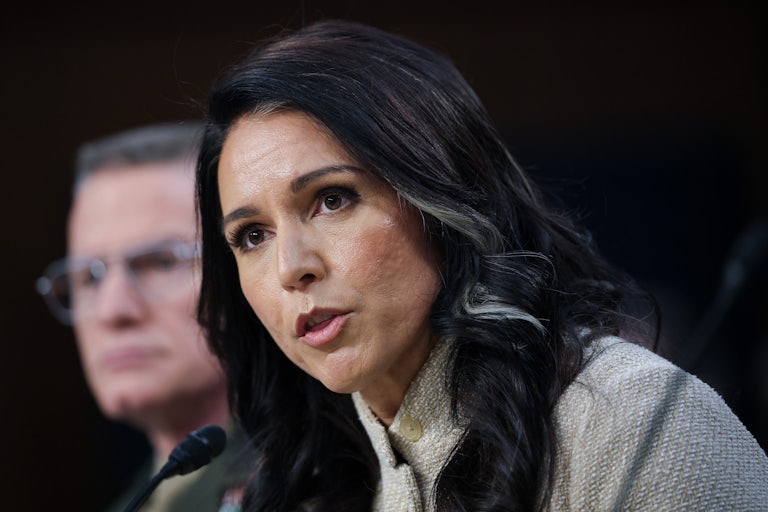
Tulsi Gabbard presses her lips together as she testifies in Congress.
Win McNamee/Getty Images
Director of National Intelligence Tulsi Gabbard testifies during a Senate Intelligence Committee hearing on March 18.

Tulsi Gabbard just contradicted a Trump administration talking point regarding her presence at an FBI raid at an elections office in Fulton County, Georgia, in January.

At a Senate hearing Wednesday, Democratic Senator Mark Warner asked the director of national intelligence why she participated in the raid, as her job is supposed to concern foreign intelligence and the warrant authorizing the raid made no mention of a foreign actor. Gabbard said it all went back to President Trump.

“Where is the authority for you to involve yourself in a domestic law enforcement activity?” Warner asked. Gabbard started to give a long-winded answer detailing her office’s legal mandate before Warner cut her off, asking her to just answer the question.

Gabbard responded that the directorate has “purview” over the Department of Homeland Security and the FBI, which in turn have purview over election security. She also said she “did not participate in a law enforcement activity, nor would I, because that does not exist within my authorities.”

Warner pressed her on the photos from the scene showing her present wearing a black baseball cap, to which Gabbard responded, “I was at Fulton County, sir, at the request of the president and to work with the FBI to observe this action that had long been awaited. I was not aware of what was in the warrant or was not—”

Warner cut in and asked what Trump’s specific request was, to which Gabbard repeated that she was there to observe the FBI. The statement inadvertently contradicts what Trump said last month, which was that Gabbard was there at the direction of Attorney General Pam Bondi.

The truth of why Gabbard was there is still unknown, but what is clear is that Trump is attempting to relitigate his loss in the 2020 election. Since the FBI raid in Georgia, he has also requested the 2020 election records from Maricopa County, Arizona. It’s creating the impression that he’s trying to gin up a justification to take over elections in the country, while also making it harder to vote by pushing the SAVE Act.

GOP and Dem Senators Double-Team DHS Nominee on “Classified” Work

In a rare show of bipartisanship, Senators Rand Paul and Gary Peters held Markwayne Mullin’s feet to the fire over his claims of serving on classified missions.

Senators Rand Paul and Gary Peters speak during a Senate hearing
Tom Williams/CQ-Roll Call, Inc/Getty Images
Senators Rand Paul (left) and Gary Peters

Senator Markwayne Mullin had a major meltdown Wednesday as senators from both sides of the aisle questioned him about a supposedly classified mission he traveled on as member of Congress—and in doing so, may have threatened his speedy confirmation vote.  

It seems the only thing Democrats and Republicans can agree on is that Mullin’s claims about a classified mission stink to high heaven. During Mullin’s Senate confirmation hearing, Senators Gary Peters and Rand Paul pressed the Oklahoma Republican on his claims about having received combat experience abroad, even though he never enlisted in the U.S. military. 

Mullin claimed that he couldn’t disclose any information about the mission unless the senators sought special clearance—but he wouldn’t say from whom or what agency. 

Earlier in the hearing, Mullin had said that in 2015 he was “asked to train with a very small contingency and go to a certain area, which was scheduled for 2016. During that time I was asked to go through, had to meet certain training qualifications.”

“I have spoke in general about my experiences, but I have never spoken specifically on details, on dates, or on the mission,” he’d added.

When asked why he failed to include this on his travel report to the FBI, Mullin said he had been asked about travel with the exception of official trips, and claimed the trip was classified. 

Peters circled back to the subject, claiming that there had been no exception for reporting official trips, and that he had explicitly instructed Mullin on how to safely provide classified information to Congress. 

“You didn’t provide any of that, and today is the first time I’m hearing about your classified activities from 2015 to 2016. Quite frankly, as we’ve had these conversations, you have not been forthcoming with me or this committee. The story always seems to evolve, to kind of change.

“We’ve checked. The SCIF is available. We’d love to have you come to the SCIF and tell us exactly what you’re talking about. I think that’ll put my colleagues’ minds at peace,” Peters said, referring to a secure room to share classified information. 

Mullin insisted he did not have to disclose his official travel. “I complied with exactly what the committee said,” he said. 

Peters claimed that the FBI had not turned over any classified document that mentioned Mullin. “We queried the Department of State, the Department of Defense, other intel folks. So, you’re in no classified document that the federal government has, according to the FBI. And yet you’re telling me that you did all this classified work,” Peters said. 

“I didn’t say ‘all,’” Mullin pushed back. 

Paul jumped in, saying he’d heard the same thing from the FBI, who did not have a separate folder documenting Mullin’s classified work that lawmakers could privately review. 

“And I’m still willing to have a vote tomorrow, but I can cancel the vote tomorrow,” Paul warned.

Mullin insisted that he would be more than happy to discuss his work, but he did not have the authority to do so, and Paul would have to receive the proper clearance—though he wouldn’t specify who to ask.

“I have zero issue with talking about it, but I don’t have clearance to talk about it this afternoon,” Mullin said, claiming only four people had been read in on the mission that was classified by the House. 

“The House classified it?” Paul asked.

“I’m assuming, I wasn’t on [the Intelligence Committee],” Mullin said. 

“We’re just not really aware how the House classifies things,” Paul said. Congress does not have the authority to classify missions, which Mullin would theoretically know because he served in the House of Representatives for a decade, and in the second half of that tenure served on the House Intelligence Committee. 

“Well, it’s a little difficult to go ask about a program that has no name, and we have nobody that we know to talk to about it, so I don’t know how we would begin doing this without your cooperation,” Paul said. 

“I’m willing to cooperate,” Mullin insisted, though his remarks suggested otherwise. 

“I’m willing to hold the vote tomorrow, but you brought this up, that you were on a super secret mission—” Paul said. 

“No, I did not say ‘super secret,’ sir. I said it was classified,” Mullin pushed back. 

Peters asked Mullin what committee he was working on at the time. “Energy and Commerce,” he replied. 

“So it was an Energy and Commerce top-secret effort?” Peters asked. Mullin pivoted, and started to complain about the Michigan Democrat’s tone of voice. 

Mullin continued to spiral out, claiming that it hadn’t been a mission—though he’d previously referred to it that way—and begging Senator John Lankford to step in and help. In the end, Paul said that every senator would need to be invited to the SCIF. “It’s all or none,” he said.

ICE Detains DACA Recipient on His Way to See Baby in NICU

ICE knew he was a DACA recipient—and detained him anyway.

An ICE agent's badge and gun
Christopher Dilts/Bloomberg/Getty Images

ICE agents detained a Texas father trying to deliver milk to his infant daughter in the neonatal intensive care unit, disregarding his status as a DACA recipient.

Juan Chavez Velasco, 35, hadn’t even left his Weslaco, Texas, neighborhood and was still on the phone with his U.S. citizen wife before agents pulled in front of his car. Telling them that he was a married father with Deferred Action for Childhood Arrivals status didn’t faze them.

“They said, ‘That doesn’t matter,’” Chavez Velasco told MS NOW on the phone from the Webb County Detention Center. He was taken to a detention facility in Laredo, Texas, leaving behind his wife and three children, all American citizens. His youngest child was born premature and was isolated in the NICU.

“I never got to hold her,” Chavez Velasco said.

The Trump administration is seemingly targeting Dreamers, as DACA recipients are called, even though the program is still tied up in court cases despite Republicans’ best efforts to overturn it. DACA status used to protect undocumented immigrants brought to the country as children, allowing them to get work permits and protecting them from deportation.

Now, not only are they being targeted, but DACA recipients applying to renew their status, required every two years, are experiencing long delays, causing their status and work permits to expire. In Chavez Velasco’s case, his status expired while in detention, after his renewal application was ignored.

A DHS spokesperson told MS NOW that Chavez Velasco is “an illegal alien” who was “issued a final order of removal in 2005” and that “illegal aliens who claim to be recipients of Deferred Action for Childhood Arrivals (DACA) are not automatically protected from deportations.”

“DACA does NOT confer any form of legal status in this country. Any illegal alien who is a DACA recipient may be subject to arrest and deportation for a number of reasons, including if they’ve committed a crime. Being in detention is a choice,” the spokesperson added, saying that Dreamers should self-deport for “$2,600 and a free flight.”

Chavez Velasco’s wife told MS NOW that he has no criminal record. He was brought to the U.S. from Colombia by his parents when he was 8, and was able to enroll in DACA in 2012, going on to earn two bachelor’s degrees in biology and clinical laboratory science. He was able to work as a medical laboratory scientist, and was working in an emergency room during the Covid-19 pandemic.

Vice President JD Vance’s threats on the campaign trail to target DACA recipients have come true, overruling President Trump’s own vague statements. To the White House and its ICE underlings, the contributions to America from people like Chavez Velasco or the well-being of their families don’t matter.

GOP Senator Demands to Know Why Trump’s DHS Pick Called Him a “Snake”

Senator Rand Paul also played a montage of video clips displaying Senator Markwayne Mullin’s violent behavior.

Senator Markwayne Mullin looks up while sitting in his Senate committee confirmation hearing for Homeland Security secretary.
Oliver Contreras/AFP/Getty Images
Senator Markwayne Mullin during his Senate committee confirmation hearing for homeland security secretary

Oklahoma Senator Markwayne Mullin had a history of bad blood to answer for during his nomination hearing to run the Department of Homeland Security, facing immediate backlash from one Republican colleague for his raucous tenure and disturbing political positions while participating in the upper chamber.

The so-called “MAGA warrior” was ripped apart as soon as the hearing began Wednesday morning. Mullin faced fierce criticism from Homeland Security Committee Chair Rand Paul, who accused him of promoting violence and suffering from severe anger issues.

Paul cited Mullin’s reaction to a November 2017 incident in which Paul was attacked by his neighbor, leaving him with several broken ribs.

Paul charged that Mullin “went on to brag” that he had “completely understood and approved of the assault,” asking Mullin to “explain to the American public why they should trust a man with anger issues to set the proper example for [Immigration and Customs Enforcement] and border patrol agents.”

The Kentuckian also dredged up another spat, in which he and Mullin publicly disagreed over a bill that would stop funding for refugee welfare programs. Paul had introduced the bill, while Mullin opposed it.

“You were confronted by constituents that were angry because you voted against my amendment to stop all funding for refugee welfare programs,” Paul said. “Instead of explaining your vote to continue these welfare programs for refugees, you decided to transfer the blame.”

“You told the media that I was a ‘freaking snake’ and that you completely understood why I had been assaulted. I was shocked that you would justify this violent assault that caused me so much pain and my family so much pain.

“I just wonder if someone who applauds violence against their political opponents is the right person to lead an agency that has struggled to accept limits to the proper use of force,” Paul added.

Former Homeland Security Secretary Kristi Noem was relocated within the government two weeks ago, following months of public controversies, but her position became especially tenuous after federal officers under her purview shot and killed two U.S. citizens in Minnesota.

Mullin told Paul that he was willing to put their political differences aside.

“Let me earn your respect. Let me earn the job. I won’t fail you. I won’t back down from a challenge. And I also admit when I’m wrong,” Mullin said.

But Mullin has so far failed to take any accountability for his gross and unprofessional behavior in Congress. Paul also played a clip from a Senate hearing in 2023, in which Mullin tried to brawl with Teamsters President Sean O’Brien. The hostile exchange was halted by Vermont Senator Bernie Sanders, but the fallout continued in the days after as Mullin refused to back down from the violence he started. Speaking with podcasters and broadcasters, Mullin invariably escalated the conflict, claiming he would “100 percent” bite and even duel the union boss.

Tulsi Gabbard Caught Changing Testimony on Iran at Last Minute

Tulsi Gabbard left out one line in her written testimony that completely demolished Trump’s rationale for the Iran war.

Director of the Defense Intelligence Agency Lt. Gen. James Adams III, Director of National Intelligence Tulsi Gabbard, and Army Lt. Gen. William Hartman testify in Congress.
Win McNamee/Getty Images
From left: Director of the Defense Intelligence Agency Lt. Gen. James Adams III, Director of National Intelligence Tulsi Gabbard, and Army Lt. Gen. William Hartman testify during a Senate Intelligence Committee hearing, on March 18.

On page six of her printed testimony for the Senate Intelligence Committee hearing on Wednesday, National Intelligence Director Tulsi Gabbard wrote that Iran’s nuclear enrichment program was “obliterated” last summer. This admission is a massive contradiction of one of the primary justifications of Trump’s deadly war on Iran—which might explain why Gabbard didn’t actually say it out loud.

Gabbard was questioned by Democratic Senator Mark Warner, who noted that he agreed with her former colleague Joe Kent, who resigned over his post as National Counterterrorism Center director because Iran was not an “imminent threat to our nation.”

“I guess what I’m concerned about, one thing is, even in your printed testimony today … in your last paragraph on page six [it] says, ‘As a result of Operation Midnight Hammer, Iran’s nuclear enrichment program was obliterated. There has been no efforts to try to rebuild their enrichment capability,’” Warner read. “You omitted that paragraph from your oral opening. Was that because the president said there was a imminent threat two weeks [ago]?”

“Sir, I recognized that the time was running long, and I skipped through some of the portions—”

“You chose to omit the parts that contradict the president,” Warner said, interrupting Gabbard before asking about what current intelligence said about the Strait of Hormuz.

Warner moved on from the question a bit too early, but the contradiction remains. U.S. war hawks of both parties have claimed that Iran is an imminent threat for decades, making it the very opposite of imminent. This war was triggered by Israeli aggression, not some incoming Iranian attack, as Marco Rubio and others within the Trump administration have made clear. Gabbard knows the truth, and she put it in writing. But she still didn’t have the guts to say it aloud.