Breaking News
Breaking News
from Washington and beyond

Pam Bondi’s Firing May Not Have Had Anything to Do With Epstein

Donald Trump reportedly felt Bondi was going too easy on his perceived enemies.

Ex-Attorney General Pam Bondi points while speaking during a House committee hearing
ROBERTO SCHMIDT/AFP/Getty Images

Pam Bondi is out of the Trump administration—and some insiders believe the underlying reason is due to an odd connection to California Representative Eric Swalwell.

Donald Trump fired Bondi Thursday, thrusting her out of government altogether and into the private sector. Her dismissal was reportedly supposed to occur Friday, but was rushed due to rampant speculation about her replacement that consumed Washington Wednesday night.

An unidentified senior administration source that spoke with the Daily Mail Thursday claimed that Bondi begged Trump to reconsider, pleading to give her more time in the role, but Trump was adamant about her departure.

“She was unhappy and tried to change his mind,” the Mail’s source said.

It was widely believed that one of Trump’s chief complaints with Bondi was her handling of the Epstein files, which remains one of the president’s most enduring scandals. But the source that spoke with Mail pointed in a different direction, positing that the sudden dismissal was in no small part because Trump believed Bondi had previously tipped Swalwell off over the FBI’s efforts to publicize decades-old files related to the lawmaker’s former relationship with a suspected Chinese spy, Christine Fang.

“She’s intervening in those matters. The White House wasn’t pleased she was intervening due to her personal friendship with Swalwell,” the source told the Mail.

Sources that spoke with Semafor also reported the Swalwell detail.

Swalwell issued a cease and desist letter to FBI Director Kash Patel on Monday, urging the intelligence chief to commit by Wednesday not to release the files on him and Fang. Swalwell is a leading Democratic candidate in the California gubernatorial race.

“The Congressman has never been accused of wrongdoing in that matter and your attempt to release the file is a transparent attempt to smear him and undermine his campaign for Governor of California,” attorneys Norm Eisen and Sean Hecker wrote on Swalwell’s behalf. “Your actions threaten to expose you, others at the FBI, and the FBI itself to significant legal liability.”

It is not clear why Bondi would have intervened in the situation. Swalwell has been a vocal critic of the president, and has publicly chastised Bondi for failing to prosecute multiple death threats against him and his family. Nonetheless, the Mail reported that Bondi and Swalwell have a “friendly” relationship.

MS NOW reported that Trump was also frustrated with Bondi’s repeated failures in prosecuting his perceived enemies.
Pam Bondi Fired as Epstein Files Backlash Catches Up to Her

President Trump has finally fired Bondi as attorney general—and she’s not sticking around.

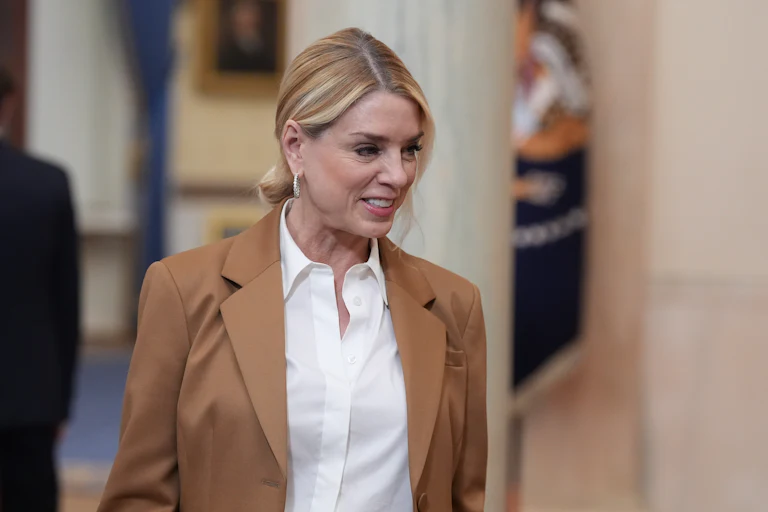
Pam Bondi smiles weirdly
Alex Brandon/Pool/Getty Images
Pam Bondi arrives at the White House to hear President Donald Trump speak about the Iran war on April 1.

President Trump has fired Attorney General Pam Bondi after more than a chaotic year marked by her indignant congressional hearings and woeful mishandling of the Epstein files.

Trump announced on Thursday that Bondi will be replaced by Deputy Attorney General Todd Blanche, and she will not remain in the administration at all.

“Pam Bondi is a Great American Patriot and a loyal friend, who faithfully served as my Attorney General over the past year. Pam did a tremendous job overseeing a massive crackdown in Crime across our Country, with Murders plummeting to their lowest level since 1900,” Trump wrote on Truth Social. “We love Pam, and she will be transitioning to a much needed and important new job in the private sector, to be announced at a date in the near future, and our Deputy Attorney General, and a very talented and respected Legal Mind, Todd Blanche, will step in to serve as Acting Attorney General.”

This is a surprising development given that other fired Trump officials received another role in the administration. Former Homeland Security Secretary Kristi Noem, who was fired last month, is now special envoy to the “Shield of the Americas.” Former National Security Adviser Mike Waltz, fired last year over Signalgate, became the U.S. ambassador to the United Nations.

Bondi became attorney general after former congressman Matt Gaetz’s nomination was derailed thanks to a House Ethics investigation that found “substantial evidence” he had sex with an underage girl. Bondi was confirmed in a 54–46 Senate vote, with John Fetterman being the only Democrat to vote yes.

“Over the next month I will be working tirelessly to transition the office of Attorney General to the amazing Todd Blanche before moving to an important private sector role I am thrilled about, and where I will continue fighting for President Trump and this Administration,” Bondi wrote Thursday on X. “Leading President Trump’s historic and highly successful efforts to make America safer and more secure has been the honor of a lifetime, and easily the most consequential first year of the Department of Justice in American history.”

Bondi’s ouster is the culmination of Trump’s growing frustrations around the intense, inadvertent scrutiny that she brought upon the administration, as she went from saying the Epstein client list was on her desk, to claiming it didn’t exist, to handing out big dramatic white binders for a photo op with MAGA influencers that contained no new information. She continuously tried and failed to declare the case closed, while exposing Epstein’s victims to more abuse by identifying them in the files. Eventually, even Republicans on the House Oversight Committee agreed to subpoena Bondi over her “possible mismanagement” of the files.

This story has been updated.

House GOP Decides Not to Vote on Shutdown Deal They Say They Want

Republicans seem to be dragging out the shutdown—again—just for fun.

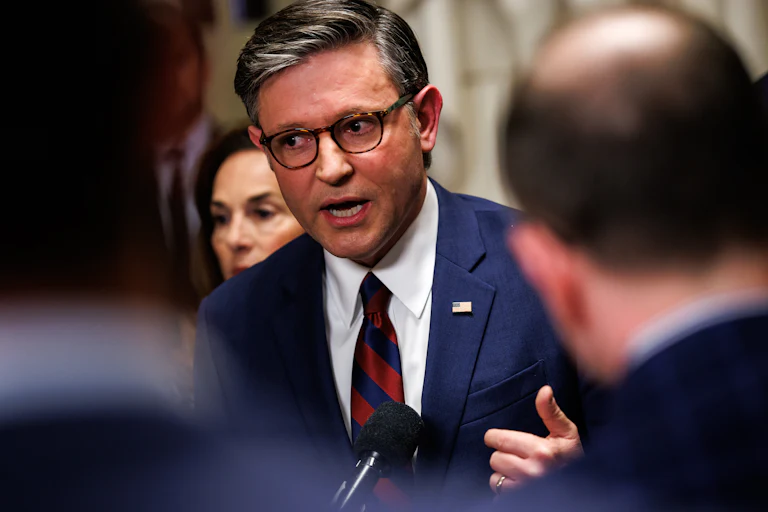
House Speaker Mike Johnson speaking
Samuel Corum/Getty Images
House Speaker Mike Johnson

Despite Speaker Mike Johnson claiming on Wednesday that he’d accept the Senate’s bipartisan deal to end the government shutdown, House Republicans adjourned the next day without putting any such bill to a vote, dragging out the shutdown for even longer.

It’s not clear why exactly the House punted on the bill, but Easter recess in Congress means that the shutdown will continue on for at least four more days.

As a result, TSA workers still won’t be paid even as Americans travel for Easter this weekend, meaning that long security lines will continue at airports. On Wednesday, Johnson and Senate Majority Leader John Thune released a joint statement saying that the House would support the Senate’s plan to fund DHS without more money for ICE and Border Patrol, and instead pursue that funding through budget reconciliation to get around a Democratic filibuster.

But it appears that Johnson, or at least his party’s caucus, are still taking their time. Democrats have held strong on the shutdown, which primarily affects agencies like the TSA, FEMA, and the Coast Guard, because ICE and Border Patrol have violently carried out President Trump’s mass deportation agenda without regard for the law, the safety of U.S. citizens, or the court orders rebuking them.

While Republicans have claimed that partially shutting down DHS makes Americans less safe, there appears to be little urgency in getting the agency running again, which Senate Minority Leader Chuck Schumer pointed out in a statement Thursday.

“The deep division and dysfunction among House Republicans is needlessly extending the DHS shutdown and hurting federal workers who are missing another paycheck,” Schumer said, adding that they should “get to work and end the longest Republican shutdown in history.”

Trump has demanded Republicans send him a bill to fund DHS by June 1. Do Johnson and his party plan to drag out the shutdown, and the problems with ICE and Border Patrol, until then?

The Question That Torpedoed Trump’s Birthright Citizenship Case

Justice Amy Coney Barrett blew a hole in Donald Trump’s case.

Supreme Court Justice Amy Coney Barrett gestures and speaks
Chip Somodevilla/Getty Images

A combative line of questioning from Justice Amy Coney Barrett could have been the death knell for Donald Trump’s scheme to undo birthright citizenship.

Solicitor General D. John Sauer argued Wednesday on behalf of the Trump administration that children should not receive citizenship if their parents lack “domicile” in the U.S.—an attempt to strip citizenship from people born in the U.S. to foreign, noncitizen parents.

Evan Bernick, a professor at Northern Illinois University College of Law, explained on Slate’s Amicus podcast later that day that Barrett’s decision to home in on the issue of slavery—and the presence of people who were forced by external powers to live in the U.S.—could have torn an irreparable hole in the government’s case.

“She made very clear that she viewed the children of slaves through the lens of unlawful immigration,” said Bernick. “She thought that the situation of enslaved people’s children was not something that could be settled on the basis of any domicile requirement. Because if we think about domicile as ‘presence with intent to remain.’”

“Well, enslaved people didn’t intend to remain anywhere!” Bernick continued. “They were taken. They were forced into a place. So domicile can’t be the rule, because then you can’t unproblematically grant citizenship to the children of formerly enslaved people.”

Birthright citizenship was enshrined in 1866 by way of the Fourteenth Amendment, which reads: “All persons born or naturalized in the United States, and subject to the jurisdiction thereof, are citizens of the United States and of the State wherein they reside.”

Sauer was similarly flustered by a query from Justice Neil Gorsuch, who asked if the government considered Native Americans as birthright citizens. Despite the fact that native people lived on the land long before European colonizers arrived, Sauer could only point to the Indian Citizenship Act of 1924 as evidence of their deserved U.S. citizenship.

“Do you think they’re birthright citizens?” Gorsuch pressed.

“No, I think the clear understanding that everybody agrees in the congressional debates is that the children of tribal Indians are not birthright citizens,” Sauer said.

Gorsuch asked Sauer to clarify based on the domicile of the parents.

“I think so, on our test. They’re lawfully domiciled here. I have to think that through, but that’s my reaction,” Sauer said.

Trump tried and failed multiple times over the last year to strip the constitutionally enshrined right. Mere hours after he was sworn into office, Trump signed an executive order stating that children born to immigrants on temporary visas or who are in the country illegally are not entitled to birthright status. That order was unanimously blocked by several judges in different court circuits over the last year. The Supreme Court had a chance to consider the executive order but opted to roll back nationwide injunctions instead.

This case stems from a challenge out of New Hampshire, finally bringing a birthright legal challenge to the nation’s highest judiciary. The nine-justice bench, stacked with three Trump appointees, who include Gorsuch and Barrett, heard the merits of the case with Trump in the room, making him the first sitting U.S. president ever to attend Supreme Court arguments.

Trump’s Pentagon Is Undercounting Troop Casualties in Middle East

An investigation found that the Department of Defense has sent out outdated statements about the number of troops wounded or killed in Iran.

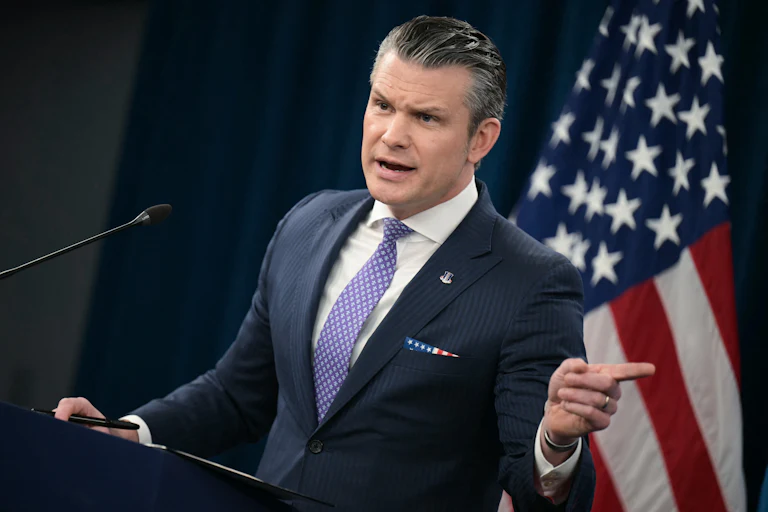
Defense Secretary Pete Hegseth points to the side while speaking at a podium
Oliver Contreras/AFP/Getty Images

The Pentagon appears to be engaged in a “casualty cover-up” of U.S. soldiers killed as a result of Donald Trump’s military onslaught in Iran, a U.S. defense official told The Intercept.

An analysis by The Intercept found that the Department of Defense has used outdated numbers in statements on casualties, resulting in undercounts of how many troops have been wounded or killed.

In a statement sent Monday, CENTCOM said that “approximately 303 U.S. service members have been wounded” since the launch of Operation Epic Fury. But that number was three days old, and excluded the at least 15 troops wounded in a strike at Prince Sultan Air Base in Saudi Arabia last week.

CENTCOM would not provide any information about the number of U.S. troops who have been killed since the start of the war, but The Intercept placed the number at around 15. Six soldiers were killed in a strike on a makeshift operations center in Kuwait, and another six died serving aboard a KC-135 refueling aircraft that crashed in Iraq. Another soldier was killed on March 1, during an enemy attack on the base in Saudi Arabia.

“This is, quite obviously, a subject that [Defense Secretary Pete] Hegseth and the White House want to keep under major wraps,” said the defense official, who spoke to The Intercept on the condition of anonymity.

CENTCOM did not deign to reply to close to a dozen requests for clarification on the casualty count. CENTCOM also refused to provide information on which U.S. bases had been struck by retaliatory attacks from Iran.

“We have nothing for you,” a spokesperson told The Intercept.

Two weeks ago, U.S. CENTCOM spokesperson Captain Tim Hawkins confirmed that 200 U.S. service members had been injured since the beginning of the joint U.S.-Israeli attacks. But that number did not appear to include the more than 200 sailors aboard the USS Gerald R. Ford who were treated for smoke inhalation after a fire on March 12. One sailor had to be medically evacuated from the ship, and two others were treated for lacerations.

Iran’s retaliatory strikes have reportedly rendered many of 13 U.S. military bases in the Gulf region all but uninhabitable, forcing American military service members to work remotely from hotels and office spaces. Iran’s attacks on U.S. military bases caused an estimated $800 million in damage, according to a report by the Center for Strategic & International Studies and a BBC analysis.