Breaking News
Breaking News
from Washington and beyond

GOP Senator Says Iran Should Have Ballistic Missiles

“They have to be able to defend themselves, or otherwise we turn this into a forever war.”

Senator Roger Marshall speaks during a news conference on Capitol Hill.
Andrew Harnik/Getty Images
Kansas Senator Roger Marshall

Kansas Senator Roger Marshall previously told Americans that freedom was more important than their pocketbooks. Now, he’s folding on the central aims of Donald Trump’s disastrous war in Iran.

During an appearance on CNN Wednesday night, host Kaitlan Collins asked Marshall if he believed Iran should be allowed to maintain its ballistic missile stockpile.

“You know, I’m hesitating,” Marshall said. “I prefer that they not. I sort of don’t want them to have long-distance missiles, I don’t want them to have nuclear armed missiles. I would prefer they didn’t, but I don’t think that’s the key issue here. I think that they have to be able to defend themselves.”

“You think Iran needs to be able to defend itself?” Collins pressed.

“I do, I think that they have to be able to defend themselves, or otherwise we turn this into a forever war,” Marshall said. “You’re never gonna get them—short of boots on the ground—surrendering everything, an unconditional agreement, if you will.”

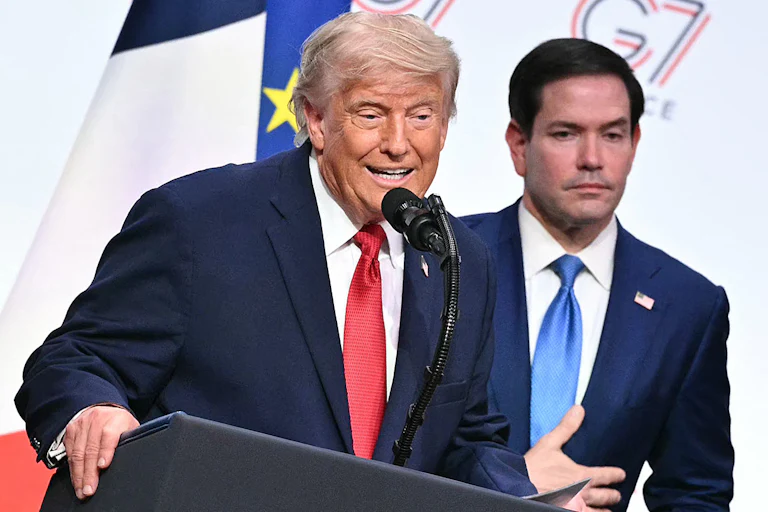
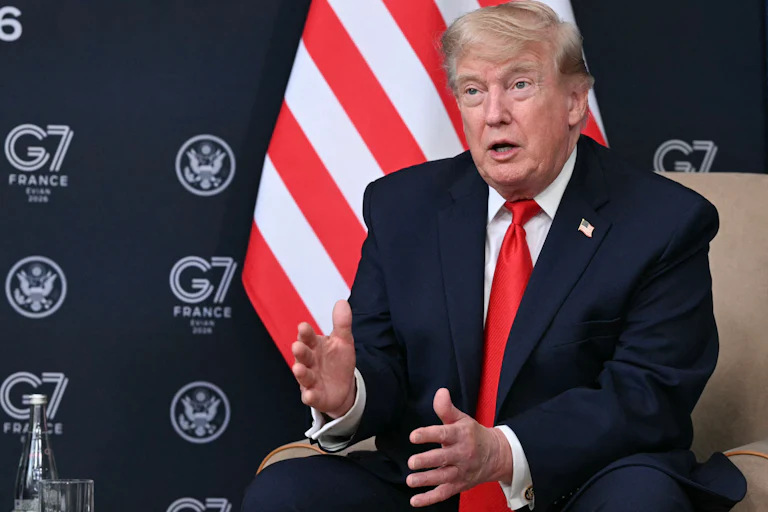
Marshall seemed to be echoing Donald Trump’s remarks during a press conference at the G7 Summit, when the president claimed he didn’t actually mind if Iran had ballistic missiles. “If other countries have them, it’s a little bit unfair for them not to have some,” Trump told reporters later.

But eliminating Iran’s ballistic missile stockpile was a key aim of “Operation Epic Fury” from the beginning.

Marshall was an enthusiastic cheerleader for Trump’s military campaign, even as it sent energy prices skyrocketing. Now, he’s trying to sell Trump’s lackluster peace deal—but clearly, his heart’s just not really in it.
Senators Warn Trump Is Redirecting Millions to White House Ballroom

Trump’s budget office just shifted $352 million in Secret Service funds.

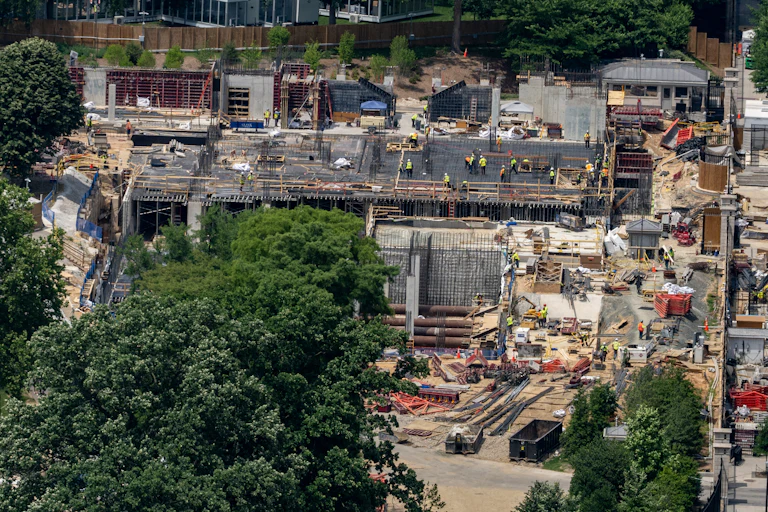
White House ballroom construction
Daniel Heuer/Bloomberg/Getty Images
White House ballroom construction on June 9

After being denied funds for his ballroom by Congress, President Trump may have secretly taken them from somewhere else.

Last week, the White House Office of Management and Budget moved $352 million earmarked for Secret Service resources toward “White House Security Measures,” NOTUS reports. Those Secret Service funds had originally been set up by Trump’s tax law, the “Big Beautiful Bill,” passed last year.

Democrats and Republicans in Congress think the funds are being covertly diverted to Trump’s ballroom project.

“I don’t know whether it’s the ballroom, but it sounds like the ballroom,” Democratic Senator Brian Schatz said to NOTUS.

“That’s a big problem,” Republican Senator Thom Tillis said. “That sounds like a different way to fund the East Wing project. If the East Wing needs support, we should be transparent about if that is in fact what happened. It seems strangely similar to the ask of Congress, but my God, we just had people from [the] Secret Service coming here saying they needed more money, how they needed more funding, and now we may be shifting it away from a Secret Service priority. I just need details. On its face it doesn’t sound right.”

Democratic Senator Chris Coons is also suspicious.

“I think there’s been more and more credible coverage that President Trump was just flat-out lying when he said the taxpayers will not pay a dime for his ballroom,” Coons said. “I think he is now trying to find ways to funnel public money into it.”

Trump’s ballroom is expected to cost $600 million, and half of that cost will come from taxpayers, according to a Washington Post report from earlier this week. Raiding the Secret Service’s money pot would cover that and more. This wouldn’t be the first time Trump has dipped his hand into funds appropriated by his own budget bill. His administration has previously used those funds to buy a luxury jet for former Homeland Security Secretary Kristi Noem, and for “border security executive travel.”

When NOTUS asked an OMB official about the transfer of funds Wednesday, that official brought up the ballroom unprompted.

“The ballroom will be built with private donations the President has secured,” the official said in a statement to NOTUS. “The administration and the President have been very clear about the need for additional security at the White House complex and the role the Secret Service, in addition to other White House components, will play in supporting the necessary security elements associated with the East Wing Modernization project.”

JD Vance Is the Fall Guy for Trump’s Terrible Iran Deal

The vice president has been tasked with selling a lost war, potentially deepening a rift with Secretary of State Marco Rubio, who has stayed eerily quiet.

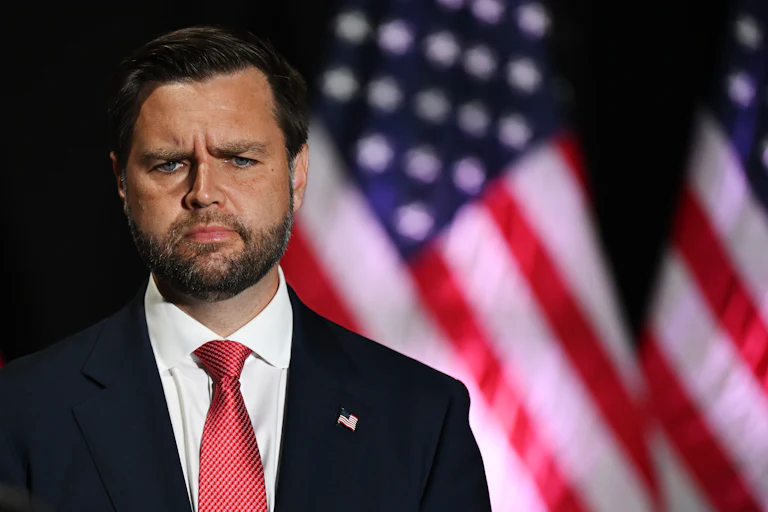
JD vance looks confused while standing in front of a US flag
Drew Hallowell/Getty Images
JD Vance in 2024

It seems that Vice President JD Vance has been chosen to carry the can for Donald Trump’s nascent peace deal with Iran. What could go wrong?

As the lead negotiator with Iran—who also happens to be running a rocky press tour for his new book—Vance has become the face for the controversial deal, which critics are already calling a complete surrender.

Republicans too afraid to challenge Trump directly have been pointing the finger at Vance, while some Republicans who don’t hate the deal view this as a golden opportunity for Vance to play peacemaker.

“Without question, the biggest potential political liability Vance had was the unpopularity of the war in Iran,” one person close to the White House who supports the deal told Politico Wednesday. “So it’s fascinating to watch his biggest enemies in the GOP unwittingly inoculate him from that liability by branding him as responsible for the peace deal.”

“He now gets to do a media tour defending the president—a.k.a. the kingmaker of our party—from their idiotic criticism of the deal,” the person said. “While even his critics would acknowledge that the vice president is a smart guy, sometimes what really matters in politics is how stupid your enemies are.”

But is Vance washing away his sins or getting himself dirty?

Secretary of State Marco Rubio, another likely contender for a 2028 presidential run, has remained eerily quiet throughout the process of launching the deal. As the president’s national security adviser, he reportedly opposed the deal behind closed doors.

Iran has agreed to return to its prewar position of allowing the free movement of trade through the Strait of Hormuz and pledging not to produce or acquire a nuclear weapon. In return, they’ve won a range of exciting cash prizes: a $300 billion investment fund, sanctions relief, and the potential to implement tolls in the strait after just 60 days.

Trump’s deal is at the very least an off-ramp from an expensive and unpopular war—but it’s clear that for now, the United States is walking away with nothing. Vance will bear the brunt of whatever comes from the continued negotiations, and given the administration’s proven ineptitude for striking deals, that could last well into midterm season.

Speaking at the G7 Summit Wednesday, Trump joked: “If it doesn’t work out, I’m blaming JD. You better be careful, JD!”

Israel Can’t Believe Trump’s Total “Capitulation” in Iran Deal

Trump’s memorandum of understanding has left those in Israel gobsmacked.

Secretary of State Marco Rubio listens as President Donald Trump speaks at the G7 summit.
Mandel NGAN/AFP/Getty Images
President Donald Trump and Secretary of State Marco Rubio at the G7 summit on June 17

Israel is reportedly in a state of shock over President Trump’s recently signed memorandum of understanding with Iran, which allows Iran to retain their ballistic missile arsenal, lifts sanctions, and admonishes Prime Minister Benjamin Netanyahu by calling for the termination of all military operations in Lebanon.

“It’s a bad agreement in which the Americans are paying with cash, and got, at the maximum, a letter of intent,” former Netanyahu adviser Yaakov Amidror told The New York Times. The Times of Israel’s editor, David Horowitz, called it a “catastrophic capitulation.” Israel’s Channel 12 news correspondent Nir Dvori even likened the deal to a “diplomatic Oct. 7.”

“Iran came out stronger, and I believe is now the regional hegemon,” former Israeli deputy national security adviser Chuck Freilich said. “They stood up to the U.S., the global superpower. They can have missiles, and there’s nothing in the agreement about the nuclear issue except [that] we’ll talk about it. This is an Iranian victory over the U.S. and Israel.”

Ensuring Iran is defenseless and economically crippled has been a priority for Israel for years. Trump’s recent deal all but assured that won’t happen. In the last 48 hours alone, the president has defended Iran’s right to have ballistic missiles, suggested that they should have the right to use nuclear power just like its neighbors, and criticized Israel for its deadly strikes in Lebanon—all which are points within the deal. And while it’s still unclear whether this is a temporary rift or a complete heel turn, this MOU endangers Israel’s long-term goals of a disarmed Iran and an occupied Lebanon.

Republicans in Uproar Over Trump’s Deal With Iran: “Total Surrender”

Republicans in Congress can’t believe the Trump administration accepted this deal.

Donald Trump speaking at the G7 summit
Mandel NGAN/AFP/Getty Images

President Trump’s deal with Iran is getting pushback from Republicans in Congress.

Senator Bill Cassidy, who lost a primary election to a Trump-backed opponent last month, said in a post on X Wednesday that “Ronald Reagan is rolling over in his grave.

“Iran’s nuclear ambitions were not curbed, and they have learned that threatening the Strait of Hormuz works and will undoubtedly leverage it in the future. Now, Iran gets to build brand-new infrastructure under this deal,” Cassidy wrote. “Now, 13 Americans are dead, families have paid billions at the pump, sanctions will be lifted, and the bombing has stopped. This is the worst foreign policy blunder in decades.”

Senator Ted Cruz tried to thread the needle of bashing the deal while minimizing blame toward the president.

“What has been released so far suggests that, unfortunately, the president is getting, I think, very poor advice when it comes to this deal. History teaches that giving billions of dollars to theocratic lunatics who want to murder us is a bad idea,” Cruz told Ben Domenech at the Daily Wire Wednesday. “Under the terms of what’s been released, somewhere between $10 billion and $30 billion will flow to the ayatollah immediately before they make even a single nuclear concession.”

Retiring Senator Thom Tillis said to The Hill that the deal was not a good return for the costs of the war with Iran.

“You got to do the balance of accounts: A hundred billion roughly, maybe more, spent today, 13 dead, 365 wounded, injured, our partners in the Middle East bombed, they’ve had casualties. There’s got to be a lot of return on that,” Tillis said. “We set out by saying we were going to drive down to zero their nuclear capability. Now we’re equivocating on that. We said that we were not going to make the mistake that Obama did by sending them a plane full of cash. I got to reconcile the numbers there.”

Some Republicans in the House were more blunt when speaking anonymously. The terms of the deal contradicted the talking points that the White House asked its Republican allies to use, Republicans told Politico.

One House Republican said the Trump administration was “lying to some degree” about the peace deal.

“The president didn’t mean to, but he effectively acknowledged he lost the war. It’s no longer worth the economic price. This is the way out, as ugly as it is,” another House Republican told the publication.

“He promised total surrender. And here it is,” a third House Republican said.

With all of this pushback to the deal, one wonders if Republican-controlled Congress will try to pass legislation to constrain parts of it, such as preventing taxpayer funds from being part of the $300 billion reconstruction fund promised to Iran. But most of them will probably fall in line as the midterms approach.