Newsletter
Power Mad
A weekly review of the rogues and scoundrels of American politics

Third Way Doesn’t Care About the Democratic Party

The centrist organization is spending millions of dollars of corporate money on a campaign to manufacture right-wing talking points to flood the media.

An April 1999 meeting of “Third Way: Progressive Governance for the 21st Century” in Washington
Luke Frazza/Getty Images
An April 1999 meeting of “Third Way: Progressive Governance for the 21st Century” in Washington

While the media has been agog and aghast at the occasional successes of 2026 candidates aligned with the Democratic Socialists of America, I haven’t been feeling the hype. A canny read of the electorate reveals that establishment Democrats, like Xavier Becerra and Amy Klobuchar, are doing just fine. Many primary winners are getting lumped in with the DSA despite not being members, or even socialists, like Brad Lander and Abdul El-Sayed. And as Lander would attest, the electorate isn’t looking for leftist bona fides from their candidates; they simply want fighters, not fakers.

But no one is more choleric over the occasional success of progressive politicians than the dismal corporate dullards at Third Way. After the aforementioned El-Sayed won his Senate primary in Michigan, the centrist organization announced that it was going to “war” with a $15 million campaign against democratic socialist candidates between now and 2028. Both the sense of aggrievement and the paltry amount of money being dispensed makes this extremely sad.

The opening salvo in this supposed “war” is also pretty sad: a wan op-ed by the organization’s top dogs, Jon Cowan and Matt Bennett, in the pages of The Washington Post. The two combine for a few hundred words of grievance, in which they argue that the Democratic Party’s recent woes can be attributed to its extreme politics, which is a very strange thing to say about a party whose recent standard-bearers were Joe Biden and Kamala Harris. Cowan and Bennett, in fact, fault Harris for not doing enough to pivot from the leftier positions she espoused on the 2020 stump. This makes me wonder if they were in a coma during the 2024 election, because I distinctly remember Harris both veering wildly toward the center, abandoning previous positions with something approaching a frenzy, and even campaigning with Liz Cheney.

The op-ed is, nevertheless, revealing. Third Way’s politics seem frozen in amber. There’s scant evidence that Cowan and Bennett have spent any time ruminating on the political shifts we’ve undergone since the 2024 election. There’s no mention of the hot-button issues that are fueling the fires of the Democratic electorate, such as the high costs of early childhood, opposition to data centers, the war in Iran, or the GOP’s corruption. The only thing they point to that could be called “recent” is a New York Times poll showing that 62 percent of the Democratic electorate identifies as either somewhat or very liberal, and that most voters want “a fighter for working people who gets things done and is authentic in his or her beliefs.”

That doesn’t describe the kind of candidate that Third Way would support. As Robert Reich wrote this week, “If you bother to look at the funding sources of Third Way ... you’ll find a Star Wars cantina of billionaire megadonors, Fortune 500 CEOs, corporate dark money bundlers, and giant corporations.” Third Way’s donor base is a “Trojan horse” packed to the gills with scoundrels: Wall Street cretins and private equity goons; “members of the GOP-aligned American Legislative Exchange Council,” best known for producing cookie-cutter right-wing legislation that is diametrically at odds with just about every Democratic Party policy priority; and supporters of the Republican Attorneys General Association, “which helps elect Republicans who fight federal environmental and other regulations.” In addition, Reich points out that two of the organization’s former honorary co-chairs are Joe Manchin and Kyrsten Sinema. Enough said! (Sludge’s David Moore also reported this week that Third Way has received donations from health insurance interests that undoubtedly oppose Medicare for All, which was the centerpiece of El-Sayed’s campaign.)

Third Way’s limitations as a political organization stem from the fact that its leaders have an umbilical connection to Republican money and probably haven’t talked to a human outside of a cable news green room in years. In fact, the last time anyone from the organization sought to learn what life is like for normal Americans, it was chronicled by Molly Ball in The Atlantic, who trailed the researchers the organization dispatched to Wisconsin after Donald Trump’s first election to find the mythical 70 percent of the population that they believed occupied a position of non-partisan purity.

As Ball’s piece described, things didn’t go the way Third Way expected. Instead of finding a centrist majority out there in the hinterlands, it found a population that was extremely partisan—and fairly skeptical of the organization’s donors. But Third Way’s superpower, it turns out, is the ability to perform vertiginous mental hijinks when its priors are challenged. As Ball reported, the study that Third Way published after its tour of flyover country neatly omitted any of the doubts that she watched the researchers wrestle with on the road. “The report surprised me when I read it,” Ball wrote. “Despite the great variety of views the researchers and I had heard on our tour, the report had somehow reached the conclusion that Wisconsinites wanted consensus, moderation, and pragmatism—just like Third Way.”

This is the biggest irony: The successful politicians who so terrify Third Way are actually really good at listening to the concerns of voters and then organizing those voters around campaigns to address those needs. A recent New York Times report on the insurgent left reveals that these candidates aren’t really reinventing the wheel, they’ve just—well, mastered politics: “The campaigns themselves say the secret is in the basics. They have built old-fashioned ground games, harnessing the anger and energy on the left to recruit armies of volunteers, who in turn have greeted the moment’s protest movement with open arms.”

In fact, if there’s one thing that the smattering of successful DSA-aligned candidates have done in recent campaigns, it’s been the thing Third Way refuses to do: show a willingness to abandon preconceived dogma when it doesn’t survive an encounter with reality. As Nathan Newman recently wrote, the local DSA-aligned politicians who are winning elections have learned something that the national DSA is still struggling to accept: “To win local office, you not only have to activate the maximum number of DSA members possible, you need to reach out to a wide range of other progressive individuals and organizations to win election.” There’s something nifty going on here: It turns out that the successful socialists, through their mastery of retail politics, are showing that they’re capable of a little moderation.

Third Way could really stand to learn a thing or two from the politicians it disdains. But that’s not what the Republican funny money backing its every move wants. Instead, you are going to get $15 million worth of Red Scare fulmination. And that rhetoric will be used by the right to disparage every single Democratic candidate—not just the ones who want to enact Medicare for All. Third Way will be arming both the conservative media machine and the slop merchants at CNN and The New York Times with talking points, and using its phony-baloney identity as a liberal organization to color these attacks as coming from the illusory center.

This article first appeared in Power Mad, a weekly TNR newsletter authored by deputy editor Jason Linkins. Sign up here.

Hang Elon Musk Around Susan Collins’s Neck

The billionaire wants to invest in the Maine incumbent’s Senate campaign. Democrats should be eager to drag her for the toxic association.

Maine Republican Senator Susan Collins arrives for the Senate Republicans’ lunch meeting.
Maine Republican Senator Susan Collins
Bill Clark/Getty Images
Maine Republican Senator Susan Collins

At the start of 2025, Elon Musk looked as if he was going to become a permanent fixture in American politics. Strutting across the stage, giving the Sieg heil!, the far-right mogul set up shop in the Trump administration’s DOGE dojo and started chaotically pulling the load-bearing beams out of the civil service and heisting the private data of an untold number of taxpayers. In June of this year, however, Musk expressed regret over getting so caught up in the political scene. Ahh, but the ketamine has since hit: In recent weeks, Musk has said that he’s going back to being a GOP bankroller, to the tune of $120 million. And the first beneficiary of his dirty money is slated to be endangered Maine Republican Susan Collins. She should suffer for it.

Part of me wonders if Elon’s willingness to spend his cash is any great concern. His investments seem to often make things more janky than they were before. He turned Twitter into a hellsite dominated by like-minded thugs that is essentially a GOP super PAC. He’s soiled the legacy of Tesla’s founders by creating a “giant rusting dumpster swasticar” that’s recently been compared to the Edsel. He just crashed a rocket into the moon. His most recent foray into political kingmaking—the $25 million he injected into the Wisconsin Supreme Court race—was a Cybertruck-level flop. And he may end up catching a criminal charge for election bribery to boot.

If Collins actually needs Musk’s money, maybe that’s a sign she’s worried that her new Democratic opponent, former state Senate President Troy Jackson, won’t be the same type of cakewalk as Graham Platner, whose Nazi tattoo put his campaign into a permanent “if you’re explaining, you’re losing” doom loop that ended last month with sexual assault charges. Still, Musk’s close-up involvement with Susan Collins should come at a high cost to the incumbent senator.

Here’s one big reason why. The guy who’s pitching himself as the GOP’s next big megafunder has spent much of his time “out of politics” becoming a pioneer in the field of manufacturing nonconsensual pornographic images of minors. Perhaps the one thing that differentiates Musk’s Grok from other AI products is that it’s become regarded as a one-stop shop for the production of child sexual abuse material, or CSAM. This has already spawned a class-action suit against Musk’s firm, xAI. He seems very concerned that his company may be further restricted from promulgating deepfake pornography: xAI attorneys are suing the state of Minnesota over a state law banning apps from generating nonconsensual deepfake nudes of people.

My thoughts on this are pretty straightforward: In a normal country, it is scandalous for a politician to fund their campaign on the proceeds of CSAM and the like. Courtesy of DailyKos writer Oliver Willis, here is a succinct and correct English-language sentence on the matter: “Susan Collins is financed by a man who wants to make it easier to create nude pictures of children.”

Musk is hardly some lone-wolf pervert skulking around Republican politics. These days, the whole party seems more or less bent on proving “pedocon theory” correct. The anti-trans panic promulgated by the right has been slowly transforming into the drive to pass laws that would put the state’s hand down the pants of women and girls all across the country. As reporter Jessica Valenti recently put it, Republicans have lately adopted what could rightly be called an agenda of “upskirt politics”:

If Democrats want a message for the midterms and 2028, that’s it right there. The GOP is the party of Peeping Toms, obsessively watching what women do with our bodies and inventing ever more ways to get a closer look—from Republican AGs fighting court battles just to catch a peek at women’s abortion records to a prosecutor so desperate to see inside a miscarriage patient’s toilet that he had it ripped off the wall.

None of this is new. As TNR contributor Graham Gallagher wrote back in 2022, prominent Republicans were hard-veering into the wilds of antisocial strangeness. “Among the right’s intellectual avant garde and media elites,” he wrote, “there is a growing adoption of habits, aesthetics, and views that are not only out of step with America’s but are deliberately cultivated in opposition to a national majority that the new right holds in contempt.” Two years later, “Republicans are weirdosbecame a clarion call among Democrats. Kamala Harris is often accused of abandoning this line of attack, which is not exactly true. Still, there was some internal debate over its efficacy.

To my mind, it’s worth reviving. The GOP has only gotten stranger since 2024. Just this week, Politico’s Kathy Gilsinan wrote at length about the GOP’s widening weirdo problems as the youngest in the party veer in the direction of off-putting, far-right grotesqueries. One anonymous Republican staffer put it like so: “We have a generation of rabid, incompetent idiots.” Sounds like an assembly line of Elon Musks.

There is perhaps no Republican lawmaker who has been treated with more undeserving gentleness than Susan Collins. Beltway reporters tend to fall for her prevarications with incredible ease; it was one of my first lessons in how many intellectual lightweights are out here cosplaying as my industry peers. Even Democrats tend to treat her with kid gloves. As TNR contributor Meredith Shiner noted back in 2020, when the party had the opportunity to showcase Collins’s then opponent, Sara Gideon, at the Democratic National Convention, Gideon was instead assigned to introduce musical guest Maggie Rogers. “The words ‘Susan Collins,’ ‘Supreme Court,’ ‘Brett Kavanaugh,’ and ‘Mitch McConnell’ were never uttered,” wrote Shiner.

Elon Musk is a weird, unpopular scoundrel with perverted tastes who’s had a direct hand in what can only be described as crimes against humanity. That he’s decided to tether himself to Collins gives Democrats a chance to make up for the shortfalls of the past and hammer Collins for what she is now: the candidate in the race with the Totenkopf tattoo (metaphorically speaking). Musk is the ripest of targets, Collins is one of the most deserving people to catch some strays. But these two won’t take themselves down—Democrats will need to take their shots, early and often.

This article first appeared in Power Mad, a weekly TNR newsletter authored by deputy editor Jason Linkins. Sign up here.

How the Democrats Can Benefit From Missing Mitch

Amid the former Senate majority leader’s mysterious hospitalization, some are placing unreasonable demands on Kentucky Governor Andy Beshear. Let’s sort this out.

Mitch McConnell speaks during a Senate Appropriations Subcommittee hearing.
Andrew Harnik/Getty Images

My family group chat has been consumed by one particular question of late: “Do you think Mitch McConnell is still alive?” I’m an editor, not a clairvoyant. But for the record: I think he is alive, albeit probably in a bad way. Those close to McConnell have, in recent days, disclosed a pair of “proof of life” photos, which, in the age of AI and deepfakes, have only fueled conspiratorial scrutiny. Meanwhile, the former Senate majority leader lies in Schrödinger’s hospital suite, in a state of being and unbeing. And all over social media, some have urged Democrats—especially Kentucky’s governor, Andy Beshear—to either do more to get to the bottom of McConnell’s condition or do something more radical, like unilaterally declare him deceased and call a special election.

Such calls are, I believe, ill advised. But there is probably an avenue here for Democrats to use this to their advantage.

I understand why McConnell and the state of his health have become such an idée fixe, here at what looks to be his final act. First of all, McConnell is basically the Final Boss of a couple recent trends: the spate of disappearing lawmakers who have made news over the last year or so, and the country’s growing negative feelings toward the gerontocracy and the perception that too many aging and infirm lawmakers are clinging to power long past their sell-by date.

But there are deeper layers of anger and resentment on display among those looking to shove McConnell out the door. He achieved mythic villain status during the Obama era, when his strategy of total obstruction, and the belief that the GOP must never give the president a win, was so total that it abrogated Washington norms. The parallels you can draw at this moment between McConnell shielding his health status from public view and his refusal to give Merrick Garland a hearing and insistence on leaving a Supreme Court seat empty are extremely obvious. Moreover, as Democratic voters search for “fighters” in their party to replace lawmakers deemed to be too accommodating to Trump, they are essentially beseeching their own to adopt the tactics that McConnell deployed to maintain and increase his party’s power.

The passions of the public, driven in equal measure by vindictiveness and projection, have lately become Beshear’s problem, as calls mount for him to do some undefined thing to force the issue itself. And this isn’t just coming from the social media randos (though it is coming from them): Former Illinois Congressman Adam Kinzinger recently took to Threads (which is still a website, apparently) to say, “I think the Governor of Kentucky has every right and responsibility to either see Mitch or declare the seat vacant.”

Folks, just some friendly advice here. Before I make demands of a Democratic governor of a red state to do something that’s likely to put state Republican lawmakers in a hysterical fury, I like to check on whether or not it’s likely that the governor will end up impeached. In this case, Republicans occupy 80 of the 100 seats in the state House (where you need 51 to impeach) and 32 of the 38 seats of the state Senate (where you need 26 to convict). So this maybe isn’t the best time for Beshear to bully his way into McConnell’s hospital wing like some righteous commando. Unless, that is, you want us to be down one blue-state governor (and one promising Democratic presidential candidate).

Beshear seems to know what he’s doing, in any case. In an appearance on Bloomberg TV, he shot down the idea of his calling a special election, saying that those who “are really pushing I think are under the impression that a Democrat in Kentucky might be able to win that election. It’s been since 1992 that we had a Democratic senator in Kentucky.” He also noted that McConnell missing votes while the seat goes unoccupied “might not be a bad thing.”

“McConnell hasn’t been there to vote on the SAVE Act, which would tear voting rights away,” said Beshear. “He hasn’t been there to vote to support this war on Iran that this president started and shouldn’t be continuing ... not having Mitch McConnell show up isn’t necessarily a bad thing because he certainly doesn’t show up to help the American people.” In the meantime, the governor has called on McConnell to either disclose his health status or resign. That, I think, covers all the bases as far as what Beshear can and should be doing. But that doesn’t mean there isn’t a role for other elected Democrats to play in harnessing the passions of their base and channeling them to a larger purpose.

The McConnell affair is emblematic of many pernicious aspects of Trumpism: The lack of transparency is part and parcel of a party that centers lies and obfuscations in its politics; the clinging to power by corrupt means reflects the party’s larger desire to suppress the vote and dodge the Constitution. Echoing Beshear’s commentary on how good it is for the country to have McConnell out of commission, and thus unable to cast destructive votes, would be a great way for Democrats to highlight how important it is to evict other GOP senators from their perches. And this is maybe the best time for Democrats to talk about McConnell’s toxic legacy—we all know that when he does pass, those who’ve had a front-row seat to his vicious power-mongering will feel the urge to not speak ill of the dead.

Most of all, this is a moment when Democrats should respect and make use of what seems to be a deep vein of anger toward McConnell among their base. I think this whole episode is stirring a lot of recollections: the memory of Democrats fruitlessly trying to entreat Republicans into the policymaking process even as McConnell urged gridlock; the remembrances of McConnell controlling the makeup of the Supreme Court even as it becomes more apparent that Democrats will need to be similarly radical. I think it’s possible that the weird way McConnell’s camp opted to go into hiding may contribute to the GOP’s destruction in the midterms. But it will only work if Democrats make it clear that the obsolete politics of bipartisan comity, which McConnell took it upon himself to destroy in order to bring rack and ruin to the Democrats, will die with him.

This article first appeared in Power Mad, a weekly TNR newsletter authored by deputy editor Jason Linkins. Sign up here.
Some New New Republic Newsletter News:

This week, The New Republic launched the TNR Blue Book: a daily newsletter that will get you up to speed on the important Democratic and liberal-progressive news of the day in just a few minutes. With a panoramic view of left-wing politics from Capitol Hill to way outside the Beltway, original reporting from Emma Janssen, and contributions from the entire TNR team, it’s an informative and entertaining way to get your day started. As with all TNR newsletters, it’s free. Subscribe here if you haven’t already.
Editor’s Pick

The Seven Trump News Cycles We’re All Stuck In

This administration is monomaniacally focused on constantly making headlines. Too bad it’s all the same bad news.

Donald Trump looks on during a bilateral meeting with President of Lebanon Joseph Aoun in the Oval Office of the White House.
Kevin Dietsch/Getty Images

It’s almost hard to believe now, but in the not too distant past, there have been presidents who actually labored quite intensely to not be in the news any more than was necessary. President Barack Obama, in fact, seemed to actually want his presidency ensconced in relative calm. If you wanted to know what happened at the presidential briefing, you had to either go to it, wait for those who went to it to report on it, or chill out until the White House published a transcript. It was only after Trump came to power in 2016 that the briefings became must-see TV on cable news—and even then, only because the White House had turned them into a daily train wreck.

Times have changed. Whereas TNR’s Matt Ford once famously compared Trump’s first term to the episode of Battlestar Galactica where the Cylons attack every 33 minutes, its second iteration has become a dull monotony. Just about everything this White House does is rooted in the president’s desire to get revenge on his perceived enemies, his quest for self-aggrandizement, and the extreme limitations that arise when your best days—from a pure cognition standpoint—are well behind you. Nowadays, there are only really seven types of Trump story, and they’re all bad.

Tariffs: Of all the kindnesses that the Supreme Court has bestowed on Trump, its February decision to strike down the president’s retaliatory tariffs stands out as advice that should have been heeded: “Hey, don’t do this, you are screwing up the economy.” Trump forsook this wise counsel and continues to wake up on random mornings with the yen for imposing tariffs willy-nilly. This week he imposed 50 percent tariffs on a slew of Canadian goods because our neighbors to the north had the temerity to fight back in the trade war Trump started. He followed that up with an announcement that he was going to put a ten percent tariff on 80 other nations. It’s always impossible to gauge whether Trump intends to stick with a tariff fight. After all, it’s in this arena that “Trump Always Chickens Out” was born. But behind the trade war pyrotechnics, the government has handed back approximately $50 billion in refunds to firms buffeted by the president’s tariff regime. Have you seen any of that money yet?

The War in Iran: As I’ve explained at length, Trump’s decision to wade into an unwinnable foreign war after limply cosplaying as The One Guy Smart Enough to Do That was born from the fact that he’s a dumb asshole who needed a distraction from a cratering economy and the daily effluvia of the Epstein news cycle. But even I thought that the backslappery that arose from the memorandum of understanding that briefly put an end to hostilities might be a sign that the administration understood it had a much-needed off-ramp. Color me naïve: We’re now back in the big muddy, talking about war crimes and taking over Kharg Island, as the president recoils from public inquiry and his congressional allies fret about their political futures. The only question left is the one asked by TNR contributor Joe Cirincione: Can Trump lose the same war twice?

ICE Violence: Too many members of the media treated the exile of Greg Bovino and Kristi Noem as a credible sign that the administration had overreached in its violent assault on American cities. But the White House’s bloodthirsty deportation machine suffered little if any lull, and ICE is back to its wanton ways, with new high-profile killings at the hand of Trump’s goons in Texas, Florida, and Maine—the latter of which may prove to regalvanize support for Senator Susan Collins’s future Democratic opponent. As TNR’s Melissa Gira Grant reminds us, the violence is a feature, not a bug. And now, Trump’s FBI has decided to turn a blind eye to investigating those responsible. Far from a drawdown, this looks like the administration is giving carte blanche to the agency to kill at will.

Self-enrichment: Trump spent last year becoming a world-class kleptocrat, on the back of self-dealing exploits too numerous to recount (though I did offer readers what I thought were the worst of the bunch). Estimates as to how much his bread got buttered by all the grift and graft are nearly as varied. The New York Times totaled up about $1.4 billion in takings, but this is the low end—financial disclosures released at the end of June put the total at $2.2 billion, while Democratic researchers on the House Oversight Committee estimate that this figure rises to “$9.7 billion when the value of Trump’s digital assets is factored in” to the equation. Regardless, Trump is still lining his pockets, with new schemes including Kazakh tungsten, Pentagon baksheesh, and what appears to be a pay-to-pardon scheme.

Voter Suppression: When Trump isn’t trying to steal your money, he’s well-nigh obsessed with stealing your vote, a subject that was supposed to serve as the (very) loose framework for his recent prime-time ramble. The president’s monomaniacal desire to see the SAVE Act—his signature voter suppression bill—pass muster has peppered the headlines with updates on the latest weird scheme to somehow enact it over the objections of all the Democratic lawmakers and not a few of their GOP colleagues. Not long ago, Trump was trying to sneak it through the reconciliation process; now Republicans have backdoored voter ID restrictions into a congressional stock-trading-ban bill. It’s clear that Trump would love to rig the upcoming midterms, though it’s not clear how he will accomplish this. It’s a bad sign for the GOP that many of the networks opted to not broadcast his prime-time rant. Perhaps the media is finally coming around to the reality that Republican claims of mass voter fraud are an obvious fiction.

Bad Renovations: Millions now living may not recall that it was once possible to go several years without thinking about the Reflecting Pool. Thanks to Trump, we’re now getting daily updates about algal blooms, phantasmal vandalism, and dubious criminal cases that only show how the administration’s Stasi-like authoritarianism can be extended almost everywhere. The real vandal, as TNR’s Michael Tomasky wrote, is Trump, whose desperate efforts to leave a mark in D.C. have led to a demolished East Wing, a hollowed-out Kennedy Center, and an Oval Office decorated with Temu gold wall appliqués. Still, as Tim Noah points out, it all does serve a grand purpose: funneling taxpayer dollars to Trump’s cronies.

Everyone’s Getting Sicker: Trump’s second term isn’t without its success stories—if you are the measles virus, anyway. As Axios reported this week, the “U.S. measles case count for this year has surged past last year’s total and now stands at 2,295—a level that hasn’t been seen in 35 years, according to a Johns Hopkins University tracker that compiles state and local health data.” This news comes hard on the heels of another public health crisis that also serves as a metaphor for the Trump presidency: the record number of cyclospora infection cases that have turned this into Explosive Diarrhea Summer. This is part and parcel of the long tail of DOGE’s effort to denude the government of its public health capabilities; we see this manifesting in our struggle to contain New World screwworm at home and Ebola abroad. And let’s remember: In the event of a Covid-style pandemic, the adults who were in the room during Trump’s first term have been replaced by quacks like Robert F. Kennedy Jr., who make the titular character from “Storm”—Tim Minchin’s seminal song about pseudoscience—look like C. Everett Koop.

There are, of course, two and a half more years of this presidency. Is it possible that an eighth Trump story emerges? For once, I’m rooting against variety—we need Trump to discover a new thing to fail at like we need a hole in the head. Let us instead work in our own ways to bring a future of relative calm and solemnity back to these lands. We all would rather be getting different push alerts from the ones we’re getting now. I know there’s one in particular that I’m really looking forward to, and it’s definitely not whatever my readers at the FBI think it is.

This article first appeared in Power Mad, a weekly TNR newsletter authored by deputy editor Jason Linkins. Sign up here.

Some New New Republic Newsletter News:

This week, The New Republic launched the TNR Blue Book: a daily newsletter that will get you up to speed on the important Democratic and liberal-progressive news of the day in just a few minutes. With a panoramic view of left-wing politics from Capitol Hill to way outside the Beltway, original reporting from Emma Janssen, and contributions from the entire TNR team, it’s an informative and entertaining way to get your day started. As with all TNR newsletters, it’s free. Subscribe here if you haven’t already.

SCOTUS’s Anti-Constitutional Crusade to Create Second-Class Citizens

The conservative legal movement lost its bid to eradicate birthright citizenship, but its war on the Reconstruction Amendments is going to continue.

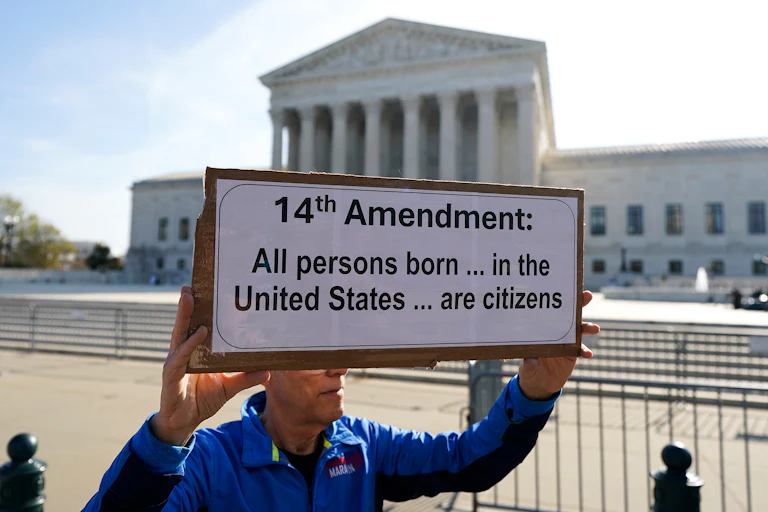
A demonstrator outside the U.S. Supreme Court on April 1, in Washington, D.C.
Al Drago/Getty Images
A demonstrator outside the U.S. Supreme Court on April 1, in Washington, D.C.

Another Supreme Court term has come and gone, and civil society is once again licking its wounds. President Donald Trump has obtained new power, the lives of trans people have gotten worse, and the high court is basically winging it when it comes to its ill-fated new “history and tradition” test on guns. At the same time, things could have gone worse—at least for all of you who work at the Federal Reserve.

The biggest bullet dodged was this week’s decision in Trump v. Barbara, in which the court ruled against Trump’s executive order attempting to nullify the birthright citizenship rights explicitly granted by the Constitution. One of the grand plans of this administration has been to ethnically cleanse the United States, and had the court gone along with Trump and his aide-de-camp, Stephen Miller, millions of Americans might now be facing the end of their citizenship—including the U.S. World Cup team’s current leading scorer, Folarin Balogun. Despite this rare victory of reason over right-wing nuttery, I think we should be concerned that the conservative legal movement still has its eye on waging war on the so-called Reconstruction Amendments—especially the one that grants birthright citizenship in the first place: the Fourteenth Amendment.

I raised an alarm last year about the far right’s desire to delete the Fourteenth. The amendment is a substantial target for the MAGA movement because of the unique way it enables and extols the promise of a multiracial democracy, something that Trump and his minions have sworn to destroy. And the way the Supreme Court overrode the disqualification clause, granting Trump the right to run for office again without any concern for the Constitution’s explicit admonitions against insurrectionists holding high office, gave abundant hope to those who’d like to see the Fourteenth Amendment dismantled.

Do the court’s conservatives disdain the Reconstruction Amendments? “They definitely do, to a certain extent,” says TNR’s Matt Ford. “They’ve largely read the Fifteenth Amendment out of the Constitution, in Brnovich and Callais, by making it impossible to properly enforce the Voting Rights Act, and they more or less nullified the disqualification clause in Trump v. Anderson. There are parts they’re fine with, like the equal protection clause in some circumstances, but they’ll never interpret it as broadly as the liberals.”

Ford says that the most charitable read is along the lines of what Justice Clarence Thomas said in his dissent in Trump v. Barbara. “They generally think the Reconstruction Amendments were designed to address the specific circumstances and exigencies of the post–Civil War era,” he says, “and that while they can have plenty of applications beyond that, they aren’t meant to be used to (in their view) fundamentally restructure American society anymore or provide special treatment for anyone.”

Here’s where the biggest conflict lies, as the liberal position is generally that the Reconstruction Amendments were a second founding, not a postbellum clean-up. “In this view,” says Ford, “Congress has broad powers to ensure that there is no American underclass or subaltern population, which Jim Crow nonetheless managed to create for about 90 years.”

Justice Ketanji Brown Jackson got at this in her concurring opinion, in which she took issue with Thomas’s dissent on these lines. Thomas’s “narrow vision of the Fourteenth Amendment bears little relationship to the history of its ratification,” she wrote, adding that his take on the matter “elides the entire point of the Second Founding: The Reconstruction Amendments were an anticaste, antisubordination reset for the Nation, not a mere spot treatment for the dark stain of slavery.”

Thomas didn’t win the argument this week. But the fact that these matters are being argued in the first place is cause for serious alarm, according to former Massachusetts Senate candidate Alex Rikleen. “By even considering the legitimacy of birthright citizenship, the Roberts Court, stacked with jurists ready and willing to make anti-constitutional rulings time and again, has helped transform a fringe white supremacist attack on the 14th Amendment into a question that millions of people now understand as up for debate.”

This is hardly a new or novel fear. The Supreme Court’s ruling in Trump v. Anderson—in which they essentially deleted the disqualification clause from the Constitution—was enabled by the fact that too many were willing to countenance the idea that the plain English language of the Fourteenth Amendment was, in fact, open to interpretation. I am still angry that The New York Times in 2023 referred to the disqualification clause as “an obscure clause of a constitutional amendment enacted after the Civil War,” thus injecting a derogatory bit of editorializing into what purported to be a straight news piece.

In light of the tête-à-tête between Thomas and Jackson, I’m disturbed anew by the way the Times casually denigrated the amendments “enacted after the Civil War,” as if they were some stitched-on appendage and not language that carries the same force and lawfulness as the founding-era amendments. If the paper of record is skeptical that the Reconstruction Amendments are legitimate (and they, like the court’s conservatives, do seem interested in creating a subaltern class beyond the Constitution’s protections, for what it’s worth), this will only further the right-wing project to tear those amendments out of the Constitution and undo the nation’s second founding. So be glad that the worst didn’t happen, but stay on guard—we are not out of danger yet.