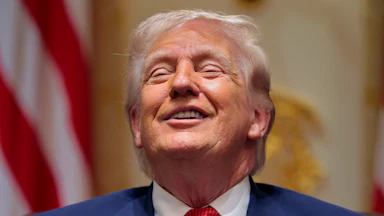
“They said, ‘Skeddadle!’ The word ‘skedaddle.’”
Last November, during his address before McDonald’s investors, President Donald Trump—as he is wont to do during public speeches—went on one of his weird tangents. “And that plane went ‘pshh,’ like this,” he continued, diving his hand downward in an accompanying gesture. “You know, when it drops a bomb, it goes down very steeply, because that gives it a better angle, and, you know, more speed for the bomb.”
It was a characteristically glib illustration for Trump, as he narrated the experience of watching military planes drop bombs on Iran. The planes were described not in terms of the damage of their payload but rather by the sound they made as they levered inexorably downward. By now, we’re used to the way the president’s mind might lock onto something loud or shiny he sees on a screen, especially if those images provoke his enthusiasm or anger. But his play-by-play descriptions of bombs bursting in air is actually something his administration and his allies have long encouraged Americans to do: view their biggest atrocities through a gamified lens.
One demographic may be particularly susceptible to this kind of incitement, one for whom targeting an otherized population is viewed more as a game than as state-sanctioned violence: lonely, angry young men.
During the 2024 campaign, Trump made a concerted effort to market himself to this cohort. He appeared on multiple podcasts popular in the “manosphere,” a community that promotes misogyny and (often white) male supremacy. Since taking office a second time, Trump and his allies have continued to gamify many of their policy decisions, in a campaign to encourage their audience to transfer their online anger to the real world.
As they are increasingly siloed online, it becomes easier for young men to distance themselves from others, viewing all other perspectives as illegitimate or unimportant. If your experience is the only true version of reality, then other people become NPCs, or “nonplayable characters”—not individuals but mere background actors populating the scenes in your everyday life.
“You’re the protagonist in the same way that a player character in a game might be,” said Adrienne Massanari, an associate professor of communications at American University.
This perspective is frequently encouraged by the administration. Defense Secretary Pete Hegseth has given his missions names such as “Midnight Hammer” and “Southern Spear,” phrases that sound more like weapons in a game than actual military operations. (Hegseth also has a tattoo that reads “Deus Vult,” a slogan adopted by the far right that was popularized by the grand strategy computer game Crusader Kings II.) And Trump, of course, continues to enthusiastically describe military strikes with the use of sound effects, as if he were watching an action flick rather than bombs dropping on human beings.
Characterizing military or law enforcement service as a video game–style activity can be an effective way to attract young men. Historically, recruitment efforts by the military have been intertwined with video game culture, encouraging this perspective—from the Army releasing its own hugely popular video game in the early 2000s to its use of esports to reach young Americans and encourage them to join up.
Immigration and Customs Enforcement has enthusiastically adopted the strategy of explicitly appealing to gamers through distinct visuals and coded language. One recruitment poster shared by ICE on its Instagram account last year harkened to the video game series Halo, encouraging potential recruits to “destroy the flood.” In the Halo series, the “flood” is a parasitic alien life form and one of the primary villains of the franchise—the administration is thus comparing undocumented immigrants to an existential threat to society that must be eradicated.
“It is easier to be able to dehumanize an immigrant, if you’re an ICE agent, if you view it as, ‘It’s just a game,’” Massanari said. If a man in a position of authority sees himself more as a protagonist in a first-person shooter game than someone working toward the collective good, that distance between him and his community only widens.
ICE has planned a $100 million year-long recruitment push—capitalizing on the role-playing-game-obsessed, violently inclined fan base that Trump cultivated on the campaign trail. Other marketing tactics include Snapchat ads, hiring influencers and livestreamers on the far-right streaming platform Rumble, and using a geolocation technique to send ads to anyone near military bases, Nascar races, college campuses, or gun and trade shows. ICE will also send targeted ads to people who listen to patriotic podcasts or attend UFC fights. As the Young Men Research Initiative has noted, the agency is explicitly targeting young men who have fears of being economically insolvent and are anti-immigrant and right-wing.
The end result may be a law enforcement culture that is more defined by a desire to exert power over the vulnerable than protect them, a perspective that has been partially shaped and encouraged by the modern internet. That shift in goal came into stark clarity on February 3, during a hearing on ICE brutality held by congressional Democrats from both chambers. Chicago resident and U.S. citizen Marimar Martinez testified about getting shot five times while following immigration agents in her car and trying to warn her neighbors.
“After being at the hospital for less than three hours, I was discharged from the hospital into custody of the FBI. As we left the hospital, I was escorted out through the back in a wheelchair. I observed over dozens of Border Patrol agents waiting outside the hospital,” Martinez said. “One of the agents came up to me with his cell phone and took a photograph of me. It was the same agent who had previously kept coming in and out [of my hospital] room, and I had to repeatedly tell him to leave.
“Was this the agent that shot me? Was this a trophy for him?”
She also revealed that the agent who shot her, Charles Exum, bragged over text after the shooting, “I fired 5 rounds and she had 7 holes. Put that in your book, boys.”
Last May, Elon Musk sulked when British journalist Mishal Husain asked him tough questions about his work at the Department of Government Efficiency, or DOGE—its very name a meme reference—which had been brutally slashing federal funding and jobs with minimal oversight. Musk called her an NPC and started giving her only one-word answers.
“I mean, I feel you’re somewhat trapped in the NPC dialogue tree of a traditional journalist,” he said. “So it’s difficult when I’m conversing with someone who’s trapped in the dialogue tree of a conventional journalist because it’s like talking to a computer.”
Musk’s willingness to refer to a woman sitting just feet away from him essentially as unreal is emblematic of how this kind of language has entered the mainstream. It’s shockingly easy for the manosphere to pick up new followers by offering a sense of community, in large part due to the overwhelming sense of isolation that many younger men feel. At least 16 percent of men under the age of 50 say they feel lonely all or most of the time, the Pew Research Center found in January 2025. And only 38 percent of men overall said they’re likely to reach out to a friend if they feel in need of support.
Young men are disproportionately likely to turn to online communities to find solidarity, according to the Young Men Research Initiative, and tend to believe that the people they follow on social media are “better” than they are: wealthier, more successful, and more attractive. This can create not only a sense of distance from their peers but bitterness that they appear to have fallen behind.
During the coronavirus pandemic, the sense of isolation deepened. A survey by SocialSphere conducted last March found that young men between the ages of 18 and 29 were more likely to report a loss in dating and socializing opportunities compared to young women. Of the young men surveyed who said they were significantly affected by the pandemic, 49 percent reported “feelings of isolation or disconnection from support networks,” and 48 percent said they have a “strong need to belong to groups where I feel completely accepted.”
The young men who were teenagers or in their early twenties during the height of the coronavirus pandemic and may not have had sufficient peer-to-peer interaction could have instead experienced the world through screens during a defining point in their development. Social media and video games in a vacuum cannot be blamed for a rise in misogyny and racism, but the “atomized” media experience during the pandemic helped further isolate this population, said Massanari.
“It made it easier to be in the spaces where … certain ideas, certain memes, certain language, would just be normalized as that’s how people talk and engage with each other,” she said.
Andrew Breitbart, the creator of the eponymous far-right site, popularized the “doctrine” that “politics is downstream of culture.” For the modern young man, the more accurate assessment is that “politics is downstream of experience,” said John Della Volpe, the director of polling at the Harvard Kennedy School Institute of Politics.
“The experience for too many people, specifically too many young men, is struggle in isolation and feeling, feeling like no one has their back,” said Della Volpe. “So that you had that moment a year and a half ago where Trump and the aligned forces, you know, in the quote-unquote manosphere promised to have their back and to allow them to be the protectors and providers that they wanted to be, making them feel good about themselves.”
This desire for belonging dovetails into a desire to see “strong” political figures. According to a survey by SocialSphere, 71 percent of young men said it was important to have a leader who “demonstrates strength and authority, even if it means bypassing traditional political norms.”
Fringe groups, such as incels, male supremacists, and neo-Nazis, are quite welcoming to people who feel isolated in real life. “They offer this status. They offer this sense of mastery over ‘forbidden knowledge,’” said Dr. Pasha Dashtgard, the director of interventions at the Polarization & Extremism Research & Innovation Lab, or PERIL, at American University. “These toxic online communities also play on grievance. They give you someone to blame. They give you an absolution for your failure” to participate in society through, for instance, getting a job or sleeping with lots of women.
Dashtgard described it as a sort of “toxic belonging”—a sense of exclusivity for people who are normally excluded.
“These kinds of toxic online communities offer a sense of meaning, a sense of being part of something bigger than themselves. And they give you this kind of narrative, that … you can be a protector of a community,” he said.
Belonging to these online communities can also make people more inclined to acts of violence, against both others and themselves. Community leaders will often lead other members down a slippery slope of increasingly extreme ideas, resulting in desensitization to violent imagery or the deepening of beliefs that certain groups are naturally inferior.
“You start to think of yourself as part of this existential conflict, between good and evil, between my people and your people. Where we can’t coexist,” Dashtgard explained. “Where it’s a zero-sum game, and either my group destroys or dominates your group or your group is going to destroy or dominate my group.”
Massanari draws a line from the “Gamergate” movement of 2014 to modern politics both online and IRL—in real life, in internet parlance. What began as a disgruntled ex-boyfriend’s lengthy rant against his former partner, a video game designer, morphed into a massive online harassment campaign against women in the gaming community. The young, white men who participated in Gamergate doxed and explicitly threatened the safety of their targets, railing against racial and gender diversity in an industry that had heretofore catered to them almost exclusively.
Right-wing provocateur and Trump adviser Steve Bannon, then a Breitbart editor, saw Gamergate as an opportunity to harness the vitriol of young men who felt their position of power threatened in the gaming community, and direct that rage toward American culture as a whole. Massanari, who has written a book on the connection between the tech community and the far right, said that Gamergate helped normalize tactics of online harassment and a widespread atmosphere of conspiracism.
Where the participants in Gamergate believed that societal ills were caused by feminists and “social justice warriors,” the current netizens of the online right see immigrants and transgender Americans as agents of a great replacement. The disaffected young men of today who are inculcated in these messages grew up with the internet that Gamergate built.
The consequences can be severe. The shooter who killed right-wing activist Charlie Kirk last year included references to memes and to the satirical video game Helldivers 2 on his bullet casings. But this does not mean that the game should be connected to any particular ideology; references to internet culture have been rising among young, male shooters for years.
Journalist Ryan Broderick noted in an interview with PBS News last year that “many young extremists that we have seen come out of the woodwork over the last few years since the pandemic see public violence as a path towards fame, towards glory, another way to go viral.” They may have an “accelerationist” viewpoint that political violence will push the country to destruction.
“It is a very nihilistic, very apocalyptic view that has become more and more popular, particularly on the dark corners of the internet in the last 10 years,” Broderick said.
Trump’s support among young men is far from universal. Some polls show that the majority of Gen Z men, and even a percentage of the young men who voted for him, are feeling some buyers’ remorse.
It is also unfair and inaccurate to blame video games, social media, or the internet as a whole for the isolation that young men may feel, or the extremism that vulnerability can beget. Loneliness can stem from something as simple as having no outlet for difficult emotions. (Let’s also just jump ahead of whatever complaint you may have about young men not being the only ones struggling with loneliness; this is a universal issue that plagues young women as well, and indeed, Americans across all ages and genders.)
Gaming communities can provide those outlets. Della Volpe said that when he talked with young men over the summer for the “Speaking With American Men” initiative, which seeks to provide research on how Democrats can reconnect with this demographic, he noticed that young men he surveyed do not feel comfortable talking about their emotions outside of “anonymized communities.”
“Whether it’s politics or financial or personal, those are the kinds of conversations that clearly come up in those kinds of channels,” said Della Volpe, who is also the founder and CEO of SocialSphere.
A potential cure, then, is ensuring that there are other opportunities for young men to connect with each other. Dashtgard added that “there are proven, empirically validated strategies for preventing this kind of violence from happening,” primarily by helping young people in general create offline spaces and networks where they can discuss the feelings that would otherwise lead them to online fringe groups.
“Violence is preventable. This is not something that … young men are doomed to,” Dashtgard said. “Most young men are not participating in extremist groups, are not being radicalized into male supremacy. Even the ones who are consuming don’t necessarily become radicalized to it.”