In 1999, Steve Ells, the founder and former CEO of the fast-food chain Chipotle, came across an article about the merits of humane, mostly pasture-raised pork—not just for the sake of the animals and the environment but for the flavor of the richly marbled and fatty meat. The piece was written by Ed Behr and published in his then-quarterly food journal, The Art of Eating. The following year, Chipotle began sourcing its pork from Paul Willis—founder of the Niman Ranch Pork Company—and one of the family farmers featured in Behr’s article.
As Ells later recounted, higher-quality pork raised the price of a carnitas burrito from $4.50 to $5.50, but consumers were happy to pay a little more for meat they could trust. Sales doubled. Today Chipotle has nearly 4,000 locations in the United States—and plans to open several thousand more—and, at least in the world of fast food, has maintained a high standard for the meat it uses, including beef and chicken. Meanwhile Niman Ranch, a network of small farms that operates under a single brand, similar to Organic Valley, has also grown significantly: When Paul Willis started selling pigs as part of the boutique retailer in 1995, he was the only hog farmer involved. Now there are over 600 such farms participating in the program and Niman’s products can be found in supermarkets throughout the country.
Chipotle is not alone. BurgerFi, a relatively small chain founded in 2011, uses only hormone- and antibiotic-free beef and chicken. Shake Shack, the upscale Danny Meyer chain launched in the early 2000s, is also committed to serving antibiotic-free meat from animals raised humanely (yes, like organic, the word humane is deeply problematic). And a number of supermarkets, including Whole Foods, Trader Joe’s, and Hannaford, have—in response to public pressure—improved the quality of meat they offer. At the same time, over the last 20 years, food justice movements, and writers who have profiled them, have compelled some of the biggest global operators, such as McDonald’s and WalMart, to adhere to higher environmental and labor standards in their supply chains.
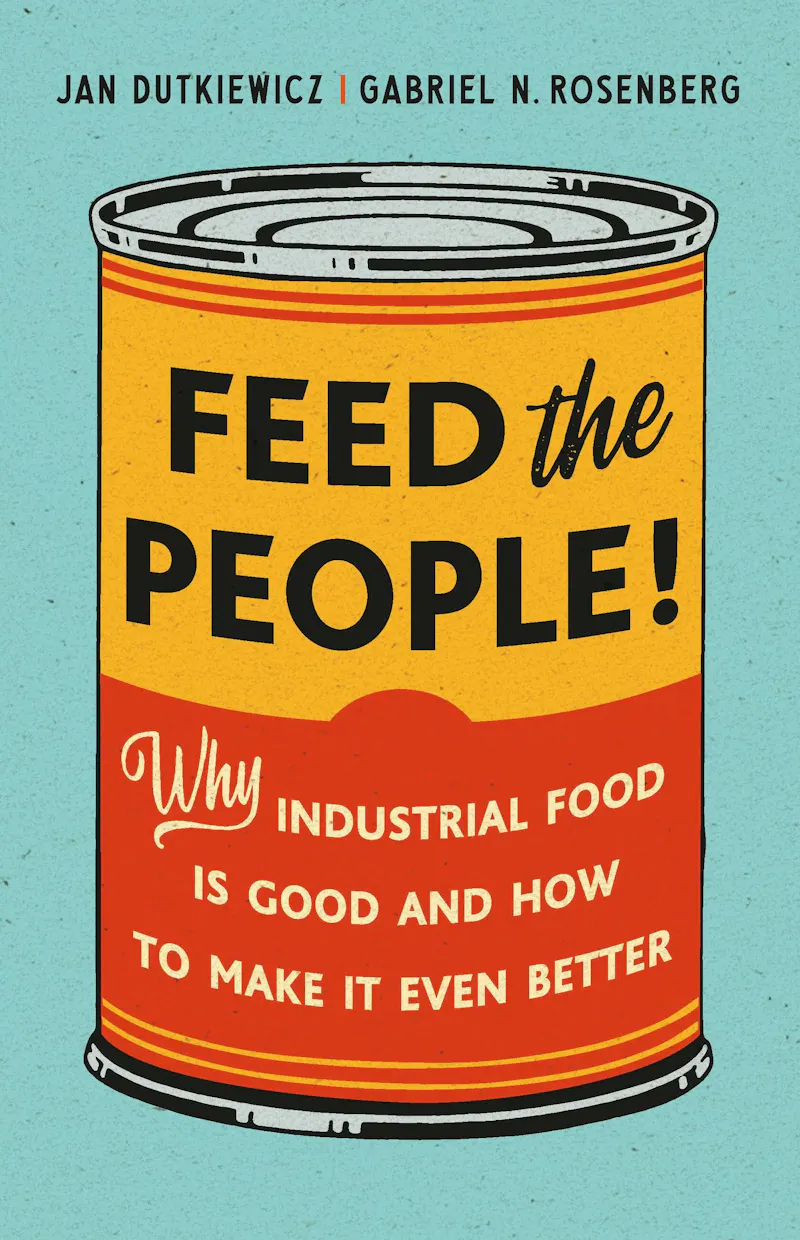
These are all trends that Jan Dutkiewicz and Gabriel N. Rosenberg, authors of Feed the People! Why Industrial Food is Good and How to Make it Even Better, would likely applaud. In their provocative book, the authors argue that improving existing modes of production is the most effective way to feed the world—with a population of more than eight billion and growing. The current system relies on low wages, enormous amounts of land and energy, and the widespread mistreatment of animals to furnish us with highly processed food that has led to poor health outcomes. At its core, the authors’ pitch comes down to access and sustainability: making sure people can afford better-quality food and that we don’t destroy the planet and the lives of workers along the way. Big, they might argue, is beautiful.
It’s a counterintuitive argument, not least because reformers have tended to look to decentralized systems of small farms built around regional and local markets for a better source of food: yielding fresher, seasonal produce that has not traveled long distances on polluting trucks or planes. Yet these models, the authors point out, have failed to make a “provably large impact on the problem.” “Escapist foodie fantasies,” propagated by writers like Michael Pollan and chef Alice Waters, they write, “are a dead end.” “Locavorism”—the idea that we should try, whenever possible, to buy food grown in the region we live in—is impractical or too expensive for most people and therefore unable to serve as the “basis for reliably feeding all of society.”
The food system isn’t broken and should not be remade from the bottom up, only reformed. (“Keep what works and get rid of what doesn’t,” they write, a deceptively simple proclamation that is much easier said than done.) The authors do not shy away from the downsides of modern agriculture and processing but contend that using the infrastructure already in place is the only viable way to meet the needs of the vast majority of people. “As far as we’re concerned,” they write, “we ought not abandon the pleasures of the industrial food system. We should make improving them the object of our politics. It’s what we call democratic hedonism.” This is what has defined the modern age: food that is cheap, safe, and abundant.
To make their case, Dutkiewicz and Rosenberg dispense with what they view as the misguided efforts of a generation of “foodie writers,” from agrarian philosopher and poet Wendell Berry—his 1977 book The Unsettling of America was a major influence on figures like Waters and Pollan—to critic cum cookbook author Mark Bittman. (The authors’ use of the phrase “foodie writer” instead of the more accurate food writer is a subtle way of implying that they are out of touch and snobbish.) According to Dutkiewicz and Rosenberg, these writers, and a handful of chefs, have spent years trying to resurrect a highly romanticized notion of farming, and have ultimately made little difference. To some extent, they’re right. In a Guardian essay marking the twenty-fifth anniversary of Fast Food Nation, the runaway bestseller that exposed the ills of a consumer culture built around cheap, fast food, Eric Schlosser acknowledged that “the harms of the food system have only got worse” in the years since. Or as Dutkiewicz and Rosenberg put it, “The locavore food revolution never arrived.”
But I’m not so sure advocates of locally produced food, who have also sought to forge closer ties between rural farmers and urban markets, were ever seeking to reinvent the industrial food system. Rooted in the back-to-the-land movement of the late 1960s and early 1970s (and first articulated in Frances Moore Lappe’s Diet for a Small Planet, which argued for a plant-centered diet made up, when possible, of local and seasonal ingredients), these neo-hippies had a much narrower and, in many ways, selfish vision. They wanted to grow their own food and be self-sufficient. Their aim was indeed escapist: They wanted out of a capitalist system and mode of agricultural production they felt was destroying the planet.
Still, the legacy of this movement should not be written off so easily. The United States, I would argue, has become a much better place to eat. Today in nearly every city and many smaller towns across the country, it is easy to find a high-quality coffee shop that cares about where its beans come from, a decent loaf of bread made with minimally processed or even locally milled flour, local cheese or beer, a restaurant highlighting produce from regional farms, and supermarkets selling pasture-raised antibiotic-free meat. The town of fewer than 5,000 people where I grew up in far northern New York State (part of Elise Stefanik’s district), where poor soils and a relatively short summer make farming difficult, now has a weekly summer farmers market that draws a surprisingly large crowd. It also has a co-op that, despite its higher price point, recently expanded to incorporate a light-filled café and smoothie bar, and if you’re interested you can easily find a community-supported agriculture, or CSA, venture in the area to support. But if that’s not your cup of tea, you can head down the road to McDonald’s, Pizza Hut, or Dunkin’ Donuts. If anything, locavorism has expanded the palate, and contrary to what Dutkiewicz and Rosenberg claim, it is not only for the uberwealthy who have the privilege of dining at places like Eleven Madison Park or Le Bernadin. Many farmers markets, for example, now accept SNAP benefits.
None of these changes alone amounts to a revolution. But taken together, they represent a dramatic shift in the way most Americans think about what they eat and where their food comes from. This is no small achievement. Dutkiewicz and Rosenberg seem to acknowledge as much. “If you’ve never read (or heard of) Wendell Berry,” they write, “you have most certainly read a book, seen a movie, engaged with a social media post, or eaten a plate of food that was directly or indirectly shaped by his writing.”
Chipotle, arguably, would not have had a consumer base that cared about the kind of pork it was using if not for the writing and advocacy of people like Berry, Paul Willis, Alice Waters, and others (indeed Ed Behr tasted his first Willis pork chop at Waters’s Chez Panisse and described it as “the best pork I’d ever eaten”). The Waffle House of Dutkiewicz and Rosenberg’s dreams—one that offers mycelium steaks and eggs made from mung beans and pays its workers a decent wage—would be inconceivable without a broadly educated public willing to demand radical reforms to animal agriculture and food policy.
The social and cultural transformation of the last few decades has set the table for the larger-scale changes Dutkiewicz and Rosenberg are interested in.
So what would a more progressive industrial food system look like? For starters, it would remove meat from the center of the American diet, especially beef. That means convincing Americans to eat a lot less meat and shifting the focus of industrial agriculture to growing staple crops—wheat, corn, and rice along with fruits and vegetables—for human consumption (a whopping two-thirds of all crops grown in the U.S. are used for animal feed, a highly inefficient system). This would be better for the planet and for us, which in theory would have the added benefit of bringing down health care costs. Worldwide, the amount of land used for rearing animals is roughly equal to the size of South and North America combined, and one of the greatest threats facing the Amazon rainforest—a major carbon sink—is the clear-cutting of forests for cattle grazing. Industrial animal agriculture is also a significant contributor to global climate emissions, habitat fragmentation, and biodiversity loss and a major consumer of water, a precious resource on a fast-warming planet.
As Dutkiewicz and Rosenberg write, “The environmental benefits of substituting chicken for beef and soybeans for chicken are so substantial that facilitating those substitutions, even through ‘fast’ and ‘industrial’ venues, is among the most consequential ways we can ease the environmental impact of the food system.”
The state would also need to play a much larger role in ensuring that good food is available across society. Free school lunch programs, for example, could be the law of the land and paid for with federal dollars. Several states, including California, Colorado, Maine, Massachusetts, Michigan, Minnesota, New Mexico, New York, and Vermont rolled out such programs during the Covid pandemic and have kept them in place. And with a relatively modest investment, school lunch programs could start serving higher-quality food. (It goes unmentioned in the book, but Alice Waters, through her Edible Schoolyard Project, has spent decades trying to improve the food served in California’s public schools. Her most recent cookbook, A School Lunch Revolution, demonstrates that a better food system using local, organic products is not only possible but capable of meeting USDA pricing requirements.) Tying SNAP benefits to the cost of living would also expand eligibility and put food dollars in the hands of families that need them most. And paying workers a basic living wage would improve the lives of many Americans—from those who work in meatpacking plants to fast food restaurants—while, arguably, making the food system safer. And it’s not out of reach: In 2024, California passed a law requiring a minimum wage of $20 an hour for all fast food workers.
A range of other measures aimed at shaping consumer behavior could also be implemented. Value-added taxes—common in European countries—impose an extra cost at each stage of processing, which is designed to incentivize the purchasing of healthier food. Labeling—a practice with broad-based public support—can also make a difference. This month the HHS will roll out a new initiative using color-coded labels to identify risks associated with eating ultra-processed foods.
Essentially, it’s more about politics—rebuilding a robust social safety net and regulatory state to guide the industrial food system—than it is about aesthetics or anyone’s notion of what is good or bad.
Feed the People!, though, arrives as the very agencies that could oversee many of the commonsense reforms outlined in the book have been gutted. The Agriculture Department has lost nearly 27 percent of its workforce, or about 24,000 employees. HHS, which includes the Food and Drug Administration, has experienced a similar shock with thousands of employees taking deferred resignations or retiring. The Centers for Disease Control and Prevention’s Foodborne Diseases Active Surveillance Network, which tracks disease-causing pathogens such as salmonella and E. coli, has also been scaled back.
And, even before Trump was reelected, there was little appetite in Congress to expand the social welfare system or oversight of the agricultural industry, which is shockingly exempt from basic labor and safety standards that apply to most other sectors. Democrats, who controlled both houses of Congress in 2008 after Obama was elected, couldn’t even pass a law to increase the minimum wage, which would have been a boon to food service workers and is a central tenet of Feed the People!
The food system, as Dutkiewicz and Rosenberg insist, may not be “broken,” but the institutions and actors needed to make it better, including Congress, are very close to dysfunctional. And after Trump’s scorched-earth second term, who knows what will be left of the administrative state responsible for keeping our food supply safe and secure? Feed the People! lays out an ambitious and admirable blueprint for reform, but whether it can actually be enacted is another matter altogether. Like the “well-meaning food purists” they decry, Dutkiewicz and Rosenberg seem nostalgic for a bygone era of political reform that reached its peak during the New Deal. Rebuilding the coalitions that made that moment possible will require nothing short of a political revolution.