Breaking News
Breaking News
from Washington and beyond

MAGA Candidate J.D. Vance Wins Ohio Senate Race, In Huge Blow to Democrats

Vance beat Tim Ryan and maintained Republican control of the seat.

Drew Angerer/Getty Images

MAGA Republican J.D. Vance was elected Ohio senator Tuesday in a tight race against Democratic Representative Tim Ryan, according to a projection from NBC.

Vance leads Ryan 53.5 percent to 46.4 percent, with 87 percent reporting.

Ohio has long been viewed as a swing state, but it went solidly for former President Donald Trump in 2016 and has continued to shift farther right ever since.

But the competition between Ryan and Vance to replace outgoing Republican Senator Rob Portman was surprisingly tight, leaving many analysts unsure of which way it would go until the results came in.

Ryan had served for years as an Ohio representative. Although he is a registered Democrat, on the campaign trail, he sought to cast himself as more of an independent. He agreed with Trump on trade, but supported environmental policy, affordable health care, and legislation to codify abortion access and regulate gun ownership.

Vance, a former venture capitalist and writer, ran on an extreme right-wing platform. He was vague on his plans for issues such as inflation and energy production. But he was clear that he wanted to push back against gun control and to stop granting amnesty to undocumented immigrants.

He said he wanted to finish the expensive and ineffective U.S.-Mexico border wall started under Trump and ban all abortion.

Vance is also a 2020 election denier and wants to end mail-in voting.

His political leaning was a surprise to many, though. Vance rose to prominence with the publication of his memoir Hillbilly Elegy, an examination of the white working class, which quickly became a bestseller and was made into a movie. At the time of publication in 2016, Vance was a conservative Trump-skeptic living in San Francisco.

But when he moved back to Ohio, he made a stark and unexpected shift to the right, endorsing QAnon conspiracy theories and the lie that the 2020 election was stolen. He even traveled to Mar-a-Lago to secure Trump’s endorsement of his senatorial campaign.

This piece was updated.
Democrat Abigail Spanberger Secures Key Win in Virginia

Republicans were expected to take Spanberger's seat, but she held on to it.

Samuel Corum/Getty Images

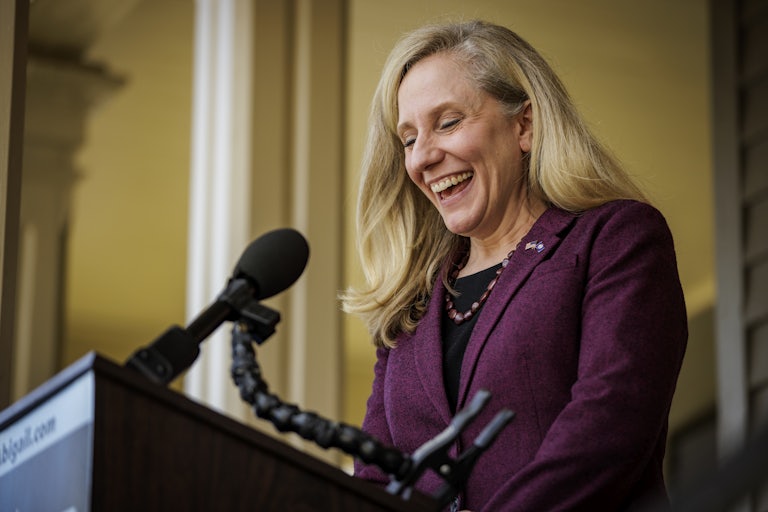
In Virginia’s 7th congressional district, Democrat Abigail Spanberger was projected the winner in a tough and very closely watched race.

Her Republican opponent was Yesli Vega, who supported a nationwide abortion ban and other far-right positions. A Fredericksburg newspaper, in endorsing Spanberger, wrote of Vega: “Not only is Vega dangerously uninformed about rape and its consequences, she is making clear what other extremists are now pushing—a total nationwide ban on abortion in the U.S.”

Spanberger’s win is a huge emotional lift for Democrats. The GOP put a big target on her, gerrymandering her district to make it more Republican and even moving it around such that the house where she lives was no longer in the district. This was a seat the GOP fully expected to take.

Assuming this holds, Democratic incumbents end up holding two of the three seats Republicans were licking their chops about. Jennifer Wexton in northern Virginia also appears to have fought off a challenge from Hung Cao, who was advertising heavily on Washington DC TV in the campaign’s closing weeks. But it does appear that Elaine Luria of Virginia Beach will lose to GOP challenger Jen Kiggans (another extremist). Luria made her work on the January 6 committee defending democracy a centerpiece of her campaign. It would have been great to see Luria pull that out.

But Spanberger’s win is huge. And she ran in part on the infrastructure bill—that is, she didn’t run away from Joe Biden’s agenda. Two out of three in Virginia, especially when one of the two is a candidate the Republicans really thought they could take out, is a very big deal.

Arizona Judge Denies GOP Request to Extend Voting, Says There’s No Evidence People Couldn’t Vote

Conspiracy theorists are pointing to a problem with voting machines in Arizona's Maricopa County, but voters could still drop off their ballots.

John Moore/Getty Images
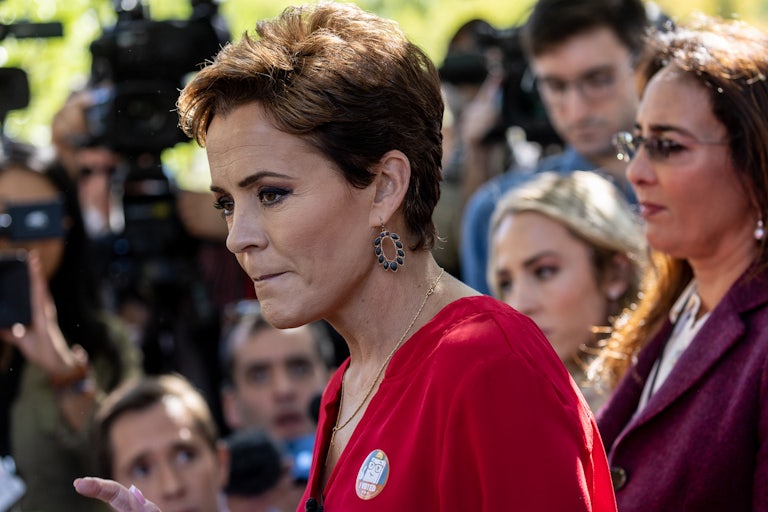
Kari Lake

There was a strange back and forth about voting in Arizona’s Maricopa County on Tuesday, which  resulted in a judge denying a request to extend voting in the county beyond normal hours.

It started with a problem with tabulator machines in the county that sparked worries (and some suspicion among conspiracy theorists) that voters in the country wouldn’t be able to cast their ballots. The Republican National Committee, the National Republican Senatorial Committee, Republican gubernatorial nominee Kari Lake, and Republican Senate nominee Blake Masters filed a joint lawsuit the same day seeking to extend voting by a few hours. In response, the campaign for Senator Mark Kelly, the incumbent and Masters’ Democratic opponent, filed a lawsuit arguing against extending voting in the county.

“At the eleventh hour of this election, Plaintiffs seek the drastic remedy of changing the rules of the election, while it is occurring, in the hopes of obtaining an electoral advantage,” the lawsuit wrote. “But there is no evidence that any voter who appeared to vote at Maricopa County polling places was turned away from the polls or that voting today in Maricopa County was substantially impeded.”

Indeed, the voting machine issue didn’t stop people at those polls from voting. Voters were simply told to instead drop their ballots off in a lockbox attached to the machines.

Late Tuesday night, a Superior Court judge for Maricopa County denied the Republicans’ request to extend voting by a few hours, saying there wasn’t strong enough evidence that voters were unable to vote within the original period of time.

The Maricopa voting machine problems garnered scrutiny from law enforcement and election officials, who moved throughout the day to quell fears that people weren’t able to cast their vote. Former President Donald Trump said, without evidence, “there’s a lot of bad things going on” in Maricopa County. But officials with the Department of Homeland Security’s Cybersecurity and Infrastructure Security Agency (CISA) stressed that despite some hiccups, voters were still able to vote.

“We have no indication of malfeasance or malicious activity,” a CISA official told reporters Tuesday afternoon. 

Colorado and North Carolina Offer Hope That There Won’t Be a “Red Wave” This Election

The so-called "red wave" might not really be a wave at all.

Michael Ciaglo/Getty Images

Tonight might not be a blowout after all.

At about 9:35 p.m. ET, or a little more than half an hour after the Colorado polls closed, NBC projected incumbent Democratic Senator Michael Bennet the winner over GOP challenger Joe O’Dea. That was a pretty fast call for a race that in September and October was labeled as one where a seemingly safe Democratic incumbent might be in trouble.

In other words, Bennet was exactly the kind of Democratic who would have tumbled in a major red wave. But the fact that he not only held on but is apparently winning pretty comfortably is a sign of hope.

Item two: About 10 minutes later, NBC shifted the North Carolina Senate race from “too early to call” to “too close to call.” “Too early” means, “Well, we can’t say it yet, but we all really know what’s going to happen”—in this case, that Republican Ted Budd was going to beat Democrat Cheri Beasley. I remember, still, the shudder of involuntary horror that consumed by body on Election Night 2016, at (I think) exactly 8:32 p.m., when NBC shifted that same North Carolina from “too early” (meaning, then, that Hillary Clinton was going to win, but they just couldn’t say yet) to “too close,” which meant that Donald Trump was going to win. And if he was going to win North Carolina, that meant he was going to win period. I still have nightmares.

But tonight, the shift to “too close” appears to bode well for Beasley. Maybe not to the extent that she wins, which would of course be great; but at least to the extent that she’s outperforming late polls, which tells us something interesting.

Things can still change. But right now, around 10 p.m. Eastern time? It’s not yet a red wave kind of night.

We Won’t Get Immediate Election Results in Nevada, Georgia, or Arizona

Three battleground states will take longer to count their votes—and then come the conspiracy theorists.

Anna Moneymaker/Getty Images
Nevada Senator Catherine Cortez Masto

Add Nevada to the list of states where the results of top ticket races may not be called tonight. That’s according to Jon Ralston, the indispensable Nevada journalist.

Ralston tweeted Tuesday evening that mail-in ballots dropped off in Clark County, the biggest county in the state, won’t fully be counted tonight and may not be until Thursday.

It was highly unlikely that control of the Senate would be decided Tuesday night. Georgia’s Senate race was expected to go to a run-off between incumbent Senator Raphael Warnock and Republican Herschel Walker..

But as election results came in Tuesday night, political strategists and candidates began to caution that election results will also not be immediately clear in Nevada and Arizona. Arizona counts ballots slowly, a Democratic official cautioned. There was also a problem with tabulating machines in Arizona’s Maricopa County, raising the possibility that a winner in the Senate race or governor’s race would not be announced Tuesday.

That three battleground states will likely have undecided Senate and gubernatorial races on Tuesday means that there will be inevitable lawsuits and scrutiny over counting the remaining ballots. And unfortunately, the conspiracy theorists will abound as well.