Breaking News
Breaking News
from Washington and beyond

Judge Cannon Prepares to Do Trump Another Favor, This Time on Shooting

Aileen Cannon is now weighing in on Donald Trump’s assassination attempt.

Judge Aileen Cannon
UNITED STATES DISTRICT COURT FOR THE SOUTHERN DISTRICT OF FLORIDA

Judge Aileen Cannon has refused a motion to recuse herself from the trial of Donald Trump’s would-be assassin.

Last month, Ryan Wesley Routh was arrested at the Mar-a-Lago golf course and charged with attempting to assassinate Trump.

In a seven-page decision released Tuesday, Cannon dismissed a motion from Routh’s attorney, arguing that the former president’s constantly praising her did not create the “appearance of partiality.”

“As Defendant acknowledges, I have no control over what private citizens, members of the media, or public officials or candidates elect to say about me or my judicial rulings,” Cannon wrote. “Nor am I concerned about the political consequences of my rulings or how those rulings might be viewed by ‘some in the media.’”

“I have never spoken to or met former President Trump except in connection with his required presence at an official judicial proceeding, through counsel,” Cannon wrote. “I have no ‘relationship to the alleged victim’ in any reasonable sense of the phrase.”

Cannon made the unprecedented decision in July to toss out the felony classified documents case against Trump by ruling special counsel Jack Smith’s appointment was unconstitutional. Her move has been criticized by legal scholars but repeatedly celebrated by Trump.

Earlier this month, it was reported that Cannon’s name is on a list of possible candidates for Trump’s attorney general, if he wins the election next week.
Pro-Trump Militias Are Threatening the Election—and Meta Lets Them

Facebook groups for far-right militias are flourishing.

The Meta logo
Beata Zawrzel/NurPhoto/Getty Images

As paper ballots are lit on fire by vigilantes and Donald Trump threatens to punish the “enemy from within,” Meta is not only allowing extremist groups on its platform but even is auto-generating anti-government militia Facebook groups.

According to data compiled by the Tech Transparency Project for Wired, after January 6, the number of Facebook groups and pages used by the alt-right to organize with each other has only grown. The Tech Transparency Project found more than 200 Facebook pages and nearly 200 anti-government pages that recruit for extremist movements. Nearly two dozen of these pages and groups have been created in the past six months.

Meta has not only looked the other way but even used its own technology to auto-generate these groups for militias. Though some chapters of American Patriots Three Percent (AP3) on the platform have been moderated or banned, in May, Facebook automatically created a page for an Arizona chapter of AP3. In June, it did the same for an AP3 “training range” in New Mexico. On the site, Facebook’s explainer reads: “This unofficial page was created because people on Facebook have shown interest in this place or business. It’s not affiliated with or endorsed by anyone associated with AP3 Training Range.”

“Nearly four years after the January 6 attack on the capitol, Facebook remains a significant recruiting and organizing tool for militias like the AP3, despite creating policies that ban them,” Katie Paul, the director of the Tech Transparency Project, told Wired.

This isn’t the first time that Meta has been caught auto-generating pages for terrorist or white supremacist groups. In 2020, a whistleblower alerted the Securities and Exchange Commission to the issue.

Most recently, groups such as the “Patriot Group” or “The Party of Trump,” the latter of which has 171,000 members, have urged their members to do ballot dropbox “monitoring,” including encouraging Trump supporters to stand guard at ballot boxes with AR-15s.

With the election a week away, as Paul asks: “How can Meta be trusted to effectively thwart extremists that have a record of engaging in and stoking political violence when its own systems create business pages for them?”

Trump Makes Racist Puerto Rico Joke 10 Times Worse With His Reaction

Amid all the backlash he’s facing, Donald Trump came up with a remarkably idiotic response.

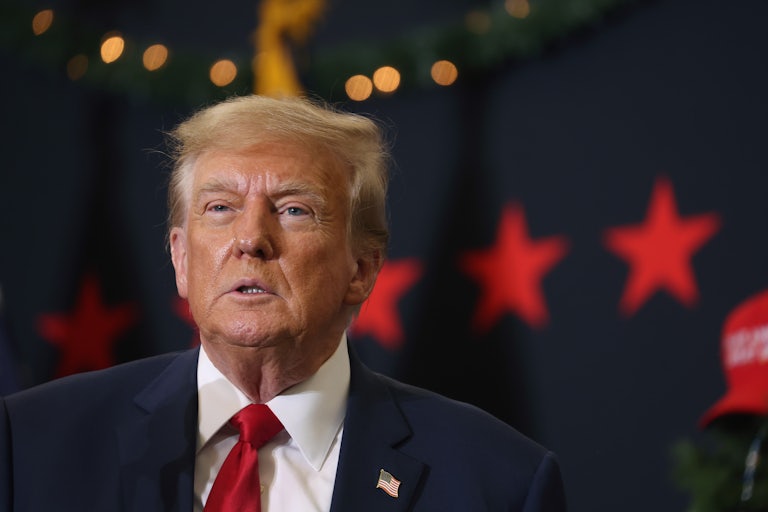
Donald Trump
Scott Olson/Getty Images

Donald Trump’s response to a comedian making a racist joke about Puerto Rico at his New York rally at Madison Square Garden came up very short.

On Tuesday morning, ABC News’s Rachel Scott asked Trump about Tony Hinchcliffe’s joke on Sunday where he called Puerto Rico “a floating island of garbage,” and Trump denied knowing anything about him or the joke.

“I don’t know him; someone put him up there. I don’t know who he is,” Trump said. The former president also claimed he had not heard the comments, despite widespread news and TV coverage and campaign spokespeople disavowing the joke Sunday and Monday.

Trump then went on to call the New York rally a “lovefest” during a rally later on Tuesday.

Trump pointedly refused to condemn or disavow Hinchcliffe’s joke directly, which will not help with the fallout his campaign is receiving. In the battleground state of Pennsylvania, which boasts a 500,000-strong Puerto Rican population, the “joke” has quickly spread through social media and WhatsApp and drawn backlash from a nonpartisan Puerto Rican organization urging its members not to vote for Trump.

Trump’s nonapology won’t go over well with some of his more influential critics, particularly the Catholic Archbishop of San Juan, who has demanded a personal apology from the former president along with the chairman of the Puerto Rico Republican Party.

JD Vance, Trump’s running mate, didn’t bail out the former president either, claiming that he hadn’t “actually seen the joke” Monday and complaining about people taking offense.

“I’m not gonna comment on the specificity of the joke … but I think that we have to stop getting offended at every little thing in the United States of America, I’m just so over it,” Vance said.

With Puerto Ricans making up a large population in the U.S. mainland, including several battleground states like Pennsylvania, Georgia, and North Carolina, Trump’s response could end up costing him key votes that he needs to win. The right (and smart) thing to do would be for Trump to clearly and categorically apologize and disavow Hinchcliffe and his “joke,” but Trump isn’t known for his willingness to take responsibility when things go badly.

Republicans in Yet Another Swing State Suffer Massive Election Blow

Republicans in Pennsylvania had a shady tactic shut down in court just days before the election.

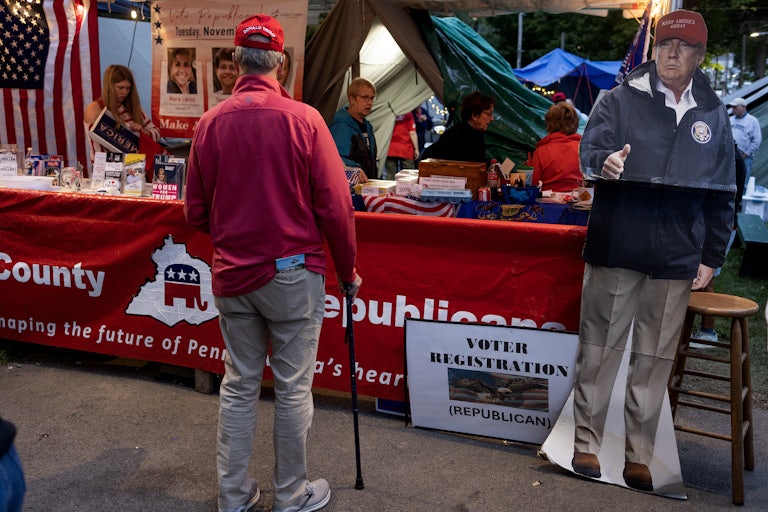
A man stands at a red Republican Party booth. A lifesize carboard cutout of Donald Trump gives a thumbs up.
Andrew Lichtenstein/Corbis/Getty Images
A Republican Party booth at the Grange Fair in rural Westmoreland County, Pennsylvania, on August 21

Republicans in the crucial swing state of Pennsylvania have been dealt a significant blow to their dubious voter suppression efforts.

Earlier this month, six Republican congressmen in the state filed a federal lawsuit against the Pennsylvania secretary of state alleging that ballots cast by Pennsylvania residents living overseas were fraudulent. The suit claimed that state law makes it possible for ineligible voters to cast ballots without providing any proof of identity, leading to inaccurate results. The lawsuit even claimed that “Iranian nationals” could “easily” take advantage of the system and falsify ballots. 

But on Tuesday, U.S. District Judge Charles Conner, a George W. Bush appointee, deemed this all to be nonsense. He dismissed the lawsuit on the grounds that the Republican congressmen were relying on “phantom fears of foreign malfeasance to excuse their lack of diligence,” and had “no good excuse for waiting until barely a month before the election to bring this lawsuit.”

Overseas ballots have been under federal jurisdiction for years under the Uniform and Overseas Citizens Absentee Voting Act, which is mostly associated with military service members stationed abroad. Many Trump supporters, like Elon Musk, have decried this normal law as a fraudulent Democratic plot to steal the 2024 election, and similar lawsuits have been filed in Michigan and North Carolina.

It’s likely that Republicans have realized that overseas voters aren’t all military, pro-GOP people—a shift that could seriously cost them. “Everyone thought overseas meant military. Not true,” Trump lawyer Cleta Mitchell told The Washington Post. “Approx 63% of [overseas] ballots in 2020 were nonmilitary.” But rather than looking inward to determine how to appeal to a broader electorate, the GOP has instead chosen to try to stop people from voting. And while this latest effort was defeated in Pennsylvania, the groundwork for claims of another “stolen” election is still being set right in front of us.

Elon Musk Makes Shocking Confession on His Plans After Trump Victory

This is a wild statement from the world’s richest man and someone reportedly in the running to join Donald Trump’s administration.

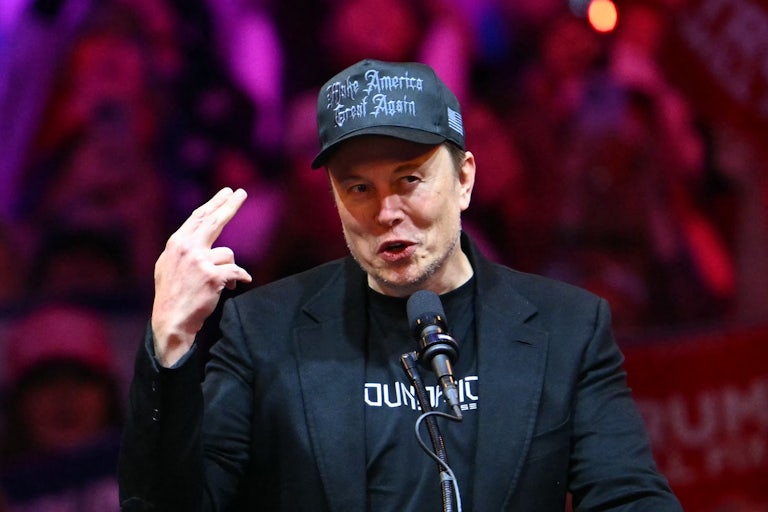
Elon wears a black MAGA Hat
ANGELA WEISS/AFP/Getty Images
Elon Musk at Donald Trump’s hate-filled Madison Square Garden rally in New York City, October 27

Elon Musk admitted that he knows that Donald Trump’s policies would crash the economy if he’s elected president, but thinks that the price is worth it.

The tech CEO and social media mogul on Monday evening replied to a post on X from right-wing influencer FischerKing64, who posted about how Trump’s plans for mass deportations of immigrants combined with Musk’s plans as a White House adviser to cut federal spending would initially crash the economy, before creating a “sounder footing.”

Musk replied, “Sounds about right.”

Twitter screenshot Will Stancil @whstancil:
Elon Musk admits that he and Trump will crash the economy, but it’s okay, because they’ll build a better world from the rubble. Not exaggerating, he just said it.

(photo of twitter interaction between FischerKing and Elon Musk)

It’s a telling admission from Musk that crashing the economy is all a part of the plan.  Experts have repeatedly warned that Trump’s mass deportations on their own would cause damage to critical industries in the U.S., including agriculture, construction, and hospitality.

Undocumented immigrants most commonly take jobs with longer hours, lower wages, and dangerous working conditions that native-born citizens don’t want, such as housekeeping cleaners, cooks, construction workers, and farm workers. These jobs also won’t have American workers lining up to fill them.

Trump’s plan to appoint Musk to his administration, possibly to lead a government efficiency task force, could also have negative effects. JD Vance, Trump’s running mate, previously said Musk told him that he plans to look at cuts to government programs like Social Security and the Department of Defense.

Judging by what happened after Musk gutted Twitter and laid off many of its workers after he purchased the social media company, there are justifiable fears that he would cripple essential government programs. Social Security, for example, is a lifeline to many older Americans, and in fact needs more funding, not less.

Musk’s status as the world’s richest man, as well as the success of his companies like SpaceX and Tesla, comes from taxpayer funds. When the government isn’t involved in his ventures, they’ve suffered, such as Twitter (now X), which has lost more than a third of its value since he took over the company. Musk’s confession that the economy would initially get worse under Trump is worrying enough, but his idea that it would lead to a rapid recovery should be cause to reject his plans altogether—as well as the administration that would enable them.