Breaking News
Breaking News
from Washington and beyond

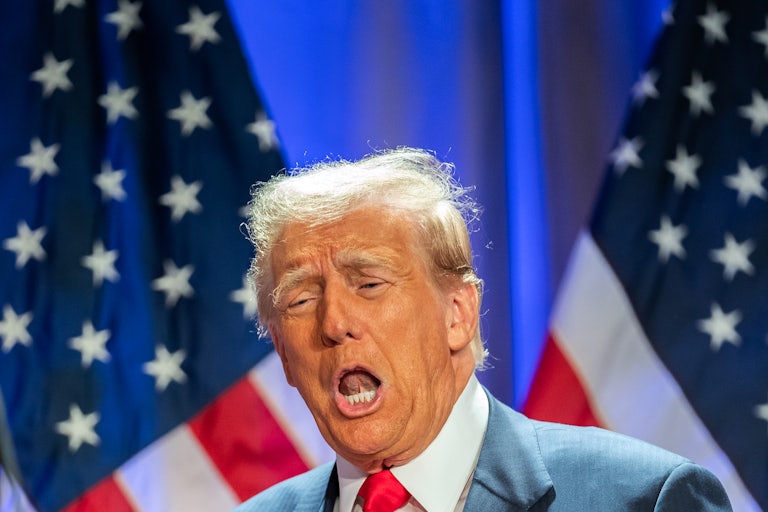
Trump Responds to Potential Trade War With Bonkers Joke

Torpedoing the U.S. economy is just a joke to Donald Trump.

Donald Trump speaks to Justin Trudeau
Nicholas Kamm/AFP/Getty Images

Donald Trump responded to Canadian Prime Minister Justin Trudeau’s warning that both Canadians and Americans might seriously suffer from the president-elect’s tariffs with respect and seriousness—just kidding: Trump actually responded by cracking a joke.

Trudeau dined with Trump at Mar-a-Lago Friday, and warned the president-elect that his plan to impose a 25 percent tariff on goods imported into the United States from Canada would be disastrous for both countries, echoing similar warnings from economists.

Fox News’s Peter Doocy reported Monday that destroying global economies is just one big joke to Trump.

“When Trudeau told President-elect Trump that new tariffs would ‘kill’ the Canadian economy, Trump joked to him that if Canada can’t survive without ripping off the U.S. to the tune of $100 billion a year, then maybe Canada should become the fifty-first state and Trudeau should become its governor,” Doocy said.

Sources told Fox News that when someone at the table reminded Trump that Canada would be a liberal state, the president-elect conceded that Canada could be split into two states: a liberal one and a conservative one.

Trudeau had traveled to Mar-a-Lago in the hopes of getting Trump to back off his tariff plan for Canada by reminding the president-elect that the U.S. border with Canada is very different from its one with Mexico. Such sentiments didn’t please Mexican President Claudia Sheinbaum, who responded by insisting that Mexico “must be respected, especially by its trading partners.”

If implemented, Trump’s plan to impose 25 percent tariffs on all goods from Mexico and Canada would result in an estimated loss of $250.6 billion in annual U.S. gross domestic product and approximately 1.97 million jobs, according to Ray Perryman, the CEO of the financial analysis firm the Perryman Group. The tariffs would also disproportionately affect border states with more integrated economies—such as Texas.
Trump’s Pick for FBI Director Already Has an Enemies List

And it’s long. Very long.

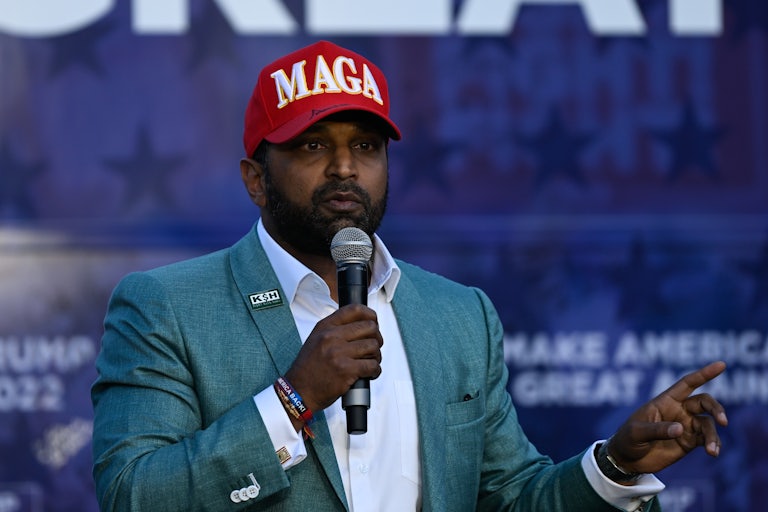
Kash Patel in Charlotte
Peter Zay/Anadolu/Getty Images
Kash Patel

Donald Trump’s choice to run the FBI, Kash Patel, has already put together a list of “deep state” officials whom he thinks need to be targeted.

In his 2023 book Government Gangsters, Patel calls out a long list of villains, which he calls “Members of the Executive Branch Deep State,” in an appendix. These villains are not restricted to Democrats or  even Biden administration officials, and in fact include several Republicans as well as Trump appointees, like Bill Barr, Rod Rosenstein, Pat Cipollone, Patrick Philbin, and special counsel Robert Hur.

Not surprisingly, Patel also includes FBI Director Christopher Wray, whom Trump wants him to replace, as well as Democrats ranging from White House adviser John Podesta to Vice President Kamala Harris. It seems to back up assertions that the choice of Patel is part of clear “authoritarian takeover,” in the words of The Atlantic’s Tom Nichols.

An FBI director having an enemies list undermines the law enforcement purpose of the position, but is exactly what Trump is looking for, since he has repeatedly stated his desire to take revenge for the grievances of his first term. Trump’s team, however, is already souring on Patel—maybe because they don’t want to end up in the enemies list of his next book.

If Trump goes ahead with nominating Patel, this latest revelation will not help his confirmation hearings, especially considering that Republicans and Democrats support Wray staying on. FBI directors are supposed to serve a single 10-year term, but Patel’s appointment would make him the third FBI director in seven years thanks to Trump, who fired James Comey in 2017 after only four years in the post.

Patel’s job at the FBI will basically be to act as Trump’s hatchet man and upend the rule of law. The underqualified MAGA loyalist has only three years working in the Department of Justice as his law enforcement experience, and is likely to butt heads with more experienced law enforcement officers. If Patel gets past the Senate, will he face resistance or cooperation from the rank-and-file FBI?

The One Thing Republicans Can’t Agree On

Republicans are already bickering over just how cruel to immigrants they should be. The infighting could help stall or stop the worst part of Trump’s agenda.

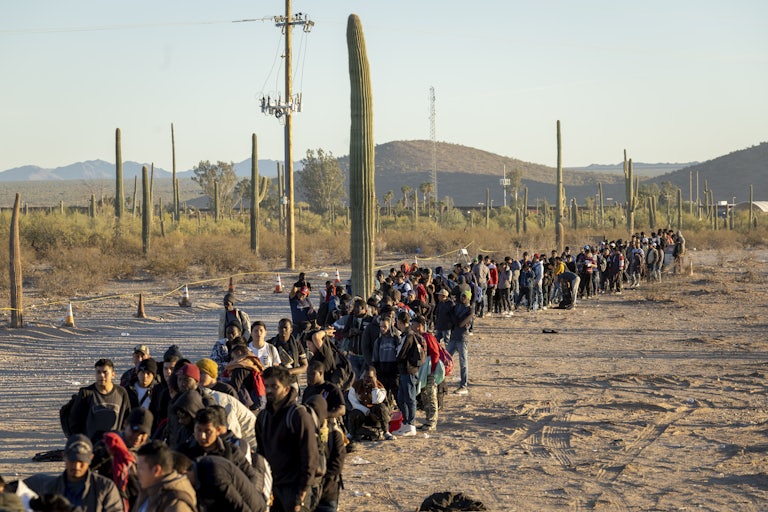
A long line of migrants in the desert in 2023
John Moore/Getty Images
A long line of migrants in the desert in 2023

The GOP is already fighting about just how far to go with Trump’s draconian vision for immigration. 

Even with control of the House and Senate, Republicans will still have to fight tooth and nail to actually pass the majority of president-elect Trump’s immigration platform, a huge part of his campaign.  

MAGA Republicans and more moderate Republicans currently disagree about how cruel they should be regarding the southern border. “We’re going to need a little time to figure out what shakes out,” said the more moderate Texas Republican Tony Gonzalez.  “What does a conference in the House want? What does the conference in the Senate want? What does President Trump want? And then that’s when we have a short window to be able to jam that all through.”

Even more troubling for Republicans is that Trump loyalists like Jim Jordan want to slide the most extreme parts of Trump’s immigration plan into the reconciliation package, which could violate the budgetary rules that moderate Republicans prefer to abide by. Jordan said that he wants the Remain in Mexico policy—which requires migrants seeking asylum to remain outside of the United States while their claims are processed—to be included in this.

“We get sworn in on Jan. 3,” Jordan said. “We should pass H.R. 2 as a stand-alone bill or [break] it up into pieces—I’m open to either one—but pass all of that to show that we’re ready to go. Then see what parts of it … can be put into reconciliation.” This conflict is set to define the earliest days of Donald Trump’s presidency.

Here’s Who’ll Pay the Highest Cost of Trump’s Tariff War

Donald Trump has proposed sweeping tariffs on Mexico.

Donald Trump makes weird face
Allison Robbert/Pool/Getty Images

Donald Trump’s tariffs will likely take the biggest toll on Texas, multiple economics experts told Newsweek.

Last week, the president-elect announced plans to impose 25 percent tariffs on all goods imported from China, Canada, and Mexico “until such time as Drugs, in particular Fentanyl, and all Illegal Aliens stop this Invasion of our Country!”

While Trump’s tariffs on Mexico are expected to cause consumer prices to soar for a number of imported products, they would have far wider adverse effects on the U.S. economy. Specifically, they will make life tough in Texas, where a majority of the residents voted for the tariff-touting incoming president.

Ray Perryman, the CEO of the financial analysis firm the Perryman Group, told Newsweek that the negative effects of Trump’s tariffs will likely hurt the Lone Star State the most “because of its proximity to and integration of supply chains with Mexico.”

“Texas would see a disproportionate impact, which we estimate to be about $46.9 billion in yearly gross state product (about 1.7 percent of the total) and approximately 370,000 jobs,” Perryman said.

Perryman warned that, if implemented, 25 percent tariffs on all goods from Mexico and Canada would result in an estimated loss of $250.6 billion in annual national gross domestic product and approximately 1.97 million jobs, amounting to nearly 1 percent of the U.S. GDP.

Gary Clyde Hufbauer, a senior fellow at the Peterson Institute for International Economics, told Newsweek that he agreed that the proposed tariffs would “severely impact” Texas.

“Not only all those avocados, mangos, beer, tequila etc. becoming more expensive to Texas consumers, but the decline in cross-border truck and rail traffic will throw a lot of Texans out of work,” he said. “Then there is the loss of Texas sales of consumer goods, cattle, gas, petroleum and electricity to Mexico. Thrown in a decline in Mexican tourism in Texas.”

Tony Payan, the director for the Center for the U.S. and Mexico at Rice University’s Baker Institute for Public Policy, told Texas Standard that the “stakes could be high for both Texas and Mexico” when it came to Trump’s proposed tariffs.

“The amount of trade between the two countries is $800 billion a year. Half of that—$400 billion—is essentially what we could call intra-firm trade,” Payan said. “That is, trade that occurs between manufacturing firms—the parts that come from Mexico or come from the United States into Mexico to complete the cars and to complete the goods that are traded.”

Payan added that he wasn’t sure Trump would “make good” on his promise to impose tariffs and ultimately he believed the president-elect would realize just how “integrated” the two economies had become.

Maxwell Marlow, director of research at the Adam Smith Institute, voiced similar concerns to Newsweek, explaining that Trump’s tariffs would “be particularly devastating for areas such as Texas, where goods cross borders multiple times during their production.”

Marlow added that the U.S. should expect retaliatory tariffs from Mexico, which would also disproportionately hurt Texas.

Part of why retaliatory tariffs would be so damaging is because Mexico receives a whopping 29 percent of Texas’s exports, Professor Dennis Jansen, head of the economics department at Texas A&M University, explained to Newsweek.

“If there is retaliation from abroad—say if Mexico follows through on the threat to raise tariffs on goods exported from the U.S. to Mexico—this will further reduce the demand for Texas (and overall U.S.) exports,” Jansen said.

Republican Lawmaker Brazenly Threatens Another Basic Right

Donald Trump’s win appears to have emboldened Republicans to set their sights on other rights.

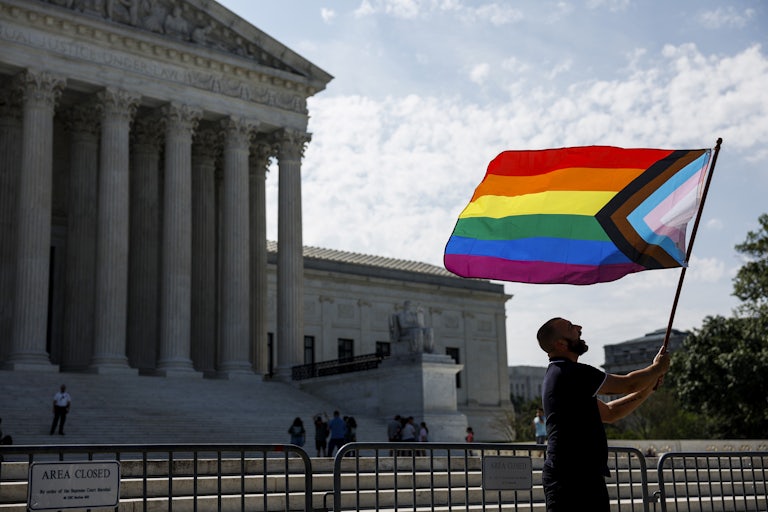
A person waves a pride flag in front of the U.S. Supreme Court
Anna Moneymaker/Getty Images

With nationwide abortion access off the table thanks to Dobbs v. Jackson Women’s Health Organization, the Republican Party is setting its sights on a new civil rights target: recriminalizing gay marriage.

The sentiment is apparently popular enough among those on the right that Michigan state Representative Josh Schriver unwarily shared his opinion on the topic Monday, writing in a late-morning post that he believed same-sex unions should be made “illegal again.”

“This is not remotely controversial, nor extreme,” Schriver posted on X.

Gay marriage was effectively legalized in 2015, when the Supreme Court ruled in Obergefell v. Hodges that keeping marriage licenses from same-sex couples was discriminatory. The decision mandated all states to issue licenses to gay and lesbian couples and required them to recognize marriages performed in other jurisdictions as well.

Marriage equality was further protected at the federal level in 2022, when the Respect for Marriage Act became law, requiring all 50 states to recognize same-sex marriages performed in other states. It did not, however, formally legalize gay marriage, so if the Supreme Court were ever to overturn Obergefell, gay marriage rights would fall with it.

And Schriver has at least one ally on the nation’s high court: conservative Justice Clarence Thomas. In his concurring Dobbs opinion, Thomas urged the Supreme Court to revisit cases ruling on same-sex marriage and contraception.

If Schriver’s loud-mouthed opinion on the intimate issue is any indicator, then conservative politics in the country have considerably regressed in the seven years since the Supreme Court ruled on Obergefell. But his opinion would also be wrong when blown out on a national scale. Roughly 69 percent of Americans support same-sex marriages, according to a 2024 Gallup poll. Republican support for gay couples’ equal rights has dipped in recent years, however, dropping from a record high of 55 percent in favor of it in 2021 to 46 percent in 2024.