Breaking News
Breaking News
from Washington and beyond

Here’s Who’ll Pay the Highest Cost of Trump’s Tariff War

Donald Trump has proposed sweeping tariffs on Mexico.

Donald Trump makes weird face
Allison Robbert/Pool/Getty Images

Donald Trump’s tariffs will likely take the biggest toll on Texas, multiple economics experts told Newsweek.

Last week, the president-elect announced plans to impose 25 percent tariffs on all goods imported from China, Canada, and Mexico “until such time as Drugs, in particular Fentanyl, and all Illegal Aliens stop this Invasion of our Country!”

While Trump’s tariffs on Mexico are expected to cause consumer prices to soar for a number of imported products, they would have far wider adverse effects on the U.S. economy. Specifically, they will make life tough in Texas, where a majority of the residents voted for the tariff-touting incoming president.

Ray Perryman, the CEO of the financial analysis firm the Perryman Group, told Newsweek that the negative effects of Trump’s tariffs will likely hurt the Lone Star State the most “because of its proximity to and integration of supply chains with Mexico.”

“Texas would see a disproportionate impact, which we estimate to be about $46.9 billion in yearly gross state product (about 1.7 percent of the total) and approximately 370,000 jobs,” Perryman said.

Perryman warned that, if implemented, 25 percent tariffs on all goods from Mexico and Canada would result in an estimated loss of $250.6 billion in annual national gross domestic product and approximately 1.97 million jobs, amounting to nearly 1 percent of the U.S. GDP.

Gary Clyde Hufbauer, a senior fellow at the Peterson Institute for International Economics, told Newsweek that he agreed that the proposed tariffs would “severely impact” Texas.

“Not only all those avocados, mangos, beer, tequila etc. becoming more expensive to Texas consumers, but the decline in cross-border truck and rail traffic will throw a lot of Texans out of work,” he said. “Then there is the loss of Texas sales of consumer goods, cattle, gas, petroleum and electricity to Mexico. Thrown in a decline in Mexican tourism in Texas.”

Tony Payan, the director for the Center for the U.S. and Mexico at Rice University’s Baker Institute for Public Policy, told Texas Standard that the “stakes could be high for both Texas and Mexico” when it came to Trump’s proposed tariffs.

“The amount of trade between the two countries is $800 billion a year. Half of that—$400 billion—is essentially what we could call intra-firm trade,” Payan said. “That is, trade that occurs between manufacturing firms—the parts that come from Mexico or come from the United States into Mexico to complete the cars and to complete the goods that are traded.”

Payan added that he wasn’t sure Trump would “make good” on his promise to impose tariffs and ultimately he believed the president-elect would realize just how “integrated” the two economies had become.

Maxwell Marlow, director of research at the Adam Smith Institute, voiced similar concerns to Newsweek, explaining that Trump’s tariffs would “be particularly devastating for areas such as Texas, where goods cross borders multiple times during their production.”

Marlow added that the U.S. should expect retaliatory tariffs from Mexico, which would also disproportionately hurt Texas.

Part of why retaliatory tariffs would be so damaging is because Mexico receives a whopping 29 percent of Texas’s exports, Professor Dennis Jansen, head of the economics department at Texas A&M University, explained to Newsweek.

“If there is retaliation from abroad—say if Mexico follows through on the threat to raise tariffs on goods exported from the U.S. to Mexico—this will further reduce the demand for Texas (and overall U.S.) exports,” Jansen said.
Republican Lawmaker Brazenly Threatens Another Basic Right

Donald Trump’s win appears to have emboldened Republicans to set their sights on other rights.

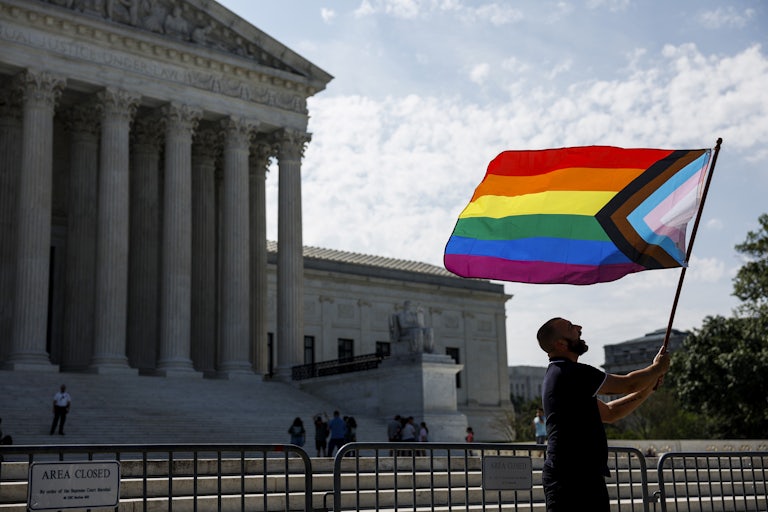
A person waves a pride flag in front of the U.S. Supreme Court
Anna Moneymaker/Getty Images

With nationwide abortion access off the table thanks to Dobbs v. Jackson Women’s Health Organization, the Republican Party is setting its sights on a new civil rights target: recriminalizing gay marriage.

The sentiment is apparently popular enough among those on the right that Michigan state Representative Josh Schriver unwarily shared his opinion on the topic Monday, writing in a late-morning post that he believed same-sex unions should be made “illegal again.”

“This is not remotely controversial, nor extreme,” Schriver posted on X.

Gay marriage was effectively legalized in 2015, when the Supreme Court ruled in Obergefell v. Hodges that keeping marriage licenses from same-sex couples was discriminatory. The decision mandated all states to issue licenses to gay and lesbian couples and required them to recognize marriages performed in other jurisdictions as well.

Marriage equality was further protected at the federal level in 2022, when the Respect for Marriage Act became law, requiring all 50 states to recognize same-sex marriages performed in other states. It did not, however, formally legalize gay marriage, so if the Supreme Court were ever to overturn Obergefell, gay marriage rights would fall with it.

And Schriver has at least one ally on the nation’s high court: conservative Justice Clarence Thomas. In his concurring Dobbs opinion, Thomas urged the Supreme Court to revisit cases ruling on same-sex marriage and contraception.

If Schriver’s loud-mouthed opinion on the intimate issue is any indicator, then conservative politics in the country have considerably regressed in the seven years since the Supreme Court ruled on Obergefell. But his opinion would also be wrong when blown out on a national scale. Roughly 69 percent of Americans support same-sex marriages, according to a 2024 Gallup poll. Republican support for gay couples’ equal rights has dipped in recent years, however, dropping from a record high of 55 percent in favor of it in 2021 to 46 percent in 2024.

Trump’s Genius Plan to Release Gaza Hostages: More War

As usual, the president thinks bellicose threats of force—very much including setting off a regional war with Iran—are the solution to all of the world's problems.

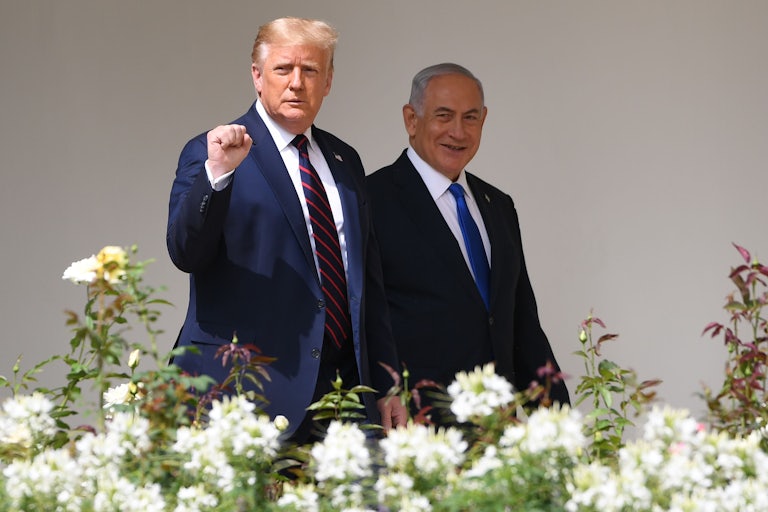
Donald Trump holds up a fist as he walks with Benjamin Netanyahu at the White House
SAUL LOEB/AFP
Donald Trump and Benjamin Netanyahu in 2020

Donald Trump promised “HELL TO PAY” in the Middle East if hostages held by Hamas in Gaza aren’t released by his inauguration on January 20, 2025.

In a Truth Social post on Monday afternoon, Trump promised consequences “for those who perpetrated these atrocities against humanity,” saying those responsible “will be hit harder than anybody has been hit in the long and storied History of the United States of America. RELEASE THE HOSTAGES NOW!”

Trump’s comments came after Hamas issued a video statement saying 33 of its captives have been killed during Israel’s brutal war on Gaza dating back to October last year, when Hamas attacked Israel and took more than 250 hostages, according to Israeli tallies. Israel has killed more than 44,000 people, including 17,492 children, in its war on Gaza.

Last month, Israeli Prime Minister and accused war criminal Benjamin Netanyahu reportedly promised Trump a ceasefire between Israel and Hezbollah in Lebanon before Trump’s inauguration. A U.S.-brokered ceasefire was agreed upon last week, although it is already showing signs of unraveling.

Now Trump seems to want the release of hostages before his presidency begins but made no mention of a Gaza ceasefire as a prerequisite. The president-elect has remarked that Israel should “finish the job” in Gaza, basically endorsing the country’s yearlong campaign that has resulted in a humanitarian crisis and war crimes charges.

Trump’s latest comments raise the question of what “hell to pay” would mean for Gaza, whose infrastructure has been reduced to rubble. Is Trump threatening to use the U.S. military in airstrikes in the Middle East against Hamas’s allies in Lebanon, Syria, and Iran? If so, that would very much set off the regional war that Trump has claimed he doesn’t want.

Elon Musk Rushes to Help Man He Once Said He Had “No Mercy” For

Elon Musk has waded into Alex Jones’s legal battle in the messiest way possible.

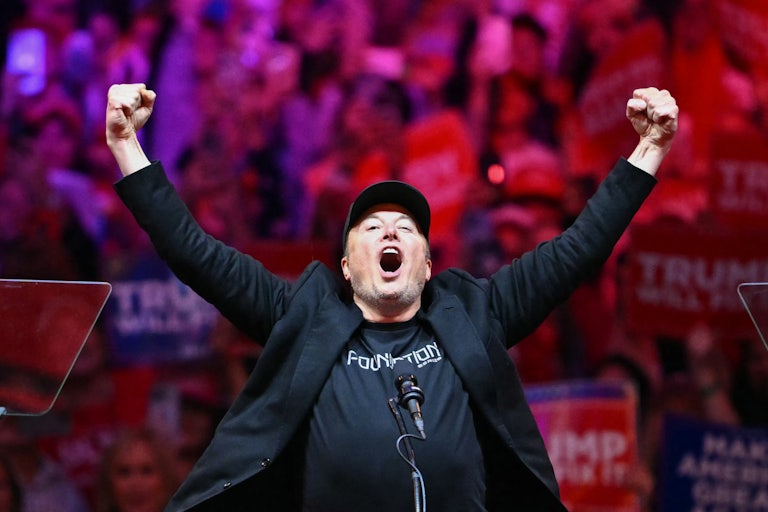
Elon Musk holds his fists above his head and yells during a Donald Trump rally
Angela Weiss/AFP/Getty Images

Elon Musk is butting his head into the auction of Alex Jones’s InfoWars.

Satirical outlet The Onion purchased InfoWars’ parent company last month for $1.75 million in conjunction with the families of children murdered during the Sandy Hook Elementary School massacre, to whom Jones lost a $1.5 billion lawsuit for repeatedly claiming that the mass shooting was a hoax.

That sale included InfoWars’ websites, its studio equipment, its dietary supplements, its branding—as well as its heavily trafficked social media accounts.

The deal appeared to be cut-and-dried, but on Monday, Musk alerted the court that he would not accept the ownership transfer of InfoWars’ X accounts. In filings with a Texas bankruptcy court, X argued that the sale violated its terms of service, which prevent the sale of its accounts, writing that the company objects “to any proposed sale or other purported transfer of any account used by Jones or FSS that is maintained on the X platform (‘X’).”

“Elon Musk, hands down, is a hero,” Jones previously said in a video message posted to his account, praising the world’s richest man for lending him a hand in maintaining his connection to the brand.

It is, nonetheless, a stark reversal of how Musk felt about Jones’s social media presence in the wake of his court judgments. In 2022, shortly after Jones lost his lawsuit to the Sandy Hook families, Musk said he wouldn’t allow Jones back on his social media platform, paraphrasing the Bible in his explanation that Jones deserved “no mercy” for using the “deaths of children for gain, politics or fame.”

Meanwhile, social media attorneys have been stunned by the intervention, noting that this appears to be the first instance in which a social media company has gotten involved in a legal dispute over account ownership.

“This is the first time I’ve seen a social media platform arguing to a court that no one can transfer ownership during a dispute over who owns an account because they will just switch it off,” Toby Butterfield, a professor of social media law at Columbia University Law School, told CNN.

Jones repeatedly claimed that the 2012 shooting that left 20 first graders and six teachers dead was a front to lure voters toward gun control policies.

In the run-up to the auction last month, Jones had appeared to be under the impression that “good guys” on the right would buy his fringe network, though he did not reveal who they were. Several groups expressed interest in InfoWars assets, including a coalition of liberal and anti-disinformation watchdog groups, according to The Daily Beast, as well as some of Jones’s own supporters, such as Donald Trump ally Roger Stone. The sale, however, has effectively crushed what was arguably Jones’s most successful endeavor while marking the beginning of his descent into irrelevancy.

Jones is currently working to appeal the sale.

“Fight of Our Lives”: Jamie Raskin Moves to Shake Up Democratic Party

Jamie Raskin is moving to take on more leadership in the House of Representatives.

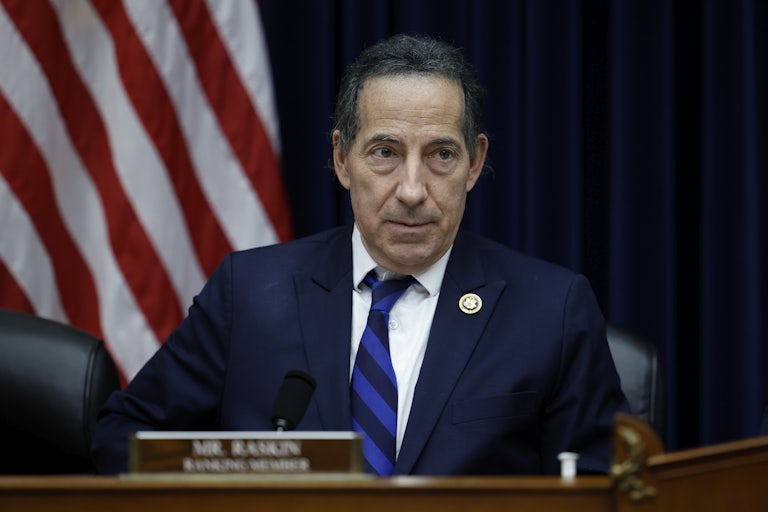
Jamie Raskin sits at the dais during a House hearing
Kevin Dietsch/Getty Images

Representative Jamie Raskin launched a campaign Monday to replace Representative Jerry Nadler as ranking member of the House Judiciary Committee.

In a letter to his colleagues, the Maryland Democrat warned that they were in “the fight of our lives.” Raskin asked for the party to support his burgeoning bid, explaining that “the stakes have gone way up since the election” as “this time the MAGA movement has not only a trifecta but a complicit Supreme Court waiting in the wings and a dominant media propaganda system parroting all the lies.”

“House Democrats must stand in the breach to defend the principles and institutions of constitutional democracy. That is our historic assignment now. We dare not fail,” Raskin wrote.

“After a week consulting most of our Colleagues and engaging in serious introspection about where we are, I am running today to be your Ranking Member on the House Judiciary Committee in the 119th Congress,” he wrote. “This is where we will wage our front-line defense of the freedoms and rights of the people, the integrity of the Department of Justice and the FBI, and the security of our most precious birthright possessions: the Constitution and the Bill of Rights, the rule of law, and democracy itself.”

Former House Speaker Nancy Pelosi was among several House Democrats who spent days urging a rather reluctant Raskin to challenge the 77-year-old Nadler, a pillar of the House’s older Democratic guard. Democrats have reportedly grown concerned that Nadler wouldn’t be as meaningfully effective in quashing Donald Trump’s abuses of power as Raskin, who headed the House’s investigation into the deadly January 6 riot at the U.S. Capitol.