Breaking News
Breaking News
from Washington and beyond

Trump’s FBI Pick Marks Clear “Authoritarian Takeover,” Expert Warns

Donald Trump’s choosing Kash Patel makes his ultimate goal clear.

Kash Patel speaking at a lectern
Rebecca Noble/Getty Images

Kash Patel, Donald Trump’s pick to head the FBI, is essential to the president-elect’s takeover, and will allow him to use the full force of the U.S. government against anyone Trump decides is an enemy.

On Saturday, Trump nominated Patel, a former chief of staff at the U.S. Defense Department, to replace the FBI’s current director, Christopher Wray, who still has more than two years left in his 10-year term. Trump appointed Wray in 2017 after unceremoniously firing James Comey.

During an interview on MSNBC Saturday, The Atlantic’s Tom Nichols voiced his concerns about Trump’s “incredibly dangerous” prospective Cabinet of sycophants, including Tulsi Gabbard, John Ratcliffe, Pam Bondi, and now Patel—a champion of the president-elect, with his penchant for “deep state” conspiracy theories and making threats against the press.

To Nichols, Patel’s nomination demonstrates not only a direction for Trump’s second administration, but also an accelerating velocity.

“You have the makings of, you know, a not-so-slow-motion authoritarian takeover of the United States government,” Nichols said.

In a subsequent piece published Saturday in The Atlantic, Nichols wrote that Patel’s appointment was part of Trump’s plan to transform the FBI into an “excellent instrument of revenge against anyone Trump or Patel identifies as an internal enemy—which, in Trump’s world, is anyone who criticizes Donald Trump.”

Trump, having nominated loyalists to serve as the heads of his intelligence, legal, and law enforcement agencies, “eliminates important obstacles to his frequently expressed desires to use the armed forces, federal law-enforcement agents, intelligence professionals, and government lawyers as he chooses, unbounded by the law or the Constitution,” Nichols wrote.

By nominating Patel, and the rest of his motley crew of conspiracy theorists and alleged sexual predators, Trump is removing the guardrails on his second administration.
Elon Musk Keeps Unleashing His Crazed Followers on Government Workers

Musk is singling out federal employees by name on social media.

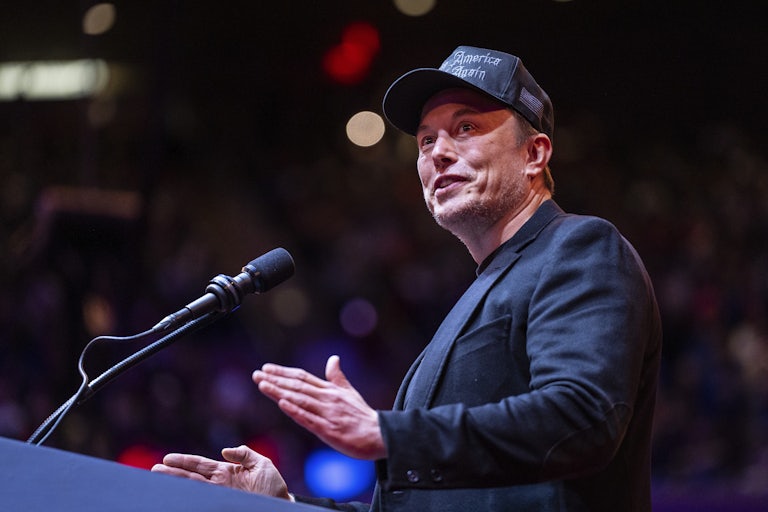
Elon Musk gestures while standing at a podium
Jabin Botsford/The Washington Post/Getty Images

Last week, Elon Musk—rearing up to fire federal employees he deems wasteful en masse as the head of the Trump administration’s planned DOGE commission—put a number of workaday government employees on blast to millions of users on X.

At the time, The New Republic reported that his behavior was not “just cruel, it’s dangerous.” Indeed, CNN reported Wednesday that those Musk singled out have been inundated with hate, leading others to fear that they too will have Musk devotees sicced on them.

Several federal employees told CNN that “they’re afraid their lives will be forever changed—including physically threatened—as Musk makes behind-the-scenes bureaucrats into personal targets.” Others said the specter of being targeted by Musk “might even drive them from their jobs entirely.”

One target of Musk’s posting spree last week was a woman who works at the International Development Finance Corporation. Her role, an official told The Wall Street Journal, involves “identifying innovations that serve U.S. strategic interests, including bolstering agriculture and infrastructure against extreme weather events.” She had her job deemed “fake” by Musk—seemingly because her title, “Director of Climate Diversification,” contains words that tend to raise right-wing culture-warrior hackles.

Facing a barrage of negative attention, she “has since gone dark on social media, shutting down her accounts,” reported CNN.

Others whom Musk and his fans went after include senior advisers for climate and environmental justice at the Department of Housing and Urban Development, as well as a chief climate officer at the Department of Energy.

Last month, CNN reported that Musk “promised a gentle touch” as the head of DOGE—a commission TNR’s Matt Ford described this month as itself a symbol of “inefficiency and waste in government” that “cannot achieve its stated ambitions for legal, constitutional, or practical reasons”—but his insatiable itch to post apparently takes precedence over his word.

Trump Team Is Having a Terrifying Debate on How to Invade Mexico

“How much should we invade Mexico?” said one Trump adviser. “That is the question.”

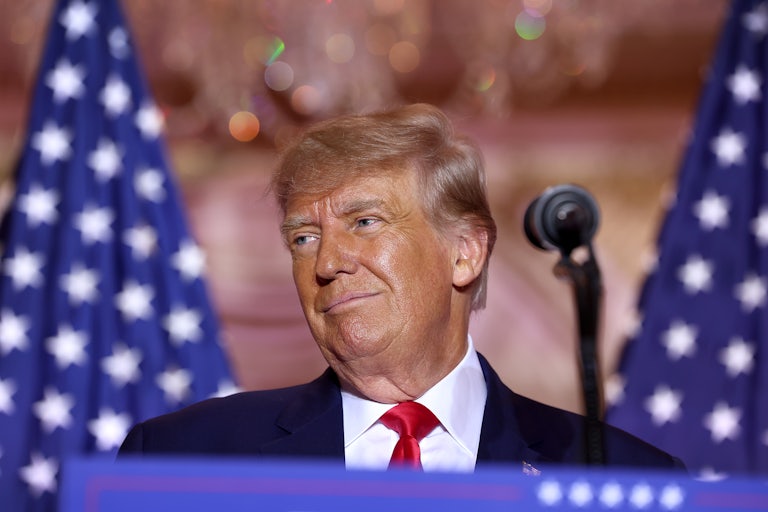
Donald Trump stands at a lectern and smiles
Joe Raedle/Getty Images

With its newfound electoral mandate, Donald Trump’s team is debating on whether to attack or invade Mexico, as the president-elect promised on the campaign trail.

“How much should we invade Mexico?” one senior Trump transition member told Rolling Stone. “That is the question.”

Trump has reportedly been gathering “battle plans” to attack drug cartels in Mexico since early 2023, with or without Mexico’s permission. Now he is president-elect, and even mainstream Republicans are on board with the idea. His nominees for secretary of defense and secretary of state, Pete Hegseth and Senator Marco Rubio, respectively, have spoken favorably of U.S. military action against Mexico, as has his “border czar,” Tom Homan. 

One source close to Trump told Rolling Stone about a plan for a “soft” invasion of the country, in which U.S. special forces would assassinate cartel leaders covertly, an idea Trump was in favor of earlier this year. The magazine spoke to six Republicans in all who have privately discussed Mexico with the president-elect and briefed him on different proposals. 

These actions vary in their level of force, including drone strikes and airstrikes against cartel targets such as drug labs, sending military advisers and trainers to Mexico, sending “kill teams” to the country, using cyberwarfare against drug lords and their organizations, and the assassination plan. 

Trump has told Republicans privately that he plans to tell Mexico to stop the transport of fentanyl into the U.S. within months otherwise he’ll deploy the military. This would seem to fit into the tariff threat he made against Mexico, Canada, and China on Monday, when he warned the three countries to stop the flow of migrants and drugs into the United States. Mexico’s President Claudia Sheinbaum didn’t take Trump’s words well, and she probably won’t like U.S. forces deploying in the country either. 

In his first term, Trump proposed to “bomb the drugs” in Mexico, according to his former national security adviser H.R. McMaster. Thankfully, nothing came of it. Now,  in addition to the presidency, Trump has captured the Republican Party, much of the judiciary, and both chambers of Congress. His Cabinet and staff appointments are made up of sycophants and people much less likely to confront or correct him. In the next four years, there won’t be much standing in the way of Trump’s violent “solutions.”

Get Ready for Total Chaos as House GOP Wins Historically Puny Majority

Republicans can only afford to lose one vote.

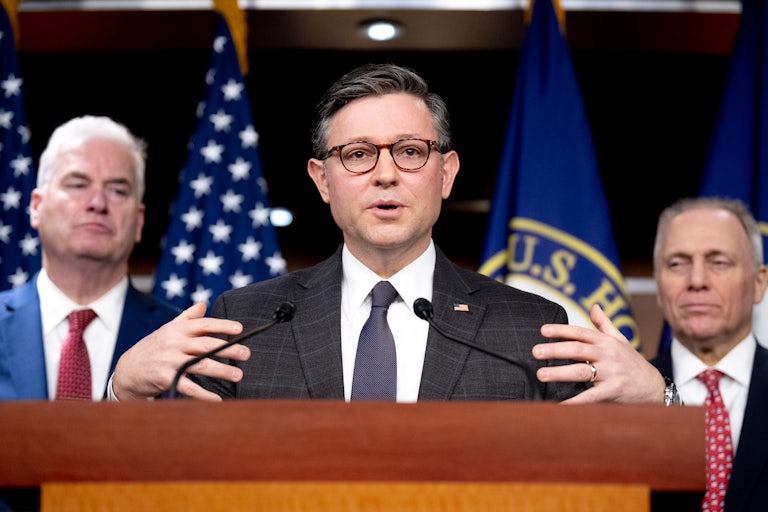
House Speaker Mike Johnson speaks at a podium while flanked by House Majority Whip Tom Emmer and House Majority Leader Steve Scalise
Andrew Harnik/Getty Images

The Republican Party’s majority in the House of Representatives is looking meager.

Three House races remain outstanding as of Wednesday—two toss-up races in California’s 13th and 45th districts and one in Iowa’s 1st district that’s leaning Republican, according to CBS.

But if current results hold, the GOP will have a record-small majority—220 seats to Democrats’ 215—CNN data journalist Harry Enten reported Wednesday morning. “You have to go all the way back since the Herbert Hoover administration to find an even smaller majority after November elections,” he observed.

And the majority could grow even narrower with the resignation of one Republican representative and the likely resignations of two more.

Representative Matt Gaetz has already resigned from his seat after Donald Trump nominated him for attorney general. Gaetz has since withdrawn as Trump’s pick in light of sexual misconduct allegations but said he does not intend to join the upcoming Congress. Representatives Elise Stefanik and Mike Waltz, whom Trump has nominated to join the incoming administration, are expected to resign in January.

Those resignations would deflate the GOP’s majority to 217–215. In that event, CNN anchor John Berman noted, in the weeks or months before the vacated seats are filled, a single Republican defector could sink a bill. Enten observed that that has not been the case in 100-plus years.

This is just the latest development throwing cold water on Republican narratives about a 2024 landslide. While Trump crowed about his purported “unprecedented and powerful mandate” on election night, as more votes have been counted, it has become clear that Trump did not win a majority of the popular vote, and his popular-vote margin over Kamala Harris has shrunk considerably.

Trump Picks Ukraine Envoy With Some Twisted Plans in Mind

Keith Kellog has a dark ultimatum for Ukraine.

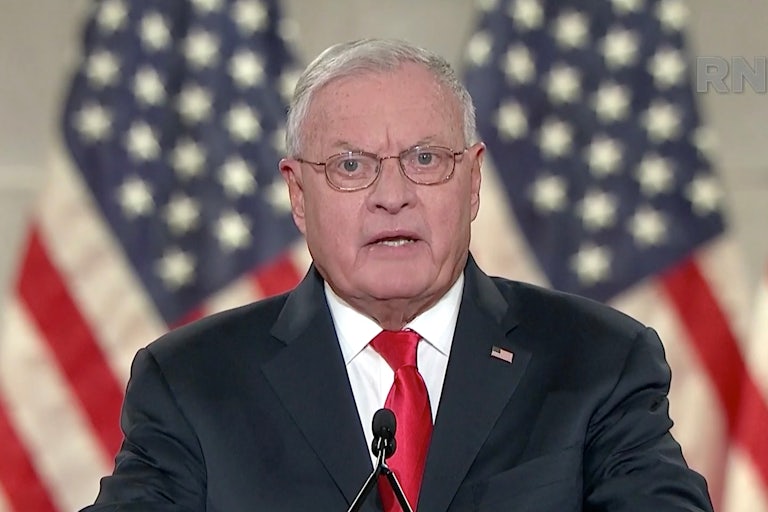
Keith Kellogg speaking
Committee on Arrangements for the 2020 Republican National Committee/Getty Images

Trump’s pick for special envoy to Ukraine wants to force Ukrainians to negotiate with Russia by holding aid hostage.

President-elect Donald Trump on Wednesday announced he has selected retired Lt. Gen. Keith Kellogg to be his special envoy for Ukraine and Russia, a position focused on ending the two-year-long war. Kellogg previously served as both national security adviser to former Vice President Mike Pence and National Security Council chief of staff during Trump’s first term.  

“I am very pleased to nominate General Keith Kellogg to serve as Assistant to the President and Special Envoy for Ukraine and Russia” Trump wrote on Truth Social. “Keith has led a distinguished Military and Business career, including serving in highly sensitive National Security roles in my first Administration. He was with me right from the beginning! Together, we will secure PEACE THROUGH STRENGTH, and Make America, and the World, SAFE AGAIN!”

Last spring, Kellogg proposed forcing an ultimatum on Ukraine: Engage in peace talks in order to keep receiving aid. The plan, which was put forward with the help of Fred Fleitz, his successor as chief of staff at the National Security Council, would also force Russia to the negotiating table by agreeing to hold off on Ukraine’s admission to NATO. Under the plan, the cease-fire would take place along existing battle lines.

Kellogg’s views align well with an incoming administration that seems to have little interest in providing aid to Ukrainians, even as Russia is advancing through the country faster than ever.

Vice President–elect JD Vance is similarly opposed to more assistance. South Dakota Governor and Homeland Security secretary nominee Kristi Noem is opposed to more assistance as well, saying that the war is “Europe’s fight, not ours.”