Breaking News
Breaking News
from Washington and beyond

Oscar-Winning Palestinian Director Kidnapped After Israeli Mob Attack

Hamdan Ballal, the co-director of the Oscar-award winning documentary “No Other Land,” was attacked, and his whereabouts are unknown.

Palestinian director Hamdan Ballal holds his Oscar award at a party.
ANGELA WEISS/AFP/Getty Images

One of the four directors of the Oscar-winning documentary No Other Land, Palestinian Hamdan Ballal, was allegedly beaten by Israeli settlers, then removed from an ambulance he called by Israeli soldiers, his Israeli co-director Yuval Abraham posted on X Monday.

There’s no word on whether Ballal is receiving medical treatment for his head and stomach injuries, Abraham noted. Abraham also posted video footage of the Israeli settler mob that attacked Hamdan’s village, showing them attacking Jewish American activists by throwing stones and causing damage to their car.

According to activists from the Center for Jewish nonviolence, a group of 10 to 20 Israeli settlers attacked them and Hamdan in the Palestinian village of Susiya in the Masafer Yatta area south of Hebron.

“We don’t know where Hamdan is because he was taken away in a blindfold,” said Josh Kimelman, one of the activists, to the Associated Press.

No Other Land won the Academy Award for best documentary feature film earlier this month but has still struggled to find a distributor in the United States. The film, which chronicles the destruction of a Palestinian community in the occupied West Bank, was directed by four activists: Hamdan, Abraham, Palestinian Basel Arda, and Israeli Rachel Szor.

The documentary premiered on just one screen in the United States on February 2, grossing $26,000 before drawing $1.2 million in the following weeks, eventually expanding to 120 screens and drawing a backlash. Miami Beach Mayor Steven Meiner even tried to block the film from being shown in the Florida city by attempting to evict a theater hosting it from a city-owned building, only to relent after a public outcry.

Meanwhile, Israel’s ongoing military campaign in the West Bank has displaced 40,000 Palestinians, the largest number in more than 50 years, and has killed 55 Palestinians, including five children, according to the United Nations and Israeli military. In Gaza, Israel’s brutal war against the territory has resumed after a brief “ceasefire” ended last week, killing 634 people, including at least 183 children, 94 women, 34 elderly people, and 125 men since March 18, according to the Palestinian Ministry of Health.

Among those killed on Monday in Gaza include two journalists, Hossam Shabat of Al Jazeera and Mohammad Mansour of Palestine Today. Israel has faced criticism for targeting journalists in the past and has killed 170 journalists and media workers since its war on Gaza began in October 2023, according to the Committee to Protect Journalists. Was the attack on Ballal, and his subsequent detention by the Israeli military, part of a campaign to silence Palestinian voices, journalists, and filmmakers alike?
Judge Absolutely Destroys Trump Lawyers’ Deportation Defense

Judge Patricia Millett was not having the Department of Justice’s excuse for using the Alien Enemies Act.

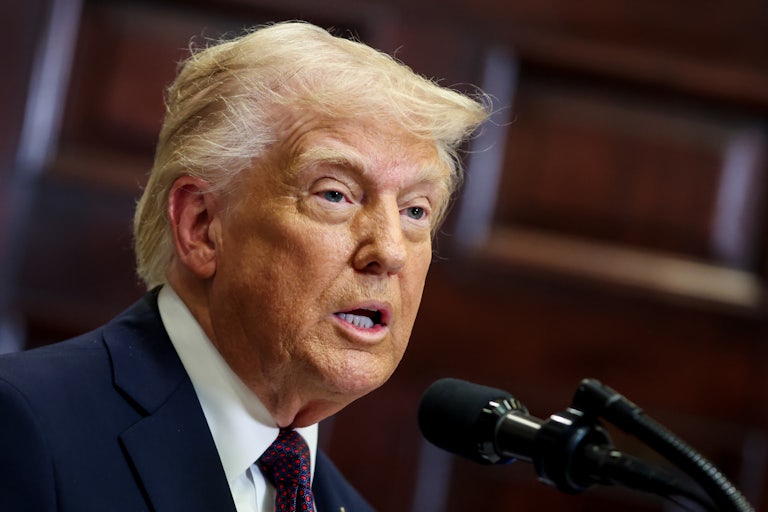
Donald Trump speaks into a microphone
Samuel Corum/Sipa/Bloomberg/Getty Images

The Trump administration is treating immigrants worse than prior presidents treated real Nazis, according to a federal judge.

The stunning observation by U.S. Circuit Judge for the D.C. appeals court Patricia Millett came during a hearing Monday over the White House’s spontaneous decision to deport more than 200 alleged members of a Venezuelan gang to El Salvador by invoking a Japanese internment-era wartime policy, the Alien Enemies Act.

Five of the men sued the Trump administration in response, attempting to prevent their “imminent removal.” But even after U.S. District Judge James Boasberg ordered that the immigrants should remain in the U.S. as they await trial, Trump officials thwarted the law and sent them to Honduras. Donald Trump justified the infraction by claiming that immigration into the country constituted an “invasion,” and described the current era as a “time of war.”

But Judge Millett argued that such an act was wildly unprecedented—even during the wartime tribulations of World War II.

“There were planeloads of people. There were no procedures in place to notify people,” she said. “Nazis got better treatment under the Alien [Enemies] Act than has happened here where the proclamation requires the promulgation of regulation.”

“They had hearing boards before people were removed, and yet here there’s nothing in there about hearing boards, no regulations, and nothing was adopted by the agency officials administrating this,” Millett continued.

“Those people on those planes on that Saturday had no opportunity to file habeas or any type of action to challenge” their deportation, she added.

Deputy Assistant Attorney General Drew Ensign disputed the “Nazi analogy,” and instead compared Boasberg’s decision to block the deportation to a judge redirecting a carrier group from the South China Sea to the Persian Gulf.

“Hang on. Hang on,” Millett rebuked. “Asserting a power to do that is not ordering ships to relocate in foreign waters, right? That is a straight up judicial process that’s allowed by the Supreme Court and Circuit precedent.”

Trump Has Three Damning Words on That War Plans Group Chat Fiasco

Does Trump have any idea what’s happening in his own Cabinet?

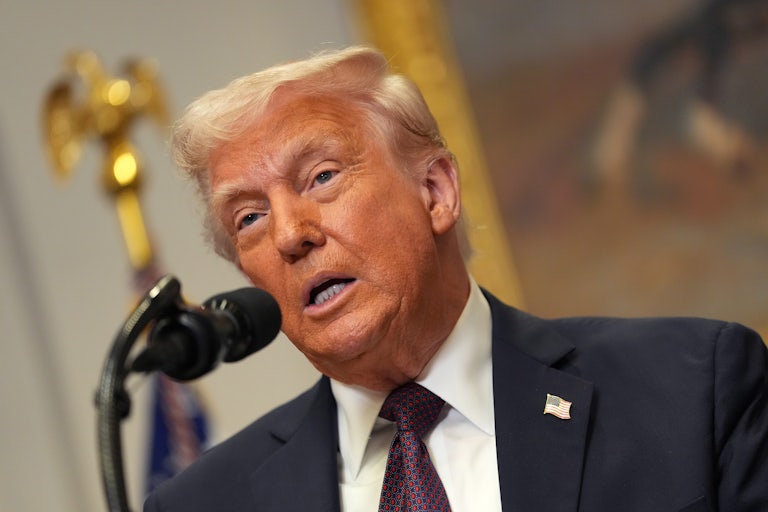
Donald Trump holds a press conference in the White House.
Win McNamee/Getty Images

Trump is claiming complete ignorance after his defense secretary accidentally leaked war plans to The Atlantic’s editor-in-chief after adding him to a Signal chat. In fact, he only has three words on the matter: “I don’t know.”

Jeffrey Goldberg reported that earlier this month, he received an offer to join a group chat on the encrypted messaging app from Trump national security adviser Michael Waltz. Goldberg accepted the invite, and saw multiple text exchanges between Vice President JD Vance, Defense Secretary Pete Hegseth, Secretary of State Marco Rubio, and National Intelligence Director Tulsi Gabbard, among other Cabinet officials. Then, they discussed a planned attack on the Houthis in Yemen.

The president was asked about all this at a press conference in the White House’s Roosevelt Room on Monday.

“Your reaction to the story in The Atlantic that said some of your top Cabinet officials and aides had been discussing very sensitive material through Signal and included an Atlantic reporter for that,” a reporter asked Trump. “What is your response to that?”

“I don’t know anything about it. I’m not a big fan of The Atlantic, to me it’s a magazine that’s going out of business, I think it’s not much of a magazine. But I know nothing about it, you’re saying that they had what?”

“They were using Signal to coordinate on sensitive materials,” the reporter responded.

“Having to do with what? … What were they talking about?”

“The Houthis.”

“The Houthis, you mean the attack on the Houthis?”

“Correct.”

“Well it couldn’t have been very effective, because the attack was very effective I can tell you that. I don’t know anything about it. You’re telling me about it for the first time.”

It’s shocking—even from this administration—that Trump’s team allowed him to take the podium without at least briefing him on the slip up. The group chat had the potential to be a massive national security crisis and raises serious questions about the care and qualifications of Trump’s inner circle.

Hegseth’s Own Words Come Back to Haunt Him After Texting War Plans

Defense Secretary Pete Hegseth accidentally texted war plans to a journalist in a jaw-dropping error.

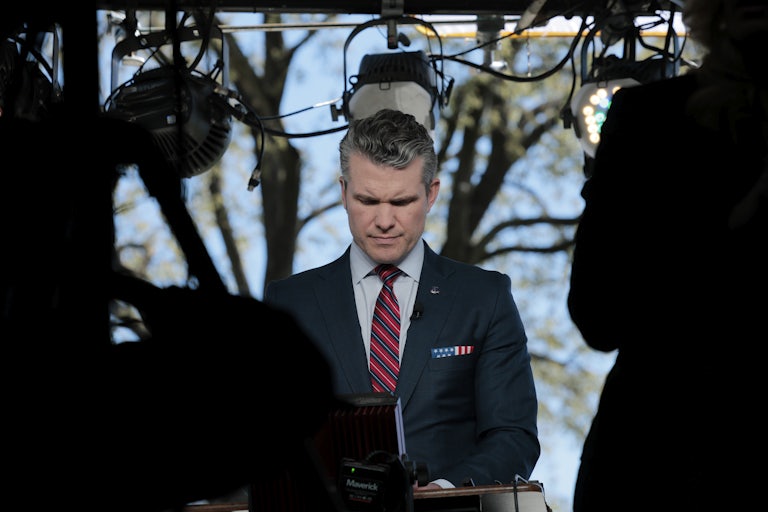
Defense Secretary Pete Hegseth lowers his head looking at a screen as press cameras surround him.
Anna Moneymaker/Getty Images

Defense Secretary Pete Hegseth probably regrets mistakenly sending the Trump administration’s classified plans to attack Yemen to Atlantic editor Jeffrey Goldberg, not least because he’ll have to eat his own words.

In 2016, while working for Fox News, Hegseth repeatedly criticized then-presidential candidate Hillary Clinton for storing classified information on a private email server at her home. In one instance, Hegseth pointedly asked: “How damaging is it to your ability to recruit or build allies with others when they are worried that our leaders may be exposing them because of their gross negligence or their recklessness in handling information?”

In the same segment, Hegseth also remarked on the recklessness and danger of Clinton’s actions.

“The people we rely on to do dangerous and difficult things for us rely on one thing from us: That we will not reveal their identity, that we will not be reckless with the dangerous thing they are doing for us. That’s the national security implications of a private server that’s unsecured,” Hegseth said.

Later, in 2023, Hegseth spoke on Fox News about classified documents found at President Biden’s home (which Biden cooperated with investigators to return, unlike Trump).

“If at the very top, there’s no accountability … then two tiers of justice exist,” Hegseth said, comparing Biden to a Navy sailor who was jailed for photographing classified areas of a submarine.

All of this exposes Republican double standards when it comes to classified information. Hegseth’s 2016 attacks on Clinton’s server seem quaint compared to sharing military plans outside of government communications on a Signal chat with a journalist present, as Hegseth did.

Hegseth’s attacks on Biden’s lack of accountability for his handling of classified documents were hypocritical even without Monday’s revelations, as Trump faced no legal consequences for keeping classified documents at his Mar-a-Lago estate and refusing to return them. In keeping with Hegseth’s own statements, should he, Vice President JD Vance, Secretary of State Marco Rubio, and everyone else in the Signal chat face accountability for discussing secret military plans outside of government servers and channels?

Trump Advisers Accidentally Sent Journalist Top Secret War Plans

Donald Trump’s senior advisers shared confidential information in a group chat.

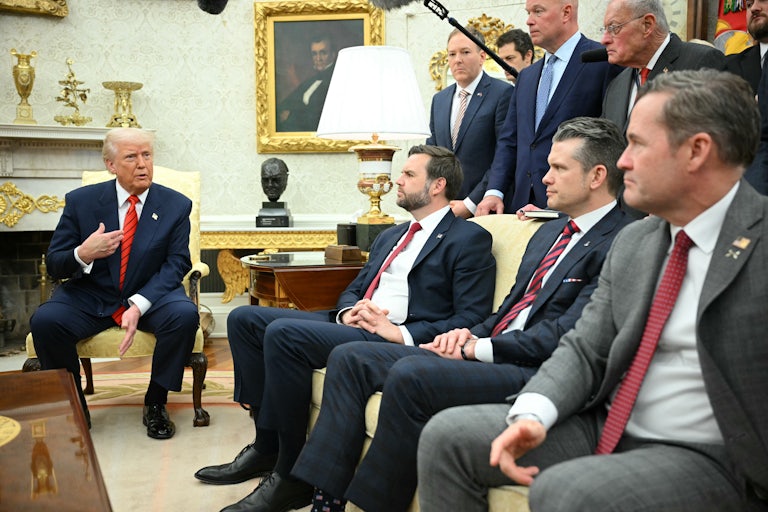
Donald Trump sits in a chair in the Oval Office and speaks, while JD Vance, Pete Hegseth, and Mike Waltz sit on a couch and listen to him
Mandel Ngan/AFP/Getty Images

Everyone knows what it’s like to be unwillingly added to a group chat—but it’s not usually a threat to national security. 

Jeffrey Goldberg, the editor in chief of The Atlantic, reported Monday that earlier this month, he’d been dropped into a Signal group chat with several high-ranking members of Donald Trump’s administration, where they plotted a bombing campaign in Yemen. 

The 18 members of the group chat called “Houthi PC small group” appeared to include senior Trump officials and Cabinet members such as Vice President JD Vance, Secretary of State Marco Rubio, Secretary of Defense Pete Hegseth, Director of National Intelligence Tulsi Gabbard, Treasury Secretary Scott Bessent, and White House Deputy Chief of Staff Stephen Miller. 

Goldberg said that he had been inexplicably added to the group chat on March 11 by a user called Michael Waltz, whom Goldberg determined to be Trump’s national security adviser. 

There, in full view of the head of a publication Trump recently called a “Third Rate Magazine,” senior-most officials hatched what appears to be a moneymaking scheme to bomb a foreign country. The latest round of strikes last week killed more than 50 people so far, and injured 100 more, according to Al Jazeera.  

On March 13, Waltz wrote that he was creating a “principles group,” or principals committee of senior officials, to discuss national security plans. 

Waltz requested points of contact from the group’s many high-ranking members, and the names seemed to be reasonably real. For instance, Vance said his point of contact would be Andy Baker, his national security adviser, and Rubio said the State Department’s would be Mike Needham, Rubio’s counselor and chief of staff. 

The next day, a signal user identified as “JD Vance” aired his hesitations about moving forward with bombing Yemen. The alleged Vance claimed that it would be a “mistake” to defend trade in the Suez Canal because that would mostly benefit Europe, which sees 40 percent of its trade travel through that route. Meanwhile, the U.S. only ships 3 percent of trade through the Suez Canal. 

“I am not sure the president is aware how inconsistent this is with his message on Europe right now. There’s a further risk that we see a moderate to severe spike in oil prices. I am willing to support the consensus of the team and keep these concerns to myself. But there is a strong argument for delaying this a month, doing the messaging work on why this matters, seeing where the economy is, etc.,” Vance wrote. 

A user called “Pete Hegseth” said that Vance should raise his concerns with the president. “I think messaging is going to be tough no matter what—nobody knows who the Houthis are—which is why we would need to stay focused on: 1) Biden failed & 2) Iran funded.” He pushed for them to proceed with the campaign in case Israel took action first or the plans leaked.

“This [is] not about the Houthis. I see it as two things: 1) Restoring Freedom of Navigation, a core national interest; and 2) Reestablish deterrence, which Biden cratered,” the user called Hegseth wrote. 

Waltz also pushed that they move forward with strikes, reminding members that the president had directed the Defense and State departments to “compile the costs associated and levy them on Europeans.” 

Later that day, the alleged Vance agreed with alleged Hegseth, writing, “If you think we should do it let’s go. I just hate bailing Europe out again.” 

The possible DOD head replied, “I fully share your loathing of European free-loading. It’s PATHETIC.”

One user, called “S M,” who Goldberg believed could be Stephen Miller, said that the U.S. should seek remuneration for the strikes in Yemen from Europe and Egypt, and figure out a way to “enforce such a requirement.”

“If the US successfully restores freedom of navigation at great cost there needs to be some further economic gain extracted in return,” the user “S M”  wrote. 

Goldberg wrote that the next day, March 15, Hegseth sent lengthy messages that could not be repeated. “The information contained in them, if they had been read by an adversary of the United States, could conceivably have been used to harm American military and intelligence personnel, particularly in the broader Middle East, Central Command’s area of responsibility,” Goldberg said.

To confirm that the group chat was legitimate, Goldberg said he waited for the first round of detonations to hit Sanaa, and they did, exactly when the user identified as “Pete Hegseth” said they would. A round of congratulatory messages were sent in the chat. Goldberg, having concluded that the conversation was real, exited the group chat, and received no follow-up from Waltz. 

Goldberg’s surreal experience among the decision-makers of the Trump administration comes amid promises to crack down on leakers within the government. 

Just hours before the U.S. began strikes on Yemen, Gabbard warned that the Trump administration would be aggressively pursuing leakers from within the intelligence community. By including Goldberg in the conversation, Waltz has made himself the classic definition of a leaker. But it may be worse than that.

“Every single one of the government officials on this text chain [has] now committed a crime—even if accidentally. We can’t trust anyone in this dangerous administration to keep Americans safe,” wrote Delaware Senator Chris Coons in a post on X Monday. 

The Atlantic reported that several national security experts surmised that Waltz’s use of Signal had likely violated the Espionage Act, because he had discussed information related to national defense. Typically, discussing military activity requires officials to enter a sensitive compartmented information facility, or SCIF, where cell phones are not allowed. “Had they lost their phones, or had they been stolen, the potential risk to national security would have been severe,” Goldberg wrote. 

Signal is also not an approved venue for sensitive information, and because Waltz had set some of the messages to automatically disappear after a few weeks, it seems that the group chat likely violated federal rules about keeping records of official acts.

National Security Council spokesperson Brian Hughes confirmed Monday that the group chat was legitimate.

“At this time, the message thread that was reported appears to be authentic, and we are reviewing how an inadvertent number was added to the chain. The thread is a demonstration of the deep and thoughtful policy coordination between senior officials. The ongoing success of the Houthi operation demonstrates that there were no threats to our servicemembers or our national security,” he said

Read more about U.S. intelligence: