Breaking News
Breaking News
from Washington and beyond

Fired Federal Workers Were Told to Contact Dead Woman to Complain

Yet another example of the Trump administration’s incompetence and cruelty.

A window displays the Health and Human Services Department logo
Kayla Bartkowski/Getty Images

Got a problem with the Trump administration? Good luck.

Recently laid-off employees from the Centers for Medicare and Medicaid Services were told to contact Anita Pinder, the former director at the agency’s Office of Equal Opportunity and Civil Rights, with any complaints. A notice informed severed workers that they had 45 calendar days to contact Pinder following their termination date, listing Pinder’s name, email, and phone number.

But those who knew Pinder said the directive came as a “gut punch,” according to The Washington Post, since Pinder died last year.

“They couldn’t have run it past the people at CMS that were at the funeral and knew she died,” Karen Shields, one of Pinder’s former co-workers, told the Post. “This is a lack of communication. There is just a better way to do this.”

Shields told the newspaper that it “pained” her to see Pinder’s name used in the reduction-in-force notices.

“She would have been someone, even though her job would have been on the chopping block, she would have helped,” Shields said.

The negligent error is just one recent instance in which the “shock and awe” of the Trump administration’s federal makeover has resulted in dud details and mass confusion.

At the Food and Drug Administration, fired staffers were instructed to contact an Office of Equal Employment Opportunity employee that had left the agency more than a month ago, the Post reported.

So far, the Trump administration—directed by Elon Musk’s Department of Government Efficiency—has fired more than 100,000 federal employees. But tens of thousands more government jobs are expected to be on the chopping block as Trump pursues a second round of “voluntary” buyouts.

More than 10,000 jobs are expected to be cut at the Department of Health and Human Services, which encompasses the Centers for Disease Control and Prevention. HHS Secretary Robert F. Kennedy Jr. has proposed downsizing the agency’s 82,000-person workforce by nearly a quarter.
Poll: Americans Are Terrified About Social Security

As Donald Trump destroys the economy, anxiety about the future of Social Security is higher than it has been at any point since the Great Recession.

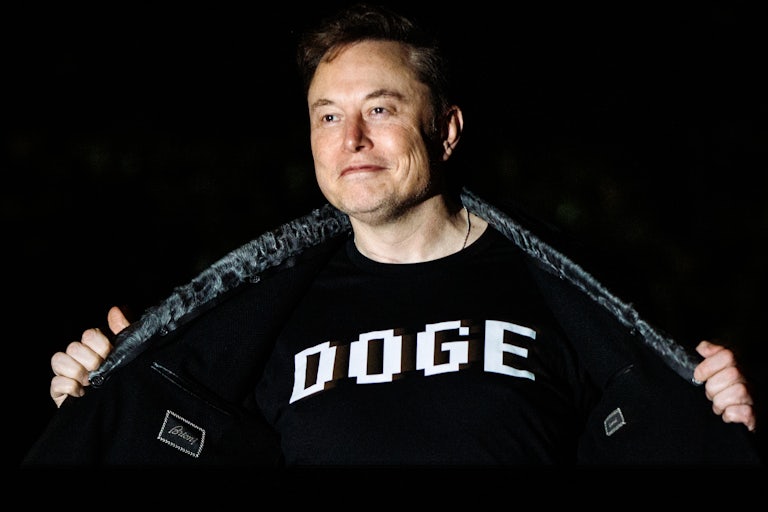
Elon Musk stands outside the White House and holds open his jacket to reveal the word "DOGE" printed on his shirt
Samuel Corum/Getty Images
Elon Musk in March

A new Gallup poll shows that Americans are much more worried about Social Security and the economy.

The poll, which measured opinions from March 3 to March 16, said that concern about the Social Security system is at a 15-year high, with 52 percent of Americans worried about it a “great deal.” Also ranking high were the economy at 60 percent, health care costs at 59 percent, and inflation at 56 percent.

The worries reflect the Trump administration’s actions over the past few months, with cuts made to the Social Security Administration and the whiplash over the president’s bizarre tariff decisions. Those fears may get worse, as Trump went ahead with instituting aggressive tariffs against countries across the world on Wednesday, calling it “Liberation Day.” Meanwhile, Elon Musk, who is overseeing much of the administration’s policy, has called Social Security “the biggest Ponzi scheme of all time.”

Markets have already plummeted Thursday, and criticism of the tariffs have even come within the Republican Party. Cuts to the Social Security Administration threaten to cause interruptions to benefits for 73 million retired workers, their survivors, and poor and disabled Americans. Last month, Martin O’Malley, who headed the SSA under President Biden, warned that the cuts could result in the agency missing payments for the first time in its 80-year history.

It’s no surprise that the last time worries about Social Security were this high, the country was in the midst of a recession brought about by the financial crisis of 2008. The difference between now and then is that these worries are brought about by self-inflicted crises. Neither the SSA or the economy were in trouble prior to Trump’s inauguration. If the president continues on its current course, these worries could evolve into full-blown panic over losing Social Security and an even worse recession.

The Trump Administration is Gaslighting Us About the Tariff Apocalypse

Administration officials keep insisting that everything is fine, even as the economy lurches off a cliff.

White House Press Secretary Karoline Leavitt talks to reporters outside the White House
Chip Somodevilla/Getty Images
White House press secretary Karoline Leavitt

The Trump administration is urging nervous voters to “trust” it in response to the impending economic fallout from the President’s tariffs on virtually all foreign imports.

“To anyone on Wall Street this morning I would say trust in President Trump,” press secretary Karoline Leavitt said on CNN Thursday morning. “This is a president who is doubling down on his proven economic formula from his first time. We saw a wages increase, we saw inflation come down. We had a Trump energy boom, we had the largest tax cuts in history, and that’s exactly what the president intends to do.… The United States of America is no longer going to be cheated by foreign nations around the world.”

The trade war that the president announced on Wednesday as “Liberation Day” has already tanked the stock market. The country is lurching into a recession, and there is little indication that things will improve anytime soon. Indeed, the tariffs announced on Wednesday are little more than a spiteful policy intended to stick it to friend and foe alike, ostensibly for the purpose of reinvigorating American manufacturing. This is virtually impossible, as these aggressive reciprocal tariffs will most certainly drive up prices for manufacturers and consumers across the country. But the administration would rather have you believe that the economic impact won’t be that bad, or even noticeable.

“What can you tell the American people that—they just can’t afford an extra $3 here and there—about the government making up the difference from them?” Lawrence Jones asked Vice President JD Vance on Thursday morning. “Will costs go up at some point, will this just be temporary? Are we talkin’ three months or six months?”

“We know a lot of Americans are worried. So we are working very hard to bring prices down,” Vance said. “What I ask folks to appreciate here is that we are not gonna fix things overnight.… We know people are struggling, we’re fighting as quickly as we can to fix what was left to us. But it’s not gonna happen immediately. But we really do believe that if we pursue the right deregulation, we pursue those energy cost-reducing policies, yes people are gonna see it in their pocketbook, they’re also gonna benefit from the fact that foreign countries can’t take advantage of us anymore, that means their jobs are gonna be more secure.”

Neither Vance nor Leavitt actually explain how actions like hitting China with a 34 percent tariff will bring prices down for the everyday American, or how this country will be a self-sufficient producer in just a few years. This backtracking and gaslighting is a far cry from Trump’s promise to “immediately bring prices down, starting on day one.”

Trump Left a Key Country Out of His Extreme Tariffs

Donald Trump has levied tariffs on nearly the entire world—except for a select few countries.

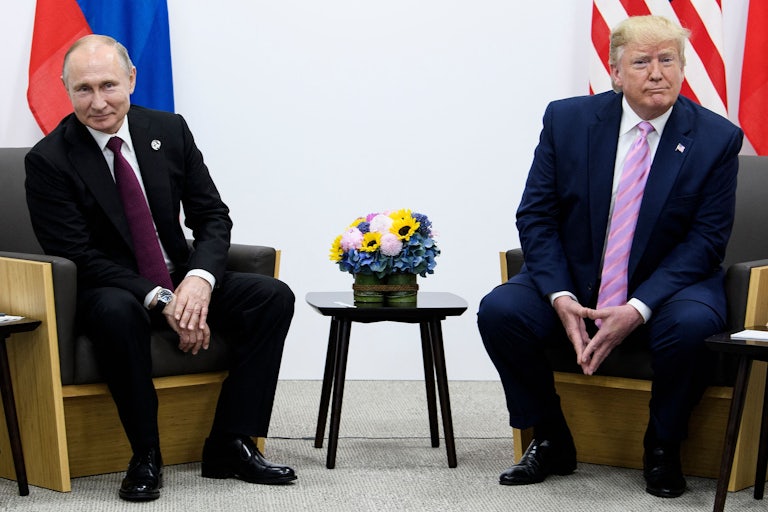
Vladimir Putin and Donald Trump smile and sit next to each other
Brendan Smialowski/AFP/Getty Images

In the scores of countries hit by Donald Trump’s sweeping tariffs announced Wednesday, one was mysteriously—but not surprisingly—absent: Russia.

White House press secretary Karoline Leavitt told Axios Wednesday that Moscow had been spared from Trump’s tariffs because U.S. sanctions already “preclude any meaningful trade.”

Similarly, Treasury Secretary Scott Bessent told Fox News that it wasn’t necessary to place tariffs on Russia because after its full-scale invasion of Ukraine in 2022, trade between the U.S. and Russia had effectively dried up.

But the claim that the U.S. doesn’t trade with Russia isn’t remotely true. In 2024, the U.S. imported $3 billion worth of goods from Russia, which was down from $4.6 billion the year before.

While this number may be small in comparison to key trading partners such as Canada, which imported a whopping $412.7 billion worth of American goods in 2024, it is still significantly more trade than with other countries that Trump levied steep tariffs against.

For example, Saint Pierre et Miquelon, a small French island territory off the coast of Canada, was hit with a whopping 50 percent tariff on imports to the U.S. The island, which has a population of roughly 5,000 people, imported only $100,000 worth of U.S. goods in 2024 and exported roughly $3.4 million worth of goods back.

If that’s not low enough, Trump even listed several uninhabited islands as receiving a 10 percent tariff on imports to the United States: Heard Island and the McDonald Islands, an Australian territory that is listed as a UNESCO World Heritage site for its “complete absence of alien plants and animals, as well as human impact.”

Clearly, a lack of trade was not an actual consideration in the Trump administration’s decision to levy tariffs, though Leavitt claimed that existing sanctions were also why Cuba, Belarus, and North Korea were not included on the list.

With Leavitt’s excuse falling flat, it seems increasingly likely that Trump has attempted to carve out a back door for Russian President Vladimir Putin to continue to do business with the U.S. as it makes an economic enemy out of every other country in the world.

Canada and Mexico were also absent from the list because Trump had already hit them with 25 percent tariffs on all U.S. imports, according to Leavitt.

Here’s How Trump Calculated His Tariffs—and It’s Ridiculous

The math just isn’t mathing.

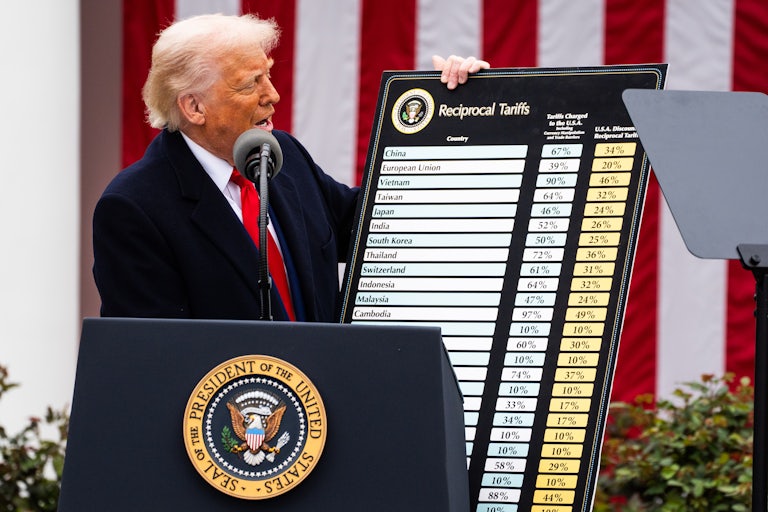
Donald Trump holds up a chart showing tariff rates for different countries during a White House Rose Garden press conference
Demetrius Freeman/The Washington Post/Getty Images

The Trump administration seems to have destroyed global economies overnight while misunderstanding basic economics.

In the wake of Donald Trump’s tariff announcement Wednesday, former New Yorker financial writer James Surowiecki pointed out that a column on Trump’s tariff sheet labeled “tariffs charged to the U.S.A.” was likely founded on bad math.

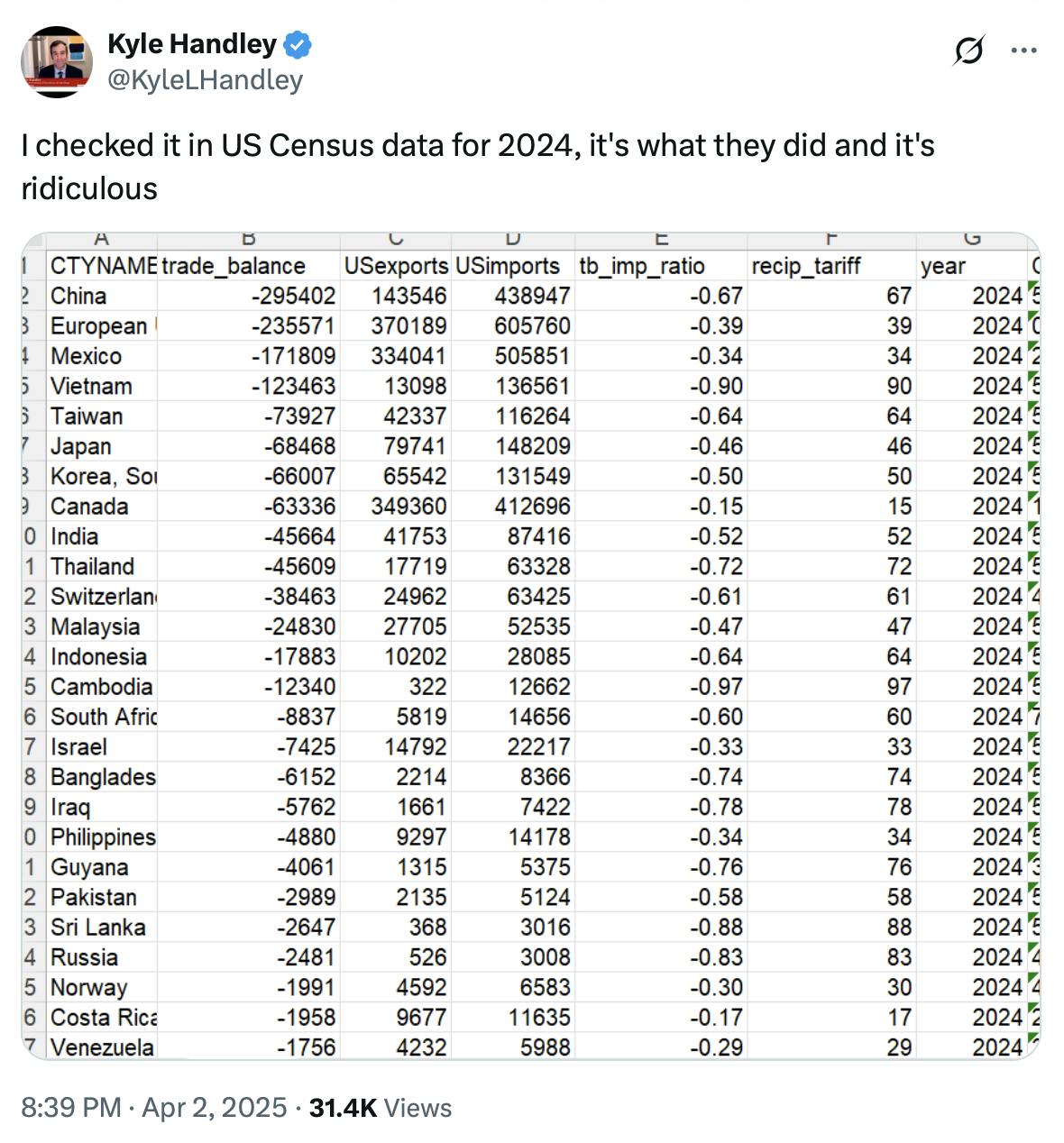
“They didn’t actually calculate tariff rates + non-tariff barriers, as they say they did. Instead, for every country, they just took our trade deficit with that country and divided it by the country’s exports to us,” Surowiecki argued. “So we have a $17.9 billion trade deficit with Indonesia. Its exports to us are $28 billion. $17.9/$28 = 64 percent, which Trump claims is the tariff rate Indonesia charges us.”

“What extraordinary nonsense this is,” he added.

That would mean that the Trump administration imposed earth-shattering tariff hikes on the rest of the world without looking at the whole picture. Mainly, that the administration calculated the tariffs charged by other countries by only looking at goods provided, rather than the combined value of goods and services—something that “most economists seem to think is an odd way to calculate tariffs,” according to BBC Verify’s Shayan Sardarizadeh.

Screenshot of a tweet
Screenshot

The White House initially refuted the tariff theory. White House Deputy Press Secretary Kush Desai posted on X that “we literally calculated tariff and non tariff barriers.” But in an attempt to prove his point, Desai grabbed a formula from the US Treasury website that actually proved Surowiecki’s.

Sardarizadeh broke it down. “∆τᵢ = (x-m) / (ε x φ x m),” he shared. “The formula includes ‘x’ for exports and ‘m’ for imports.”

“But it also has ‘ε’ for ‘price elasticity of import demand’, set at 4 by the Treasury; multiplied by ‘φ’ for ‘elasticity of import prices’, set at 0.25 by the Treasury, which means they basically cancel out each other as 4 x 0.25 = 1,” Sardarizadeh continued. “So, in effect, all you’re left with in the formula is exports - imports / imports, which is what X users and journalists had accurately pointed out all along.”

But the administration’s bad math only matters so much to the tariff-heavy agenda. Even in countries where the trade deficit was less than 10 percent, or even in countries where there was a surplus, Trump still tacked on a 10 percent tariff.