Breaking News
Breaking News
from Washington and beyond

Americans Have Never Been Less Proud to Be American, New Poll Finds

A new poll finds American pride is at an all-time low ahead of Fourth of July.

Tree men stand by two white hearses and a U.S. flag being flown at half-mast.
Stephen Maturen/Getty Images

As fireworks will rocket into the sky this weekend, national pride has, under Trump, sunk to its lowest point in recent memory, per a new Gallup poll.

Since January 2001, the polling firm has asked Americans whether they are proud to be an American, and this year’s results—published with the Fourth of July on the horizon and the semiquincentennial a year away—have proven to be the most dismal on record.

Only 41 percent of American adults reported being “extremely” proud to be an American, and only 17 percent were “very” proud, according to Gallup. Twenty percent find themselves on the less-proud portion of the spectrum, saying they are “moderately,” “only a little,” or “not at all” proud (19, 11, and nine percent, respectively).

Only 36 percent of Democrats report being very or extremely proud to be an American, a 26-point drop from last year. The only other time when less than a majority of Democrats were proud was in 2020, during a global pandemic.

Independents’ pride—which has steadily declined since 2001—is also lower than ever, with just 53 percent being very or extremely proud.

Meanwhile, Republicans, 92 percent of whom are very or extremely proud, are as chipper as ever. Members of the GOP have consistently floated around that figure, only dipping below the 90 percent mark in 2016 and 2020–2024.

According to Gallup, there is a significant generational divide in national pride: The younger the generation, the less likely than the previous it is to be very or extremely proud to be an American.

From 2021 to 2025, just 41 percent of Gen-Z adults and 58 percent of millennials were very or extremely proud, Gallup reports, whereas that figure for Gen X, Baby Boomers, and the Greatest Generation is 71, 75, and 83 percent, respectively.

In his inaugural address, Trump promised that his “top priority will be to create a nation that is proud, prosperous, and free.” Perhaps the best that can be said of his presidency is that he’s delivered to his base on that first promise.
Trump Border Czar Has Gruesome Response to Man Dying in ICE Custody

According to Tom Homan, it’s normal for people to die in federal custody.

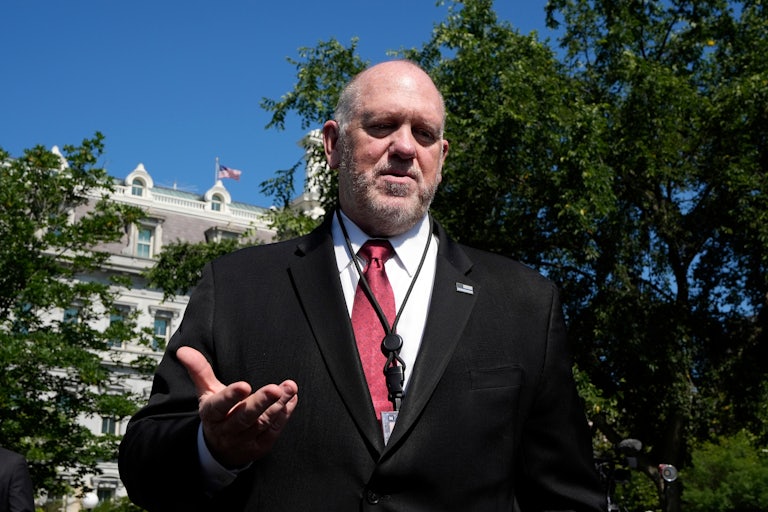
Tom Homan looks down and gestures while speaking to reporters outside the White House
Yuri Gripas/Abaca/Bloomberg/Getty Images
Border czar Tom Homan

Donald Trump’s border czar Tom Homan couldn’t care less that people are dying in ICE custody.

A reporter asked Homan Monday to respond to reports that Isidro Perez, a 75-year-old Cuban man who’d been living in the United States for nearly 60 years, died last week in ICE custody.

“I’m unaware of that, I’m not aware of that. I mean people die in ICE custody, people die in county jail, people die in state prisons,” Homan replied, brushing off that a man had just died on his watch.

“The question should be how many lives does ICE save? Because when they go in detention, we find many with diseases and stuff that we deal with right away to prevent that,” Homan said. Perez is at least the twelfth person to die in ICE custody so far this year, a notable uptick from previous years in line with the Trump administration’s directive to increase the rates of ICE arrests.

“People can argue with me all they want, but the facts are the facts. I think the politicians in New Jersey found this out, that we have the highest detention standards in the industry,” Homan said. He was referring to a group of three lawmakers the Department of Homeland Security previously claimed had stormed Delaney Hall in Newark, New Jersey, last month.

Homan claimed that the lawmakers had found the standards of the 1,000-bed ICE detention facility to be “outstanding” and added that it was “probably the cleanest facility in that entire state.”

But crucially, the lawmakers who visited Delaney Hall last month never completed their inspection of the newly reopened ICE facility. A court filing in Newark Mayor Ras Baraka’s lawsuit against Alina Habba, New Jersey’s acting U.S. attorney, stated that lawmakers were kept in a waiting room inside the facility for over an hour before they departed to join Baraka outside, where a wild confrontation ensued, resulting in Baraka’s arrest and landing Representative LaMonica McIver with assault charges, to which she pleaded not guilty last week.

New guidelines released by ICE this month asserted that lawmakers are not permitted to inspect ICE field offices and must give three days’ notice before arriving to inspect another facility, in violation of federal law. ICE claimed that lawmakers have no right to inspect field offices, because they are not detention centers, though the agency routinely holds immigrants at field offices and does not distinguish between those offices and larger detention centers, according to Democracy Docket.

Despite the illegality of ICE’s rule, lawmakers have been repeatedly locked out of ICE facilities. “They are undergoing conditions that are inhumane, in my opinion. They were not able to change their underwear for 10 days,” said California Representative Judy Chu, after she was blocked from entering a facility outside of Los Angeles.

Instead of encouraging more visits, Homan referred individuals concerned over safety standards to ICE’s website.

“Go to ICE.gov and look at our detention standards; it’s the highest detention standards in the industry at a very expensive cost to the taxpayers,” Homan said, adding: “Go look for yourself and then come back to me.”

ICE facilities’ poor conditions are well documented. The agency recently renewed a contract with a facility that was previously decommissioned for its failure to comply with health standards, and the DHS has been quick to brag about its “Alligator Alcatraz” tent facility in the middle of the Florida Everglades.

Trump Sues Los Angeles After City’s Anti-ICE Protests

The Trump administration is suing Los Angeles, a key battleground in the president’s war on immigration.

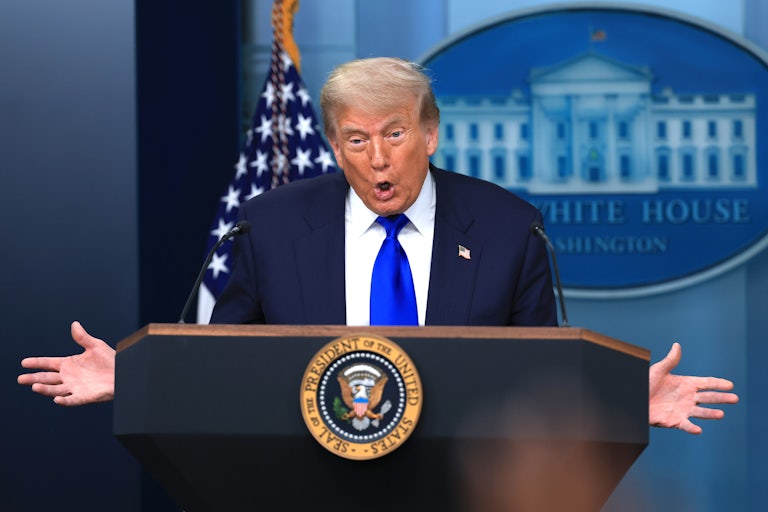
Donald Trump speaks in the White House press briefing room.
Joe Raedle/Getty Images

President Trump’s Department of Justice is suing the city of Los Angeles on the grounds that its sanctuary city policy is an obstruction to the federal government’s mass deportation campaign.

“The challenged law and policies of the City of Los Angeles obstruct the Federal Government’s enforcement of federal immigration law and impede consultation and communication between federal, state, and local law enforcement officials that is necessary for federal officials to carry out federal immigration law and keep Americans safe,” the lawsuit, filed Monday, reads.

The DOJ is looking to overturn Ordinance Number 188441, which prevents Los Angeles’s resources, local police included, from being used for federal immigration enforcement as part of the city’s sanctuary status.

“Sanctuary policies were the driving cause of the violence, chaos, and attacks on law enforcement that Americans recently witnessed in Los Angeles,” Attorney General Pamela Bondi said in a statement Monday. “Jurisdictions like Los Angeles that flout federal law by prioritizing illegal aliens over American citizens are undermining law enforcement at every level—it ends under President Trump.”

This is yet another installment in Trump’s monthslong beef with the city of Los Angeles and California as a whole. He slashed crucial federal funding to the state, and deployed the National Guard and the Marines without the approval of Governor Gavin Newsom to crush anti-ICE protests in Los Angeles. This lawsuit is driven by spite.

Trump Desperately Begs Japan for His Weirdest Trade Deal Yet

Donald Trump has been reduced to pleading other countries on social media to make deals.

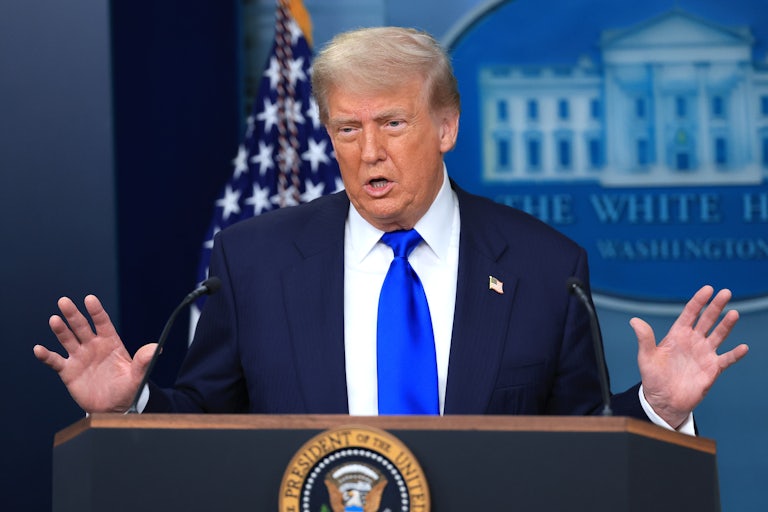
Donald Trump holds his hands out to the side while speaking at the podium in the White House press briefing room
Joe Raedle/Getty Images

Donald Trump is trying to squeeze American rice supplies into Japan without a trade negotiation.

In a Truth Social post Monday afternoon, the president claimed that the Japanese people and their government were “spoiled” because they wouldn’t buy American rice. He then promised to send them a “letter,” in which he would assert the current rate of trade between the two nations.

“To show people how spoiled Countries have become with respect to the United States of America, and I have great respect for Japan, they won’t take our RICE, and yet they have a massive rice shortage,” Trump wrote, casually insulting the nation with which America has one of its largest trading relationships. “In other words, we’ll just be sending them a letter, and we love having them as a Trading Partner for many years to come.”

Japan has been struggling with a rice crisis for the last couple of years. The grain, which is a foundational ingredient in Japanese cooking, first started slipping from supermarket shelves in 2023, when extreme heat waves led to low crop yields. Then, a possible “megaquake” warning last year inspired people to panic-buy the pantry essential. The ensuing shortage has seen rice prices more than double since the crisis began, reaching between 4,500 and 5,000 yen, according to government data.

But Trump’s threat is particularly ill-timed, leaving the U.S. president with little negotiating power on the matter: Japan’s national supermarket association reported last week that the shortage appears to be easing, with prices for a five-kilogram bag dropping below 4,000 yen for the first time in the last two months, finally reaching the target goal set by Prime Minister Shigeru Ishiba.

Rice has become a sticking point in U.S.-Japanese trade negotiations. In March, Trump pledged to impose a 24 percent “reciprocal” tariff on Japanese imports, with its automobile and metals industries facing a slightly higher rate at 25 percent. Since a 1993 World Trade Organization arrangement, Japan has imported 770,000 metric tons of rice each year without tariffs—approximately half of which comes from the U.S., Time reported.

Changing the arrangement in favor of U.S. goods will face enormous pressure from Japanese leadership: the Liberal Democratic Party, which has been in power almost continuously since it was founded in 1955, has staunchly opposed adding a special quota for American rice imports.

The plea followed an embarrassing flub for America’s relationship with its longtime ally on Sunday, when Trump seemingly forgot the name of Japan’s prime minister in an interview with Fox News, instead referring to Ishiba as “Mr. Japan.”

In the same interview, Trump said that the letters would serve as the “end of the trade deal,” suggesting that no negotiations will take place after the White House hits the mailbox. “We don’t have to meet. We understand, we have all the numbers,” he said.

It’s not the first time that Trump has offered to stamp out trade talks by issuing a string of letters. He made similar promises on May 16 and June 11, claiming both times that the letters would be issued in a handful of weeks, though that never came to fruition.

State Department Revokes British Punk Duo’s Visas After Anti-IDF Chant

Musical duo Bob Vylan was set for a U.S. tour before they had their visas revoked.

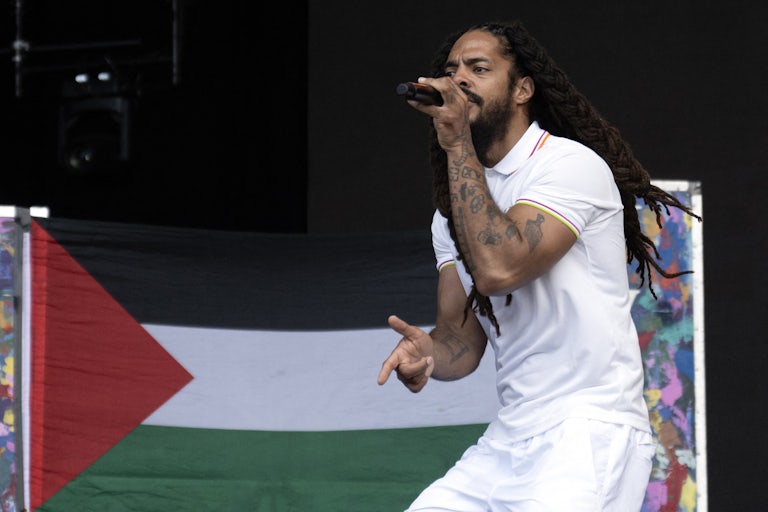
To the backdrop of a Palestinian flag, Bobby Vylan of British duo Bob Vylan performs on stage at the Glastonbury festival.
OLI SCARFF/AFP/Getty Images
To the backdrop of a Palestinian flag, Bobby Vylan of British duo Bob Vylan performs at the Glastonbury festival in Somerset, England, on June 28.

The two musicians comprising the U.K. punk-rap duo Bob Vylan have had their U.S. visas revoked for leading chants against the Israeli Defense Forces during their performance at the Glastonbury Festival over the weekend.

The group has been under fire since leading the festival crowd in the chant, “Death, death to the IDF” on Saturday.

On Monday morning, Deputy Secretary of State Christopher Laundau took to X to announce that the State Department “has revoked the US visas for the members of the Bob Vylan band.”

Landau described the decision as a retaliation against Bob Vylan “in light of” the chants at Glastonbury, which he described as a “hateful tirade” where the group led “death chants.”

“Foreigners who glorify violence and hatred are not welcome visitors to our country,” Laundau said.

The band, which has also been dropped by its talent agency, according to
The Hollywood Reporter, had upcoming tour dates scheduled in numerous U.S. cities.

Prior to the official announcement, the free speech advocacy group Foundation for Individual Rights and Expression, or FIRE, condemned reports that the State Department was looking into banning Bob Vylan for their expressive acts.

FIRE compared the then-planned ban to countries like Russia and China banning artists such as Selena Gomez and Katy Perry for speech that cuts against official state doctrine.

“Nations committed to free expression should not use their borders as a tool of censorship, as Russia and China have done with artists whose political expression they seek to silence,” FIRE posted. “Revoking visas from controversial musicians and artists doesn’t make our country freer or safer. But it may make it silent.”

This comes as the Trump administration pursues an aggressive campaign of revoking international students’ visas, including for political expression, such as pro-Palestinian advocacy.