Breaking News
Breaking News
from Washington and beyond

Harvard Hits Back at Trump With Lawsuit Over International Student Ban

Harvard University is suing the Trump administration over its cruel move.

Harvard University campus
Mel Musto/Bloomberg/Getty Images

Harvard University is suing the Trump administration over its revocation of the school’s ability to enroll international students.

In a lawsuit filed on Friday in Boston, the university slammed the administration’s “unlawful and unwarranted action,” calling it a “blatant violation” of the law.

The school highlighted the over 6,800 visa holders from more than 100 countries that will be negatively impacted by the administration’s disdain for basic First Amendment principles.

“With the stroke of a pen, the government has sought to erase a quarter of Harvard’s student body, international students who contribute significantly to the University and its mission,” Harvard said in the suit.

Harvard said it will also be seeking a temporary restraining order against the move.

The move comes one day after the Trump administration announced it is revoking Harvard’s Student and Exchange Visitor Program certification, which would bar all international students on F- or J- nonimmigrant visas from enrolling in the university for the 2025–2026 academic year, including those already pursuing a degree at the school.

“This administration is holding Harvard accountable for fostering violence, antisemitism, and coordinating with the Chinese Communist Party on its campus,” Homeland Security Secretary Kristi Noem said in a press release full of propaganda on Thursday. “It is a privilege, not a right, for universities to enroll foreign students and benefit from their higher tuition payments to help pad their multibillion-dollar endowments. Harvard had plenty of opportunity to do the right thing. It refused. They have lost their Student and Exchange Visitor Program certification as a result of their failure to adhere to the law.”

Noem claims that Harvard can avoid the ban on future foreign student enrollment by simply doxxing all of its current foreign students to the Trump administration.
Is Trump Trying to Set Energy Policy in Other Countries Now?

Donald Trump went on a weird rant about windmills—in the U.K.

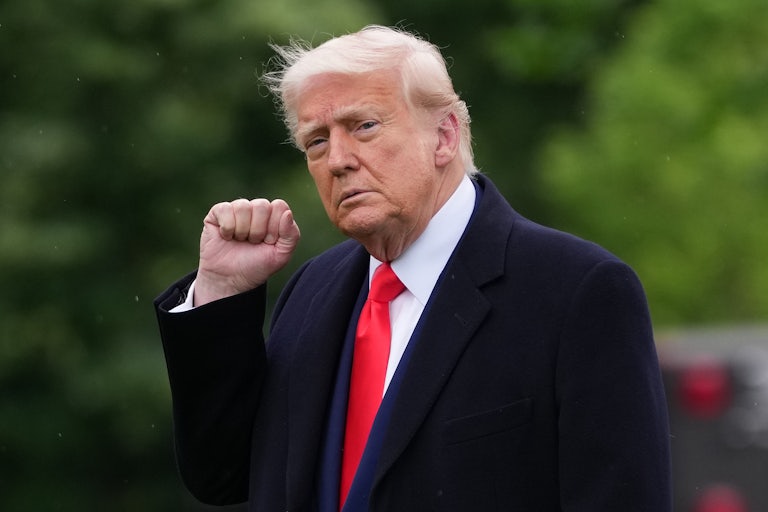
Donald Trump raises his fist while walking outside the White House
Kevin Dietsch/Getty Images

Weeks after negotiating a palatable trade deal with the United Kingdom to squash the tariffs, Donald Trump wants more.

The president pitched early Friday that the U.K. should—like his administration—focus on divesting from clean energy and return to oil drilling, claiming that the switch would bring energy costs “way down.”

“Our negotiated deal with the United Kingdom is working out well for all,” Trump wrote on Truth Social. “I strongly recommend to them, however, that in order to get their Energy Costs down, they stop with the costly and unsightly windmills, and incentivize modernized drilling in the North Sea, where large amounts of oil lay waiting to be taken.

“A century of drilling left, with Aberdeen as the hub,” he continued. “The old fashioned tax system disincentivizes drilling, rather than the opposite. U.K.’s Energy Costs would go WAY DOWN, and fast!”

Britain has some of the highest energy prices in the world, but experts don’t point their finger at green solutions as the problem. Instead, it’s the nation’s overreliance on gas for electricity and heat that has “led to record high levels of household energy debt and a sharp slump in industrial activity,” The Guardian reported earlier this week.

Industries reliant on vast energy resources have fallen by a third in the U.K. since 2021, marking their lowest level since 1990, according to a business overview released by Britain’s Office for National Statistics on Monday. Bringing business back up will depend on solving the crisis.

“These figures are a wake-up call,” Sam Richards, the chief executive of lobbying group Britain Remade, told The Guardian. “Sky-high energy costs have gutted Britain’s industrial base, with output in sectors like steel and chemicals collapsing to record lows. If we’re serious about protecting jobs and rebuilding our manufacturing strength, we need to cut industrial electricity costs, and fast.”

Meanwhile, Trump’s interest in expanding drilling isn’t without influence. Oil and gas lobbyists were Trump’s fourth-largest source of donations during his most recent presidential campaign, handing more than $14 million to the anti-environmentalist, according to campaign filings.

Read more about Trump’s energy policy:

Trump Drops Another Tariffs Bombshell to Begin in a Matter of Days

So much for walking back his trade war.

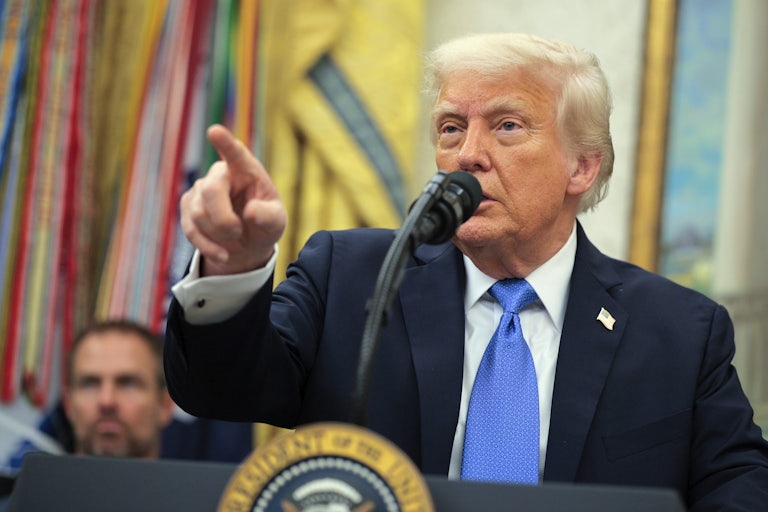
Donald Trump points while speaking at the presidential podium in the White House.
Chip Somodevilla/Getty Images

President Trump on Friday suggested ramping up tariffs against the European Union, indicating that his trade wars are still only just beginning. 

The president called for a 50 percent tariff on products from the EU, to begin on June 1. 

“The European Union, which was formed for the primary purpose of taking advantage of the United States on TRADE, has been very difficult to deal with. Their powerful Trade Barriers, Vat Taxes, ridiculous Corporate Penalties, Non-Monetary Trade Barriers, Monetary Manipulations, unfair and unjustified lawsuits against Americans Companies, and more, have led to a Trade Deficit with the U.S. of more than $250,000,000 a year, a number which is totally unacceptable,” Trump wrote on Truth Social. “Our discussions with them are going nowhere! Therefore, I am recommending a straight 50% Tariff on the European Union, starting on June 1, 2025. There is no Tariff if the product is built or manufactured in the United States.”

Earlier in the morning, he suggested also directly tariffing Apple.

“I have long ago informed Tim Cook of Apple that I expect their iPhone’s that will be sold in the United  States of America will be manufactured and built in the United States, not India, or anyplace else,” the president wrote on Truth Social. “If that is not the case, a Tariff of at least 25% must be paid by Apple to the U.S. Thank your for your attention to this matter!”

The iPhone is primarily manufactured in China, one of the countries with the iciest current trade relationships with the Trump administration (although Apple has moved some manufacturing to India in an attempt to offset that). This tariff, once again aimed to force companies into more domestic manufacturing, could raise the price of the iPhone by 25 percent, which could price it at around $3,000. 

Stock market futures in the U.S. took a dive after each announcement from the president, a persisting theme in his ongoing effort to destabilize the international market. The European stock market also fell by 2 percent. This all comes before what will likely be an uneasy Friday meeting between Trump administration trade representative Jameson Greer and his European counterpart. 

This story has been updated.

Karoline Leavitt Melts Down Over Blocked South Sudan Deportations

Donald Trump was none too happy that a judge intervened, either.

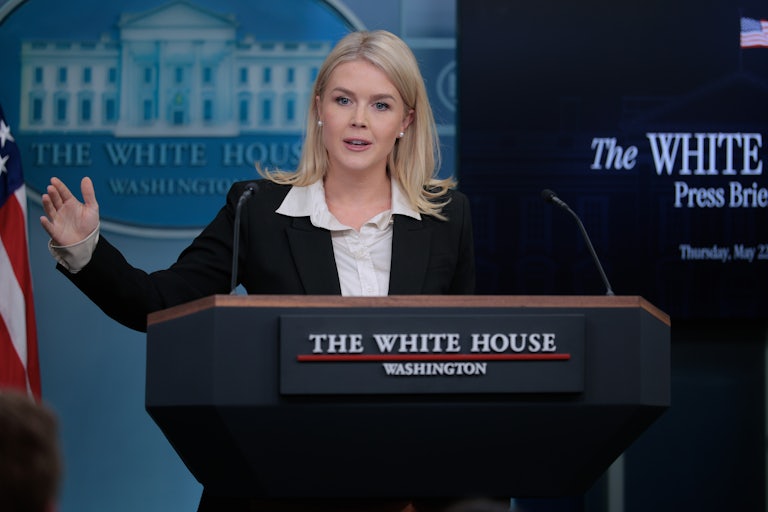
Karoline Leavitt gestures while speaking at the podium during a White House press briefing
Chip Somodevilla/Getty Images

White House press secretary Karoline Leavitt delivered a tirade Thursday against a federal judge who ruled against Donald Trump’s illegal deportations to South Sudan.

During a press briefing, Leavitt railed against U.S. District Judge Brian Murphy of Massachusetts, who ruled Wednesday that the Trump administration had provided “plainly insufficient” notice to several third-country nationals before deporting them to South Sudan, which is in the midst of violence and political unrest. As a result, the migrants are being held at a U.S. naval base in Djibouti.

“Judge Murphy is forcing federal officials to remain in Djibouti for over two weeks, threatening our U.S. diplomatic relationships with countries around the world, and putting these agents’ lives in danger by having to be with these illegal murderers, criminals, and rapists. This is completely absurd,” Leavitt said.

“Judge Brian Murphy is not the secretary of state, he is not the secretary of defense, or the commander in chief. He is a district court judge in Massachusetts. He cannot control foreign policy or national security of the United States of America, and to suggest otherwise is being completely absurd,” Leavitt continued, wrongly arguing that the judicial branch had no power to challenge illegal orders from the executive one.

The Trump administration has continually argued that its illegal deportations are a matter of foreign policy, and therefore exempt from judicial review. Some military officials were surprised when the controversial deportation flight that left Tuesday was described at a Department of Homeland Security press conference the following day as a “diplomatic and military security operation,” according to CNN.

If anything, Murphy’s status as a “district court judge in Massachusetts” might suggest he has a better grip on the law than the two former television stars that run the White House and Pentagon, respectively. As for Marco Rubio, a former attorney, there is literally no excuse.

Murphy had previously ruled to stop a similar spate of deportations to Libya.

Leavitt wasn’t the only one to blow a gasket over Murphy’s ruling. Trump had his own temper tantrum on Truth Social Thursday. “A Federal Judge in Boston, who knew absolutely nothing about the situation, or anything else, has ordered that EIGHT of the most violent criminals on Earth curtail their journey to South Sudan, and instead remain in Djibouti,” Trump wrote.

The president whined that a “a large number of ICE Officers, who would otherwise be in the United States, protecting our citizens,” had to remain in Djibouti to watch the detainees. He asked that the Supreme Court end the “quagmire that has been caused by the Radical Left.”

Cognitive Decline? Trump Makes Bonkers Claim About Drug Prices

Donald Trump exposed his own cluelessness about how drug pricing works.

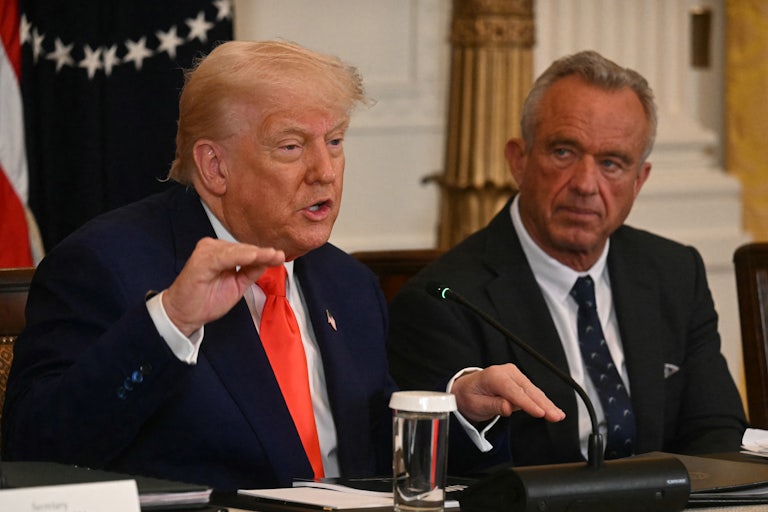
Donald Trump gestures and speaks while sitting next to Robert F. Kennedy Jr.
Jim Watson/AFP/Getty Images

The president’s great solution to equalize America’s prescription costs with countries around the globe apparently boils down to raising the cost of drugs everywhere else.

Donald Trump explained during the unveiling of Robert F. Kennedy Jr.’s “Make America Healthy Again” report Thursday that his administration had had intense discussions with the country’s biggest pharmaceutical companies, allegedly cornering them into lowering the cost of drugs by raising them in other nations.

But further details of Trump’s plan didn’t sound like a leader that was hard on drug companies.

“The companies are all coming in, we’ve had some very promising interactions,” said former TV host and Centers for Medicare and Medicaid Services Administrator Mehmet Oz. “People have talked about drug prices in a silo in isolation, but when you start going to the countries where they give discounts to because they’re getting beat up there and you support these companies, they see a huge upside potential. Even greater than the numbers you mentioned.

“They should be able to charge more than what they would have historically been tolerant of, if they have the support of the U.S. government and you,” he continued, mentioning that Kennedy was aware of the conversations with drug companies.

“Well, they were artificially low and artificially high. We were artificially high, they were artificially low,” Trump responded, emphasizing that the government would be acting expediently to enact the international price changes.

It’s not the first time that Trump has lied that America subsidizes the health care of other countries, and that low drug prices outside the U.S. are because the American government has financially offset would-be high prices in other countries.

But that’s detached from reality: The U.S. pays more for drugs because it’s an outlier among high-income, developed countries, which predominantly support universal public health coverage—not because the U.S. government “subsidizes” drug costs in other developed nations.

Other things that researchers point to as potential solutions for high drug prices in the U.S. include restricting pharmaceutical monopolies within the country, reworking insurance benefits to restrict out-of-pocket, and recentralizing price negotiations through the leverage of a single-payer system (like those in Australia, Germany, the U.K., or any number of other wealthy nations), according to a report by the Commonwealth Fund, a private American foundation focused on health care reform. It’s unclear how the Trump administration would work to undo the policies and regulations in foreign countries that keep their drug prices low.

Beyond that, America’s lax drug pricing has historically been thanks to Trump’s party.

In a post on Truth Social earlier this month, Trump pledged that his executive order focused on hacking prescription drug prices would save the government trillions of dollars. He also falsely claimed that Democrats had stood in the way of this kind of pharmaceutical reform, ignoring the fact that health care and pharmacy drug reform has been a pillar of the progressive platform in recent years (see: Representative Alexandria Ocasio-Cortez’s “Medicare for All” 2021 revival, which would have created a single-payer system in this country).

“Campaign Contributions can do wonders, but not with me, and not with the Republican Party. We are going to do the right thing, something that the Democrats have fought for many years,” Trump wrote at the time.

But in 2006, Republicans were the ones who adamantly stood in the way of federal drug price negotiations, ripping the teeth out of a bill that would have mandated drug companies to negotiate lower drug prices with Medicare officials.

“Instead of actually tackling the issues that concern average American families, the Republicans have passed legislation to help their wealthy friends and the huge corporations that support their campaigns,” said former North Carolina Representative G.K. Butterfield at the time before the measure passed.