Newsletter
Fighting Words
What got me steamed up this week

Trump Is Teeing Up a Pardon of Epstein Accomplice Ghislaine Maxwell

Think he wouldn’t do it? Really? Did you also think he wouldn’t pardon the January 6 insurrectionists?

Donald Trump, Melania Trump, Jeffrey Epstein, and Ghislaine Maxwell pose together at Mar-a-Lago.
Davidoff Studios/Getty Images
Trump, future wife Melania Knauss, Jeffrey Epstein, and Ghislaine Maxwell at the Mar-a-Lago club in Palm Beach, Florida, on February 12, 2000

So Ghislaine Maxwell, the longtime abettor of dead pedophile Jeffrey Epstein, is meeting Friday for a second time with Deputy Attorney General Todd Blanche. OK, first of all, let’s just stop right there. Why Blanche? Well, gosh, you say, he’s a deputy A.G.; seems legit. Actually, no, not by a long shot. Blanche was Trump’s personal defense attorney—on a sex case. (Technically, it was a hush-money case—the one involving adult film actress Stormy Daniels, which Blanche and Trump lost—but it was really about sex, in this case between consenting adults.)

So, no—Blanche, whose actual job entails the day-to-day running of the department, is absolutely not the appropriate person for this task. Wait—let’s stop right there again. Is this “task” even legitimate? Under certain circumstances, it might be. Let’s say a mobster is in the can for some felony. Prosecutors believe he has information about a different crime. So they go to him to see if he’ll talk, and they offer him a deal.

If that’s what’s going on here, maybe it’s OK—although alas, we stop again to ponder the morality of offering a deal to a child sex trafficker (hey, right wing, I thought this was a moral line in the sand for you?). This is not a mobster rat whose information could bring down another made man or even a whole family. This is a woman who was convicted of conspiring to groom minors for Epstein’s pleasure and who, according to at least one witness at her trial, participated in the sex.

So the whole thing shouldn’t even be happening. She was tried, she was convicted, and that’s that. But: If it had to happen; if we are to concede that questioning her at this point is a legitimate enterprise, shouldn’t it be done by a line attorney who is familiar with the details of the case? Of course it should. Someone like, oh, Maurene Comey. Oh. Wait. They fired her last week.

I hope you’re putting these puzzle pieces together with me as we go. The bottom line here is obvious. Donald Trump, I believe, wants to pardon Ghislaine Maxwell in exchange for her silence. Note I said wants to. He might not. A pardon would rip his base in two. He may grasp that and not do it.

But I say there can be little question that he’s thinking about it. In fact, on the White House lawn Friday morning, a couple hours after I wrote this column, he was asked about a possible Maxwell pardon, and he said: “I’m allowed to do it.”

I’m not the only one who smelled this possibility coming. Dave Aronberg, who worked as the Florida drug czar under U.S. Attorney General Pam Bondi when she was the state attorney general, made some interesting comments on CNN the other day.

First, he observed how weird it was that Blanche was conducting these interviews: “I can’t overstate it, Brianna [Keilar]. It’s as if the number two executive at CNN was conducting this interview with me instead of you. Like, what? It never happens.”

Then he connected the political dots: “But there are others who could do this, which makes me believe this is a lot about perhaps some politics involved, like maybe to protect the president, to get a deal with Ghislaine Maxwell that she would get some immunity now and maybe a hidden pardon in the future, some sort of implication that she would be pardoned in the future if she comes out and says that the president was exonerated, not involved in any criminal activity.”

Of course, we do not know whether Trump committed these heinous crimes. Like any American, he is entitled to the presumption of innocence. But the mere fact of these interviews being conducted the way they are raises certain obvious suspicions.

Maxwell and her lawyers surely know all this. She has a lot of incentive, in other words, to say what Trump and Blanche want her to say. Oh, and by the way, let’s stop here again. Why should we believe a word she says? There is much-documented evidence of Maxwell showing a “significant pattern of dishonest conduct,” as Merrick Garland’s Justice Department put it in 2022. They spared her (and themselves, and their finite resources) a perjury trial because she’d already been convicted of the big stuff.

Even assuming Trump is personally innocent, he still has a motive to cut a deal with Maxwell that leads to an eventual pardon. She might name prominent Democrats or other people to whom Trump is hostile. Her “pattern” suggests she’ll say anything Trump wants her to say.

If you think Trump wouldn’t do this, that pardoning a child sex trafficker is a bridge too far even for Trump … honestly, wake up. I bet you also thought he’d never pardon 1,200 anti-American insurrectionists.

If Trump is innocent, there’s one simple thing he should do. Order the release of all the Epstein files. Ah, but now we know that his name appears in them “multiple” times and that he lied earlier this month when asked about it. (The Wall Street Journal reported this week that Bondi told him about the multiple mentions of his name back in May.)

How would MAGA world receive a possible pardon by their hero of a woman who did the things Maxwell did? Some percentage, maybe even a substantial percentage, would throw in the towel, finally. But I doubt a majority. They’ll find an excuse. Child rape is bad, sure, but it’s really only bad when Democrats do it. Trump was sent by Jesus, after all, and Jesus teaches us to forgive, so Trump’s joined-at-the-hip, 15-year friendship with Epstein was about as Jesus-like as you can get, right? The sad thing about that joke is that, if it’s ever revealed that Trump did unspeakable things, one of those sick “Christian” preachers will probably say this in all seriousness.

The administration’s handling of the Epstein scandal and the likely coming indictment of Barack Obama, which I’ll write about next Monday, take us to depths we never, ever imagined we could reach in this country. Trump is the law, the law is Trump. I’ve always thought that, as horrible as everything is, if there’s an election in 2028 and the Democrat wins, we can get back to normal fairly quickly. As of this week, I’m not so sure.

This article first appeared in Fighting Words, a weekly TNR newsletter authored by editor Michael Tomasky. Sign up here.
Latest From Politics

Donald Trump Is Having One of His Worst Weeks Ever

This will go down as the week that the MAGA pixie dust didn’t work for once. It won’t be the last time.

Trump in chair
Aaron Schwartz/CNP/Bloomberg via Getty Images

So this is the thing about stories like the Jeffrey Epstein saga: There’s always new stuff waiting to come out. The explosive story that The Wall Street Journal dropped Thursday evening about Donald Trump’s alleged note to Epstein in a “birthday book” compiled for the child molester in 2003 by Ghislaine Maxwell was bound to come out. And if other things are out there about Trump’s history with Epstein—as there almost certainly are—they’re bound to become public someday, too.

That’s the first reason Trump needs to be worried. Even if his name does not appear on some master list created by Epstein with a heading like “Good Friends of Mine Who Raped Underage Girls With Me,” it still has to be the case that there are emails, photographs, and other material that at the very least won’t look good. (I couldn’t help wondering what Maurene Comey, the sex crimes prosecutor in New York’s Southern District who was fired by Attorney General Pam Bondi on Wednesday, knows about Epstein and Trump.)

And here’s the second and more interesting reason. These cracks in the MAGA coalition right now are only that—cracks—but time may prove this week to have been a pivotal, even decisive, moment in MAGA history.

On Monday, several voices in MAGA world (Charlie Kirk, Laura Ingraham, Megyn Kelly) were outraged over the administration declaring the Epstein matter closed. On Tuesday, a lot of those same voices said okay, nothing to see here, time to move on. Then, on Wednesday, they pivoted back to outrage, suggesting that on this one matter, social-media marching orders from Dear Leader could not staunch the blood flow. And Thursday night, the Journal story broke.

We don’t know yet what the impact of the Journal story will be in MAGA world, though it seems to be rallying some of his Epstein critics to his defense. So it might be that the story allows Trump to play victim and blame the fake news. Trump denies that he wrote the greeting and, as usual, has vowed to sue, which means he’s suing none other than Rupert Murdoch, who quite interestingly—if Trump’s Thursday night rant on Truth Social is to be believed—turned down the chance to use his power to kill the story.

Or it might edge some to start coming to grips with the fact that their hero is not the valiant knight they imagined him to be. To a certain kind of person who consumes a certain kind of media, Trump is a sea-green incorruptible: the man who quite literally risks his life (the two assassination attempts) to slay the debauched and ossified dragons that have been perverting America for decades and keeping the decent God-fearing people of “normal” America down.

Now? As I said, we can’t make any conclusions just yet. But this is the week the pixie dust didn’t work. Maybe it’s a one-time thing. On the other hand, maybe it’s not.

Before we get to all that, let’s do a quick deconstruction of what the Journal reported. There was a drawing of a naked woman (and why the Journal hasn’t posted an image of this thing is weird). Inside the drawing was a typewritten imagined dialogue between Trump and Epstein:

Voice Over: There must be more to life than having everything.

Donald: Yes, there is, but I won’t tell you what it is.

Jeffrey: Nor will I, since I also know what it is.

Donald: We have certain things in common, Jeffrey.

Jeffrey: Yes, we do, come to think of it.

Donald: Enigmas never age, have you noticed that?

Jeffrey: As a matter of fact, it was clear to me the last time I saw you.

Donald: A pal is a wonderful thing. Happy Birthday — and may every day be another wonderful secret.

Obviously, the key line here is Trump saying “enigmas never age.” I have to say I give him credit for seeming to know what the word “enigma” means. In fact, the use of “enigma” is the one piece of evidence that suggests that maybe this wasn’t Trump!

But “never age.” And Epstein replying that this fact was “clear to me the last time I saw you.” That’s clearly a reference to a specific event. If you want to believe it refers to that time they bought Girl Scout cookies together, be my guest.

If this is a genuine article, well, it’s very rare in this life that things like that card exist in isolation. The two were joined at the hip for 15 years. There will almost certainly be new explosions in the coming weeks. They probably won’t emerge from the grand jury materials whose release Trump authorized in the wake of the Journal scoop. We can presume that material has been vetted to exculpate Trump. But maybe there were things that the grand jury didn’t see. As The Washington Post noted Friday morning, “the grand jury testimony would constitute only a fraction of the evidence amassed by federal authorities.”

But back to that pixie dust. That’s the story here. Every single thing Trump has done for 10 years—every outrage against decency, every crime, every incitement to violence, all the rest—have been justified in MAGA world because Trump was doing all these things for them.

And he was supposed to blow the lid off this whole Epstein thing for them, too. Instead, he’s covering up for himself. The order to Bondi about the grand jury material just looks like the kind of ass-covering bullshit move any politician would make. Members of the r/Conservative subreddit on Friday morning were definitely not appeased.

Most of MAGA will continue to believe. Some people will need a photograph of Trump in flagrante delicto with a 12-year-old before they reconsider. And even then, they may insist the photo is fake.

But others are already starting to question the whole enterprise. If Trump loses just 15 percent of his hard-core supporters, that’s huge; electorally, it’s potentially decisive. If we put his hard-shell supporters at 30 or 35 percent of the country, well, 15 percent of that is 4 or 5 percent. In a country this narrowly divided, that’s a lot to lose—a lot of midterm voters who decide the hell with it, I’m staying home.

And finally, let’s not forget what this is about. Epstein did literally the sickest things a human being can do. Even if Trump didn’t do them, if he was that close to Epstein for that long, there’s roughly zero chance he didn’t know something. Is that what supposed Christians want in a president of the United States? Some of them are already wondering. As other shoes drop, more will.

This article first appeared in Fighting Words, a weekly TNR newsletter authored by editor Michael Tomasky. Sign up here.
Latest From Politics

How Can the Democrats Be Losing to These Cruel, Stupid, Inept People?

You may have noticed: While Republicans debate Medicaid and other cuts, there’s one aspect of Trump’s big ugly bill that absolutely cannot be discussed.

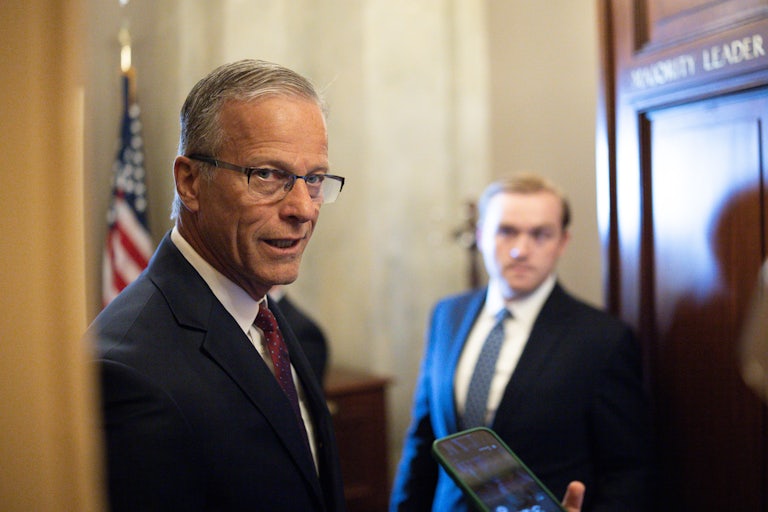
Senate Majority Leader John Thune
Kayla Bartkowski/Getty Images
Senate Majority Leader John Thune

Senate Republicans have no “big, beautiful” bill. It isn’t close to finalized. The Senate parliamentarian, combing through the details and determining which provisions will need a supermajority to pass, is hammering them. They’re locked in ferocious internal debate about the cuts to Medicaid. They haven’t held a single hearing on the bill in any committee.

And they say they’re going to start voting on it tomorrow.

Even worse is the complete hypocrisy of the thing, which has been true of every Republican tax bill going back to 1981. Ever since Arthur Laffer sold the GOP on his ridiculous curve, they’ve been lying to the American people about how their tax cuts will produce more revenue. It has never happened. Ever. Some of the dumber Republicans may believe this, but the smarter ones know Laffer’s theory is a lie, and they say it anyway.

And so we watch as Senate Republicans argue about the degree to which they want to destroy Medicaid. You’ve been reading and hearing about this, I’m sure, and you may even have become familiar with the phrase “provider tax.” Journalistic shorthand usually does a poor job of explaining what that actually is. Bear with me for this brief explanation, because it makes clear how cruel and deliberate these cuts are.

Health care services that are reimbursed by Medicaid are, well, provided by a range of different “providers.” Chief among these are hospitals, but the category also includes nursing homes, other long-term care facilities, doctors, physical therapists, even chiropractors: all sorts of people. But the big money revolves around hospitals, and specifically rural hospitals, which rely heavily on Medicaid dollars because they are poorer on balance than other hospitals. They tend to be run on a nonprofit basis. They are less likely than urban or suburban hospitals to have commercial insurance, and they’re more dependent on Medicaid revenue because their client base tends to be poorer. There are about 1,800 rural hospitals in the United States. Here’s a map.

OK. Starting in the 1980s, during an earlier funding crisis, Congress allowed states to start taxing providers. In many states (this gets very complicated, and I’m not going to go into it that deeply), the cap on the tax that states can charge hospitals is 6 percent of the patient revenue money (it’s called the “safe harbor maximum” in wonkspeak). The Senate bill seeks to lower this cap over a few years to 3.5 percent.

To make a long story short, when you reduce a tax, you reduce the amount of revenue it brings in. It’s also worth bearing in mind here that Medicaid reimbursements rarely cover the cost of care to begin with, so these cuts will make an already dire situation much worse. Governors and state legislatures will be staring at a quite substantial reduction in Medicaid tax revenue. They will then be faced with three choices: one, raise some other sort of tax; two, cut some other state service, like education; three, cut Medicaid services.

As congressional Republicans well know, most states are going to choose number three, because it’s the easiest path. And that brings devastation. If you want to see why Republican Senator Thom Tillis is so freaked out, click on that map above and zoom in on his state, North Carolina. You’ll see in detail how many rural hospitals there are operating at a loss, and how many have already closed.

So this is what Republicans are debating—and deliberately and dishonestly telling the American people that it’s a simple case of cutting “waste, fraud, and abuse,” as if they have no choice in the matter.

It’s a monstrous lie.

They have a choice. But of course it’s a choice they’ll never make. What is that choice? They could, in theory, reduce the tax cuts to the rich. The problem would be instantly solved.

The proposed Medicaid cuts come to around $800 billion. The cost of making the 2017 income tax cuts permanent is around $2.2 trillion. So in other words, canceling the tax cuts would more than cover the proposed Medicaid cuts. In fact, the Republicans could leave nearly two-thirds of the tax cuts intact, and just pare them back, and leave Medicaid untouched.

In a fantasy world, they could, dare I say it, eliminate the tax cuts altogether. They’d have $2.2 trillion to play with, and they could expand rural health care—you know, actually do something of substance for all the people who vote for them, besides scaring them into thinking that Democrats want to steal their guns and neuter their children.

But you notice: No one ever, ever, ever discusses the tax cuts. No one. None of the, ahem, moderates—not Senator Susan Collins, not Representative Mike Lawler (at least that I’ve heard). Tax cuts aren’t written in ink and on paper, to Republicans. They’re written in lightning on tablets from Mount Sinai. They cannot be discussed.

And these aren’t just your usual, run-of-the-mill GOP tax cuts. They’re worse. They’re the most redistributive tax cuts in modern American history, and by redistributive, I don’t mean from the top down. I mean to the top from the rest of us.

Here are a few facts about the House’s version of the bill, from the Institute on Taxation and Economic Policy, or ITEP:

  • The richest 1 percent of Americans would receive a total of $121 billion in net tax cuts in 2026. The middle 20 percent of taxpayers on the income scale, a group that is 20 times the size of the richest 1 percent, would receive less than half that much: $56 billion in tax cuts that year.
  • The $121 billion in net tax cuts going to the richest 1 percent next year would exceed the amount going to the entire bottom 60 percent of taxpayers (about $79 billion).
  • The poorest fifth of Americans would receive less than 1 percent of the bill’s net tax cuts in 2026, while the richest fifth of Americans would receive 70 percent. The richest 5 percent alone would receive 45 percent of the net tax cuts that year.

There’s a lot more. The richest 1 percent ($916,900 and above) will get an average cut of $68,430, or 2.5 percent. The poorest 20 percent (up to $27,000) will get a whopping cut of $30, or 0.2 percent. In percentage terms, the cut for the rich is 10 times the cut for the poor.

But wait—incredibly, it gets worse. ITEP estimates that when you throw in the costs of Donald Trump’s tariff proposals, the net impact on the bottom 20 percent will be a tax increase of 2.2 percent. The tariffs aren’t finalized, of course, so we can’t really know the hard number, but as a general rule, tariffs cost poorer people more since they’re spending a far higher percentage of their income on imported necessities.

The whole thing is just a disgrace. A policy disgrace. A moral disgrace. Rural hospitals will close, and working-class people will die so that Trump’s golf buddies can get tax cuts of tens or hundreds of thousands of dollars.

The American people don’t know all the above facts and figures, but they do seem to know in their bones that this bill is a heist. It’s deeply unpopular. But even so, the Democrats could be doing much more here. Why don’t they fan out across the country one day next month and have events at money-losing rural hospitals that face potential closure? Back in the spring, when they did those anti-DOGE events in Republican districts, it seemed to have an impact. At least they were visibly doing something. There are rural hospitals in every state. Democrats could do a lot worse than to try to show rural Americans that they care.

But it’s like Jon Lovitz, playing Michael Dukakis, said on Saturday Night Live back in 1988: I can’t believe we’re losing to these guys. If Democrats were more aggressive, this bill would kill Republicans off in 2026 and 2028. It’s that cruel, it’s that stupid, it’s that inept. Democrats need to find dramatic ways of saying so.

This article first appeared in Fighting Words, a weekly TNR newsletter authored by editor Michael Tomasky. Sign up here.

Latest From Politics

The Fate of the World Is Now in Donald Trump’s Hands. Gulp.

The president is no principled pacifist. He’s capable of anything with Iran, from peacemaking to nuking (but hey, just a small nuke).

Donald Trump speaks while sitting at his desk in the Oval Office
Ken Cedeno/UPI/Bloomberg/Getty Images

I’ve been just staggered this week to hear some people—in a few cases, the exact same people—repeating the lines we heard so often in 2002 and 2003: how the situation was intolerable, how the country in question posed a direct threat to the United States, how action was morally and strategically imperative, and how easy it would all be.

Here was freshly minted Republican Senator Lindsey Graham in 2003: “It’s long past time for Saddam Hussein to be replaced. President Bush used the only reasonable option available to him and our nation.” 

And here was an older and no wiser Graham, having descended into the age of the lean and slippered pantaloon, earlier this week: “It’s time to close the chapter on the ayatollah and his henchmen. Let’s close it soon and start a new chapter in the Mideast: one of tolerance, hope, and peace.”

You could sense the fever rising midweek, when it felt like Donald Trump just might pull the trigger and unleash his—actually, our—B-2 bombers on Iran’s Fordo nuclear facility. In 2002–03, as the editor of The American Prospect, I watched slack-jawed while the propaganda machinery of official Washington (and Beltway outlets including The New Republic, where dissenters were few) geared up for a war that was cooked up on specious grounds and during which, alas, Iraqis did not lay rose petals at our soldiers’ feet. Because once George W. Bush made up his mind, the Washington foreign policy establishment decided collectively that when a president wants to launch a war, there’s nothing to be gained by opposing him.

On Wednesday, I smelled the same sulfurous odor in the air. I simply couldn’t believe that just 22 years after we waltzed into Iraq, we were going to do … not the same thing, but something eerily similar with potentially similar consequences.

Then, on Thursday afternoon, White House press secretary Karoline Leavitt told the world that the boss wanted two weeks. If the boss were a deliberative, rational, mature man, we could welcome this as reassuring news. But as the boss is Donald Trump, it means nothing. Two weeks to the day from Leavitt’s announcement, as fate would have it, will bring the Fourth of July—a good day for a peace deal but an even better day to go bombs away! Imagine Trump, after that bust of a military parade, having strafed Iran during the day and sitting back and watching all those fireworks displays at night. Strength!

Trump 2.0 has ranged from being a disaster to a comedy, a tragedy to a farce. But the one development that I’ve watched with quiet curiosity—the one matter on which, if asked, I’d have told a pollster I actually approved—was that Trump was seriously negotiating with Iran. I did not, of course, approve of his abandoning the Obama-era nuclear deal during his first term, but it was interesting that he was now pursuing diplomacy. It was very interesting that he appeared to be willing to get crossways with Benjamin Netanyahu. Until early this month, when Ayatollah Khamenei refused the latest U.S. offer, it really looked like we were on track for a deal (the sticking point was whether a proposed international consortium for civilian uranium enrichment be based within or outside Iran).

That was June 4. As everyone now knows, talks were scheduled for the following Sunday, but that preceding Thursday night, Israel started bombing, and Trump woke up Friday, turned on Fox, saw them slavering over Bibi’s macho dice rolling, and the talks were dead. They might be back on now. However we feel about Trump, that would be a very good thing.

So: What is Trump going to do? Given the apparent truism that Trump talks to different people, agrees with the last person he talked to, reads nothing, and makes an instinctual decision at the last second, it’s worth running down the people he’s talking to and what they’re probably telling him:

  • Steve Witkoff. Trump’s Iran envoy’s qualifications for his position are that he’s Trump’s old real estate and golfing buddy. His batting average so far isn’t great—he was supposed to secure a ceasefire in Gaza. Who knows, maybe he’ll prove to be a modern-day Bishop Talleyrand on the diplomacy front. Or maybe he won’t. But at least he’s surely telling Trump to give talks a chance.
  • Bibi Netanyahu. We know what he’s saying. He’ll be sharing Israeli intelligence aimed at telling Trump that a Fordo hit can be clean, quick, and low risk. And it should be noted that there will be wealthy, right-wing Jewish Americans who may have the president’s ear who’ll reinforce this message (Miriam Adelson, Bill Ackman, etc.).
  • Dan Caine, Michael Kurilla, and John Ratcliffe. Respectively, they’re the head of the Joint Chiefs of Staff, head of the U.S. Central Command, and CIA director. Trump loves Caine, whose made-up middle name is “Razin,” because he’s out of “central casting” and because of his role in defeating ISIS. Of Kurilla, an Israeli news outlet in April said he was “the U.S. general Israel doesn’t want to strike Iran without.” Of Ratcliffe, CBS News reported Friday that he “has said in closed-door settings that Iran is viewed as being very close to possessing nuclear weapons,” which is at least slightly at odds with the less alarmed intel assessment Tulsi Gabbard has been touting. Sure sounds like on balance, this group will be urging that things go boom.
  • Steve Bannon. We know that his is the most prominent voice urging Trump to slam the brakes. He and Trump had lunch Thursday. Hard to know how seriously Trump takes him. But his view does reinforce what appears to be Trump’s gut instinct toward noninvolvement.
  • Fox News hosts. Don’t we kinda feel that when all is said and done, it comes down to what they’re saying on Fox News at decision time? Since odds are strong that whoever Trump is watching is likely to be rattling the saber to one extent or another, this isn’t the most comforting thought in the world.

One last point. The Guardian reported Wednesday that some in the U.S. military aren’t sure that our conventional bunker-buster bombs could really do the job at Fordo and that only a tactical nuke could do it but that Trump isn’t considering such a possibility. To which a Fox News White House correspondent rejoined: “I was just told by a top official here that none of that report is true, that none of the options are off the table, and the U.S. military is very confident that bunker busters could get the job done at Fordo.”

No options are “off the table” is standard lingo in such situations. Still, even before I read about this, I had been wondering. The United States reportedly possesses nuclear warheads as small as eight kilotons (and as large as 300 kilotons). The bomb we dropped on Hiroshima was 15 KT. Can’t you just hear someone saying to Trump: “Mr. President, it’s really just a teeny little bomb—enough to do the job without question, but not enough for the world to get into a big tizzy about”?

Of course you can. And this is the point: Trump, no principled pacifist, is literally capable of anything, from peacemaking to nuking. His “opposition” to the Iraq War, somewhat ginned up after the fact, had far less to do with principle than with some tortured combination of risk aversion and his commitment to macho stagecraft (meaning that if you’re going to do something, do it big—take their oil, level their cities, etc.).

Those two impulses exist in tension within him. But no one should think for a second that any of it amounts to principle. One or the other will win, based on his mood that day. And so I may be sitting here a month from now, slack-jawed once again as the Washington foreign policy establishment decides collectively that when a president wants to launch a war, there’s nothing to be gained by opposing him. 

This article first appeared in Fighting Words, a weekly TNR newsletter authored by editor Michael Tomasky. Sign up here.

Latest From Politics

The Manhandling of Alex Padilla Was a Red-Line Moment for America

This is the essence of Trumpism: Go intentionally overboard, and then lie about it and try to reverse reality.

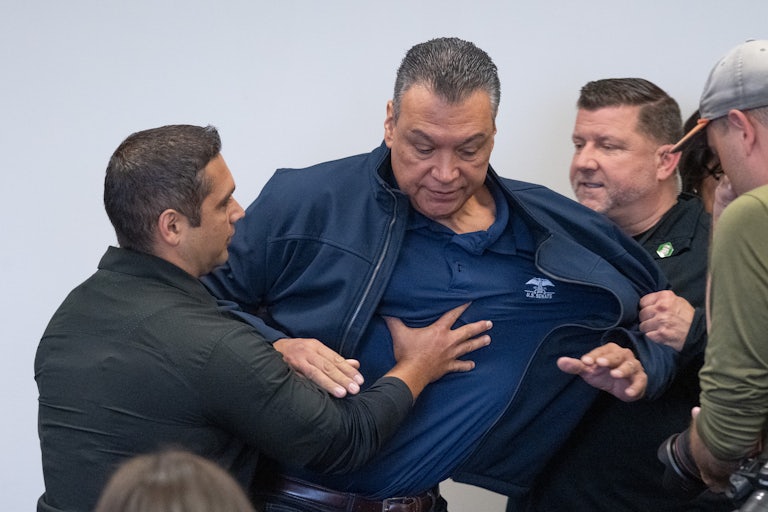
California Senator Alex Padilla is pushed out of the room
David Crane/MediaNews Group/Los Angeles Daily News/Getty Images
California Senator Alex Padilla is pushed out of the room as Homeland Security Secretary Kristi Noem holds a news conference in Los Angeles on Thursday.

In May 1856, Massachusetts Senator Charles Sumner took to the floor of the Senate to deliver a speech denouncing slavery. Sumner was a fiery abolitionist; in his maiden speech on the floor of the Senate four years earlier, he had called for the repeal of the Fugitive Slave Act, which an Alabama senator disparaged thus: “The ravings of a maniac may sometimes be dangerous, but the barking of a puppy never did any harm.” Sumner continued to inveigh against slavery and its apologists throughout his first term. Clearly, he suffered from Pierce Derangement Syndrome (Franklin).

Among those Sumner attacked directly in his May 1856 speech was his Senate colleague Andrew Butler of South Carolina. His words were, to be sure, impolitic: “[Butler] has chosen a mistress to whom he has made his vows, and who, though ugly to others, is always lovely to him; though polluted in the sight of the world, is chaste in his sight—I mean the harlot, Slavery.”

Two days later, in one of the most infamous incidents in American political history, Representative Preston Brooks of South Carolina, a first cousin once removed of Butler’s, walked over to the Senate chamber, waited until no women were present in the gallery (Southern chivalry!), and attacked Sumner on the Senate floor with a metal-topped cane, beating him within an inch of his life.

Alex Padilla, the Democratic California senator, did not bleed Thursday. He wasn’t even hurt. But the sight of a U.S. senator being manhandled by FBI agents was shocking enough. Lawrence O’Donnell said Thursday night that Padilla was the first senator in history to be so accosted by law enforcement officials. I don’t know for sure that that’s true, but (1) I suspect if there were another, we’d know about it, and (2) even if he’s the second or third, that wouldn’t make how he was treated any better.

The incident didn’t last that long. But the real damage came after, when the lie machine reliably revved itself into action. It started with Kristi Noem, the homeland security secretary whose press conference Padilla had interrupted. She went on Fox News within the hour to say he “burst in” and was “lunging” toward her and “did not identify himself.”

All lies. As anyone can see from the video, he was a good 10 feet away from Noem. But even if he had lunged—and even if he were not a senator but a mere citizen, or really any human being who is not threatening violence—this is how Donald Trump’s FBI treats such people? Escort them away—OK. But push them to the ground and cuff them, when they’ve left the room and are no longer in any way a plausible “threat”?

And it was in that moment—the decision by the agents to take the matter to a totally unnecessary, completely gratuitous extreme—that we find lurking the essence of Trumpism.

The essence of Trumpism is just this: Dig in the heel of the boot; step on the enemy’s neck; determine in any situation the action that would be appropriately small-d democratic, and then do the opposite—go intentionally overboard, do something that shocks and offends the democratic sensibility. And then lie about it and try to reverse reality—to convince America that it didn’t see what it just saw. That truth is not what it seems.

A few Republican senators, and I mean a precious few, responded appropriately. Like, one: Alaska’s Lisa Murkowski said, “It’s horrible. It is shocking at every level. It’s not the America I know.” Susan Collins emitted the usual timorous excretion. Otherwise? Democratic Senator Chris Murphy said on Morning Joe Friday that he and colleagues Cory Booker and Brian Schatz waited on the Senate floor—who knows, perhaps not far from Sumner’s Desk 29, occupied today by New Hampshire Democrat Jean Shaheen—for their GOP colleagues to appear and denounce what happened. Not only did they not do that, Murphy said: “They basically said he deserved what he got simply because he was disrespectful to the president.”

But Trump was surely most pleased by House Speaker Mike Johnson, who put all the blame on Padilla and called on the Senate to censure him: “I think that that behavior at a minimum rises to the level of a censure. I think there needs to be a message sent by the body as a whole that that is not what we’re going to do; that’s not what we’re going to act.” Note the “at a minimum,” which leaves dangling the insane possibility that Padilla should … what? Just be expelled? Again, the essence of Trumpism is found in those three words.

This is what they do. All the time. Trump federalizes the National Guard and sends in the Marines; he crows that if he hadn’t acted, Los Angeles would have been “completely obliterated.” Think about the scale of that lie, referring to protests in a four- or five-block area in a city of 500 square miles. He told it over and over in various forms, as did Noem and others. The behavior has its precedents in the United States: Southerners accused Sumner of faking his injuries. They argued that the cane was not heavy enough to cause severe injury. Others, more direct about matters, piped up that Sumner deserved a caning every day.

And the right-wing media, like the Southern press in the 1850s, reliably echoed every word Trump, Noem, and the others said. Meanwhile the mainstream media failed dramatically this week by accepting the lazy frame that immigration is a “winner” for Trump. Two polls came out—this one and this one—showing this emphatically not to be the case. The second poll, from Quinnipiac, was bleak for Trump across the board. Only 27 percent of the country supports the big ugly bill. That’s not even all of MAGA America. People are beginning to understand that they indulged themselves last year in some fantasy projection of “Donald Trump.” They’re seeing the real article now, and they’re remembering his viciousness, his ignorance, his incompetence, and his lawlessness.

And it’s going to get worse. Trumpism proceeds by the successive breaking of taboos. Each time a new one is broken, the previous one is normalized, made to look not so bad by comparison. The cuffing of Padilla was a red-line moment. And yet: There’s plenty of reason to worry that in four months, we’ll look back on it as a moment of comparative innocence.

This article first appeared in Fighting Words, a weekly TNR newsletter authored by editor Michael Tomasky. Sign up here.