Breaking News
Breaking News
from Washington and beyond

Trump Vows More Corruption Is Coming in Unhinged Rant on Intel Deal

The president said that anyone who didn’t appreciate it was “stupid.”

Lip-Bu Tan, CEO of Intel, at an event organized by the company in April.
Andrej Sokolow/Picture Alliance/Getty Images
Intel CEO Lip-Bu Tan at an event organized by the company in April.

Asserting federal control over the private sector is as American as apple pie, according to Donald Trump.

The president apparently sees nothing wrong with his administration’s latest deal with Intel, the only chipmaker allowed to make the tech parts in the U.S.

Last week, the government took a 10 percent stake in the company, purchasing 433.3 million shares for a total price of $8.9 billion. In a press release Friday, Intel underscored that the exchange came at a “discount” to the company’s current stock rate. Commerce Secretary Howard Lutnick also confirmed the deal.

The transaction has made the U.S. government Intel’s largest single shareholder, though Intel said that the White House would not have a board seat or hold any governing rights of the company. The terms of the deal do, however, allow the U.S. to buy an additional five percent of Intel’s market shares if the company is “no longer majority owner of its foundry business,” according to MSNBC.

But Trump’s recounting of the events has been remarkably different. By Monday morning, Trump still refused to acknowledge that the stock purchase came with a price, deriding his critics of the deal with simple insults.

“I PAID ZERO FOR INTEL, IT IS WORTH APPROXIMATELY 11 BILLION DOLLARS. All goes to the USA,” Trump wrote on Truth Social. “Why are ‘stupid’ people unhappy with that? I will make deals like that for our Country all day long. I will also help those companies that make such lucrative deals with the United States States.”

“I love seeing their stock price go up, making the USA RICHER, AND RICHER. More jobs for America!!! Who would not want to make deals like that?” he added.

Trump’s insistence that the White House’s involvement in private business is a good thing does not bode well for the rest of the private sector: The government is already looking to take equity stakes in other companies, according to one of Trump’s top economic advisers.

“I’m sure that at some point there’ll be more transactions, if not in this industry, in other industries,” National Economic Council Director Kevin Hassett told CNBC Monday.

The deal with Intel followed several weeks of personal attacks by Trump against Intel CEO Lip-Bu Tan, in which the president openly questioned the Malaysian-born American business executive’s previous investments in Chinese tech firms. Since the deal was announced, however, the president has noticeably pulled back on his calls for Tan’s resignation.
Trump Adviser Vows Government Will Take Over More Businesses Soon

Isn’t this called ... communism?

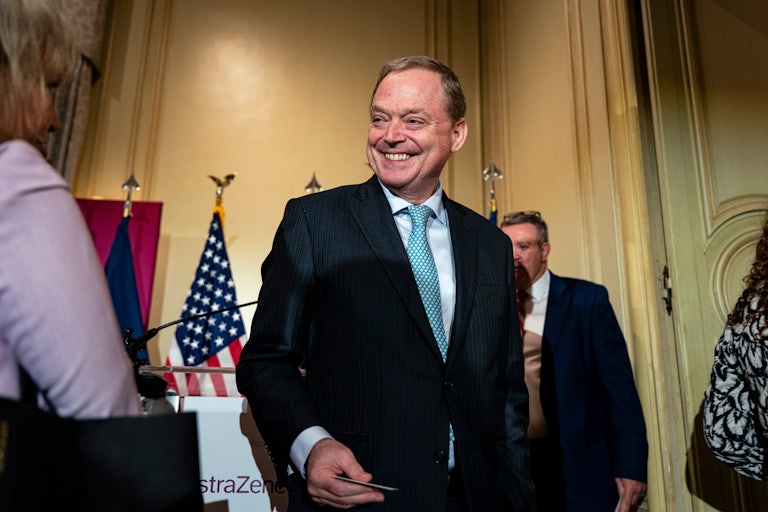
Kevin Hassett, director of the National Economic Council, smiles as others walk nearby.
Al Drago/Bloomberg/Getty Images

The Trump administration’s Intel deal represents only the first of more such interventions into the private sector, according to Kevin Hassett, the director of the White House National Economic Council.

Trump last week announced that the U.S. government will be taking a 10 percent passive ownership stake in the tech company Intel. The deal came just weeks after the president called for Intel CEO Lip-Bu Tan to resign after Senator Tom Cotton alleged the executive has problematic ties to China.

Trump made remarks Friday indicating that the move was something more of a shakedown than a deal, and that more such interventions may eventually be in the works. “[Tan] walked in wanting to keep his job, and he ended up giving us $10 billion for the United States,” the president told reporters. “So we picked up 10 billion. And we do a lot of deals like that. I’ll do more of them.”

On Monday, CNBC host Andrew Ross Sorkin asked Hassett about that prospect.

“So, we should expect the U.S. government to be taking more equity stakes in businesses around the country?” Sorkin asked. “That is something that if you’re a CEO, this morning, watching us, you should say, ‘OK, the sovereign wealth fund may be coming and trying to effectively buy in some kind of equity stake?’”

Hassett replied in the affirmative. “It’s possible, yeah,” he said. “That’s absolutely right.”

To allay fears of government meddling in business decisions, the adviser insisted that the government would only ever acquire non-voting stock.

But such assurances are likely to be met with skepticism, given that a major tenet of Trump’s agenda appears to be bending American businesses and institutions to his will. Take, for example, recent reports that the administration is keeping a scorecard of companies’ loyalty to the administration’s agenda.

Trump Goes Mask Off With Chilling Comment About Dictators

The president has some disturbing thoughts about what the American people really want.

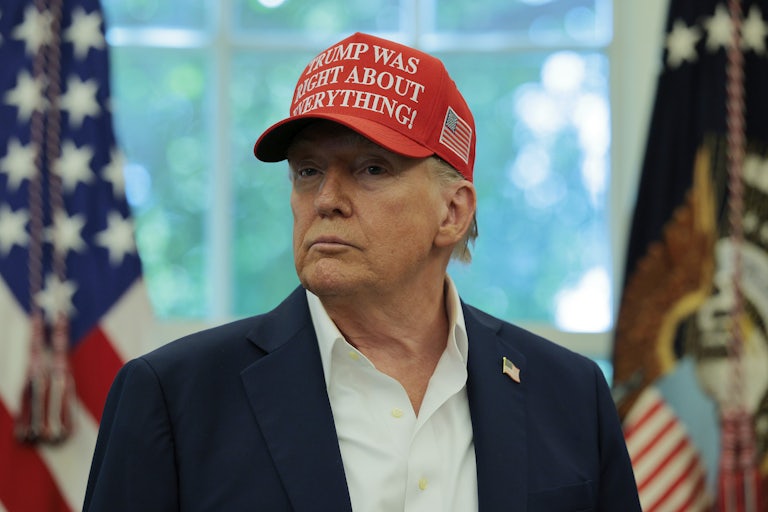
President Donald Trump sits in a chair in the Oval Office.
Chip Somodevilla/Getty Images

Donald Trump claimed the American people are asking for a dictator—and he seems more than happy to give them what they want.

While signing executive orders in the Oval Office Monday morning, Trump whined that people were up in arms after he suggested that he would deploy National Guard troops in Chicago, following his federal takeover of Washington D.C.

Not everyone in Chicago was unhappy with this plan, he claimed.

“A lot of people are saying ‘maybe we’d like a dictator,’” Trump said.

The president then attempted to course-correct. “I don’t like a dictator, I’m not a dictator,” he quickly said. “I’m a man with great common sense, and I’m a smart person.”

It’s not clear that there is any meaningful difference between a dictator, and a leader pleasing the people who are asking for one. What is apparent, however, is that Trump’s plan to move federal forces to other American cities is so unpopular that he’s concocting consent for tyranny as a means to justify it.

Crucially, Trump gets closer to becoming a dictator everyday. On Monday, he signed an executive order which would criminalize flag burning, an act of political expression protected by the First Amendment, claiming that it incited riots.

If Trump truly believed that inciting a riot earns you a year in prison, then the president himself is well overdue for a stint behind bars.

Read more about the Trump administration:

Trump Bans Flag Burning in Direct Threat to First Amendment

The Supreme Court has already ruled on this. Donald Trump doesn’t care.

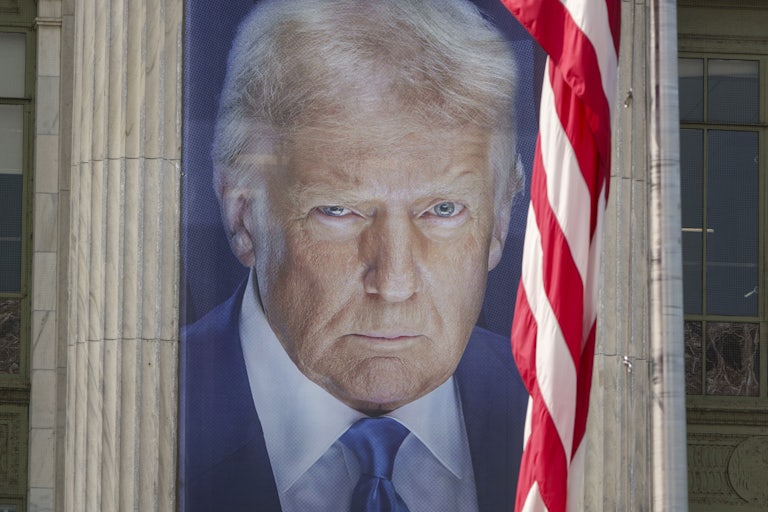
A giant banner of Donald Trump staring as a limp U.S. flag hangs in front of him.
Kevin Carter/Getty Images

President Trump on Monday signed an executive order instructing the U.S. attorney general to pursue criminal charges against anyone caught burning the American flag, blatantly violating basic freedom of speech and expression laws.

“Flag burning. All over the country they’re burning flags. All over the world they burn the American flag,” Trump said at his press conference, where he signed another executive order revoking cashless bail in Washington, D.C. “What happens when you burn a flag is, the area goes crazy. If you have hundreds of people they go crazy…. When you burn the American flag it incites riots at levels that we’ve never seen before.”

“If you burn a flag, you get one year in jail, no early exits, no nothing. You get one year in jail,” Trump said. “You don’t get 10 years, you don’t get one month, you get one year in jail. And it goes on your record. And you will see flag burning stopping immediately.”

The president claimed the Department of Justice would “investigate instances of flag burning” in situations where “prosecution wouldn’t fall afoul to the First Amendment.” But the order does exactly that. In 1989, the Supreme Court ruled 5-4 that flag burning is a protected right under the Constitution.

Trump also made unsubstantiated claims that flag burning is a rampant practice in America right now (it is not) and that anyone doing it is being paid by the “radical left.”

It’s extremely unclear how exactly the administration can throw American citizens in jail for burning a piece of fabric without “running afoul” of the Constitution. This is a move that would be relentlessly vilified if someone like Russian President Vladimir Putin or North Korean leader Kim Jong Un did it. Instead, Trump is using this despotic tactic to crack down on protesters and further push his dark MAGA agenda.

Trump and RFK Jr. Plan to Scrap Covid Vaccine, Because Why Not

The Trump administration reportedly plans to pull it from shelves within months.

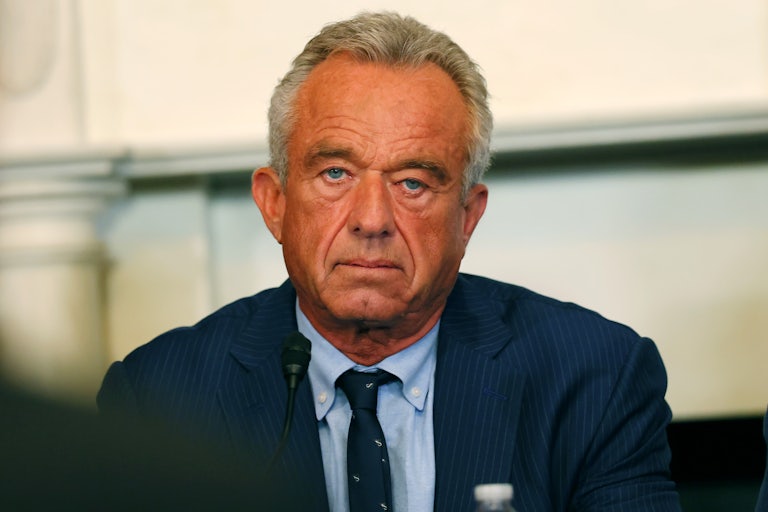
RFK Jr. looks into the camera at a press conference.
Michael M. Santiago/Getty Images


The Covid vaccine could be off the shelves in a matter of months.

Despite the coronavirus shot saving millions of lives during the pandemic, the Trump administration is planning to nix nationwide access to the vaccine “within months,” a close associate of Health Secretary Robert F. Kennedy Jr. told the Daily Beast.

Dr. Aseem Malhotra, a British cardiologist who has repeatedly claimed, contrary to scientific evidence, that the vaccine has more ramifications than the disease it is intended to treat, told the Daily Beast that people around Kennedy “cannot understand” why the vaccine is still on the market. Malhotra noted that the administration intends to remove it from shelves even if it sows a “fear of chaos,” or sparks major legal consequences.

“It could [happen] in a number of stages, including learning more about the data,” said Malhotra. “But given the increased talk of vaccine injuries in the past few weeks among the administration, it could also come with one clean decision.”


The skepticism stems from a 2022 paper, published in the science journal Vaccine, that examined “serious adverse events” that occurred during clinical trials of Pfizer and Moderna mRNA Covid-19 vaccines. The widely dismissed study found that individuals who had gotten the jab were at a 16 percent higher risk of “excess serious adverse events” than those who did not.

Critics of the paper claimed that the researchers underestimated the benefits of the vaccine, overstated methodological risks, selectively chose data, and ignored the broader public health impacts of the vaccine.

It wouldn’t be the first vaccine that Kennedy has canceled on the grounds of his unscientific doubts. Earlier this month, the health secretary said his agency would divest $500 million from mRNA research, effectively axing 22 mRNA studies since—according to Kennedy—the vaccines “fail to protect” against “upper respiratory infections like COVID and flu.”

Instead, Kennedy said that his agency would shift the funding toward “safer, broader vaccine platforms that remain effective even as viruses mutate”—which apparently does not include the latest and greatest medical advances.

The problem with Kennedy’s approach is twofold: It will result in a sacrifice of time and money. Traditional vaccines injected a weakened or dead version of a virus, triggering the body’s immune response and the development of antibodies. Researching and developing these vaccines is a “lengthy and costly” process that becomes further complicated when researchers have to respond to mutations in the virus, according to Penn Medicine.

mRNA technology, meanwhile, employs a synthetic genetic code that instructs the body to produce proteins akin to the viral protein, training the body’s immune system without ever actually exposing the individual to the disease. Once the response is initiated, the synthetic genetic sequence breaks down in the body, according to Medline Plus. The result is a “plug-and-play” vaccine technology that offers rapid development times at a lower cost to traditional vaccines.

In the years since mRNA technology debuted on the U.S. market, biomedical researchers have also framed mRNA as a potential cancer treatment. But its sudden emergence in the U.S. prompted suspicion from anti-vaxxers, including Kennedy.

After Kennedy took the reins at HHS, he replaced independent medical experts on the Center for Disease Control and Prevention’s vaccine advisory panel with vaccine skeptics. He also warned against the use of the MMR vaccine during Texas’s historic measles outbreak, recommending that suffering patients instead take vitamins. And he founded his new directive for America’s health policy—the “Make America Healthy Again” report—on studies generated by AI that never existed in the real world.