Breaking News
Breaking News
from Washington and beyond

John Fetterman Hits New Low in Quest for Donald Trump’s Approval

The Pennsylvania Democrat backed voter ID legislation to combat a nonexistent voter fraud problem.

John Fetterman holds up his hands and looks down and to the side in front of an American flag
Andrew Harnik/Getty Images
John Fetterman in 2024

Ex-progressive Senator John Fetterman is bucking his party yet again, but this time the fallout could drastically impact the results of future elections.

The Pennsylvania turncoat came out in favor of voter ID legislation, revealing that he would support a clean bill if it required voters to show identification before they cast their ballot. The issue is currently gaining momentum in the Senate under the banner of the Safeguarding American Voter Eligibility, or SAVE, Act. Democrats have branded the voter restriction initiative “Jim Crow 2.0”

“I would never refer to the SAVE Act as like Jim Crow 2.0 or some kind of mass conspiracy,” Fetterman told Fox News’ Kayleigh McEnany. “But that’s part of the debate that we were having here in the Senate right now. And I don’t call people names or imply that it’s something gross about the terrible history of Jim Crow.”

The SAVE Act would require Americans to present their birth certificate or passport in order to register to vote, and would further require voters to bring physical identification with them to the ballot box.

That’s not only completely unnecessary considering that it’s already illegal for nonvoters to participate in U.S. elections, but could also prove disastrous for married women, adding additional hurdles for individuals who have changed their names since their birth certificate was issued.

Donald Trump already tried and failed to implement voter ID in June. At the time, a federal judge excoriated the president’s efforts, arguing that adding layers of difficulty to the voting process would only serve to harm eligible voters by adding significant barriers before they can cast their ballots.

Since he lost the 2020 election, Trump and his allies have obsessed over contrived claims of voter fraud—a statistical nonissue in U.S. elections. For instance, a statewide audit out of Georgia, the epicenter of Trump’s baseless theory, revealed in September that just 20 noncitizens out of 8.2 million residents existed on the state’s voter roll, just 0.00024 percent of the state’s voting population. Out of those 20, only nine participated in elections, years ago, before ID was required as a part of the voter verification process. The other 11 individuals were registered but never actually voted, according to Secretary of State Brad Raffensperger.

But Fetterman—who mind-bogglingly ran on the progressive ticket—has had a penchant for Trumpian politics since he moved to Washington.

“It’s not like a radical idea,” Fetterman told Fox. “It’s not something—and there already are many states that show basic IDs. So that’s where we are in the Senate.”

Critics argue that restrictions on the front end of the electoral process—such as one-day voting, mail-in ballots, and requiring day-of voter ID—would minimize voter turnout and limit the American democracy’s ability to represent its constituents. This would especially be true in high-density areas like the nation’s biggest cities, where those stipulations would significantly drain resources (i.e., by increasing the number of volunteers required) and require more time to process, potentially leading to more delays that Republicans could weaponize to further restrict voter access.
Civil Rights Groups Sue to Protect Georgia Voter Data Seized by FBI

NAACP and a collection of other groups want to protect voter data after the FBI raid in Fulton County.

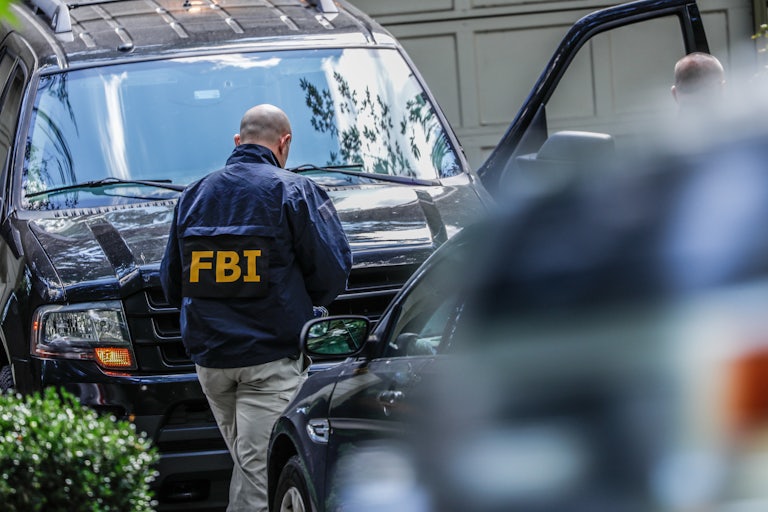
An FBI agents walks to his car.
Yasin Ozturk/Anadolu/Getty Images

The federal government is being sued by civil rights organizations to protect voter data seized by the FBI in a raid at a Fulton County, Georgia, elections building last month.

The NAACP, the Lawyers’ Committee for Civil Rights Under Law, the Georgia Coalition of the People’s Agenda, and other groups filed a lawsuit in the U.S. District Court for the Northern District of Georgia Sunday to “prohibit the Trump administration from misusing the voter information” it seized as part of the raid.

Donald Trump has long claimed the 2020 election was stolen from him despite no evidence of voter fraud. Georgia was won by President Biden in that election, and as a result, the Trump administration last month launched an investigation into Fulton County, the largest and most Democratic-leaning county in the state.

“Having already failed to overturn the valid results of the 2020 presidential election by invoking false claims of widespread voter fraud, promoting fake electors, and inciting a violent insurrection, Trump and his minions are refusing to give up the ‘lost cause,’ trampling even more voting and privacy rights in the process,” said Damon Hewitt, the president and executive director of the Lawyer’s Committee, in a statement. “Ironically, this is happening in the same jurisdiction where Trump pressured state elections officials to ‘find 11,870 votes’ in an effort to declare himself the victor in 2020.”

The Georgia raid has raised concerns that Trump is trying to manufacture a justification to take over elections in battleground areas, especially considering that Director of National Intelligence Tulsi Gabbard was inexplicably present and found to be giving updates to Trump the next day. The president claims the raid happened on the orders of Attorney General Pam Bondi, who hasn’t cleared things up.

Gabbard has spent the last several months investigating long-debunked claims of voter fraud from the 2020 election, a departure from her supposed job overseeing U.S. intelligence. Under her watch, the FBI seized close to 700 ballots and other election materials from Fulton County, including tabulator tapes from scanners that count votes, electronic ballot images created when ballots were counted and then recounted, and all voter rolls.

This new lawsuit joins another legal action filed by the county earlier this month to return all seized materials. Meanwhile, Trump and his Republican allies continue to push for a federal takeover of elections, with the president threatening to push through voter I.D. even without Congress. It seems that the future of free and fair elections rests on whether the courts can stop the Trump administration.

Trump Blames Popular Black Democrat for Potomac River Sewage Spill

Trump’s National Park Service is supposed to be working with DC Water to fix the issue, so of course he’s blaming someone else entirely.

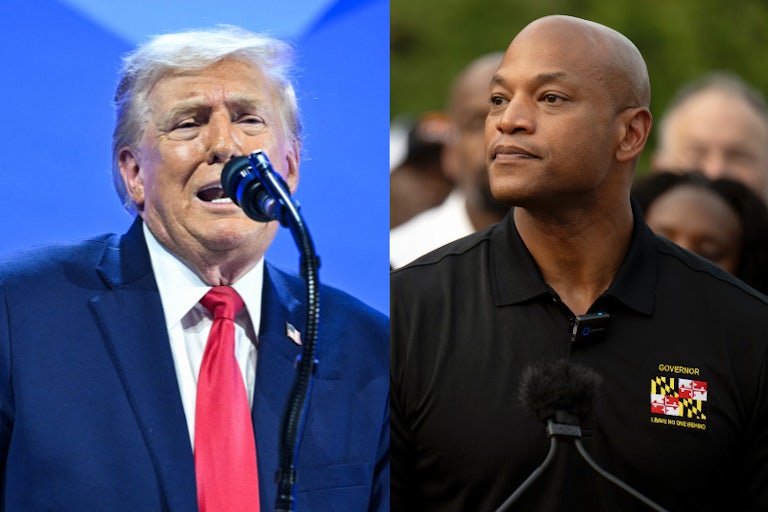
Splitscreen of Donald Trump and Wes Moore
Getty x2
President Donald Trump and Maryland Governor Wes Moore

President Trump is blaming Maryland Governor Wes Moore for sewage pollution in the Potomac River, something Moore has no control over. 

“There is a massive Ecological Disaster unfolding in the Potomac River as a result of the Gross Mismanagement of Local Democrat Leaders, particularly, Governor Wes Moore, of Maryland,” Trump wrote on Truth Social Monday afternoon. “A sewer line breach in Maryland has caused millions of gallons of raw sewage to be dumped directly into the Potomac River, a result of incompetent Local and State Management of Essential Waste Management Systems. This is the same Governor who cannot rebuild a Bridge. It is clear Local Authorities cannot adequately handle this calamity.” 

Trump added that he is “directing Federal Authorities to immediately provide all necessary Management, Direction, and Coordination to protect the Potomac, the Water Supply in the Capital Region, and our treasured National Resources in our Nation’s Capital City.” 

Environmental Protection Agency head Lee Zeldin reposted Trump’s message. 

It sounds like Trump heard “sewage emergency in Maryland” and took the opportunity to shit on a popular Black Democrat and potential 2028 presidential candidate without doing his research.  

“He’s just blatantly lying about this,” The Independent’s Andrew Feinberg wrote on X. “The pipe is maintained by ⁦DC Water⁩ and runs along the Clara Barton Parkway, which is maintained/run by the National Park Service. It has nothing to do with ⁦Governor Wes Moore⁩.”

A massive overflow of sewage spewed into the Potomac River in January after a large pipe burst, leading to contamination in Washington, D.C., Virginia, and Maryland. Federal authorities were already involved before Trump’s Truth Social post Monday, as the National Park Service has been closely working with DC Water to address the issue.

The Francis Scott Key Bridge in Maryland, which Trump was likely referring to in his post, collapsed in 2024 when a cargo boat struck one of its piers, and is projected to open back up in 2030. 

The Pentagon Just Sent a Terrifying Message to AI Companies

It warned Anthropic it will “pay a price” if it continues to demand its products have safeguards.

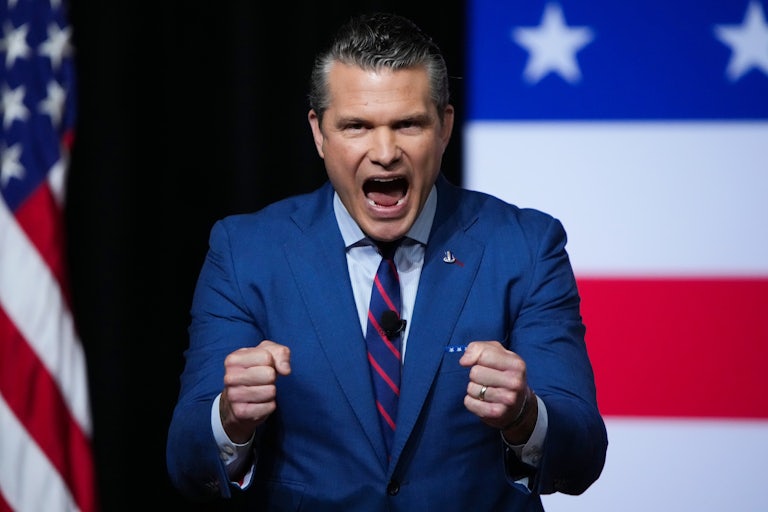
Secretary of Defense Pete Hegseth clenches his fists and screams in front of an American flag
Andrew Harnik/Getty Images

Donald Trump’s so-called Department of War is threatening to cut ties with Anthropic because it won’t help the Pentagon conduct mass surveillance on Americans or make fully autonomous weapons that the administration can use however it likes.

A senior Trump administration official told Axios Monday that the Pentagon was fed up after Anthropic refused unfettered use of its AI systems. “Everything’s on the table,” including cutting ties altogether, the official said.

An “orderly replacement” would have to be found, if they ended the relationship, the official added.

Last summer, Anthropic signed a contract with the Pentagon valued up to $200 million—but the company set hard boundaries against its systems being used to develop weapons, conduct surveillance, or facilitate violence. For months, the Pentagon has sought to negotiate with Anthropic to let the military use its tools for “all lawful purposes,” including weapons development and intelligence gathering, without being forced to argue individual use cases.

In January, tensions came to a head after an executive at Anthropic reportedly reached out to an executive at Palantir to ask whether it had used the company’s Claude AI assistant as part of the U.S. military raid to capture Venezuelan President Nicolás Maduro. (Spoiler alert: It did.)

“It was raised in such a way to imply that they might disapprove of their software being used, because obviously there was kinetic fire during that raid, people were shot,” the senior official told Axios.

A spokesperson for Anthropic denied that such a conversation had taken place in a statement to Axios, saying the company had “not discussed the use of Claude for specific operations with the Department of War. We have also not discussed this with any industry partners, outside of routine discussions on strictly technical matters.”

“Anthropic’s conversations with the DoW to date have focused on a specific set of Usage Policy questions—namely, our hard limits around fully autonomous weapons and mass domestic surveillance—none of which relate to current operations,” the spokesperson added.

Chief Pentagon spokesman Sean Parnell suggested to The Wall Street Journal that the Department of War’s relationship with Anthropic was under review. “Our nation requires that our partners be willing to help our warfighters win in any fight,” Parnell said.

Meanwhile, Anthropic appears to only be wading further into politics. Last week, the company announced that it would pledge $20 million toward Public First, a super PAC that will oppose groups funded by the company’s rival OpenAI.

George W. Bush Torches Trump in Presidents’ Day Message

Bush praised virtues from “self-control and courteousness to modesty and diplomacy,” in an essay about George Washington that was also clearly a message about the current occupant of the White House.

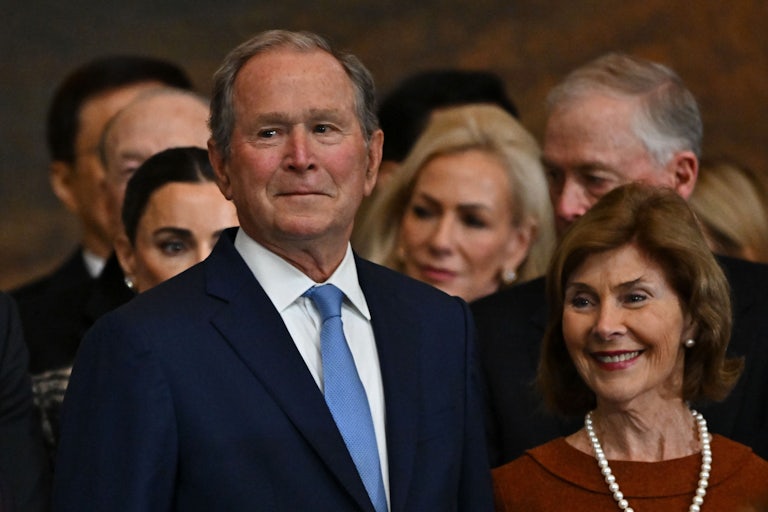
George W. Bush does his little smirk thing at Trump's inauguration. He's standing with his wife Laura, who is smiling.
Ricky Carioti/Pool/Getty Images
George W. Bush at Trump’s inauguration in January 2025

Former President George W. Bush won’t defy the “code of silence” that prevents ex-U.S. leaders from publicly chastising their successors, but he’s apparently not opposed to throwing shade.

In a Presidents’ Day essay published Monday by the pro-democracy institution More Perfect, Bush’s adoring gaze toward the qualities of America’s first president only served to underscore just how unpresidential the current administration has become.

Bush waxed poetic on several of George Washington’s qualities, but paid particular attention to ones that are currently in short supply. Those included “humility,” a deep appreciation for history, a reverence for knowledge superior to his own, and an unwillingness to retain power “for power’s sake.”

“Our first president could have remained all-powerful, but twice he chose not to,” Bush wrote. “In so doing, he set a standard for all presidents to live up to.”

Bush also dissected Washington’s commitment to a code of conduct that was considered, at the time, to be the “gentlemanly arts.” Washington, according to Bush’s research, “schooled himself” by copying “the 110 maxims from Rules of Civility and Decent Behavior in Company and Conversation,” a text authored by French Jesuits in the late sixteenth century.

“Many of the qualities that came to be associated with Washington’s leadership, from self-control and courteousness to modesty and diplomacy, can be traced to that short book on manners,” Bush wrote.

Washington’s repeated decisions to step down from power were critical lessons for the nation, according to Bush, who argued that Washington’s decision to step down as commander of the U.S. Army after the Revolution, and his later decision to end his presidency after two terms,  “ensured America wouldn’t become a monarchy, or worse.”

The message carried particular weight considering that Donald Trump has continually contested election results in fruitless grasps at power, including an attempt to overthrow the 2020 presidential election and threats to run for president a third time, against the constraints of the law.

But Washington’s performance—and his commitment to building a lasting governmental foundation—was paramount not just to his success but to the future of the Oval Office and the country, according to the forty-third president.

“Our first leader helped define not only the character of the presidency but the character of the country,” Bush wrote. “Washington modeled what it means to put the good of the nation over self-interest and selfish ambition. He embodied integrity and modeled why it’s worth aspiring to. And he carried himself with dignity and self-restraint, honoring the office without allowing it to become invested with near-mythical powers.”