GOP and Dem Senators Double-Team DHS Nominee on “Classified” Work
In a rare show of bipartisanship, Senators Rand Paul and Gary Peters held Markwayne Mullin’s feet to the fire over his claims of serving on classified missions.

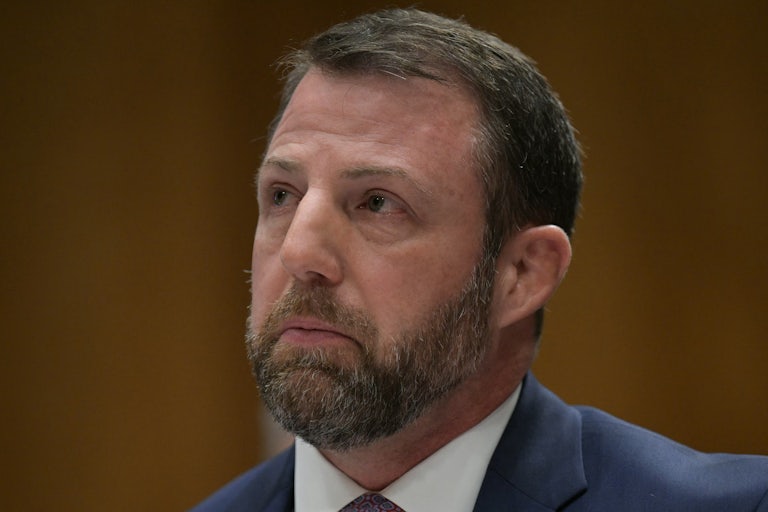
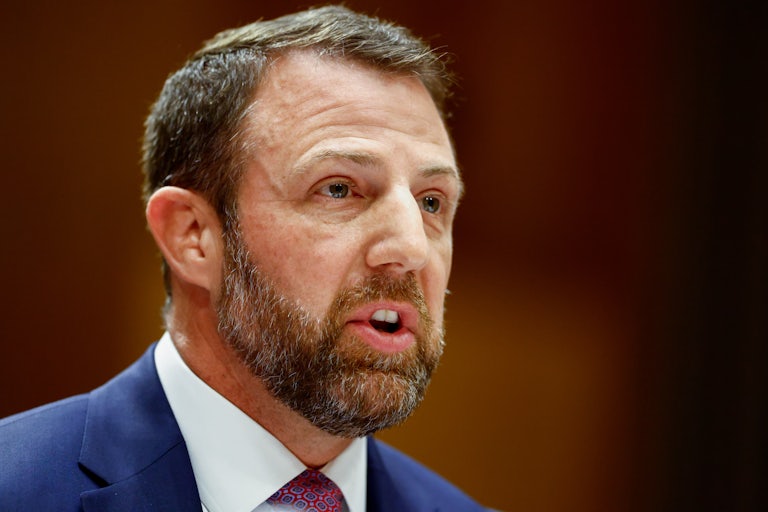
Senator Markwayne Mullin had a major meltdown Wednesday as senators from both sides of the aisle questioned him about a supposedly classified mission he traveled on as member of Congress—and in doing so, may have threatened his speedy confirmation vote.
It seems the only thing Democrats and Republicans can agree on is that Mullin’s claims about a classified mission stink to high heaven. During Mullin’s Senate confirmation hearing, Senators Gary Peters and Rand Paul pressed the Oklahoma Republican on his claims about having received combat experience abroad, even though he never enlisted in the U.S. military.
Mullin claimed that he couldn’t disclose any information about the mission unless the senators sought special clearance—but he wouldn’t say from whom or what agency.
Earlier in the hearing, Mullin had said that in 2015 he was “asked to train with a very small contingency and go to a certain area, which was scheduled for 2016. During that time I was asked to go through, had to meet certain training qualifications.”
“I have spoke in general about my experiences, but I have never spoken specifically on details, on dates, or on the mission,” he’d added.
When asked why he failed to include this on his travel report to the FBI, Mullin said he had been asked about travel with the exception of official trips, and claimed the trip was classified.
Peters circled back to the subject, claiming that there had been no exception for reporting official trips, and that he had explicitly instructed Mullin on how to safely provide classified information to Congress.
“You didn’t provide any of that, and today is the first time I’m hearing about your classified activities from 2015 to 2016. Quite frankly, as we’ve had these conversations, you have not been forthcoming with me or this committee. The story always seems to evolve, to kind of change.
“We’ve checked. The SCIF is available. We’d love to have you come to the SCIF and tell us exactly what you’re talking about. I think that’ll put my colleagues’ minds at peace,” Peters said, referring to a secure room to share classified information.
Mullin insisted he did not have to disclose his official travel. “I complied with exactly what the committee said,” he said.
Peters claimed that the FBI had not turned over any classified document that mentioned Mullin. “We queried the Department of State, the Department of Defense, other intel folks. So, you’re in no classified document that the federal government has, according to the FBI. And yet you’re telling me that you did all this classified work,” Peters said.
“I didn’t say ‘all,’” Mullin pushed back.
Paul jumped in, saying he’d heard the same thing from the FBI, who did not have a separate folder documenting Mullin’s classified work that lawmakers could privately review.
“And I’m still willing to have a vote tomorrow, but I can cancel the vote tomorrow,” Paul warned.
Mullin insisted that he would be more than happy to discuss his work, but he did not have the authority to do so, and Paul would have to receive the proper clearance—though he wouldn’t specify who to ask.
“I have zero issue with talking about it, but I don’t have clearance to talk about it this afternoon,” Mullin said, claiming only four people had been read in on the mission that was classified by the House.
“The House classified it?” Paul asked.
“I’m assuming, I wasn’t on [the Intelligence Committee],” Mullin said.
“We’re just not really aware how the House classifies things,” Paul said. Congress does not have the authority to classify missions, which Mullin would theoretically know because he served in the House of Representatives for a decade, and in the second half of that tenure served on the House Intelligence Committee.
“Well, it’s a little difficult to go ask about a program that has no name, and we have nobody that we know to talk to about it, so I don’t know how we would begin doing this without your cooperation,” Paul said.
“I’m willing to cooperate,” Mullin insisted, though his remarks suggested otherwise.
“I’m willing to hold the vote tomorrow, but you brought this up, that you were on a super secret mission—” Paul said.
“No, I did not say ‘super secret,’ sir. I said it was classified,” Mullin pushed back.
Peters asked Mullin what committee he was working on at the time. “Energy and Commerce,” he replied.
“So it was an Energy and Commerce top-secret effort?” Peters asked. Mullin pivoted, and started to complain about the Michigan Democrat’s tone of voice.
Mullin continued to spiral out, claiming that it hadn’t been a mission—though he’d previously referred to it that way—and begging Senator John Lankford to step in and help. In the end, Paul said that every senator would need to be invited to the SCIF. “It’s all or none,” he said.